A wedding guest was shocked by the song that a bride and groom chose for their first dance.
Taking to Reddit‘s “Wedding Shaming” forum. she explained that she was her husband’s guest for a colleague’s nuptials. While she said that the Episcopal ceremony was long, that “wasn’t the weird part.”
In her post she explained, “We had just finished the dinner and speeches and the dancing was about to start. The MC announced that the couple would have their first dance. So they got up and their ‘song’ started playing.”
The bride and groom’s first dance song was truly shocking.
“The song was “Before He Cheats” by Carrie Underwood.”
If you’re unfamiliar, the song is about getting revenge on a partner after they cheated and contains lyrics like, “I dug my key into the side / of his pretty little souped up four-wheel drive / Carved my name into his leather seats / I took a Louisville Slugger to both headlights / Slashed a hole in all four tires / Maybe next time, he’ll think before he cheats.”
“I was shocked and looked around,” the wedding guest admitted, adding, “About 30% of the audience looked as shocked as I was. Another 20% had on poker faces, while I would say the other 50% didn’t realize what song was playing or didn’t care.”
After the wedding was over, she asked her husband about the decision, and he didn’t understand it either.
“As far as he knew, there was no history of infidelity within the couple, and when they were dancing they looked completely happy,” she wrote, asking, “So yeah, worst first dance ever?”
Fellow Redditors agreed that “Before He Cheats” was a surprising choice.
Others rushed to agree with her in the replies.
“Hopefully some sort of inside joke between the couple? But yeah, that’s a weird choice,” one person wrote.
Others shared similar sentiments, with one person writing, “I like the idea of pairing up with your new partner in life to just completely troll all your friends and family with a terrible song choice.”
“Maybe it’s a “this song was playing when we first met” kind of situation. ?” another user wondered.
Some users chimed in with other examples of “worst” wedding songs.
Some other Redditors shared unusual first dance songs that they’d selected or had seen at weddings they’d attended. Examples included Johnny Cash’s “Ring of Fire” and Dolly Parton’s “Jolene.”
One person admitted to being utterly shocked when a groom danced with his mom to the song “Afternoon Delight,” which is about getting intimate with your partner in the afternoon. Someone else said that their bridal colleague had danced to Sade’s “Smooth Operator” with their dad.
“Directly after our ceremony was over, while we were walking out and to the reception, we had Another One Bites the Dust play. I’m not really sure anyone noticed, but we thought it was funny and that was enough,” one happily married user shared.
While one person admitted that “Before He Cheats” was a “crazy” choice, they added that it wasn’t close to being the “worst” wedding song. Instead, “I still don’t think anything will ever beat the video of the bride walking down the aisle to ‘Crazy B—h’ by Buckcherry.”
RPA is really a software that today enables everyone to customise software programs or an automaton for imitating and incorporating human behavior and communicating with electronic systems in order to execute business operations.
RPA robots should use operating systems to capture data and deceive implementations in the same way that humans do. In need to execute a wide range of repetitive tasks, they perceive, interact, and trigger reactions with some other technologies. RPA robots haven’t ever slept, start making no mistakes, and are less expensive than employees.
One of the most crucial challenges that companies must make is focusing on the importance of the toolset to be used in their RPA implementation.The issues considered will also ensure that you have a better understanding of your RPA tool as well as its architecture. To gain a better understanding of the RPA tool and its architecture, we must first recognize the following key parts that encompass one RPA platform:
Become a RPA Certified professional by learning this HKRRPA Training !
Robotic Process Automation Training
Master Your Craft
Lifetime LMS & Faculty Access
24/7 online expert support
Real-world & Project Based Learning
RPA Architecture:
The most important factor to consider is RPA architecture. However, for the time being, the most important aspect that must be thoroughly understood is the architecture of the specific product. This also aids in comprehending the implications of when it must not be used.
Usability:
Usability has been the most effective way to improve decision-making, but for test automation, functionality becomes even better because there are fewer stepping stones for setup issues.It enhances the general configuration and management procedure whether it is simpler for someone else to recognize. More available interface can enable higher usability, ease of implementation, and enhanced customer adoption.
Integration:
An excellent RPA tool is able to incorporate numerous other technologies that may be used in the business operations of an organization. They achieve greater and more robust technology as their support systems improve.
Exception Handling:
An intelligent RPA tool has been equipped to manage situations or scenarios effectively, as well as to pertain to experts in the field when a verdict or manual action is required. This implies that error managing all through automation must be simplified, and that errors should then be addressed instantly.If it is not possible, its RPA solution would be inspected for discrepancies in such scenarios. The orchestration of automated processes in the work environment can run smoothly and efficiently with secure exception handling.
Security:
Whenever an RPA solution has been deployed in a company, RPA solutions can have access to the information. But also, as a component of this, the security protocols and indicators which are crucial to a technology toolkit must not be overlooked.There may be various ways to handle such contexts based on the market, but choosing the right solution throughout your case is an important part of this activity.
Configuration features:
Each RPA application has a functionality designed specifically to speed up the process of creating setup editing at all times. This guarantees that automation is deployed effectively and also contributes significantly to the development of the necessary core competencies.So every RPA tool comes with a set of useful support that are particularly designed to address such configuration organizational challenges.
Deployment features:
Deployment occurs only because all of the setup and testing rules have been met.It contains features such as the ability to distribute updates all over machines, manage environment-specific factors, and provide access controls for live environment installations. Some companies necessitate specific deployment scenarios, which necessitate the use of a robust deployment toolset. Support and documentation from the vendor:The stronger the vendor support for a specific RPA tool, the better the resources that facilitate deployment. The maturity of support organizations varies greatly because many key players already have a presence in the market, as do new budding enterprises looking to establish a presence in this industry. There is no such thing as a perfect RPA tool for each and every firm’s process. As a result, the challenge of choosing the best RPA tool is often related to the regulations which you necessitate and the features which these tools offer. Users can move ahead with the next set of formalities prior to actually completing the transaction if you find the nearest match.
Subscribe to our YouTube channel to get new updates..!
RPA solution Architecture:
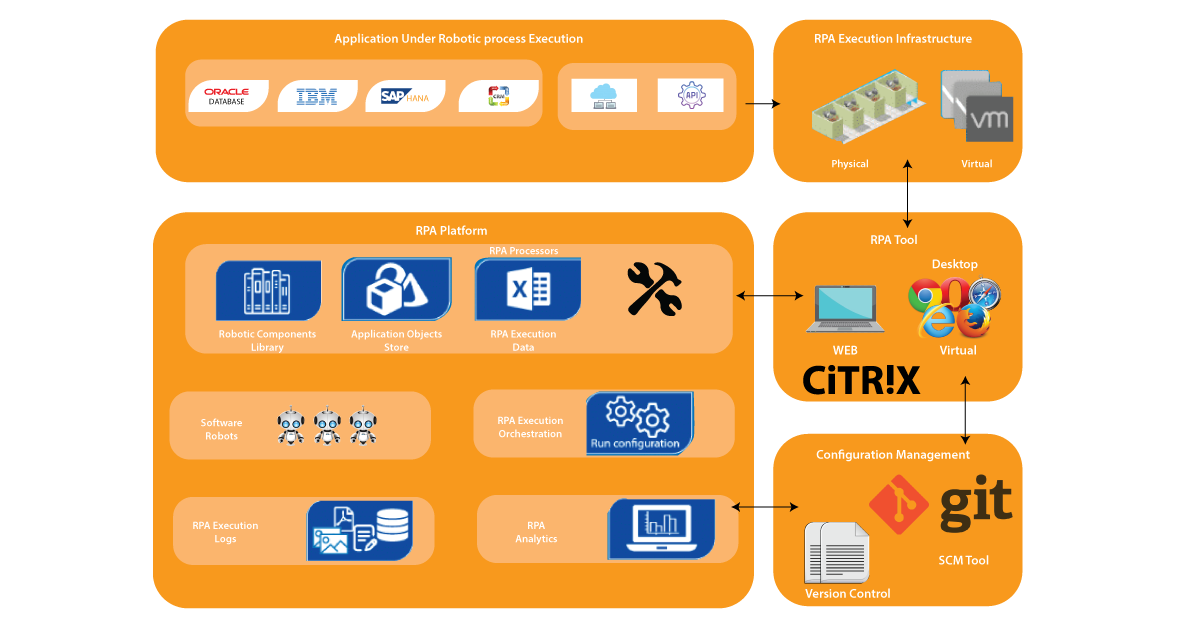
Based on the information presented above, you should be able to determine the significance of the architecture of any given RPA tool. To help comprehend this, let’s look at the architecture of the RPA tool. The following block diagram depicts a typical RPA solution as well as its architecture.At first glance, you could indeed tell it was not a powerful process, but rather a collection of tools, systems, and network components that join together to create a comprehensive RPA tool or solution. Let’s take a closer look at the elevated specifics of all of these blocks in the system architecture shown below:
1. Applications under the RPA execution
RPA is ideal for businesses and application development such as ERP solutions (For example, SAP, Siebel, or massive data processing or records processing applications like Mainframes). The majority of such applications seem to be data-centric as well as data-intensive, with a plethora of set – up and repetitive process activities.
2. RPA tools
The following are the majority of the critical capabilities that are expected to be available in any RPA tool:
The capacity to optimize a wide range of application environments, including Web, Desktop, and Citrix.
The capacity to produce software robots that understand by recording, configuring, and improving them with programming logic (For example, loops and conditions).
To really be able to create configuration files that can then be applied to various robots, making sure modular design, increased efficiency, and increased flexibility.
Being able to create shared application UI object stores as well as object repositories containing object locators
The capacity to learn and write from/to various data sources while these software robots are running.
3. RPA Platform:
RPA within the cloud always provides a reference point repository for the processing among all software robots as well as RPA-based resources used by the tool. These RPA assets could be further subdivided into libraries of software robots (as repeatable sub-processes). An RPA system’s tools and features include scheduling, delivering, and tracking the implementation of software robots.
Considering all of the information available about RPA assets and executions, the RPA framework also allows you to create purposeful data analysis regarding your software robots as well as their implementation statistics.
4. RPA Execution Infrastructure:
RPA execution infrastructure sometimes can take the form of a financial institution of simultaneous physical and virtual lab machines that can be regulated based on usage patterns. Ramping high or low the number of computers running concurrently to complete the goals of automation also is possible, and it can be left unsupervised for about as soon as you want to.
Configuration management is required for RPA asset versioning because the fundamental implementation about which operating system robots are built may be generated to incorporate newer versions, as will the RPA assets and software robots.
Furthermore, as RPA implementations scale up as well as numerous members of the team develop RPA resources at same time, and provided that there really are assets which are universally accessible and recyclable along all various software robots, it is clear which source code management abilities are made to enable branching and combining of RPA assets.The diagram above elevates one’s comprehension of RPA to next level by depicting the RPA platform as a layered design and explaining each layer in the RPA tool’s architectural design. The advantages of all of these layers are also addressed in the diagram, which adds to already prior knowledge of the system design.
The illustration shows how an RPA solution can always be fed on feedback to improve the automation model’s efficiency. The four stages of an application in which an RPA tool has been trained to perform a set of mundane, monotonous rule-based, repetitive tasks. Once the software robots have been thoroughly trained, you may want to consult with your business users about any specific changes to the existing system.
Following the completion of the assessment process, you implement the automation standard to improve which your automation has always been attempting to run and, as a result, the activities designed via this automation are executed.Beyond a certain number of great executions of such software robots, users conduct a deep introspection to understand better and define important components at which greater recommendations could be enacted to perform the task in a much more efficient and productive way. The main objective of this RPA model would be to accomplish the best-suited workflow automation model which satisfies the criteria and business objectives.
6.Further Considerations
Numerous RPA vendors offer RPA tools, systems, and facilities as part of a unified solution or separately. For greater coordination, this might be a good idea to purchase the majority of such services from the same vendor. If users intend to be using the free RPA tool, you will not receive a complete RPA system or implementation infrastructure and applications, and you will receive anything for free.
There is currently no tool-agnostic RPA technology platform; that might be a smart option as an established RPA vendor or cloud provider to make such a product available to consumers in future. As in the RPA tool as well as the RPA framework you select, take a glance for service management capabilities. It may not be a concern in the beginning, however as users scale up, it’s a very valuable investment.
We’ve talked about what RPA is and how it works in this article. We’ve gone a step further and talked about how we might go about implementing RPA. Broadening the conversation, we too have attempted to develop a better understanding of what various constituents were also needed to obtain a good RPA.
I feel this post was completely obvious and can provide the clear guidance of RPA while also instilling the much more crucial points about it. If you’ve any queries or comments on this article, please leave them in the comments section.
To provide the best experiences, we use technologies like cookies to store and/or access device information. Consenting to these technologies will allow us to process data such as browsing behavior or unique IDs on this site. Not consenting or withdrawing consent, may adversely affect certain features and functions.
Functional
Always active
The technical storage or access is strictly necessary for the legitimate purpose of enabling the use of a specific service explicitly requested by the subscriber or user, or for the sole purpose of carrying out the transmission of a communication over an electronic communications network.
Preferences
The technical storage or access is necessary for the legitimate purpose of storing preferences that are not requested by the subscriber or user.
Statistics
The technical storage or access that is used exclusively for statistical purposes.The technical storage or access that is used exclusively for anonymous statistical purposes. Without a subpoena, voluntary compliance on the part of your Internet Service Provider, or additional records from a third party, information stored or retrieved for this purpose alone cannot usually be used to identify you.
Marketing
The technical storage or access is required to create user profiles to send advertising, or to track the user on a website or across several websites for similar marketing purposes.