Heybike’s Latest Foldable Commuter Bike Has Kept My Car in the Driveway for Weeks. It’s Now $500 Cheaper


Save $500: Heybike’s Ranger 3.0 Pro is $1,499 right now, a 25% discount to encourage early adopters to upgrade. This foldable ebike is now priced lower than most of its competitors without sacrificing performance or safety on the roads.

Commuter ebikes are, in my opinion, the weirdest category of bikes out there. In a world where many enthusiast cyclists dedicate hours upon hours to shaving as much weight from their kit as possible, commuter ebikes stand alone. They’re heavy, often encourage a seat position that feels anathema to most other bikes and come with features aimed at making you as visible as possible to the other vehicles you share the road with.

Of the many brands in this space, Heybike’s Ranger series is a reliable distance-focused option with few compromises. Its latest bike, the Ranger 3.0 Pro, is an ebike aimed lagrely at replacing your car. And with some narrow exceptions, it did that for me really well.

Heybike Ranger 3.0 Pro on a trail in the woods

Russell Holly/CNET

Out of the box, Heybike’s Ranger 3.0 Pro is a beast. Weighing in at 75 pounds, it’s noticeably heavier than its predecessors. It makes folding the bike up and storing it more challenging than the Ranger S, especially if you’re a smaller rider. One of the biggest reasons for the increase in weight is the increase in capability, powered by a removable 720Wh battery, a more capable 750-watt rear hub motor and an eight-speed derailleur system. The biggest thing you get in return is a 440-pound weight capacity, a 40-pound increase over previous versions.

A larger battery and a more efficient motor mean this bike can go for hours before needing to be recharged. Heybike says this bike can go 90 miles on a single charge, but during my test, it started slowing down around mile 81. Given all of the hills in my area, it’s a solid range. That’s considerably further than most folks will ride in multiple days. In fact, I rode this for four days of basic neighborhood commuting and still had 20% of my battery remaining.

Heybike Ranger 3.0 Pro headlight with integrated turn signal

Integrated turn signals are a significant feature on road-ready ebikes.

Russell Holly/CNET

Heybike gets top marks on distance, but speed is another story. Like most bikes in the US, it’s artificially limited at 28mph, but you’re in no danger of reaching that speed quickly. Whether you’re relying on the half throttle on the handlebar to get you across a busy intersection or power-assist as you pedal, you won’t feel that lurch forward that many overly aggressive motors have. It’s a more gradual start, ramping up to the speed you’re looking for. Some folks prefer that sudden burst of speed after a stop, but you won’t find that here.

What you will find is a healthy focus on safety. In addition to its fat tires — its 20-inch wheels are each 4 inches across — your upright riding position makes you easy to see even from a lifted truck. The included front headlight is both bright and easy to point where you need it most, and it has an integrated turn signal that’s reflected in the rear lights, which light up when you apply your brakes.

Heybike Ranger 3.0 Pro controls

You can control most of the bike’s settings with your left thumb, with the right hand controlling throttle.

Russell Holly/CNET

Controls for lights, as well as the very loud onboard horn, live right next to a new color TFT display, which is designed to be easier to read in direct sunlight than those with LCD displays. You can also use your phone to unlock the bike now, which is much faster than the previous PIN-code unlock system. The app also gives you good pointers for maintenance and lets you track the bike if it goes missing.

The whole point of this bike is to be able to comfortably ride wherever you want to go. Whether you’re navigating aggressive traffic or cruising on a beach trail, your ride will feel pretty similar. You can get to work and back without being all sweaty by the end. You can ride out to a restaurant to hang out with friends and comfortably ride home. The included back rack allows you to add whatever storage you like, which means you can add a basket or side panniers and likely never need to worry about how much you’re carrying.

Heybike Ranger 3.0 Pro tail lights with integrated blinker

Attach whatever accessories you want to the back, just don’t cover up the brake lights and blinkers.

Russell Holly/CNET

Heybike provided its front and rear baskets so we could test the full hauling capacity of the Ranger 3.0 Pro, but I don’t know that I would recommend them for this bike. Heybike’s accessories are undeniably sturdy, and allowed me to haul four large bags of groceries and rode smooth enough that the eggs were still intact when I got home. However, the metal bars don’t come with any padding or pockets like its competitor Velotric, and including either basket makes the folding feature of this bike a lot more awkward. Personally, a pair of Coolcave panniers from Fjallraven and a folding front basket from Citizen work a lot better for the kind of commuting I tested.

Ultimately, the Ranger 3.0 Pro is exactly what it says on the box. It’s a huge bike designed to help you feel safe as you ride basically everywhere, but if you live up one or more flights of stairs or you think you might struggle to lift 75 pounds into a car, this may not be the bike for you. More than anything, it’s encouraging to see more manufacturers focused on range.


Source link

Leave a Reply

Subscribe to Our Newsletter

Get our latest articles delivered straight to your inbox. No spam, we promise.

Recent Reviews


What is Network Security?

The planning and implementation of network security procedures to preserve the integrity of networks and programs against hacking and illegal access is indeed a subcategory of information/cyber security. It defends the organization’s IT structure and network-accessible services against a wide range of cyber threats, including viruses, Trojan, spyware, spam ware, malware, and more. Network security includes user credentials, internet connectivity, firewalls, backups, and encryption. A network security professional’s goal is to make the system more secure by offering technical assistance using intrusion detection systems, encrypting, firewalls, and digital certificates, among other things.

Wish to make a career in the world of JNCIA? Start with JNCIA Training !

What is Cyber Security? 

Cyber security is a broad word that refers to all areas of the internet. It is a subcategory of data security that is concerned with defending the authenticity of systems, devices, and programs against assault, damage, or illegal access from the outside. It refers to a collection of approaches, technologies, and procedures for defending systems and networks from cyber-attacks. It protects networks against unwanted electronic access by putting in place a variety of security mechanisms and controls. All inbound and outbound network traffic is monitored by cyber security professionals to limit the danger of cyber assaults while also protecting the firm from unauthorized system use.

Wish to make a career in the world of Cyber Security? Start with Cyber Security Training! 

Cyber Security Training

  • Master Your Craft
  • Lifetime LMS & Faculty Access
  • 24/7 online expert support
  • Real-world & Project Based Learning

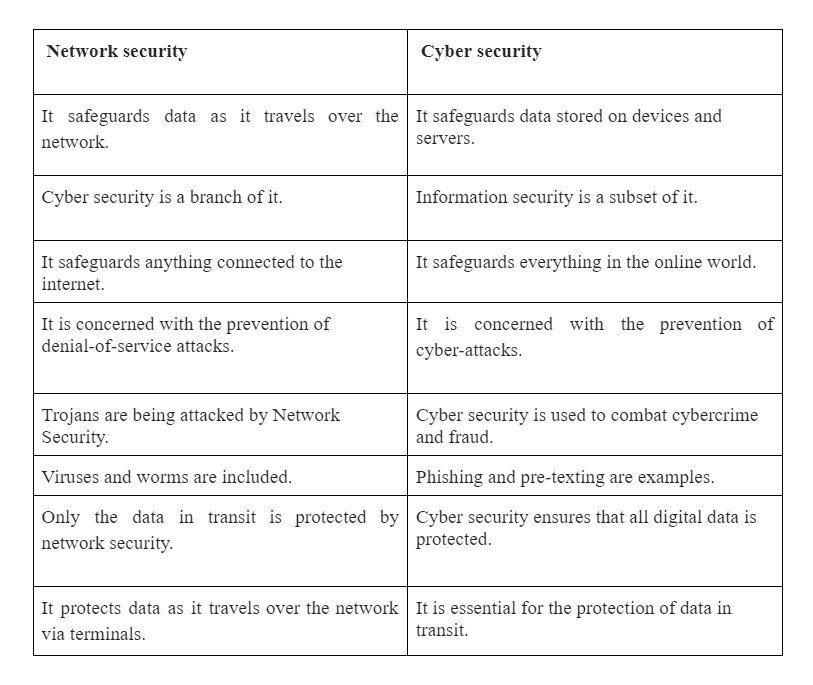
(Network Security vs Cyber security) Difference Between Both

1. Definition

Cyber security is a branch of information security that refers to a set of strategies and methodologies for preventing harm, attack, or illegal access to networks, devices, programs, and data. Cyber security, to put it simply, is the process of defending internet-connected devices and networks against digital threats. The process of safeguarding files and folders in a computer network from misuse, hacking, and illegal access to the system is known as network security. Network security is a subcategory of cyber security that guards against unwanted access to your system and network-accessible resources.

2. Security

While the phrases are interchangeable, they are vastly distinct in nature of security. If you see an organization as a walled castle, network issues are associated with keeping the peace within the castle walls and defending the organization’s sovereignty from network-related threats. Cyber security, on either hand, safeguards a company against external risks such as those posed by the internet. It defends an organization’s systems, networks, and applications against all types of digital attacks, such as phishing, baiting, and so on. The goal of network security is to secure an organization’s IT infrastructure from internet dangers such as viruses.

Wish to make a career in the world of Forescout Administrator ? Start with Forescout Administrator Training

3. Data

Network security becomes a component of cyber security, but cyber security is indeed a broad word like data security. While the authenticity of data and programs is the most important factor in both circumstances, cyber security emphasizes threat monitoring and detection to a higher extent. Network security is primarily concerned with protecting an organization’s IT network from the inside, while cyber security is concerned with protecting an organization’s information security technologies (ICT) against cybersecurity threats that exploit system weaknesses. Network security includes firewalls, user names and passwords, backup, and encryption.

If you have any doubts on Cyber Security, then get them clarified from Industry experts on our Cyber Security Tutorial !

Acquire Cyber Security certification by enrolling in the HKR Cyber Security Training in Banglore!

HKR Trainings Logo

Subscribe to our YouTube channel to get new updates..!

4. Security Expertise

Cyber security experts or analysts are those who, by their knowledge and experience of databases, firewalls, network security, and encryption, are fully responsible for defending network infrastructure and related systems. An expert in cyber security control, detection, and recovery is a cyber security professional. A security professional’s primary responsibility is to monitor all inbound and outbound traffic and to collaborate with other departments within the company to manage risk assessment tools and technology. A network security professional’s job includes securing the organization’s IT infrastructure, which contains data assets, financial data, and other confidential data

Network security and Cyber security

frequently asked Cyber security Interview questions and Answers !!

Cyber Security Training

Weekday / Weekend Batches

Conclusion

In brief, cyber security is an important part of information security dealing with data security during retention and transmission, while network security is indeed a subdivision of cyber security concerned with securing an organization’s IT infrastructure and limiting access to it. Both phrases are frequently used interchangeably, with the exception that cyber security is a much larger term, whereas network security is one component of information/cyber security.

Related Articles

  1. Cyber Security VS Data Science
  2. Cyber security Technologies


Source link