How Can Metadata Management Streamline Your Data Strategies?


Data is a key growth driver for businesses today. However, efficient, high-quality data integration remains a challenge for many organizations. Imagine you’ve got the data to advance your business, but don’t know how to map and implement it? An advanced metadata management strategy is your map.

Managing metadata has become unavoidable for organizations due to big data implementation and the need for easy data accessibility. To address these needs and manage metadata, companies adopt specified tools. In 2024, the global metadata management tools market was valued at $11.6 billion and is expected to go beyond $36.4 billion by 2030.

So, let us understand what managing metadata means and explore the top tools for managing metadata. Firstly, let us learn what metadata is…

What is Metadata?

Simply put, metadata is the ‘data about data’. It describes the key information about a dataset that helps users understand what it’s about. Using metadata enables companies to organize, manage, and use data more simply. Metadata typically includes title, author, keywords, subjects, creation date, and the dataset’s file size.

Integrating and managing metadata can streamline data management and governance endeavors. Alongside that, it can also save data management costs significantly. So, if data is your company’s gold, metadata is the treasure map.

There are five types of metadata. Each type indicates various aspects of data:

  • Descriptive metadata
  • Structural metadata
  • Administrative metadata
  • Technical metadata
  • Preservation metadata

What is Metadata Management?

Metadata management is the practice and technology that captures, organizes, and governs context so people and systems can find, trust, and use data reliably. It turns scattered facts into searchable, actionable intelligence, a single source of truth for the meaning, lineage, and health of your data assets. Active and passive metadata management are two significant approaches to handling metadata.

Best and innovative practices in managing metadata include integrating AI, ML, automation, and building a metadata-driven data architecture. According to sources, companies that fail to adopt a metadata-driven approach spend 40% more on their data management efforts.

Why does Your Business Need to Manage Metadata?

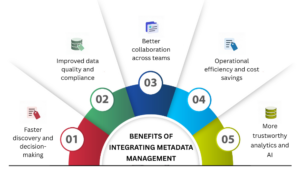
Metadata management can serve as a multiplier for your organization’s data value. Its key benefits are:

Benefits of Integrating Metadata Management

Faster discovery and decision-making: Teams find the right dataset quickly because metadata offers core details about datasets without consuming much time.

Improved data quality and compliance: Lineage and quality tags offered by metadata management tools make it easier to trace errors, demonstrate controls for audits, and validate data sources.

Better collaboration across teams: Managing metadata offers shared business definitions and ownership to stop duplicate analyses and conflicting reports.

Operational efficiency and cost savings: Automation reduces manual tagging, fastens onboarding, and lowers support overhead, allowing data teams to focus on higher-value work.

More trustworthy analytics and AI: Metadata management models trained in well-documented, quality-assured data are more reliable and less risky to deploy.

Top Tools for Metadata Management

Alation

Alation offers advanced, AI-enabled metadata solutions to keep your organization data-ready. It aims to streamline operations, safeguard data, and sustain data-driven innovation with cutting-edge metadata management strategies.

Features:

  • Automates active metadata handling.
  • Enables context and accountability for AI models.
  • Offers simplified navigation for business users.
  • Integrates AI-powered data cataloguing.

Pricing: Alation has custom pricing for users based on their business needs.

Atlan

Atlan addresses the modern and diverse metadata management needs of users. It focuses on helping users discover, understand, trust, and collaborate effectively with data assets.

Features:

  • Supports data source connectors.
  • Enables automated metadata extraction.
  • Allows data lineage and impact analysis.
  • Provides data profiling and quality monitoring.
  • Encourages collaboration and knowledge sharing.

Pricing: Atlaoffersas a monthly subscription and includes a demo.

Collibra

Collibra is a data intelligence platform that offers efficient metadata management services. With advanced data cataloging, lineage mapping, quality monitoring, and AI governance, this platform empowers organizations with top-notch metadata handling.

Features:

  • Enables automated data discovery and cataloging.
  • Offers active metadata management and AI insights.
  • Provides end-to-end data lineage.
  • Creates business glossary and policy management.
  • Supports collaborative workflows and stewardship.

Pricing: Collibra pricing depends on organization size and the number of users.

IBM InfoSphere Information Analyzer

InfoSphere Information Analyzer by IBM maintains consistency and quality of data through in-depth content and structural evaluation. It also helps in maintaining data accuracy and advanced methods to detect anomalies. The platform further supports delivering trusted content through validating data.

Features:

  • Offers deep data profiling and analysis.
  • Enables anomaly and redundancy detection.
  • Offers data lineage and governance.
  • Provides reporting and monitoring.
  • Unlocks exception management.

Pricing: IBM InfoSphere Information Analyzer is not publicly available.

Oracle Enterprise Metadata Management (OEMM)

Oracle Enterprise Metadata Management empowers modern businesses to harvest and govern metadata across their entire data management architecture. While addressing critical business challenges with advanced metadata handling, this tool maintains data transparency.

Features:

  • Reports to source lineage.
  • Provides model versioning.
  • Offers annotations and tagging.
  • Supports metadata standards.
  • Builds and maintains a business glossary.
  • Enables big data.

Pricing: OEMM offers custom pricing models based on usage.

Manage Metadata with the Right Tool!

Metadata management succeeds when the process meets the appropriate platform. Look for tools that can automatically generate metadata, show lineage, enforce business-centric glossaries, and surface-active recommendations. The right tool becomes your organization’s quality data enabler, unlocking easy discovery, governance, and AI, while sustaining scalability.

Read our informative blogs to stay up to date on the key technological shifts and trends!


FAQs:

1. What are the three types of metadata?
Answer: Three types of metadata include descriptive, administrative, and structural data.

2. What’s the difference between data and metadata?
Answer: Data defines any sort of raw information or content. On the other hand, metadata is the data about data that gives context and details about raw datasets.


Also Read:

Data Protection for Small Business: Easy Steps to Take


Source link

Leave a Reply

Subscribe to Our Newsletter

Get our latest articles delivered straight to your inbox. No spam, we promise.

Recent Reviews


The abbreviation for TOSCA is Topology and Orchestration Specification for Cloud Applications. Tosca test suite is a software testing tool for businesses that are frequently used to automate the process. It provides complete test case capability for an efficient test management process. Tosca is classified as an enterprise tool since it may be used in large-scale applications.

Interested in learning Tosca? Click here to learn Advanced Tosca Training from hkrtrainings Experts!

Why Tosca?

Tosca is one of the best and most often used automated testing tools. It is widely employed in large-scale applications to achieve successful outcomes. Tosca is used by most testers in the automotive, metal & mining, financial, and education industries due to its user-friendly characteristics. 

Tosca Training

  • Master Your Craft
  • Lifetime LMS & Faculty Access
  • 24/7 online expert support
  • Real-world & Project Based Learning

History of Tosca

TOSCA Testsuite is developed and designed by the TRICENTIS Technology & Consulting GmbH (A Vienna-based Austrian software firm). Tricentis was established in 2007 by Franz Fuchsberger and Wolfgang Platz, transforming their former consulting firm into a software firm. The company’s headquarters are in Mountain View, California, and Vienna, Austria.

  • Tricentis received a $9 million early-stage investment from Viewpoint, which is now part of Kennet Partners, in 2012. Sandeep Johri took over as CEO in 2013. Johri has sat on the boards of many startups and worked as a VP of HP’s cloud business.
  • Insight Venture Partners provided $165 million in series B funding to Tricentis in 2017.
  • Deutsche Bank, Toyota, UBS, Allianz, BMW, and Starbucks are among the company’s clients.
  • Tricentis and SAP, an enterprise software company, announced cooperation in July 2020. The Tricentis continuous testing platform, which is being incorporated into the SAP Application Lifecycle Management (ALM) portfolio, would be the testing platform for the SAP Solution Extensions program under the terms of the agreement.
  • Machine learning techniques are used by the Tricentis tools to identify potential integration risks among SAP and third-party applications. They’re also utilized to automate SAP and related application end-to-end testing.
  • Kevin Thompson was named CEO and Chairman of the Board in April 2021.

Key features of Tosca

Tosca covers several features on testing API, and mobile, along with automation and artificial intelligence techniques. It offers the following features:

Vision AI

  • Vision AI is the next technology that “sees” in the same way that humans do.
  • It allows for quick automated testing for apps that were previously difficult or impossible to automate, like those operating on distant desktops.
  • It can also automate tests based on design mockups before any code is developed
  • It allows you to test far earlier in the development cycle.\

Test automation based on models

  • Create codeless, resilient automated testing using a unique technique that separates an application’s technical information from the automation model
  • It allows you to increase automation rates to 90%+.
  • It lowers the maintenance costs.
  • Increases productivity.

Risk-based test optimization

  • Using a risk-based approach to testing allows you to reduce the number of tests in your automation suite while reducing risk in your software releases. 
  • It enables you to prioritize testing for business-critical functionality. Lowers the overall test creation.
  • Reduces the maintenance costs.
  • Make better “go/no-go” release decisions.

Interested in learning Tosca? Click here to learn Tosca Training in Hyderabad

Service Virtualization

  • The nightmare of trying to check replies from systems that are difficult to access/provision or that haven’t been developed yet is over with service virtualization. 
  • This eliminates one of the most significant causes of testing delays.
  • It enables automated tests to perform at any time.

Test data management

Expecting “good” test data is another hindrance that delays traditional software testing. You can use test data management to produce and deliver stateful data on-demand (imported, masked, or synthetic) for even the most complicated situations.

Distributed execution

  • distributed infrastructures and virtual machines can be used for executing several tests in parallel.
  • Testing is made faster and at scale.  

API scan

  • API testing may be made easier.
  • The codeless approach accelerates the process.
  • It increases test stability.

Assistant for recording automation

By giving business users an easy way to record their day-to-day actions, which can later be transformed into automated test cases, they may avoid manual testing.

Mobile testing

  • Create mobile tests quickly.
  • It can be used as building blocks for end-to-end test scenarios on iOS and Android devices.
  • Supports using native, hybrid, or mobile websites

     If you want to Explore more about Tosca? then read our updated article – Tosca Tutorial 

Tosca, others, what-is-tosca-description-0, others, what-is-tosca-description-0, Tosca, others, what-is-tosca-description-0, , others, what-is-tosca-description-1, others, what-is-tosca-description-1, Tosca, others, what-is-tosca-description-0, , others, what-is-tosca-description-1, , others, what-is-tosca-description-2, others, what-is-tosca-description-2

Subscribe to our YouTube channel to get new updates..!

Benefits of Tosca

Tosca has several advantages. The following are the most significant benefits.

  • Tosca is a wonderful solution that allows users to experience no scripting option. As scripting isn’t required, it’s no surprise that individuals use it more frequently.
  • Tosca employs the Agile testing approach because it aids in the development of both small and large-scale applications.
  • Most prevalent technologies, including SAP, ORACLE, JAVA, SOA, HTML, and so on, are supported by the Tosca automation tool. 
  • Offers excellent vendor assistance to gain a large audience.
    Provides a simple interface at a reasonable price.
  • Guarantee high-quality rapid results in a short period of time.

Top 30 Tosca interview questions & answers for 2023

Tosca Training

Weekday / Weekend Batches

 Conclusion
Tosca is a user-friendly automation tool that includes a test suite for software testing. The remarkable feature allows consumers to benefit from improved functioning on a regular basis. It provides low-cost testing services across various platforms.

Related Articles:

1. Selenium vs Tosca

2.Tosca Automation Tool


Source link