How I used the Chase Sapphire Preferred $100 hotel credit


I’m always looking for ways to squeeze more value out of my travel credit cards while I’m on the go. Last weekend, the Chase Sapphire Preferred® Card (see rates and fees) came in clutch.

After attending an Atlanta Braves baseball game with my family on Friday, I wanted to extend my stay in the area through Sunday. Thankfully, the Sapphire Preferred’s $100 hotel credit (received each account anniversary year) made that easy.

The Sapphire Preferred’s newly-doubled hotel credit now more than offsets the card’s $95 annual fee on its own. And, it helped me pay just $35 for a night at the Atlanta Marriott Alpharetta. Here’s how I did it — and how you can, too.

How the Sapphire Preferred’s $100 hotel credit works

If you were familiar with the old $50 hotel credit on the Sapphire Preferred, the revamped $100 credit works similarly.

You can use the credit on hotel bookings made through Chase Travel℠. The credit can be used for one or more stays (there are no monthly or biannual restrictions) and it renews every account anniversary. And you don’t have to activate the credit before you use it.

Cardholders can check their progress by logging into their online account, selecting the “Benefits & travel” menu and clicking “Benefits.” The website has a benefits tracker that helps you manage your progress. You can even see your unique renewal date.
Hotel credit tracker
CHASE

Be sure you pay with your eligible Sapphire Preferred if you want to redeem this credit. Statement credits usually post within three business days, but Chase notes it can sometimes take up to four weeks.

It’s important to note that you won’t earn Chase Ultimate Rewards points on the portion of your booking covered by the statement credit, but you will earn points on any remaining cost after the statement credit is applied. Since my booking was $135 total, I earned points on the remaining $35.

Related: Why the Chase Sapphire Preferred is one of the best cards for everyday spending

Reward your inbox with the TPG Daily newsletter

Join over 700,000 readers for breaking news, in-depth guides and exclusive deals from TPG’s experts

How I booked my $35 stay

When I started planning to extend my weekend in Atlanta, I logged into Chase Travel and started some searches. Since I’d be spending most of my time with my family anyway, I wanted to find a hotel that was functional and affordable so I could get the most mileage out of my $100 credit.
Atlanta Marriott Alpharetta Chase Travel listing
CHASE

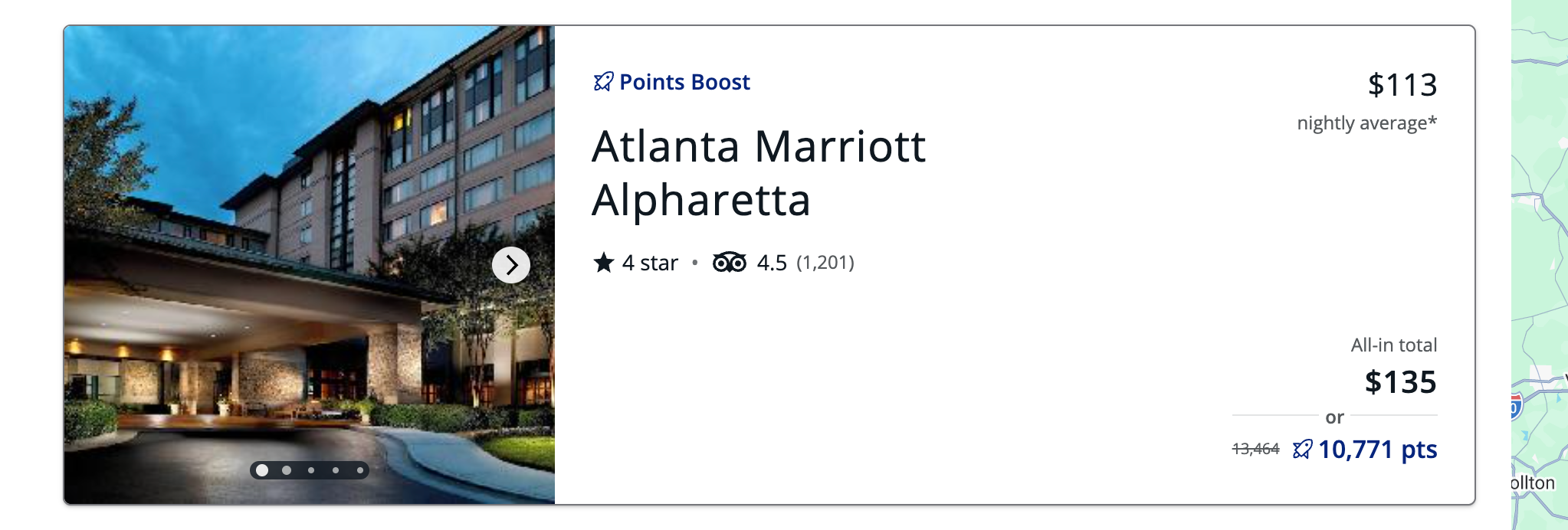
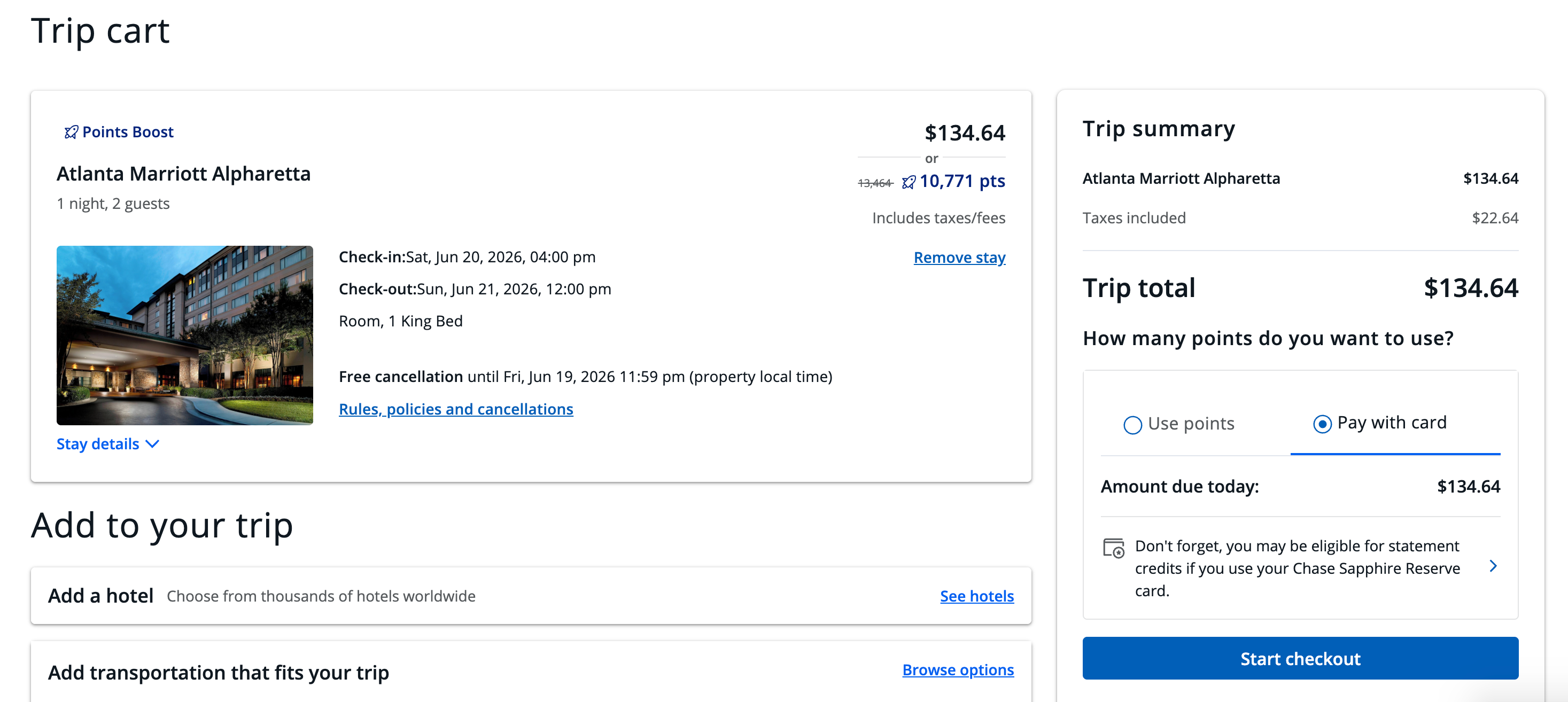
I decided on the Atlanta Marriott Alpharetta, in a suburb to the north of the city. For $135 it was perfect for a Saturday night stay. I’d get $100 off (more than offsetting my $95 annual fee on the Sapphire Preferred) and pay $35 out of pocket.

I also have the Chase Sapphire Reserve® (see rates and fees), so I had to double-check that I was paying with my Sapphire Preferred.
Paying for Atlanta Marriott Alpharetta in Chase Travel
CHASE

After my stay on Saturday, I logged back into my Chase account to check if the statement credit had been posted. I found it in the “Rewards” section of the website.
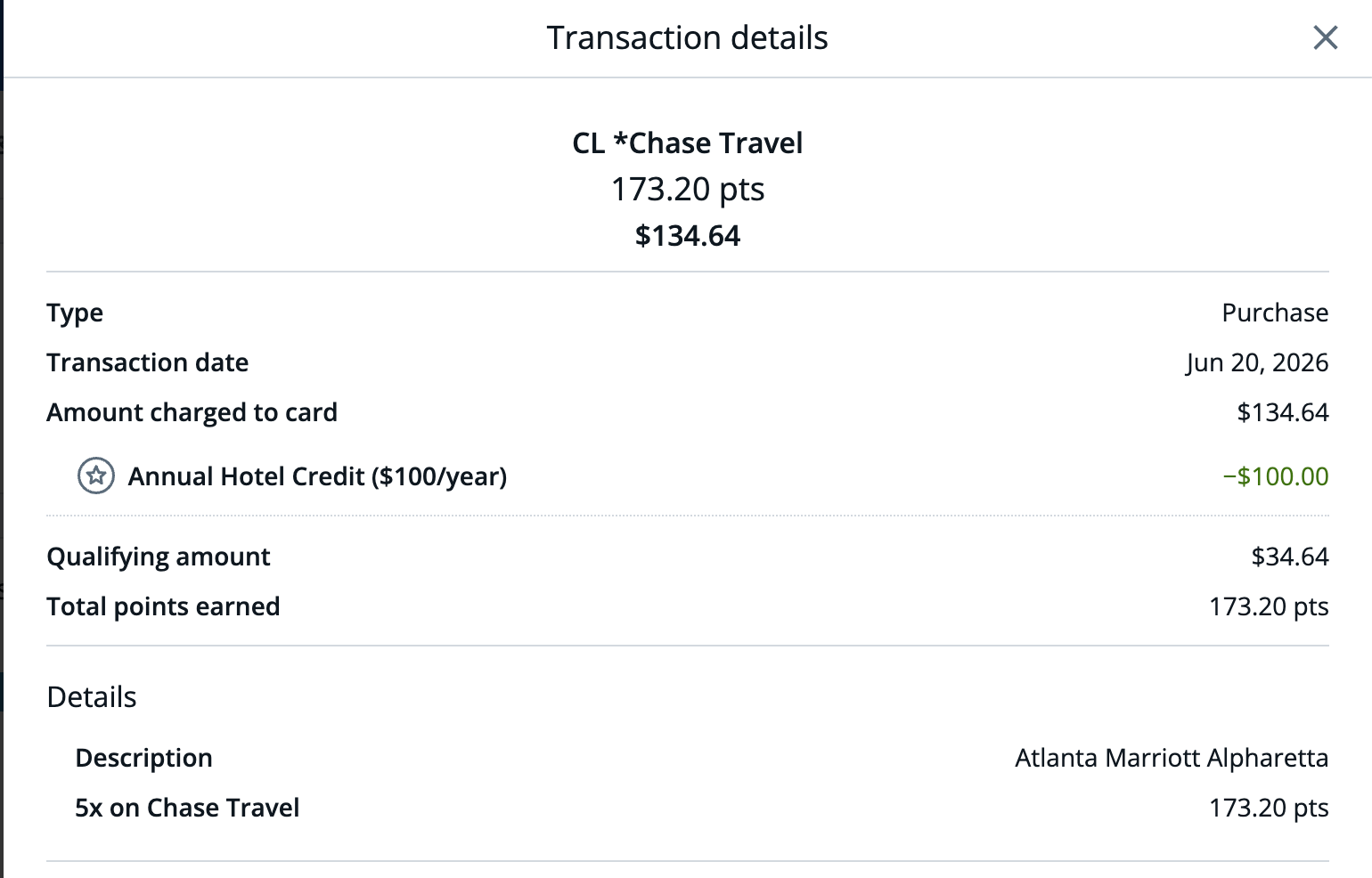
Chase Travel statement
CHASE

I knew I wouldn’t earn points on the $100 statement credit, but I did earn 173 points on the remainder of the booking. This is thanks to the Sapphire Preferred earning 5 points per dollar on Chase Travel purchases.

Related: Value simplicity? Why the Chase Sapphire Preferred is now the only card you need

How to maximize the Sapphire Preferred’s hotel credit

If you find a hotel within the $100 to $150 range, you can maximize the credit just like I did and pay very little out of pocket with the Sapphire Preferred.

As you navigate Chase Travel, keep an eye on the total costs. Don’t limit yourself to city-center properties; there are suburbs with nice properties at lower rates.

This Marriott in Alpharetta was 25 minutes from where the Braves play, but the $35 price tag made it well worth it.

Atlanta Marriott Alpharetta guest room
AUGUSTA STONE/THE POINTS GUY

From luxurious villas to city-center hotels and suburban spots like my Alpharetta Marriott, I think Chase Travel has enough options to make this credit work in most markets.

And for a $95 annual fee, the Sapphire Preferred can pay for itself in just one night at certain properties.

Related: After more than 16 years, why the Chase Sapphire Preferred should still be your first rewards card

Bottom line

The Sapphire Preferred’s $100 hotel credit is one of the simplest credit card perks to use.

There’s no need for activation and no restrictions on timing; all you have to do is book through Chase Travel and let the statement credit do the work. For a card with a $95 annual fee, one night away can put you ahead before you’ve used any other benefit.

Plus, the Sapphire Preferred is offering an outstanding welcome bonus right now: Earn 100,000 bonus points after spending $5,000 on purchases in the first three months from account opening. If you’ve been considering it, now is a great time to apply.

To learn more, read our full review of the Sapphire Preferred.


Apply here: Chase Sapphire Preferred Card


Source link

Leave a Reply

Subscribe to Our Newsletter

Get our latest articles delivered straight to your inbox. No spam, we promise.

Recent Reviews


Google Cloud Free Tier – Table of Content

However, even when the free money has run out, the free gifts will continue. There are 24 distinct products that provide “always free” samples on a regular basis. Even if you’ve been a customer for a long time, you can still try new things. Of course, Google clarifies that the term “always” in this generous commitment is “subject to change”. Until then, the BigQuery database will process one terabyte of queries every month, and AutoML Translation will convert 500,000 characters from one language to another.

Some developers use the free tier for what it was designed for: an opportunity to explore without having to beg their bosses and bosses’ bosses for the budget. Others work on a side business or a website for the youngsters in their neighborhood. When the load is small, it’s simple to innovate without having to worry about a monthly bill.

This is taken to an extreme by some developers. They attempt to spend as little time as possible in the free tier. Maybe they want to brag about how low their burn rate is. Maybe it’s just a new kind of machismo. Perhaps they’re short on cash.

Working this free angle for as long as feasible often results in lean and efficient web applications that perform as much as possible with as little as possible. When they leave the free tier, the monthly bills will remain low as the project grows, which will make every CFO happy.

Here are some tips for getting the most out of Google’s free service. You might be a scrooge. Maybe you’re just waiting till the brilliance is fully understood before telling your boss. Maybe you’re just having fun, and this is a mistake. In any case, there are numerous ways to save.

1.Only keep what is really necessary

Free databases such as Firestore and Cloud Storage are extremely versatile solutions for storing key-value documents and objects. The always-free tier of Google Cloud allows you to store your initial 1GB and 10GB of data in each product. However, the more information your program stores, the faster the free gigabytes run out. So, unless you definitely need it, stop keeping information. This means you won’t be collecting data obsessively just in case you need it for later debugging. There are no unnecessary timestamps, and you don’t need to retain a large cache of data just in case.

Want to get certified in GCP. Learn from our experts and do excel in your career with HKR’S Google Cloud Training

2.Your ally will be compression

There are hundreds of useful pieces of code for compressing your clients’ data. Instead of storing large blocks of JSON, the client code can compress the data using LZW or Gzip before delivering it over the wire to your server instances, which will store it without unpacking it. This translates to speedier replies, fewer bandwidth concerns, and a smaller effect on your monthly data storage capacity. Be cautious, because compression overhead can cause some extremely little data packets to grow in size.

Google Cloud Training

  • Master Your Craft
  • Lifetime LMS & Faculty Access
  • 24/7 online expert support
  • Real-world & Project Based Learning

3.Go without a server

Google’s intermittent compute services, which are priced per request, are more generous. Cloud Run will automatically start and run a stateless container that will answer two million requests per month for free. In response to another two million requests, Cloud Functions will launch your function. On a daily basis, that’s more than 100,000 different operations. So stop waiting and start developing serverless programs.

Note: Some architects would cringe at the thought of combining two distinct services. It may save money, but it will increase the application’s complexity, making it more difficult to maintain. That is a genuine risk, but you can often more or less recreate Cloud Functions’ function-as-a-service structure inside your own container, allowing you to condense your code later if you plan ahead.

4.Make use of the App Engine

Google App Engine is still one of the finest methods to get a web application up and running without having to worry about all of the nuances of deployment and scaling. Almost everything is automatic, so if the load increases, more instances will be deployed. The App Engine comes with 28 “instance hours” every day, which means your basic app would run for free for 24 hours a day and can even grow for four hours if demand rises.

5.Service calls should be consolidated

If you’re careful, there’s some room for extras. The amount of individual requests, not the complexity, is what sets the limit for serverless invocations. Bundling all data activities into one larger packet allows you to pack more activity and outcomes into each exchange. So you may include ridiculous gimmicks like stock quotes if you slide a few more bytes into the absolutely necessary packets. Keep in mind that Google keeps track of the amount of memory consumed and the amount of time it takes to compute. Your functions can’t use more than 400,000 GBs of memory and 200,000 GHz of computation time.

6.Make use of local storage

The current web API provides a number of useful storage options. Then there’s the perfectly delicious, old-fashioned cookie with a four-kilobyte limit. The Web Storage API is a document-based key-value system that keeps at least five megabytes of data in the cache, with certain browsers keeping up to ten megabytes. The IndexedDB provides a more comprehensive collection of capabilities, such as database cursors and indexes, to help speed up the process of sifting through large amounts of data.

The more data you save locally on your users’ machines, the less server-side storage you’ll need. This can result in speedier answers and a reduction in the amount of bandwidth used to send countless copies of data back to your server. However, there will be issues when users transfer devices because the data would most likely be out of sync. Just make sure all of the crucial facts are the same.

Want to get certified in GCP. Learn from our experts and do excel in your career with HKR’S Google Cloud Training in Hyderabad!

, Cloud Computings, google-cloud-free-tier-description-0, , Cloud Computings, google-cloud-free-tier-description-1

Subscribe to our YouTube channel to get new updates..!

7.Look for hidden bargains

Google has a page that summarizes all of the “always free” items, but if you look around, you’ll find plenty of other free services that aren’t on the list. For example, Google Maps gives “$200 in free monthly usage.” Google Docs and a few more APIs are always available for free.

8.Make use of G Suite

Many G Suite products, such as Docs, Sheets, and Drive, are invoiced separately, and customers can access them for free with their Gmail account or pay for them as a package. Rather than developing an app with built-in reporting, simply export the data to a spreadsheet and share it. The spreadsheets are capable of displaying graphs and plots in the same way that a dashboard would. To handle interactive requests, you’ll need to burn through your compute and data quotas if you construct a web app. However, if you simply create a Google Doc for your report, you’ll be throwing the majority of the work onto Google’s servers.

Click here to get frequently asked Google Cloud interview questions & answers

Check out our Latest Interview Questions video. Register Now  Google Cloud Online Training to Become an expert in Google Cloud.

9.Get rid of the gimmicks

Modern online applications have some functionalities that are largely unnecessary. Is it necessary to include stock quotes in your bank application? Is it necessary to provide the time or temperature in the local time zone? Do you need to include the most recent tweets or Instagram photographs in your post? No. Remove all of these extras because each one necessitates a new request to your server computers, reducing your available bandwidth. The product design team may have big aspirations, but you have the power to say “No!” to them.

10.Be cautious with new options

Some of the most advanced technologies for developing artificial intelligence services for your stack provide you plenty of room to experiment. Before costs kick in, the AutoML Video service allows you to train your machine learning model on video streams for 40 hours each month. For six hours, the service for tabular data will mill your rows and rows of data on a node free of charge. This provides you enough rope to play around with or make simple models, but be careful. It would be risky to automate the procedure so that each user may initiate a large machine learning task.

Acquire GCP certification by enrolling in the HKR GCP Training in Banglore!

Google Cloud Training

Weekday / Weekend Batches

11.Keep your expenses in perspective

It’s all too easy to take this game too far and convert your app’s architecture into a Rube Goldberg device only to save a few dollars. It’s crucial to note that in Google Cloud, the transition from free to paid is frequently a very small one. While many free services on the Internet can easily go from free to thousands of dollars with a single click, Google’s offerings aren’t usually priced that way.

Following two million free Cloud Function invocations, the next one costs $0.0000004. That works out to just 40 cents per million. You should be able to cover a few extra million with ease if you search through your sock drawer.

When you leave the free zone, the price schedule is generous enough that you won’t suffer a heart attack. If your application requires a few million dollars more here or there, you’ll most likely be able to cover it. The main takeaway is that reducing the computing burden results in smaller bills and faster responses.

Conclusion:

We hope this blog has provided the necessary information and you have learned various tips which assisted you in making the best use of free tier services in google cloud. 

Related blog:

AWS vs Azure vs Google Cloud

HPE Simplivity Training


Source link