How Long Should You Be Able to Hold a Plank? Here’s How You Compare by Age


Fact checked by Nick Blackmer

Planks work multiple ab muscles at once.Credit: Maskot / Getty Images
Planks work multiple ab muscles at once.
Credit: Maskot / Getty Images
  • Planks work multiple core muscles simultaneously, making them essential for maintaining strength and mobility.
  • For younger adults, holding a plank for at least 45 seconds is a good benchmark; for those over 60, 20 seconds is a solid goal.
  • Ultimately, however, focusing on proper form is more important than chasing duration.

If you’ve spent any time on social media lately, you’ve probably come across plank challenges—people propping themselves on their forearms, legs extended behind them, holding the position for as long as they can. 

While experts caution that focusing too much on plank duration may actually make the exercise less effective, there’s good reason to strive for strong, steady form and to build up your endurance over time. So how long should you really be able to hold a plank? Here’s what to know.

What Planks Can Do For You

Planks are a highly effective way to strengthen your core, Evan Williams, CSCS, strength and conditioning coach for the Milwaukee Bucks, told Health

They’re a great bang-for-your-buck exercise, he added, because they engage multiple core muscles at once—your rectus abdominis (the front of your abdomen), obliques (the sides), and transverse abdominis (the deep, stabilizing muscles that wrap around your midsection). That's not the case for many other ab exercises, such as crunches, which tend to target only one area.

Planks also teach you how to properly brace and stabilize your core as you move. “This is essential for protecting the lower back and maintaining proper alignment during movement,” Williams said—whether you’re deadlifting at the gym or simply loading boxes into your car at home.

That emphasis on stability becomes even more important with age. In a small 2012 study, older adults who completed a nine-week core-stability program improved trunk strength, spinal mobility, and dynamic balance—all of which are important factors in reducing the risk of falls.

How Long Should You Be Able to Hold a Plank?

When it comes to plank timing—like pretty much everything else in fitness—it’s hard to give a one-size-fits all answer. Multiple factors can influence how long you can hold the position, including body weight and proportions, overall fitness level, experience with planks or similar exercises, muscular endurance, and breath control, Williams said.

Age also plays a big role. As you get older, natural changes—like a decrease in muscle mass, strength, and joint health—can affect how long you’re able to maintain a plank, Williams said. “However, consistent training can significantly slow or even offset these declines,” he added.

While there’s no single number everyone should shoot for, there are general ranges that can serve as helpful benchmarks. Here’s how plank hold times break down by age, according to Williams:

  • Ages 18–39: 45–90+ seconds for the general population; 60–120 seconds for those who are more fit
  • Ages 40–59: 30–75 seconds for the general population; 45–90 seconds for those who are more fit
  • Ages 60+: 20–60 seconds for the general population; 30–75 seconds for those who are more fit

How To Do a Plank

It’s easy to get caught up in trying to extend your plank time, but what matters most is the quality of your form—not how long you last, Williams said. 

So what does good form actually look like? Start by stacking your joints: your elbows should be directly under your shoulders, with your spine in a neutral position. From there, engage your glutes and quads along with your core, focus on drawing your ribs down, and actively press through the floor to stay stable. If you’re struggling, you can try a modification such as dropping to your knees or elevating your hands on a sturdy step.

One of the most common mistakes, Williams said, is failing to properly brace the core, which can cause the lower back to arch and the spine to fall out of alignment. Another frequent issue is neglecting the upper back, allowing the shoulders to collapse.

“The biggest tip is to focus on proper bracing and full-body tension, actively squeezing the core throughout the movement rather than just holding the position,” Williams said.

In practice, that means only holding a plank for as long as you can maintain proper form. If your alignment starts to slip, it’s time to stop.

How to Safely Prolong a Plank

Once you’ve mastered your form, building endurance can come next. To increase your hold time, start with shorter planks—like 15 to 20 seconds—and gradually add five to 10-second increments as those start to feel manageable, Williams said. Shoot for two to three sets per session, and try to include them in your workouts two to three times a week if your goal is to increase your plank time.

But planks alone won’t do the whole job. Incorporating other core-strengthening exercises, like side planks, bird dogs, dead bugs, and suitcase carries, can help reinforce the same muscles and, ultimately, prolong your plank holds.

Finally, keep in mind that a long plank isn’t necessarily the ultimate measure of fitness. Chasing extreme durations—for some people, even hours—can be counterproductive, Williams noted, because it often leads to a slackening of full-body tension and slipping into a more passive position just to hold for time.

“Most people are better off focusing on high-quality holds,” he said, adding that increasing exercise difficulty—by adding movement like shoulder taps, for example—can be more effective than simply trying to hold longer.




Source link

Leave a Reply

Subscribe to Our Newsletter

Get our latest articles delivered straight to your inbox. No spam, we promise.

Recent Reviews


Lost a crucial document because your system crashed before you could save it? Worry no more! Microsoft Word has introduced an automatic save option that regularly backs up your work, so you’ll never lose your progress again.

Users will now be able to manage their Word documents without thinking about saving them manually. The new Microsoft Word update allows users to automatically save their documents to the cloud as soon as they start documenting any content piece.

Raul Munoz, the Senior Product Manager at Microsoft, has stated about the new feature, “We are modernizing the way files are created and stored in Word for Windows! Now you don’t have to worry about saving your documents: Anything new you create will be saved automatically to OneDrive or your preferred cloud destination.

Microsoft additionally hints at introducing similar features for Windows Excel and PowerPoint, which are now live.

How Does the Auto-save Feature Work?

The auto-save option can be accessed and used effectively with the compatible Word for Windows version. Let’s understand how the process works-

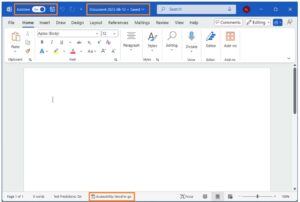
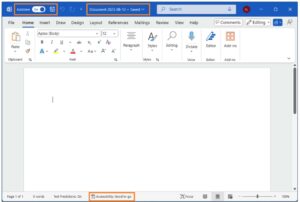
Primarily, users need to create a fresh document in Word and switch the AutoSave option on. Unlike the previous default document name- DocumentN, the autosave feature saves the files with the date.

Microsoft Word Update - Step 1

Source: Microsoft Tech Community

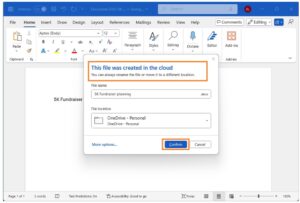
To change the name of the file and its location, users need to select Save or press Ctrl+S. After selecting the file name and location, press Confirm to save the changes.

Microsoft Word Update - Step 2

Source: Microsoft Tech Community

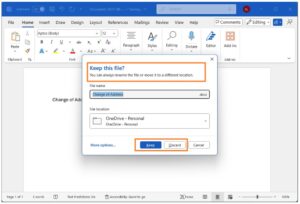
In case users try to close the file before it gets saved, a dialog displays on the screen asking whether they intend to Discard or Keep the file. If users try to close empty files, Word discards them without asking for confirmation.

Microsoft Word Update - Step 3

Source: Microsoft Tech Community

Availability of the Auto-Save Feature of Microsoft Word Update-

The AutoSave feature of Microsoft Word update is available to users with Version 2509 (Build 19221.20000) or newer. This advancement is set to enhance accessibility and address the challenge of lost files. Similar features have been introduced on Windows Excel and PowerPoint as well.

Advantages of the Latest Microsoft Word Update

Microsoft Word’s new auto-save feature will unlock several benefits for users. Alongside increased security, it offers flexible file management capabilities. Let us discuss other significant advantages-

Flexibility in File Storage and Control: Users can store and manage their files more flexibly than ever. As users are in charge of the documents, they can adjust file names and locations to save, organizing the files according to convenience.

Never Lose Your Files: The auto-save feature in Microsoft Word addresses the challenge of losing files due to not saving them manually. As soon as you start making progress in a file, it automatically gets saved.

Enhanced Security and Compliance: Files saved in your organization’s cloud servers already adhere to the set security guidelines and practices. Hence, users do not need to think about protecting the files separately.

Increased Accessibility: The auto-save feature enables enhanced accessibility of Word files. It can be accessed from diverse types of devices and platforms once shared, including Android, iOS, and web browsers. Changes made to the file will get synced on all devices and platforms.

Better Collaboration: The AutoSave feature has made collaboration within and across teams easier. Users can easily share the cloud file and initiate collaboration by making changes, adding comments, and resolving comments in real time.

Agentic AI Support: The Word files are now equipped with Copilot agentic AI support. Users can unlock AI-powered capabilities whenever they need to improve or update their documents. Nevertheless, to use Copilot in Word, a Microsoft 365 Copilot license is needed.

Additional Tips: 

  • Users will be able to easily change the location for new documents. Right-click on any cloud folder in the File section of Word, then select Set as Default Location to choose the location.
  • Users can manage how their files are created, whether in the traditional manner or automatically in the cloud, in the Save tab of Word Options, and opt in or opt out for Create new files in the cloud automatically.

Key Elements to Keep in Mind-

  • When a new Word session is started while another is running, the new file does not autosave. Hence, users need to close the previous file to enable the auto-save option for new files.
  • Users may sometimes encounter a delay in refreshing the recent files list while changing the name of a document.
  • If users disable the option for Show the Start screen when this application starts, remember that the first file they create will not autosave automatically.

Concluding Remarks!

Microsoft has been making significant advancements in its 365 Office platforms for better collaboration and enhanced productivity of diverse teams within an organization. With the integration of Copilot and flexible features, the firm is aiming to boost user experience and accessibility of the tools, including Word for Windows.

Learn about the major technological shifts and practices with KnowledgeNile!


FAQs:

1. What is the AutoSave feature in Microsoft Word?

Answer: The AutoSave feature in Microsoft Word lets users save their files automatically.

2. What is the purpose of AutoSave?

Answer: The AutoSave feature aims to reduce the challenges of data loss in unwanted circumstances, such as power shortages and device failures.

3. Where are AutoSave Word documents stored?

Answer: Automatically saved Word files are stored in cloud storage, like OneDrive.


Recommended For You:

Oracle identity cloud vs Microsoft Active Directory: Which to opt for and why?


Source link