How to access American Airlines Admirals Club lounges


The American Airlines Admirals Club airport lounge is a great place to relax and recharge before a flight on American Airlines or its partners.

Inside the lounge, you can expect complimentary refreshments, Wi-Fi and a place to sit away from the hustle and bustle of the airport terminal. You’ll find nearly 50 Admirals Clubs in airports worldwide, including major American hubs.

There are a handful of ways to access the Admirals Club before your next flight — here are your options.

Related: First look: American’s new Flagship Lounge and Admirals Club in Philly shine in big debut

Access the Admirals Club on same-day flights

admirals club phl
ZACH GRIFF/THE POINTS GUY

Regardless of how you gain access to the Admirals Club — through a membership, class of service or American Airlines AAdvantage elite status — know that you must present a same-day boarding pass on American, Aer Lingus or a Oneworld partner airline.

Flights operated by Aer Lingus are a special case:

  • Status or premium-cabin access: Allowed only on flights marketed by Aer Lingus and operated by American
  • One‑day pass: Not valid on Aer Lingus; must be marketed and operated by American Airlines or a Oneworld airline

Lifetime Admirals Club members are exempt from the same-day flight requirement and any airline restrictions for entry into the clubs.

Access the Admirals Club with a credit card

An easy way to access the Admirals Club is by opening the Citi® / AAdvantage® Executive World Elite Mastercard® (see rates and fees), which comes with a 70,000 bonus miles after spending $7,000 on purchases in the first three months of account opening. Cardholders also receive a complimentary Admirals Club membership, which largely offsets the $595 annual fee. With this membership, you get access for up to two guests or immediate family members traveling with you (with a same-day boarding pass for an eligible flight).

Reward your inbox with the TPG Daily newsletter

Join over 700,000 readers for breaking news, in-depth guides and exclusive deals from TPG’s experts

The real hidden gem of this card is its generous authorized-user policy. You can add up to three authorized users to your account for $175, then additional authorized users for $175 each. Authorized users get Admirals Club access when they hold a same-day ticket on American or its partners.

Because of this, some may even consider splitting the annual fee among several authorized users to lower everyone’s lounge costs.

Be aware that authorized users do not get a full membership but rather just access. They must present their physical Citi / AAdvantage Executive World Elite Mastercard and may bring immediate family members or up to two guests. Authorized users do not have access to partner lounges.

You can also access Admirals Club lounges with four single-visit Admirals Club passes each year for the primary cardmember with either of the following cards:

To use them, you must present a same-day boarding pass for an eligible American Airlines or Oneworld flight. These passes cannot be shared or gifted, and guests are not permitted unless they are traveling on their own pass. The primary cardmember may redeem all four passes in a single visit to bring in up to three adult guests. Any passes not redeemed at the end of the calendar year will be forfeited.

Related: Best credit cards for American Airlines flyers

Access the Admirals Club with a paid membership
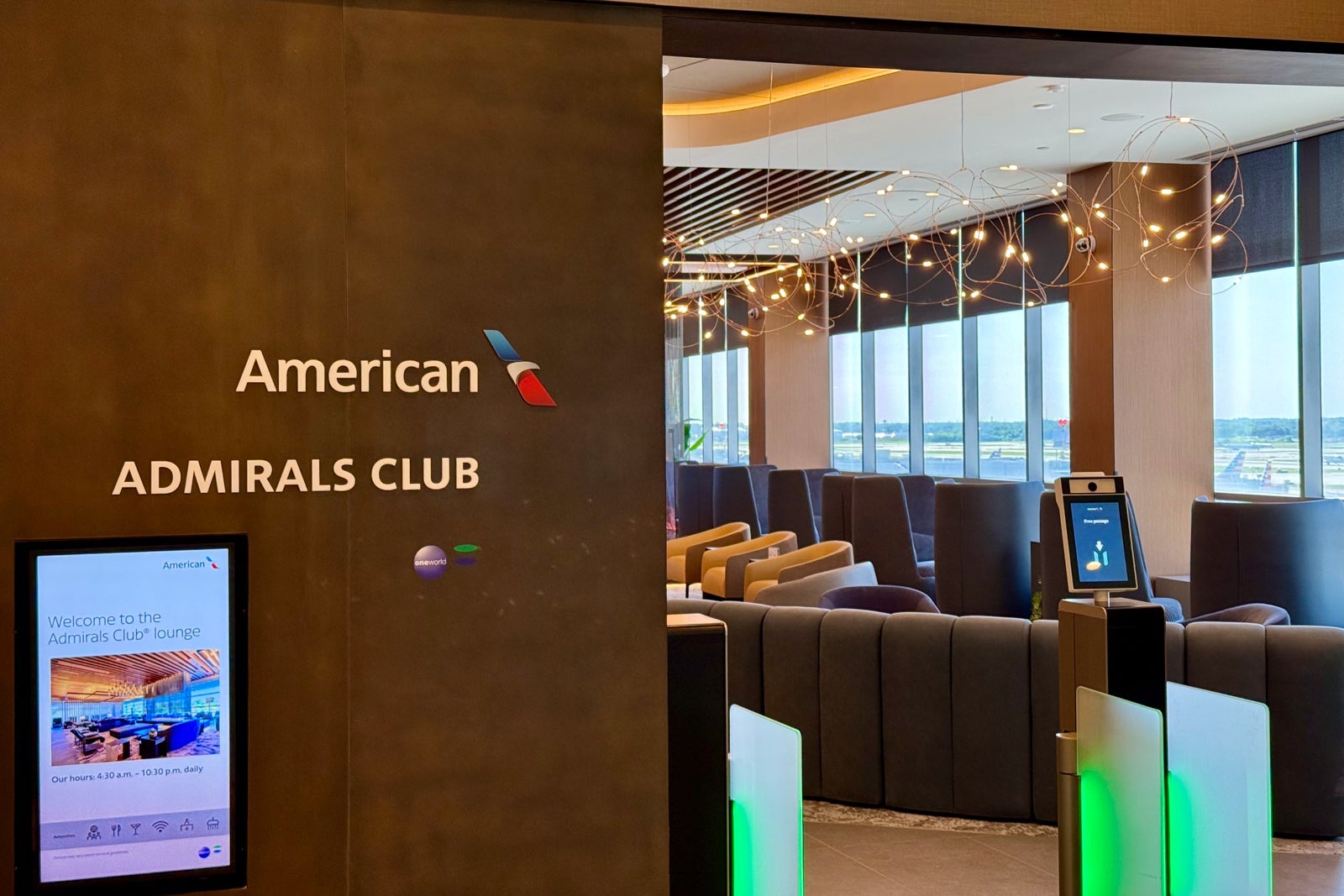
American Airlines Admirals Club at Philadelphia International Airport (PHL).
ZACH GRIFF/THE POINTS GUY

If opening a credit card is not appealing, you can always purchase a membership. Here’s how much you should expect to spend:

Type of membership Annual price (individual membership)
Annual price (household membership — membership for you and your spouse or domestic partner)

$850 ($800 to renew)

$1,650 ($1,600 to renew)

$825 ($775 to renew)

$1,625 ($1,575 to renew)

$800 ($750 to renew)

$1,600 ($1,550 to renew)

$775 ($725 to renew)

$1,575 ($1,525 to renew)

$750 ($700 to renew)

$1,550 ($1,500 to renew)

Free

You can also use miles to purchase an Admirals Club membership at 1 cent apiece. Per TPG’s May 2026 valuations, American miles are worth 1.6 cents apiece, so we generally don’t recommend redeeming American miles this way.

Type of membership Annual price (individual membership, in miles)
Annual price (household membership — membership for you and your spouse or domestic partner, in miles)

85,000 (80,000 to renew)

165,000 (160,000 to renew)

82,500 (77,500 to renew)

162,500 (157,500 to renew)

80,000 (75,000 to renew)

160,000 (155,000 to renew)

77,500 (72,500 to renew)

157,500 (152,500 to renew)

75,000 (70,000 to renew)

155,000 (150,000 to renew)

Free

Related: Best credit cards for airport lounge access

Admirals Club 1-day pass
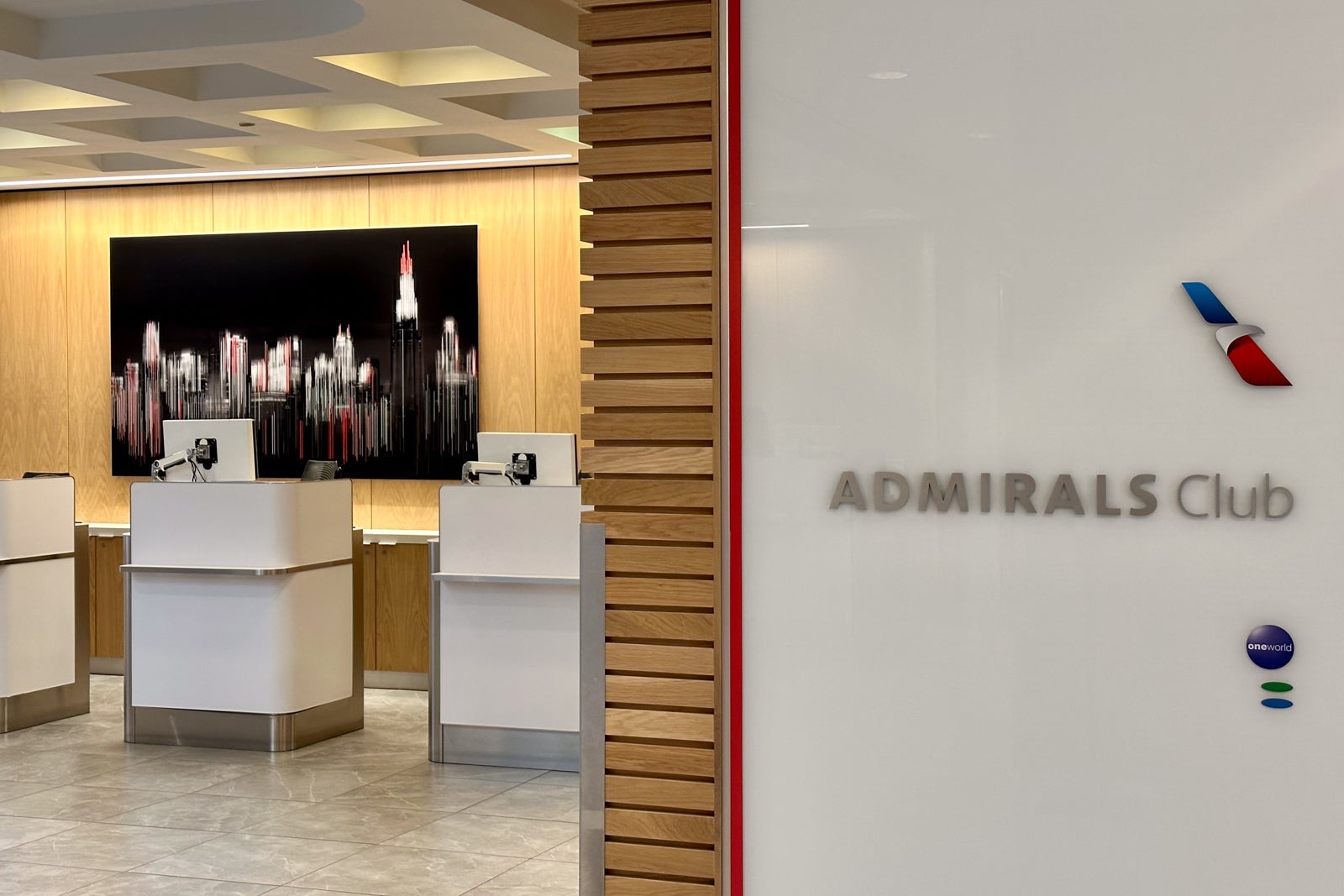
American Airlines Admirals Club Chicago O'Hare
ZACH GRIFF/THE POINTS GUY

You can use one-day passes at some Admirals Club locations. These are available for purchase for $79 or 7,900 AAdvantage miles. During peak hours, however, be prepared to be turned away with a one-day pass.

A one‑day passholder may bring up to three children under 18 at no extra charge, subject to lounge capacity.

Access the Admirals Club with elite status

Admirals LAX lounge
CLINT HENDERSON/THE POINTS GUY

Elite status access rules are nearly identical for the membership-based Admirals Clubs and Flagship Lounges, which are reserved for premium-cabin travelers on long-haul flights. If you have a choice, go to the superior Flagship Lounge.

American AAdvantage and Alaska Atmos Rewards elite members

If you hold Oneworld Sapphire or Emerald status through American AAdvantage (via Platinum, Platinum Pro or Executive Platinum status) or Alaska Airlines Atmos Rewards elite status, you and a guest can access Admirals Clubs or Flagship Lounges on qualifying international itineraries operated by American or a Oneworld partner, even in economy class.

If you’re relying on status to enter and you’re flying Alaska Airlines, American does not grant access on flights between the U.S. and Canada, the Caribbean or Mexico.

Other Oneworld elite members

If you are a Oneworld Sapphire or Emerald member with a program other than AAdvantage or Atmos Rewards, you and a guest can access an Admirals Club or Flagship Lounge when traveling on American or another Oneworld carrier. Flagship Lounge access is a generous benefit for Sapphire-level members of foreign programs.

Related: Why I earn status with foreign airlines — and whether you should, too

Loyalty Point Rewards

Side of an American Airlines jet
COOPER NEILL/AFP/GETTY IMAGES

The following Loyalty Point Rewards are available to help you get into an Admirals Club. When you reach the following point thresholds, you can choose a reward:

  • 250,000 Loyalty Points: An Admirals Club membership (remember, when you achieve this tier, you can select from two Loyalty Point Rewards, but the Admirals Club membership requires both of your selections)
  • 400,000 Loyalty Points: An Admirals Club membership (requires two choices)
  • 550,000 Loyalty Points: An Admirals Club membership (requires two choices)

One-day passes are no longer offered as a Loyalty Point Reward.

Access the Admirals Club with a certain fare class

BA Club Suite
ERIC ROSEN/THE POINTS GUY

While standard domestic first-class tickets won’t get you access to Admirals Clubs, the following types of tickets will:

  • Business- and first-class tickets on international American- or Oneworld-operated flights.
  • Domestic Flagship-ticketed flights. This includes Flagship nonstop flights between John F. Kennedy International Airport (JFK) and Los Angeles International Airport (LAX), John Wayne Airport (SNA) or San Francisco International Airport (SFO); Boston Logan International Airport (BOS) and LAX, Miami International Airport (MIA) and LAX, Dallas Fort Worth International Airport (DFW) and Honolulu’s Daniel K. Inouye International Airport (HNL), Ellison Onizuka Kona International Airport at Keahole (KOA) or Kahului Airport (OGG), O’Hare International Airport (ORD) in Chicago and HNL or OGG and seasonally, Phoenix Sky Harbor International Airport (PHX) and HNL.

Again, if you’re flying through JFK, LAX, MIA, Dallas Fort Worth International Airport (DFW), Philadelphia International Airport (PHL) or O’Hare International Airport (ORD), you should seek out a Flagship Lounge. Still, Admirals Club access can be a benefit for premium transcontinental passengers originating in Boston or San Francisco.

You won’t be able to bring in a guest if you’re getting lounge access this way unless you’re flying in international first class, in which case you’re allowed one guest, so long as they’re on the same flight.

Military access to the Admirals Club

With a valid military ID and same-day American Airlines boarding pass, U.S. military personnel traveling in uniform can access the Admirals Club and most partner club locations. You can bring in your immediate family or up to two guests.

However, uniformed U.S. military personnel can’t access these two partner lounges:

  • Aspire Lounge in San Diego International Airport (SAN)
  • JAL Sakura Lounge in Honolulu’s Daniel K. Inouye International Airport (HNL)

Related: The best travel perks and discounts for members of the military

Bottom line

There are numerous ways to access American Airlines’ Admirals Clubs. While the creature comforts of the Admirals Clubs vary significantly, these lounges are still better than sitting in a crowded terminal and spending more than $5 on a bottle of water.

Ensure you’re well-versed in the ins and outs of accessing Flagship Lounges. After all, if you have access to Flagship Lounges, which are significantly nicer, you wouldn’t want to visit the Admirals Club mistakenly.

If you’re like many TPG staffers who value an Admirals Club membership, an American Airlines cobranded credit card that provides you with membership and access for your guests may be the way to go.


Source link

Leave a Reply

Subscribe to Our Newsletter

Get our latest articles delivered straight to your inbox. No spam, we promise.

Recent Reviews


There are a number of administrative rules that businesses have to comply with. This can create administrative headaches for businesses–particularly small businesses.

The requirement for annual maintenace of state corporate status is an example. Businesses, particularly small businesses, often fail to meet annual state filing requirements. The result is that their corporate powers are limited. They then have to reinstate the entity, which in itself is another hassle.

State laws allow for businesses to retroactively fix these issues when there is a problem, so this is not a “gotcha” situation for them. But what about the IRS? Consider the example where the taxpayer owes the IRS and asserts is right to a collection due process hearing. Can the IRS have the hearing and then when the taxpayer petitions the tax court coming out of that hearing, not be able to bring suit in tax court due to state compliance issues?

The court addressed this fact patterin in Arbor Vita Corp. v. Commissioner, 166 T.C. No. 5. The corporation filed its tax court petition within the 30-day window while its California status was suspended, and eventually revived that status — but only months after the filing window for tax court had closed.

Facts & Procedural History

The taxpayer was a California corporation. It was formed in 1998. The California FTB suspended the corporation for failure to file certain California state tax returns. The business was legally disabled under state law.

For tax year 2017—several years earlier—the IRS had separately determined that the corporation failed to pay its unemployment tax liability. The IRS also assessed a civil penalty under tax code Section 6721 for the corporation’s failure to file Forms W-2, Wage and Tax Statement, with the Social Security Administration. These payroll tax disputes — employment taxes and associated reporting penalties — represent one of the more common types of federal liability that arise when a business is struggling to keep up with its obligations.

The IRS filed a notice of federal tax lien (“NFTL”) against the corporation. The corporation contested the lien filing by timely requested and participated in a collection due process (“CDP”) hearing before the IRS Independent Office of Appeals. Appeals sustained the lien filing in a Notice of Determination in 2025.

The corporation then filed a petition in the U.S. Tax Court — within the 30-day window. Its California corporate status remained suspended at that point. The FTB did not issue a Certificate of Revivor until more than five months after the Notice of Determination issued and well after the 30-day filing window had closed. The IRS moved to dismiss the tax court proceeding for lack of jurisdiction on the ground that the corporation lacked the capacity to maintain the proceeding.

Taxpayer Collection Due Process Rights

When the IRS pursues collection of unpaid tax debts through a federal tax lien or levy, the tax code gives taxpayers the right to contest that collection action before it proceeds. This is a fundamental right that is intended to satisfy the Constitutional right to be heard prior to taking of property.

Section 6330 requires the IRS to provide notice and an opportunity for a CDP hearing before the IRS Office of Appeals. At that hearing, the taxpayer can challenge the appropriateness of the collection action, contest the existence or amount of the underlying liability in certain circumstances, and raise collection alternatives such as installment agreements or offers in compromise.

Appealing IRS collection actions through the CDP process is often a great way to pause collection activity and negotiate a resolution. Section 6320 governs CDP rights in the context of tax liens. Section 6330 covers levies. Both sections provide for judicial review of an adverse determination by Appeals, but both also require a timely petition.

The 30-Day Window to Petition the Tax Court

If the case is not resolved in the taxpayer’s favor, generally, the administrative portion of the CDP hearing ends when the IRS issues a Notice of Determination.

After the IRS issues a Notice of Determination sustaining a collection action, the taxpayer has 30 days to file a petition for review in the U.S. Tax Court. This deadline comes from Section 6330(d)(1). Missing the window has historically meant no further judicial review, and the IRS can proceed with its collection activity.

For many years, courts treated the 30-day deadline as jurisdictional for the tax court. A jurisdictional deadline is one whose violation deprives the court of all authority to hear the case — no exceptions, no equitable relief. Missing it was fatal, full stop. That framework changed in 2022.

In Boechler, P.C. v. Commissioner, 142 S. Ct. 1493 (2022), the Supreme Court held that the Section 6330(d)(1) deadline is not jurisdictional. It is an ordinary, nonjurisdictional deadline subject to equitable tolling. The distinction matters. A nonjurisdictional deadline may be extended in appropriate cases where the taxpayer demonstrates diligence and extraordinary circumstances outside its control. We’ll address it further below, but the Boechler decision also has a downstream effect on the corporate capacity question in this case.

Corporate Capacity: Tax Court Rule 60(c)

Before getting into Boechler further, we have to consider tax court Rule 60.

The U.S. Tax Court is a court of limited, legislatively granted jurisdiction. It often notes its own limitations in cases–even though other courts who review its cases on appeal do not always agree that the tax court’s jurisdiction is so narrrow. But even then, the tax court can only hear cases that Congress has specifically authorized.

This brings us to Tax court Rule 60(c). This rule provides that the capacity of a corporation to engage in litigation before the court is determined by the law under which the corporation was organized. For a California corporation, California law governs the capacity question — not federal law. Like most other states, a corporation that lacks legal standing under California law at the time the jurisdictional or filing requirements are met cannot maintain a proceeding in the tax court.

Equitable Tolling for a Timely-Filed Petition

This brings us back to this case. The taxpayer filed its petition in late April of 2025. Its California corporate status was suspended at that time. The 30-day window under Section 6330(d)(1) expired in early April 2025 — 30 days after the March 2025 Notice of Determination.

When that window closed, the IRS acquired a statute of limitations defense. The corporation did not revive its California status until September of 2025, more than five months after the deadline had passed.

Following Boechler, the suspension at the time of filing did not automatically bar the petition, because Section 6330(d)(1) is a nonjurisdictional, procedural deadline. California’s relation-back doctrine could theoretically apply. The problem was Section 23305a. Retroactively validating the petition at that point would directly prejudice the Commissioner’s limitations defense — a defense that had fully accrued before revival occurred. The tax court declined to override that accrued defense.

The taxpayer argued that California courts have allowed retroactive validation of a notice of appeal filed by a suspended corporation. The tax court rejected this analogy on two grounds. First, an expired statute of limitations constitutes an accrued defense under Section 23305a, whereas the expiration of a time limit for filing a notice of appeal does not carry the same defense-accruing effect under California law.

Second

Second, the tax court noted that it is not an appellate court. The Supreme Court has characterized the tax court’s role as closely resembling that of the federal district courts and not as an appellate tribunal. There was no principled basis for treating a tax court petition as a notice of appeal, and the court declined to create one.

As a fallback argument

As a fallback argument, the taxpayer asked the tax court to apply equitable tolling to the 30-day deadline. Because Boechler established that the deadline is nonjurisdictional, it would seem that equitable tolling is available under Section 6330(d)(1). To obtain it, a taxpayer only has to show that it pursued its rights diligently and that extraordinary circumstances outside its control prevented it from filing on time.

The court disposed of this argument with a simple observation: equitable tolling extends a deadline that was missed. The taxpayer here did not miss the deadline. It filed its petition on time. There was no extension to grant. The taxpayer’s problem was not that it filed late — it was that it filed without legal capacity, and its revival came after the window closed. Equitable tolling has no mechanism to address that circumstance because there is no expired deadline to extend.

But with that said, is this a moot issue? Can the taxpayer can simply file a second petition now, and again assert equitable tolling? It would seem that this is the remedy and could put the matter before the court again.

The Takeaway

The outcome in this case shows that there is a convergence of California corporate law and federal tax procedure that can catch even well-advised businesses by surprise. The Boechler decision created genuine flexibility for California corporations that file timely CDP petitions while suspended — so long as revival occurs before the 30-day window closes.

According to this case, the moment the window expires before revival, that flexibility disappears. The IRS acquires an accrued limitations defense, and California’s Section 23305a gives that defense protection against retroactive override. For any California business simultaneously dealing with state tax compliance failures and federal collection actions, these two clocks run concurrently and entirely independently of each other. Resolving the state compliance problem first — or at minimum within 30 days of an adverse CDP determination — is not advisable. This can help avoid having to file multiple tax court petitions.

Watch Our Free On-Demand Webinar

In 40 minutes, we’ll teach you how to survive an IRS audit.

We’ll explain how the IRS conducts audits and how to manage and close the audit.  


Source link