I Build and Review PCs: Don’t Make This Upgrade Mistake


There are a few ways to boost your gaming PC’s performance, but upgrading the components, especially the graphics card or GPU, is one of the key ways to unlock faster frame rates, higher-quality visuals and higher resolutions. However, you can’t always be certain that a GPU upgrade alone will give you the performance lift you’re after. For gaming, other factors can hold your system back, and one of the big culprits is actually the central processor. Understanding CPU bottlenecks, how you can run into them and how you can work around them can help you unlock greater performance gains. 

The recipe for “CPU-bound” scenarios

With gaming, your CPU and GPU both have important tasks on their own and work together to complete the overall job of smooth gaming. Put simply, your CPU figures out what needs to happen in the game. It calculates things like physics and enemy AI, then tells the GPU to get to work. The GPU figures out where everything is going to go within the virtual space of the game and what it’s all going to look like. It then sends that out to your TV or monitor

You can think of it like a restaurant. A waiter (the CPU) seats guests and takes orders, then passes those orders to the kitchen. The cooks in the kitchen (the GPU) whip up the food for the guests. Ideally, the cooks finish the food in the right amount of time so the waiter can bring it to the guests (your monitor, in this case). Ideally, the waiter isn’t waiting for the cooks, and the cooks aren’t waiting for the waiter. When it’s all timed correctly, your monitor gets a steady stream of fully rendered frames to create smooth on-screen motion. All the guests get their food on time, in other words.

A computer graphics card sitting next to an open PC case.

Mark Knapp/CNET

It’s fairly easy to get this sequence out of balance if your gear isn’t capable of the performance required for your chosen resolutions, game detail, screen resolution and so on. If the cooks (your GPU) are too slow, the result is often a slow or stuttering frame rate. This is usually pretty obvious. When the bottleneck is the CPU, slow-moving waiters in our analogy, the cooks will be waiting, underperforming what they’re capable of. When the CPU is what’s limiting your performance, that’s called being CPU-bound.

When you drop in a new graphics card to your PC, it’s like replacing the cooks you originally had in the kitchen with even faster cooks. However, if you keep the wait staff the same, the orders might not get to the kitchen staff any faster, so overall, a similar amount of food is getting to the customers. The orders will just sit under a heat lamp waiting for pickup. 

Or to put it more plainly, if you just get a new graphics card and your CPU is already at its limit, you won’t improve your overall performance that much. You’ll likely see some improvement, but not nearly as much as you would have gotten had you also upgraded your CPU. 

A concrete example: Upgrading my rig

I’ve been running a gaming rig with an Intel Core i7-12700K (or in our analogy, a good “waiter”) and an AMD Radeon 7900XT (an OK “cook”) for a while. Then I saw an opportunity to upgrade to an RTX 5080 (a way better “cook”). That GPU is considerably newer than the Core i7 CPU, though, and I knew there was some potential for the system to be held back because of being CPU-bound.

CPU heat sinks and fans.

Mark Knapp/CNET

Curious to see how much the older i7 could hamper performance, I tested my GPU-upgraded system against another PC running a much more potent gaming CPU (an AMD Ryzen 7 9800X3D). I put the exact same graphics card into each system so there’d be no card-to-card variance. The results raised a lot of valuable findings regarding gaming performance, benchmarks and balancing CPU/GPU load to get the most out of your hardware. 

Synthetic benchmarks don’t tell the whole story

I ran CNET’s usual suite of 3DMark benchmarks on both systems. Although my PC improved its scores from before the upgrade, I was surprised by how marginal the differences were, especially compared to the Ryzen-powered system. The Ryzen 7 9800X3D is widely considered the best gaming CPU, and yet here was my aging 12700K somehow going neck and neck with just a simple graphics swap. In the Wildlife Extreme benchmark, the Ryzen system performed just 0.12% better. Time Spy and Steel Nomad also failed to show the Ryzen system offering even a 1% improvement in performance. 

Chart showing different benchmark test results between a Ryzen rig, the writer's rig with the RTX 5080 and the writer's rig with the RX 7900XT.

Mark Knapp/CNET

Neither system was getting a heat advantage, either, as both ran 3DMark’s Steel Nomad Stress test and passed with matching 99.3% stability, confirming consistent performance and adequate cooling for both. In Steel Nomad Lite, Fire Strike Ultra and Port Royal benchmarks, the Ryzen system won by as much as 6% and as little as 2%. 

Those aren’t exactly gains I would want to buy a whole new CPU and platform for. All of this happened in spite of 3DMark’s CPU Profiler showing a 15.4% lead for the Ryzen system in single-threaded processing (albeit with a 0.8% deficit in max-threaded processing, thanks to the 12700K’s 20 threads to the 9800X3D’s 16 threads). So what’s going on? Is being CPU-bound a myth? Not so fast. Time to dig deeper.

1080p gaming shines a light on the weaknesses

Turning to actual game benchmarks, the tiny crevice between the two systems widened to a chasm. Running Shadow of the Tomb Raider at 1080p and the highest graphical preset, my PC hit 202 frames per second on average. A respectable number — but actually slower than with my old video card! With the older Radeon, it was able to get an average of 208fps. 

Meanwhile, the Ryzen system reached an impressive 360fps. My PC with the RTX 5080, running Guardians of the Galaxy at 1080p and high settings, managed 162fps, while the Ryzen system leaped ahead to 267fps. Remember, that’s with the same graphics card. This is the kind of improvement I’d hope to see from an expensive graphics card upgrade. This isn’t just a graphics card upgrade, but it’s also an entire platform swap with a CPU, motherboard and new memory (so another $1,000 to build). It does tell us a few things, however.

Chart showing the performance of the Ryzen rig, the writer's right with the RTX 5080, and the writer's rig with the RX 7900XT with three different games: Shadow of the Tomb Raider (1080p), Guardians of the Galaxy (1080p High) and Assassin's Creed Shadows (1080p High).

Mark Knapp/CNET

The Guardians of the Galaxy test helps highlight which component is responsible for performance shortcomings. It gives us specifics about the average frame rate, but diving deeper into the results, it also gives us frametimes — in other words, the amount of time required by the CPU and GPU to produce a frame. 

Looking at that same 1080p run, the Ryzen CPU needed an average of 3.2 milliseconds per frame while the Core i7-12700K needed 5.9ms. That seemingly small difference adds up considerably over dozens or hundreds of frames. After all, the CPU and GPU need to spit out a frame every 16ms to deliver just 60fps. In that same benchmark, the GPU only needed an average of 2.2ms per frame on the Ryzen system versus 2.4ms on the Intel system. Going back to the restaurant analogy, the cooks were clearly getting their job done so quickly that they had to wait around for new orders from the waiter.

The Ryzen system’s lead over the older Intel system wasn’t always so substantial. Running a more modern, far more demanding game changed things. For Assassin’s Creed: Shadows at 1080p with high settings, the Ryzen system managed 91fps while the Intel system trailed at 87fps. That gave the Ryzen system a marginal 5% lead. Now, why is that?

Two PCs side by side on a desk.

Mark Knapp/CNET

While 1080p gaming can show a gulf between CPU performance, it may only do so when a game demands a lot out of the CPU and not as much from the GPU. The GPU still has a heavy load at 1080p with Assassin’s Creed: Shadows, so things look quite different. To show just how that looks in practice, I also ran benchmarks at 1440p and 4K (and higher graphical settings in a couple cases for good measure). The results of those tests highlight a key way to get past the shortcomings of an older, slower CPU by shifting the load.

Shifting the load

Your waiter can only work so fast, and you don’t want your cooks sitting around doing nothing. So what do you do? Give the cooks more to do. Perhaps more food per order or something fancier for each table. Assassin’s Creed: Shadows leveled the playing field considerably between the Ryzen 7 9800X3D and Intel Core i7-12700K. Make no mistake: It’s pretty demanding on a CPU, but even at 1080p, it can slam an RTX 5080 hard with all its ray-traced graphics. So a graphically demanding game can “hide” a CPU shortcoming. By adjusting settings, you can often make a game more or less graphically demanding to fine-tune your system based on its specific CPU and GPU strengths (or weaknesses). 

The role of resolution

Let’s go back to Shadow of the Tomb Raider. At 1080p, the Ryzen system crushed the Intel system. The RTX 5080 was hardly breaking a sweat on the Intel system, even at the highest graphics setting. Even dialing up the resolution to 1440p, the average frame rate didn’t drop. It still hit 202fps and was now delivering 744 million pixels per second (resolution by average frame rate) instead of 418 million pixels per second like it was at 1080p. 

That bump in resolution gives you sharper visuals, and in this case, it didn’t cost any frames per second. It’s as if the cooks were making an extra-large serving and still serving it up in the same amount of time. The Ryzen system was still faster at 282fps when jumping to 1440p (that’s 1 billion pixels per second), but it did see its frame rate decline compared to 1080p. 

Chart showing the different frame rates per second of the Ryzen rig, the writer's rig with the RTX 5080, and the writer's rig with the RX 7900XT at different resolutions. The performance was evaluated with Shadow of the Tomb Raider, Guardians of the Galaxy and Assassin's Creed Shadows games at 1080p, 1440p High and either 4K or 4K high.

Mark Knapp/CNET

The jump to 4K with Shadow of the Tomb Raider takes some frames off the Intel system’s average, bringing it down to 153fps (or 1.27 billion pixels per second). That shift implies that the CPU is no longer the major limiting factor. Success! We’re no longer CPU-bound. In fact, back on the Ryzen system, the 4K results are also 153fps. That’s no coincidence since, remember, these are using the same video card.

The role of other graphics settings

Guardians of the Galaxy highlights a different case. The Intel system delivered little change whether the resolution was 1080p (162fps average), 1440p (162fps average) or 4K (161fps average). In each case, the GPU had to work harder, but the CPU remained the limiting factor. Some games are just CPU-heavy, including those with complex physics, elaborate nonplayable character AI and world destruction, as explained in this Intel interview with game devs. 

My tests used high graphics settings. If we changed those settings instead of the resolution, we can also shift the load to the GPU. Running at 1080p but upping the settings to Ultra, the Intel system ran at 157fps on average, barely losing any speed while getting a big graphical upgrade. In this case, the cooks made filet mignon instead of a hamburger, and it barely took any additional time.

This gives you a second option to break free of being CPU-bound. You can increase the in-game graphics settings while staying at the same resolution. If you’re already playing at your monitor’s or TV’s native resolution, this may be the more useful option. 

Two PCs side by side on a desk.

Mark Knapp/CNET

Another element to consider is dynamic or subsampling resolution. If your games are using DLSS, FSR or XeSS, it’s akin to running at a lower resolution and can, therefore, present a similar opportunity to be CPU-bound. In these cases, you can try upping the setting (for example, upping Quality or DLAA instead of Performance) or you can disable them altogether and render at your display’s native resolution. 

Game graphics and resolutions can only go so high (practically speaking), so there will still come a time when the only reasonable answer will be to upgrade your CPU. Armed with this information on CPU-bound scenarios and how to shift the load, hopefully, you can make sure that time doesn’t come too soon.

Reverse! Reverse!

One last thing: Understanding CPU-bound scenarios and how to work around them also arms you with information about how to work around GPU-bound scenarios. 

Just like how you can find ways to shift the balance of the load to be greater on the GPU than it is on the CPU, you can shift the load back to the CPU by performing the opposite adjustments. For example, want higher frame rates in a competitive or fast-paced game? Lower the resolution and dial back graphics settings. You may even find that changing just a few specific settings can help without a major drop in visual quality. 


Source link

Leave a Reply

Subscribe to Our Newsletter

Get our latest articles delivered straight to your inbox. No spam, we promise.

Recent Reviews


What is Denodo Tool?

Denodo tool is a leading data virtualization tool that helps many business users across industries. Moreover, Denodo serves as an interactive data storage for semantic search and data governance across the enterprise. 

Data virtualization is a technical approach to data management. It develops a single logical data layer linking multiple data. Also, it offers integrated access to the apps that use the semantic components. These components are stated within the virtual layer, and users can reuse them. 

Denodo tool has the potential to provide the logical data fabric across the industry. Further, the Denodo platform offers combined data access across the business entity. It does so without replicating the data. The Denodo tool is handy for many users across industries. Thus, it offers data virtualization (DV) technology.

Why Denodo Tool?

Denodo is really the market leader in data visualization. For many years, Denodo has indeed been ahead of many other vendors throughout this industry. Clients, partner organisations, and industry experts have identified denodo trusted technology. Here are a few examples:

  • It really can apply sophisticated optimization algorithms instantaneously, which is critical in large data scenarios. 
  • To really be accessible in a Docker container and be registered on the Amazon Web Services (AWS) and Microsoft Azure Marketplaces.
  • It enables business customers to look for information and explore connections. It has received more industry accolades than any other data virtualization vendor. 
  • Denodo persists to push the boundaries of data virtualization with the in fabric assistance, data cataloging, and enterprise-wide rollouts.

Denodo platform offers leading data virtualization and data integration facilities. By using the Denodo tool, many industries got satisfied due to its data virtualization technology. It helps entities to recover data faster by saving time. It allows business users to find accurate data through an intuitive and interactive interface. 

Moreover, it helps to achieve advanced performance benefits in big data scenarios, logical data storage, and operations. It offers powerful data integration software that automatically applies advanced optimization techniques to optimize data. Also, it speeds up the usage of cloud DV and allows many business users to search data and find out the relations. Hence, the following are the various benefits of using the Denodo tool.

Prompt data usage by business users with Self-Service data discovery

Denodo Platform offers a user-friendly and interactive interface to search actual data. Further, users can browse specific links among the data items to search for data specifically. Now users can build many improvised queries. Also, they can store these queries as views using the latest Advanced Query Wizard (AQW). Moreover, users can use the approved data model to learn about various things. These include data accessibility, structure, and connectivity with other data systems. 

Extensive integration with a vast range of data sources

We can connect to any data source, including the web and any other structured or unstructured format at any time, to the Denodo Platform. But it doesn’t support some data sources for which Eclipse Plugin and connector SDK are used. Moreover, the Denodo Platform can manage the RDMS, Streaming data, Hadoop, flat files, REST, SOAP Web Services, Email, Documents, etc. 

Speedy adoption of cloud Data Virtualization (DV)

The latest version of the Denodo tool is Denodo 8.0. But the Denodo version 6.0 is the only version available as a data virtualization solution at AWS Marketplace. Further, the platform minimizes the DV costs, simplifies its use and speeds up its adoption. It doesn’t need any installations. 

Advanced level performance in the context of Big Data and logical data storage

The Denodo Platform comprises a caching process that allows complete materialization and sequential query caching. It does so additionally apart from the Dynamic Query Optimizer (DQO). Further, the Denodo Platform also uses progressive Big Data optimization methods. 

To minimize the network traffic automatically, the DQO implements the approach of “forward processing to the data”. Further, this dynamic optimizer selects the best query performance plan based on various data source statistics. It also includes the features of significant data sources to provide outstanding performance. 

Governed and secured access to the information

The strategy, row and column-based security management skill consist of managed access to role-based security access, data-specific and across schema permissions. Further, it includes support for crucial security protocols, including single instances like Kerberos.

Support for many analytical, operational, and Big Data scenarios

Denodo Platform supports Big Data, Web Integration, and other conventional data handling use cases. It also provides various use cases and the typical analytical examples that many data virtualization platforms offer. Moreover, using the Denodo Platform, you can build a data services layer that reveals the primary data sources as services. 

Also, to integrate with the business web portals and MS SharePoint, we can produce data services as REST Web Services, including web components. Further, in the Denodo Platform, the data services enable the virtual presentation created for reusability. Apart from this, it offers a single and compatible rendering of the fundamental data assets.

To gain in-depth knowledge with practical experience in Denodo, Then explore HKR’S  Denodo Training!

Denodo Training

  • Master Your Craft
  • Lifetime LMS & Faculty Access
  • 24/7 online expert support
  • Real-world & Project Based Learning

Is Denodo considered a Database?

The Denodo tool is considered a database where Denodo Server includes multiple virtual databases. A database schema consisting of various data sources, stored processes, web services, and other capabilities is a virtual database. Each virtual DB built within the Denodo Server is different from other databases. 

Moreover, each virtual DB may have multiple benefits allocated by various users. The Denodo tool also contains a cache module that saves the local copies of data. This data is recovered from the data sources inside a relational database. Along with a database, it is also a modern data management and data integration tool.

Denodo Express

Denodo Express is a simple and free-to-use edition of Denodo Data Virtualization platform. It is easy and free to use, develop and download and offers some essential Denodo features. Further, the Denodo Express combines and links different data sources on the cloud and on-premise, like structured, unstructured, and others. 

Moreover, users can easily access these resources, including business apps, dashboards, portals, and other valuable tools. Any single user registering online can utilize Denodo Express. Furthermore, we can use Denodo Express for training in DV, department-related projects, and model enterprise projects. However, it helps to create value for the clients and users. 

Understand Data Virtualization (DV) in Denodo

The Denodo tool is famous for its data integration and virtualization fields. Data virtualization is the fastest way to access all enterprise-level data without worrying about primary difficulties. 

Moreover, DV offers a logical data layer that links diverse data and provides blended access to ingest apps. 

These apps will utilize the semantic components stated within the virtual layer and reuse them as required. It combines all the business data from different sources and manages the blended data central security and control. Also, it makes it available for many business users in real time. It makes your apps free from the physical sources of data storage. 

How does Data Virtualization Work?

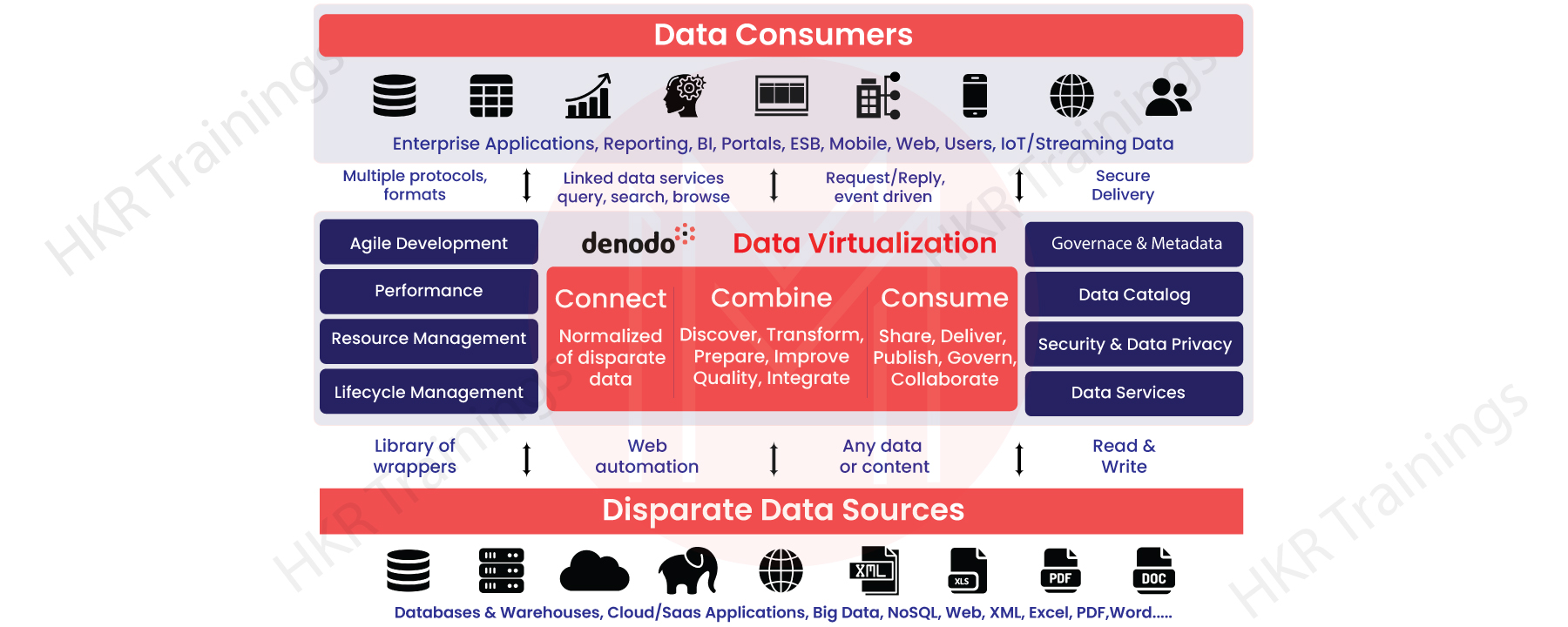
This concept includes the logical data layer that allows business users to utilize business data in various forms. It blends the enterprise data from multiple systems and manages it for central security and administration. Further, data virtualization uses an approach that includes three steps- connect, unify, and consume. It provides a complete view of the enterprise data throughout the primary systems of the enterprise. There are many benefits of using data virtualization. 

The primary concept behind the Denodo tool is to offer it more power. Also, it provides the fastest way to get all the business data without any issues quickly. 

, Business Intelligence & Analytics, denodo-tool-description-0, Business Intelligence & Analytics, denodo-tool-description-0, Business Intelligence & Analytics, denodo-tool-description-0, Business Intelligence & Analytics, denodo-tool-description-0, Business Intelligence & Analytics, denodo-tool-description-0, Business Intelligence & Analytics, denodo-tool-description-0, , Business Intelligence & Analytics, denodo-tool-description-0, Business Intelligence & Analytics, denodo-tool-description-0, Business Intelligence & Analytics, denodo-tool-description-0, Business Intelligence & Analytics, denodo-tool-description-0, Business Intelligence & Analytics, denodo-tool-description-0, , Business Intelligence & Analytics, denodo-tool-description-0, Business Intelligence & Analytics, denodo-tool-description-0, Business Intelligence & Analytics, denodo-tool-description-0, Business Intelligence & Analytics, denodo-tool-description-0, , Business Intelligence & Analytics, denodo-tool-description-0, Business Intelligence & Analytics, denodo-tool-description-0, Business Intelligence & Analytics, denodo-tool-description-0, , Business Intelligence & Analytics, denodo-tool-description-0, Business Intelligence & Analytics, denodo-tool-description-0, , Business Intelligence & Analytics, denodo-tool-description-0, Denodo Tool, Business Intelligence & Analytics, denodo-tool-description-1, Business Intelligence & Analytics, denodo-tool-description-1, Business Intelligence & Analytics, denodo-tool-description-1, Business Intelligence & Analytics, denodo-tool-description-1, Business Intelligence & Analytics, denodo-tool-description-1, Business Intelligence & Analytics, denodo-tool-description-1

Let us know in detail how the virtualization of data in Denodo works.

Connect with multiple data sources

The connect layer in the Denodo tool enables the upper layer to access the data from different storage. It protects them from the core reporting protocols and layouts. The DV links various data sources, Big Data Systems, databases, and cloud storage. 

It uses custom connectors to link specific apps and turns data source types. Therefore, all the primary views look like relational views to the upper layers.

Combine any data type

Data Virtualization (DV) in the Denodo tool unifies the related data into business views. The data can be in any format like Hadoop, NoSQL, Cloud APIs, etc. The layer uses the pre-built template library and some components to automate the web integration process interactively. This layer provides the flexibility to do so. It performs so by designing workflow, extraction, and driving, including the construction of web and other data types. 

Further, users using this layer can execute complex data changes, designing metadata, data quality, etc., through SQL and other relational tools. It supports data changes using logical operators for creating composite data views flawlessly. 

Consume data in any mode

The Consume layer under DV offers single-point access to the primary data sources, including distracted data views in an ordinary delivery form. However, data virtualization allows business users to consume data in various forms like reports, web & mobile apps, dashboards, etc. 

Moreover, the Consume layer offers various data delivery options. Such as JDBC, SOAP and RESTful Web Services, ODBC, OData, Portlets, exporting data to MS Excel or SQL, etc. 

Hence, these are the various layers and their uses under the Denodo tool’s data virtualization concept. 

Get ahead in your career with our Denodo Tutorial 

, Business Intelligence & Analytics, denodo-tool-description-0, Business Intelligence & Analytics, denodo-tool-description-0, Business Intelligence & Analytics, denodo-tool-description-0, Business Intelligence & Analytics, denodo-tool-description-0, Business Intelligence & Analytics, denodo-tool-description-0, Business Intelligence & Analytics, denodo-tool-description-0, , Business Intelligence & Analytics, denodo-tool-description-0, Business Intelligence & Analytics, denodo-tool-description-0, Business Intelligence & Analytics, denodo-tool-description-0, Business Intelligence & Analytics, denodo-tool-description-0, Business Intelligence & Analytics, denodo-tool-description-0, , Business Intelligence & Analytics, denodo-tool-description-0, Business Intelligence & Analytics, denodo-tool-description-0, Business Intelligence & Analytics, denodo-tool-description-0, Business Intelligence & Analytics, denodo-tool-description-0, , Business Intelligence & Analytics, denodo-tool-description-0, Business Intelligence & Analytics, denodo-tool-description-0, Business Intelligence & Analytics, denodo-tool-description-0, , Business Intelligence & Analytics, denodo-tool-description-0, Business Intelligence & Analytics, denodo-tool-description-0, , Business Intelligence & Analytics, denodo-tool-description-0, Denodo Tool, Business Intelligence & Analytics, denodo-tool-description-1, Business Intelligence & Analytics, denodo-tool-description-1, Business Intelligence & Analytics, denodo-tool-description-1, Business Intelligence & Analytics, denodo-tool-description-1, Business Intelligence & Analytics, denodo-tool-description-1, Business Intelligence & Analytics, denodo-tool-description-1, , Business Intelligence & Analytics, denodo-tool-description-0, Business Intelligence & Analytics, denodo-tool-description-0, Business Intelligence & Analytics, denodo-tool-description-0, Business Intelligence & Analytics, denodo-tool-description-0, Business Intelligence & Analytics, denodo-tool-description-0, , Business Intelligence & Analytics, denodo-tool-description-0, Business Intelligence & Analytics, denodo-tool-description-0, Business Intelligence & Analytics, denodo-tool-description-0, Business Intelligence & Analytics, denodo-tool-description-0, , Business Intelligence & Analytics, denodo-tool-description-0, Business Intelligence & Analytics, denodo-tool-description-0, Business Intelligence & Analytics, denodo-tool-description-0, , Business Intelligence & Analytics, denodo-tool-description-0, Business Intelligence & Analytics, denodo-tool-description-0, , Business Intelligence & Analytics, denodo-tool-description-0, Denodo Tool, Business Intelligence & Analytics, denodo-tool-description-1, Business Intelligence & Analytics, denodo-tool-description-1, Business Intelligence & Analytics, denodo-tool-description-1, Business Intelligence & Analytics, denodo-tool-description-1, Business Intelligence & Analytics, denodo-tool-description-1, , Business Intelligence & Analytics, denodo-tool-description-0, Business Intelligence & Analytics, denodo-tool-description-0, Business Intelligence & Analytics, denodo-tool-description-0, Business Intelligence & Analytics, denodo-tool-description-0, , Business Intelligence & Analytics, denodo-tool-description-0, Business Intelligence & Analytics, denodo-tool-description-0, Business Intelligence & Analytics, denodo-tool-description-0, , Business Intelligence & Analytics, denodo-tool-description-0, Business Intelligence & Analytics, denodo-tool-description-0, , Business Intelligence & Analytics, denodo-tool-description-0, Denodo Tool, Business Intelligence & Analytics, denodo-tool-description-1, Business Intelligence & Analytics, denodo-tool-description-1, Business Intelligence & Analytics, denodo-tool-description-1, Business Intelligence & Analytics, denodo-tool-description-1, , Business Intelligence & Analytics, denodo-tool-description-0, Business Intelligence & Analytics, denodo-tool-description-0, Business Intelligence & Analytics, denodo-tool-description-0, , Business Intelligence & Analytics, denodo-tool-description-0, Business Intelligence & Analytics, denodo-tool-description-0, , Business Intelligence & Analytics, denodo-tool-description-0, Denodo Tool, Business Intelligence & Analytics, denodo-tool-description-1, Business Intelligence & Analytics, denodo-tool-description-1, Business Intelligence & Analytics, denodo-tool-description-1, , Business Intelligence & Analytics, denodo-tool-description-0, Business Intelligence & Analytics, denodo-tool-description-0, , Business Intelligence & Analytics, denodo-tool-description-0, Denodo Tool, Business Intelligence & Analytics, denodo-tool-description-1, Business Intelligence & Analytics, denodo-tool-description-1, , Business Intelligence & Analytics, denodo-tool-description-0, Denodo Tool, Business Intelligence & Analytics, denodo-tool-description-1, , Business Intelligence & Analytics, denodo-tool-description-2, Business Intelligence & Analytics, denodo-tool-description-2, Business Intelligence & Analytics, denodo-tool-description-2, Business Intelligence & Analytics, denodo-tool-description-2, Business Intelligence & Analytics, denodo-tool-description-2, Business Intelligence & Analytics, denodo-tool-description-2

Subscribe to our YouTube channel to get new updates..!

Denodo Testing Tool

Denodo Testing Tool is a discrete application with a simple and easy-to-use user interface executable through the command line. It allows Denodo users to automate the testing process of their data virtualization situations. It does so at the time of development and maintenance of its virtualized solutions. Further, it acts as a safety net before making major alterations to these environments.

Here is some important information regarding the Denodo Testing Tool:-

  • You don’t need to acquire Java skills for this. The text files and folders are stated and arranged for testing.
  • It holds a test result reporting system which is Pluggable.
  • All test sets are executed with automation. We can combine the executions of these test sets with the existing CI procedures.
  • Support for test inheritance makes developing big sets of closely related tests simpler.

So, this is all about the Denodo Testing Tool and its usage. 

Denodo Platform Architecture:

The Denodo Platform that connects to numerous data sources, incorporating and publishing data in a business-friendly format to various users.

Follow these three simple steps such as:

  • Connect
  • Combine and 
  • Consume
  1. With the connect step, one can easily integrate or connect any type of data from any source.
  2. The combine phase describes data transitions and configurations that are appropriate for your business.
  3. The consume step provides real-time data services to one’s corporate data consumption platforms.

Key Features of Denodo Tool:

Here are some key features of the denodo tool. They are:

  • A completely revamped web-based user experience provides an exceptional user experience that is tailored to the specific needs of business and IT stakeholders. 
  • Intelligent and optimal query execution method utilizing a Dynamic Query Optimizer for fast information access. 
  • With the help of Summaries, Smart Query Acceleration can be used for various analysis scenarios. 
  • In-Memory Parallel Processing accelerates data access to unprecedented speeds.
  • A collection of automatically generated product lifecycle features that allow users to spend less time in finding data and much more time utilizing information to make decisions.
  • A Dynamic Denodo Data Catalog facilitates easy data access, increased collaboration, and ML-driven fully automated suggestion.
  • Cloud systematic approach that is automated, with PaaS support for cloud and hybrid contexts.
  • A advanced data services level which endorses OAuth 2.0, SAML, OpenAPI, OData 4, GraphQL, as well as other cloud standards to facilitate connectivity with existing cloud environments. 
  • Denodo can be deployed using marketplaces such as Amazon Web Services (AWS), Microsoft Azure, Google Cloud Platform (GCP), and Docker. Secure, preferential connectivity to a firm’s complete data holdings via a single interface and management key to establishing safety and leadership.

Denodo Training

Weekday / Weekend Batches

Pros and Cons of Denodo Tool:

Pros of Denodo Tool:
  • You could indeed connect directly to various environments and combine data sets.
  • The “miracle” of data virtualization is that no information is generated, so data is noted to target consumers in relatively close time.
  • For development companies, the UI is simple to use. Simply attach to a source of data, create tables, as well as join those to certain other datasets to get started.
Cons of Denodo Tool:
  • Denodo does have a tiny community of users, so there isn’t a lot of information available if you do get trapped.
  • Cost: Because data virtualization is not relatively inexpensive, smaller companies may be hesitant to use it due to high licensing fees.
  • Caching strategy: A few really slightly quicker sets of data will necessitate caching. Which begs the question, why not do conventional ETL if these are required?

Conclusion:

In the above blog post we had explained about the denodo tool in brief. Had any doubts please drop them in the comments section to get them clarified.

Related Article:

1.Denodo Certification


Source link