

Pros
- Unique concentric circle design allows for limitless patterns and color changes
- Chatbot-style prompts work surprisingly well for offering ambient light based on moods, themes and subjects
- Prompts offer multiple generated patterns to explore
- Voice and typing options available for prompts
- Music syncing and DIY mode expand potential
- Very easy to set up
- Relatively affordable at under $80
Cons
- Fragile
- Hard to say if the AI will get stuck in repeating patterns over time
- Voice assistants don’t add anything to this lamp
Lepro wants to be at the forefront of artificial intelligence in lighting — and as I noticed at recent IFA and CES events, that’s taken the Chinese company to interesting places, like this orrery-inspired table lamp.
Clearly designed to be a centerpiece of decorative lighting, Lepro’s $64 TB1 table lamp offers all the latest music syncing, color schemes, palette matching and more effects to get precisely the look you want for your room. But the most striking feature is the ability to give it LLM-style prompts to generate on-the-fly light experiences for whatever your mood is, from yoga or reading time to cyberpunk styles.
I wasn’t sure how this would work at first, but I came away from testing with a sense of fun. Lepro’s smart lamp does very well, elevating it among the masters in the field like Govee, and its “moody” features bring enjoyment by not taking too much control. Here’s what you can expect if you want it for a dorm, playroom, reading nook or any other living space.
A unique, if complex, lighting design
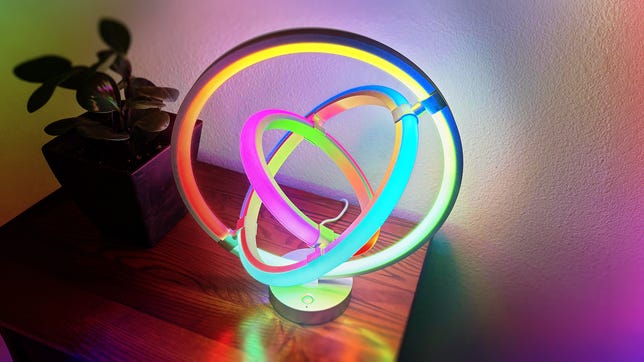
Lepro’s lamp is about a foot across and filled with potential.
Lepro’s light is lightweight and easy to set up in seconds, followed by a quick Lepro sign-in, in which you can use your Apple, Google or other primary logins to save time. That’s in contrast to how the light works, which is a little complicated.
The TB1 has three concentric, adjustable circles of LEDs, each made of sections about an inch wide that can be customized individually by color and brightness. That gives the Lepro automation a lot to play with, but whatever you use it for, the lamp is meant to play a central role and will need a bit of table space to show off.
A big part of that showing off is how the lamp incorporates AI commands that let you play with it, without doing all the LED management yourself.
A Chatbot-style LLM in charge of your lamp
Lepro can come up with so many interesting color cycles for this lamp.
The app opens with a prompt window that will look rather familiar to anyone who’s tried ChatGPT or other chatbot prompts on their phone. The default is a mic button you press like an intercom and say — well, anything that comes to mind. Lepro’s AI will give you ideas such as, “I feel relaxed,” or, “Star Wars,” but you’re free to describe any mood or activity (as well as type them in, if you prefer).
I tried everything from “set lights for lunch time” to “I’m in a reading mood,” “give me something peaceful,” “now I’m ready for a more active workout,” and many other experiments. The AI generates and implements a light pattern to match. It doesn’t always get it right, but Lepro wisely has the AI generate several different color options, some static and some moving, so I could almost always find something that worked for me.
Voice prompts for lighting are an innovative use of AI.
A peaceful mood command, for example, started with a slow pulsing of pastel colors, but I could choose from a glowing rose color or a slowly spiraling trail of light blues and greens.
When I talked about lunchtime, I found a white setting with one aqua flicker that danced around Lepro’s circles in a pleasing manner. For an active workout, the lamp flared bits of blue, yellow and red. Star Wars was more disappointing, but I did find a cycle of lightsaber colors and a motif that somehow reminded me of the Death Star.
And yes, I would be remiss if I didn’t also try “I’m feeling stressed out,” and, “I’m feeling miserable,” which offered building patterns of soft colors, or ebbs and flows of warm light, along with more static red hue options (which the algorithm seems to use as a general-purpose default).
I really appreciated that prompts provided multiple choices, not just the first one the AI chose.
While the first pick wasn’t usually my favorite, I could always see a generated pattern I liked. The only thing that comes close to this is Govee’s generative AI Lighting Bot, which has many of the same tricks, but no lamp like Lepro’s interesting design.
You can also choose to snap or download a photo for inspiration, and the AI will analyze it to produce lighting ideas from the visuals, if that works better for you.
So many shades, so little time
The ability to cycle and grow colors into blooming themes is a particularly unique option in this lamp.
The AI prompt mode is my favorite feature of Lepro’s table lamp, but it also offers a couple of additional modes.
One section of the app is devoted to music syncing, which uses your phone’s mic to pick up nearby beats and offer various dancing light patterns to accompany it. The sync works fine, especially since the lamp’s complex design lends itself to mimicking a multicolor disco ball or other fantastical displays. It’s enough to take center stage in a darkened party room, as long as no one knocks the delicate lamp over.
Music syncing for the Lepro lamp worked well enough, aided by the light’s design, which can easily serve as a mesmerizing party light.
There’s also a DIY section, which allows you to set the lights to a specific mode or switch each little LED section to a hue and brightness of your choosing. It works, but it’s an exhausting process, best left to creative endeavors where you have a firm idea and plentiful time.
Finally, there are sunrise and sunset modes, where you can program a basic white light to slowly brighten or dim to help your sleep cycles. You can set exact schedule times and final brightness levels here, but it’s a simple trick compared to what the rest of the lamp offers.
Oh, and one more smart thing: Lepro’s TB1 lamp does work with Alexa and Google Home, but those voice assistants won’t be able to do the in-depth customization of Lepro’s app.
Final thoughts on the Lepro TB1 AI Table Lamp
Prompts like an upbeat workout yield bright color options.
There’s lots of understandable concern about the low-quality content generative AI is putting out into the world. But here’s one area where AI prompts offer plenty of fun with few downsides and no risk of taking jobs.
I would have been annoyed if Lepro’s lamp had made all its lighting decisions for me, but by offering several suggestions, I could find something I liked without spending much time thinking about it. The AI may eventually run out of ideas, but not for any of the moods I tested.
With no subscription and a price well below options like Ikea’s $100 smart lamp, Lepro’s TB1 is competitively priced, too. The complex design is unique and lends itself well to the more complex schemes its generative AI came up with — although you will need to be careful in party mode, since the lamp is fragile.
It’s good to see Govee get some competition, plus another home AI that’s more useful than not, without significant privacy risks. With back-to-school on the horizon, Lepro’s table lamp could also make a great dorm gift.

Stephan is the sports journalist for the Maple Grove Report.