If You Buy a New Router, It Might ‘Turn Into a Pumpkin’ Next Year


Key takeaways:

  • The Federal Communications Commission has banned the sale of new foreign-made routers in the US. The sweeping order applies to virtually every Wi-Fi router currently available in the US market.
  • After speaking with four cybersecurity experts, my advice is to hold off on buying a new router if you can. 
  • Under the current rules, banned routers will no longer receive essential security firmware and software updates after March 1, 2027. 
  • The FCC’s action has effectively frozen the entire market while router companies scramble to gain approval. 
  • More specific information on which router companies will be subject to the ban is expected to become clearer within the next month or two. 

In my eight years of writing and reviewing broadband and routers, I’ve rarely seen news that I would describe as unprecedented. The FCC’s recent decision to ban foreign-made routers is absolutely unprecedented.

The sweeping order applies to any router in which any stage of “manufacturing, assembly, design and development” occurs outside the US — in other words, just about any router you can buy right now. The FCC order says that foreign-made routers pose “unacceptable risks” to national security. The ironic side effect is: It could stop your current router from receiving vital security updates.

The ban doesn’t apply to routers that were already authorized by the FCC — that is, every router that’s currently for sale in the US — and will only impact new models that haven’t been approved yet. That means every router that was available before the order is still available today, and router companies can still restock them using their existing manufacturing processes. 

Essentially, the FCC is freezing the entire router market. As William Budington, a technologist for the digital rights nonprofit Electronic Frontier Foundation, put it to me, “This is using an extremely blunt instrument.”

Where previous FCC bans have been limited to specific companies, such as last year’s push to ban TP-Link routers, this one affects an entire industry. So where does that leave someone who needs a new Wi-Fi router? Should you buy a model you’ve had your eye on in case it sells out? Or is it better to wait and see which companies the FCC considers foreign-made?

I know what I would do, but I gut-checked my advice with four cybersecurity experts. Turns out, we agree. 

My advice: Hold off on buying a new router for now

When I first saw the FCC’s announcement, I couldn’t stop thinking about how much chaos this would introduce to the US router market. As I tried to tease out which manufacturers would count as “foreign-made,” it quickly became clear how deeply international the supply chains for routers are. 

Understanding the scope of the ban

Take Netgear. While it’s a US-founded and headquartered company, it manufactures routers in Vietnam, Thailand, Indonesia and Taiwan. With the exception of Starlink — the company says its newer routers are made entirely in Texas, according to the BBC — I couldn’t find a single router brand that’s homegrown. 

I don’t have any issues recommending routers that were manufactured abroad. After all, they’d already gone through the FCC’s authorization process, and I haven’t seen convincing evidence that any one router brand has more hardware vulnerabilities than another. 

Thomas Pace, CEO of cybersecurity firm NetRise, told me last year during an interview about the potential TP-Link ban: “We’ve analyzed an astonishing amount of TP-Link firmware. We find stuff, but we find stuff in everything.”

I just finished testing, reviewing and rating over 30 routers, and after years of resistance, I finally concluded that Wi-Fi 7 routers are worth the money for the speeds you get. While I stand by my recommendations, with this ban in place, the router you buy today may not be any good in a year. 

The future-looking security risk

Then I saw the FCC’s Public Notice on the ban, which specifies that manufacturers can continue providing software and firmware updates “at least until March 1, 2027.” That means if you own a foreign-made router — if you own any router, in other words — it won’t be able to get security patches after that deadline. 

That’s why I think the wise move here is to wait on buying one if you can. Keeping your router’s firmware up-to-date is an essential part of securing your home network. If you buy from a router company that doesn’t get an exemption from this ban, you risk having an unsecured device a year from now. 

It’s an ironic side effect of an order that is ostensibly designed to keep Americans safer: They may no longer be able to get the latest security fixes.  

“If you’re limiting the ability of people to get security updates, then you’re making the problem worse, not better,” Alan Butler, senior counsel at the Electronic Privacy Information Center, told me. “A lot of those routers are going to turn into pumpkins in a year unless they extend this waiver.”

By saying you can update your firmware “at least until March 1, 2027,” the FCC does leave some wiggle room for an extension. But until we know more about which companies the FCC considers foreign-made and which will be exempt, I wouldn’t feel comfortable recommending spending money on a new router right now. 

Advice for immediate router needs  

If your old router stopped working, I’m not going to tell you to wait for clarity from the FCC to get back on Wi-Fi — the timeline for concern is more in years than months. A good compromise might be to buy an older budget router rather than the latest Wi-Fi 7 model you’ve had your eye on. But if you can afford to wait a month or two, it’s worth exercising some caution. 

“I do think this is going to become a mess very quickly,” Butler said.

This is the messiest point in the process we’re likely to see. As the dust settles in the coming weeks, we’ll likely have better information on which routers will still be safe to use a year from now. 

black-wifi-router

TP-Link is one of the most popular router brands in the US, and the subject of several 2025 government investigations.

Gianmarco Chumbe/CNET

Expert opinion: Is your current router still safe to use?

When I polled four cybersecurity experts, I was surprised to find that they were generally in favor of the FCC taking action to protect router security in theory, but critical of the execution. 

“It’s going to impact many harmless products in order to stem a real problem,” Budington said.  “It’s also not particularly well-targeted, since routers are only one part of the problem, along with IoT devices.”

The concern for national security risk 

The FCC says that routers produced abroad were “directly implicated” in the Volt, Flax and Salt Typhoon cyberattacks. These attacks aren’t necessarily targeting an average person’s data, but they can turn your router into a tool to be used in malicious attacks. 

“The individual user who owns the router probably doesn’t even know anything about it,” Butler said. “It’s happening in the background without their knowledge, and it’s not necessarily affecting them directly in any way that they can notice.” 

In the Salt Typhoon attack, hackers gained access to data from millions of people through their internet providers, aiming to gain access to information from court-authorized wiretaps. It was a particularly bold instance of a tried-and-true hacker approach called “spray and pray”: Find default login credentials and try them on as many connected devices as you can. 

“It can be only one router out of 5,000, but that one can be a bingo,” Sergey Shykevich, a threat intelligence manager at Check Point Research, told me about these types of attacks. “It’s mostly just easy. In many cases, you don’t have to be a very sophisticated actor, or even nation-state, in order to be successful.”

How you can secure your router right now 

It’s just as easy for hackers to gain access through a router’s default credentials as it is for you to change your own settings. Most routers have an app that lets you update your login credentials from there, but you can also type your router’s IP address into a URL. These are different from your Wi-Fi name and password, which should also be changed every six months or so. It’s also a good idea to keep your firmware updated, which you can do automatically in your router’s settings or by manually downloading updates in your router’s app or web portal.

When will we know more?

I wish I could point to another time when the FCC ordered a blanket ban on an entire category of consumer products, but nothing like this has happened before. Manufacturers can apply for “Conditional Approval,” and they are likely scrambling behind the scenes to make the cut. When I reached out to the FCC for more clarity on the order, I was referred to the commission’s “Covered List” FAQ page.

My best guess is that we’ll learn more specifics on which companies are banned in the next month or so — an estimate that was echoed by two industry observers I spoke with. But the wait could be even longer. Budington told me he thinks router companies might wait until the ban is lifted rather than hustle to try to move their entire supply chains to the US. 

No matter how it shakes out, we’ll likely look back on this as the most chaotic chapter of the router ban story. Unless you need a new router immediately, there’s a good chance you’ll be able to make a more informed decision a month from now. 


Source link

Leave a Reply

Subscribe to Our Newsletter

Get our latest articles delivered straight to your inbox. No spam, we promise.

Recent Reviews


Power Bi Dashboard – Table of Content

What is Power BI?

Power BI is a Business Intelligence and Data Visualization tool that transforms information from diverse sources into visualisations and BI reports. Power BI suite includes a variety of software, connectors, and services, including Power BI desktop, SaaS-based Power BI service, and mobile Power BI apps for various platforms. Business users use this set of services to consume data and create BI reports. Power BI Desktop is used to create reports, Power BI Services (Software as a Service – SaaS) is used to publish reports, and Power BI mobile app is being used to view dashboards and reports. Power BI Desktop is available in 32-bit and 64-bit configurations.

Become a Power BI Certified professional by learning this HKR Power BI Training !

What is a Power BI Dashboard?

A Power BI dashboard is a single-page visualisation that uses multiple charts and graphs to tell a storey. This one-page dashboard visualisation is also known as a Canvas. The Power BI dashboard is accessible only in Power BI Service. Because a Power BI dashboard is only one page long, it only encompasses the features of a storey. Power BI Desktop does not support the creation of dashboards. A Power BI dashboard is a single sheet, also known as a canvas, that uses visualisations to tell a storey. A well-designed dashboard includes only the features of that storey since it is restricted to one page. Readers can get more information by viewing related reports.

Power BI Dashboards

Power BI Dashboard on Power BI Service

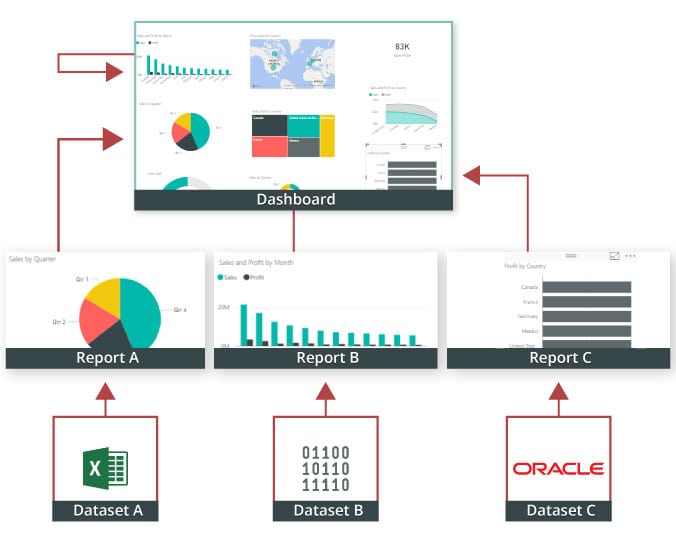
In a dashboard, representations are produced from reports, and each report depends on one dataset. The representations present on the dashboard are called tiles, and report creators pin these tiles to the dashboard.

Dashboard

Advantages of a Power BI dashboard : 

Dashboards are a magnificent method for observing your business and seeing each of your most significant measurements initially. The perceptions on a dashboard can emerge out of one basic dataset or many, and from one basic report or many. A dashboard joins on-premises and cloud information, giving a united view paying little heed to where the information resides.

• A Power BI dashboard empowers clients to examine reports and view exceptionally significant measurements initially

• Utilizing a Power BI dashboard, clients can make perceptions from numerous datasets or various reports

• You can alter dashboards to meet the necessities of any venture

• Power BI dashboards can be inserted into applications to give a brought together client experience

• You can immediately impart a dashboard to different partners in your association

How to Create a Dashboard in Power BI?
Building reports in the dashboard provides details regarding Power BI Desktop and distributing them to Power BI Service is probably the most ideal way to see how a Power BI dashboard functions.
For our demo, we’ll be taking a gander at a deals dataset that contains item deals data all through the United States. The dataset contains different client related subtleties, including client names, request and shipment dates, item names, item classes and subcategories, benefit made, etc. This dataset is normally known as a Sample Superstore dataset. We’ll investigate this dataset to analyze deals and benefit from each section, year, and quarter.
We’ll likewise make a guide to show the deals across various states in the USA.
Coming up next is the dataset that we’ll use to make the dashboard:

Fig: Sales Data

sales-data

To begin, we will make three different vouchers to evaluate total sales, profit, and amount of sales. Click “card” in the visualisation committee on the power to make a vacant card.

Drag the sales column onto the fields to see the total amount of sales for all products. The user  can change the font size and colour of the sales value on this card. The user  can also give this card a headline. Correspondingly, by having to drag corresponding columns onto disciplines, you can generate 2 more cards for net income and total amount of sales.

Then, in our visualisation, we’ll add a slicer to slice the data based on the “Order Date” column. This will allow us to screen the data as well as visualise it as needed.

Fig: Cards and Slicers

sales-dashboard

Assume you are hoping to picture and investigate deals and benefit over a specific number of years. To do this, you’ll make a line and stacked segment diagram. Select the line and stacked segment graph from the representation board and drag the “Request Date” section on to “Shared Axis.” Put “Deals” under “Segment” values, and addition the “Benefit” segment into “Line” values. That will create the chart. You can alter the shade of the bars and the line under the organization tab.

cards-slicers

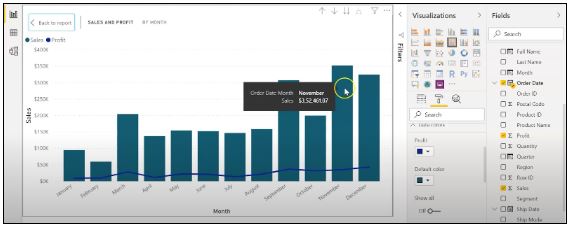
In the outline over, the bars address the deals, and the line addresses the benefit. The chart uncovers that the most noteworthy measure of deals and benefits happened in 2017. Power BI Desktop gives an amazing component to dive into the information and picture the chart as far as each quarter, month, and day. This choice is accessible at the top when you explore a particular outline.

sales profit by month

Fig: Sales and profit by each month

You can likewise add the names to the diagram by tapping the “Organization” tab and turning on the information marks.

adding-labels

Fig: Adding labels to the graph

Presently, we should make a bunched segment diagram by dissecting yearly and quarterly deals.

From the Visualizations menu, select the “Grouped Column Chart.” Add the “Year” segment to the pivot. Take the “Quarter” sections under “Legend,” and add the “Business” segments to “Worth.”

clustered-bar-chart

Fig: The clustered bar chart

The diagram above shows that the principal quarter of each year had the most minimal marketing projections, while the final quarter was reliably the most elevated. You additionally have the choice to change the shadings on your diagram to make it all the more outwardly engaging.

Presently, how about we examine the deals for each state in the US. To do this, we’ll utilize a filled guide. Select a filled guide from the representations board. Add the “State” section to “Area.” Drag the “Deals” segment onto “Tooltips.” To alter the shadings, click on the “Configuration” tab, and pick “Information Colors.” Select the contingent arranging choice and add the scope of tones that you’d like.

formatting-colors

Fig: Formatting colors based on the sales

Our colour has been described for the smallest, medium, and greatest sales values. The green-colored states had the smallest sales. California, Texas, and New York, which are highlighted in orange or red, had the highest sales. Correspondingly, you can create a map to see the profit and number of units sold in each nation.

sales-state

Fig: Sales by each State

So far, our report appears to be as follows. We’ve covered how to make cards, slicers, line and stacked column charts, clustered bar charts, and packed maps.

sales-report

Fig: Sales report

Following that, we’ll take a glance at how to make a donut chart to evaluate revenue and profit by section.

Select the pie chart from the visualizations menu. Add the section column to the legend. Drag the “Sales” column to the “Values” column and the “Profit” column to the “Tooltips” column.

donut-chart

Fig: Donut chart for Sales and Profit

According to the pie chart given above, the customer group had the most revenue and profit, while the head office segment had the least. To make the visualisation more visually appealing, you can format it as needed.

We will now create a pie chart to visualize the sales for each product category. Move the “Category” column to the “Legend” column and add the “Profit” column to the “Values” column. Drag the “Sales” column to the “Tooltips” section.

pie-chart

Fig: Pie Chart for Profit and Sales

The new tech classification produced the most sales and profit, while furniture generated the least. To change the colours and make any necessary changes, go to the “format” tab.

The following is an example of the the last total sales report:

overall-sales-report

Fig: Overall Sales Report

Allow us now to picture our information at a more granular level by examining deals, benefit, and units sold at territorial and state levels.

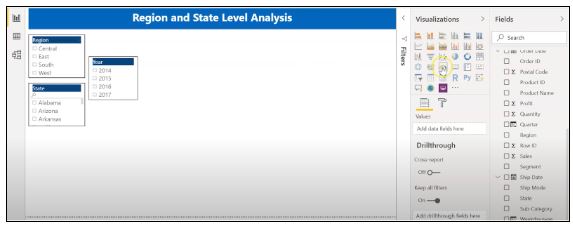
In the first place, we’ll make three slicers to channel our information. Click on the slicer from the representations board and add the “Area” segment on to “Field” to make a local slicer. Additionally, you can make a state and year slicer. You likewise have the choice to alter the slicers to change the text dimension, increment the size of the text, and add a foundation tone.

slicers-filter-data

Fig: Slicers to filter data

We’ll presently make a table to check the sum and the advantage made in each city. Under the “Insights” tab, select “Table”. Add the “City” fragment under “Values,” followed by sum and the “Advantage” area. Add an establishment tone to the fragment headers and addition the size of the printed style. You can channel the data by picking the things from all of the slicers.

Under, we have picked the central region and picked the region of Minnesota. In the table, you can see all of the metropolitan regions in the area of Minnesota, the sum sold, and the advantage they made.

creating-a-table

Fig: Creating a Table in Power BI 

Orchestrating a table is another limit that Power BI Desktop maintains. This gives clients the decision to sort the segment in a table in their solicitation for tendency.

By and by, could we create a clustered reference diagram to separate the arrangements for each thing class across different states? Select the gathered bar layout from the discernments board. Take the “State” area on the center point, “Characterization “portions on to the legend, and “Arrangements” on to “Worth.”

cluster-bar-2

Fig: Clustered Bar Chart

Among the three classes of things, the region of California made the most critical arrangements for all orders.

Then, at that point, we should check the yearly advantage by grouping using an area diagram. Select the area chart from discernments and drag the “Year” segment on to the turn, the “Class” fragment on to the legend, and “Advantage” on to “Values.”

area-chart

Fig: Area chart using Power BI

You can separate the advantage and sum that each thing class and subcategory sold. You can moreover make a line. Clients can research their various decisions through the dashboard.

region-state-report

Fig: Region and State Level Report

To go comprehensively and make a more granular level report, you can do that by making a report considering the things’ orders and subcategories, as shown in the report underneath. You can use class and subcategory as your slicers and make different line traces, bubble outlines, treemaps, and pie charts to imagine the data.

category-level-report

Fig: Category and subcategory Level Report

We’ll as of now disperse our overall business diagram on Power BI Service and make a dashboard. Save your reports on Power BI Desktop. Then, click on the home menu and select the “Convey” tab.

sales%20and%20profit

Fig: Publishing report on to Power BI Service

You can in like manner make another workspace or disperse the report to a current workspace in Power BI Service.

publishing-powerbi

Fig; Publishing to Power BI successfully.

Power BI Training

  • Master Your Craft
  • Lifetime LMS & Faculty Access
  • 24/7 online expert support
  • Real-world & Project Based Learning

Reports in Power BI :

A Power BI report is a multi-perspective look at a dataset, with visual effects representing various information and results from that set of data. A report may contain a single visual or possibly multiple pages of visual elements. Based on your work, you may be in charge of creating reports.

Power BI reports v Dashboards : 

Pages- Dashboards are not permitted to span more than one page; all essential reports are displayed on a single page.

Data sources- Dashboards are founded on the basis of multiple data tables that are linked to one another in one or more contexts. Reports are typically generated from a solitary table of data with no relationships to other tables.

Available in Power BI Desktop- Both the features are available in Power BI desktop

Pinning- Dashboards are fastened to the page so that the viewer can simply read through the data. Reports are built with various filters and shredders to allow the user to communicate with the set of data.

Subscribe- Reports can be published on the web and subscribed to via email. Dashboards have the same features as reports, but they can only be exported to a limited number of formats, so they are used to visualise important data rather than analyse it, which is only possible with reports.

Filtering- Power BI dashboards don’t at present have filter channels though reports are made with any sort of channels and slicers so the client can cooperate with the informational index. Dashboards are stuck to the page even the report proprietor.

Set alerts- With a dashboard, you can set up alarms for when a tile arrives at a specific limit. Thusly, you will not need to continue to return on the dashboard to check whether the tile has arrived at that limit. Sadly, it is absolutely impossible to set up a caution for a report. Thus, you should continue to inquire on the report to check whether the measurements you are following have arrived at a specific limit.

Modify/change visualization type- Dashboards contain an assortment of outlines and tables on a scope of related points though reports contain diagrams and tables on a solitary theme. Accordingly, dashboards regularly offer an undeniable level outline of a subject, and reports will generally be more granular and smaller in center.

Click here to learn Power BI Tutorial

HKR Trainings Logo

Subscribe to our YouTube channel to get new updates..!

Features of Power BI : 

Range of Attractive Visualizations :

Visualizations, or the visual representation of data, are important in Power BI. It provides a wide variety of detailed and appealing visualisations.

Get Data Feature :

The Get Data feature in Power BI permits the users to choose from a variety of data sources. The data sources can range from on-premise to cloud-based, unstructured to structured. Every month, new data sources are added.

Datasets Filtration :

A dataset is a single set of data created by combining data from multiple sources. You can use the datasets to create various types of visualisations.

Customizable Dashboards :

Dashboards are a grouping of visualisations that provide useful information or insights into data. Power BI dashboards are typically made up of multiple visualisations as tiles.

Flexible Tiles :

In a Power BI dashboard, a tile is a single block that contains a visualisation. Tiles properly separate each informative visualisation to provide a clearer view.

Click here to get latest Power BI Interview Questions and Answers

Power BI Training

Weekday / Weekend Batches

Conclusion :

Power BI dashboard is a wonderful storytelling tool that can be really helpful to develop actionable business insights. In addition to this, we have also illustrated the differences between the Power BI dashboard and the reports. If you have any questions let us know in the comments section.

Related Article :


Source link