In a thunderous launch, Artemis II astronauts leave Earth. Here’s what’s next


The Artemis II crew — which includes NASA astronauts Reid Wiseman (left), Victor Glover, Christina Koch, and Canadian Space Agency astronaut Jeremy Hansen — is on their way to the moon. Here's what to expect over their roughly 10-day mission.
Bill Ingalls | NASA

For the first time in more than 50 years, astronauts are heading to the moon. The Artemis II crew launched Wednesday atop NASA's SLS rocket, which left thick trails of vapor across a clear-blue Florida sky. The four astronauts and their team on the ground are now busy preparing for the challenges that lie ahead.

NASA astronauts Reid Wiseman, Victor Glover and Christina Koch, along with Canadian Space Agency astronaut Jeremy Hansen, launched from Kennedy Space Center in Florida, ensconced in an Orion capsule attached to an SLS rocket. The historic mission — the first time in more than half a century that humans have visited the moon — will take them on a 230,000-mile journey around the lunar body and back that will serve as a critical test flight of the Orion spacecraft.

The nearly 10-day mission will not only test the spacecraft's life-support systems and maneuverability, but conduct critical science ahead of future deep space missions to the lunar surface.

The trajectory

The mission is on a flight path that keeps the spacecraft in Earth's gravitational influence past the moon, then falls back to the planet for splashdown. This path, called a free return trajectory, uses less fuel and is less risky than entering a lunar orbit.

About a day after launch, the spacecraft is set to perform a translunar injection, firing its engine and sending the Artemis II crew on their lunar journey.

The path will take the crew to within about 5,000 miles above the lunar surface. Apollo missions typically orbited the moon under 100 miles (or touched down on the surface).

"When they pass by the far side of the moon, it'll look like a basketball held at arm's length," said Artemis II mission scientist Barbara Cohen. "It'll be that kind of view."

Testing, testing

After separating from the rocket that got them into space, but before heading to the moon, the crew tested the Orion spacecraft closer to home.

Just hours after entering high-Earth orbit, the crew performed what's known as a proximity operations test — taking manual control of the vehicle to see how it handles in space.

"We are essentially going to make sure that the vehicle flies the way that we think it does, that we designed it to do," Artemis II pilot Victor Glover said ahead of the launch.

Controlling the spacecraft will be important for future missions, which will need to dock with a lunar lander in orbit. And while this process is likely going to be automated, NASA wants to know how it handles should astronauts have to take manual control.

"We also want to give qualitative and quantitative feedback to the ground team, so letting them know what it feels like now that we can hear and feel the thrusters, and to just understand the human experience," said Glover.

Near the end of the maneuver, the pilot appeared to give the vehicle high marks.

"Overall guys, this flies very nicely," he told team members on the ground.

Time for science

The astronauts themselves will be the subject of science experiments: Because the crew is going farther into deep space than any human has gone before, researchers are taking this opportunity to study the impact it will have on the human body.

Medical researchers will be collecting data on physiological changes in response to space travel and increased radiation exposure. The astronauts' cells have been placed on tiny chips and distributed throughout the capsule — in an effort to understand these effects in greater detail.

The crew will also lend their eyes for geological research, since they are flying around the far side of the moon, where no human has ventured before.

"They'll be able to see places on the moon that, actually, no human eyes have ever seen before," said Cohen.

Geologists on Earth trained the crew to spot unique features on the lunar surface, and snap photos of them for further study. (This follows in a time-honored tradition: Apollo astronauts who visited the moon more than a half century ago were also trained by geologists.) These observations will help them better understand that side of the moon, and possibly help plan for a human landing.

And the mission's high-altitude flyby of the moon gives them a unique perspective.

"The benefit of that to science, is that kind of like when you're traveling cross country on an airplane, what you can see is a strip of land below you. You don't see the whole globe of the Earth. That's what the Apollo astronauts did," said Cohen. "The Artemis II astronauts will be able to see it from much farther away."

The mission is also carrying stowaways in the form of CubeSats — tiny satellites bound for high-Earth orbit. The payloads are from Germany, South Korea, Saudi Arabia, and Argentina, and will study various impacts of space radiation on space hardware, monitor space weather, and how the environment affects electrical hardware bound for the moon.

Heading home

As the crew makes their return home, their capsule will be traveling close to 25,000 miles per hour as it re-enters the atmosphere. The friction generated by hitting the atmosphere at that speed will cause the Orion capsule to experience temperatures of close to 3,000 degrees Fahrenheit.

The capsule is equipped with a heat shield to protect the astronauts from the intense heat of reentry. During an uncrewed test flight in 2022, NASA discovered unexpected damage to the heat shield. To further protect the crew, the capsule will hit the atmosphere at a much steeper angle than Artemis I, which will limit the time it will experience those harsh conditions.

Once the spacecraft is past that danger zone, eight parachutes will slow the spacecraft down even more before splashing down in the Pacific Ocean off the coast of California. A series of airbags will deploy to make sure the capsule is right side up. A crew at sea will scoop up the astronauts, bringing their mission to a close.

What's learned on this flight is critical to future Artemis missions. Last week, NASA administrator Jared Isaacman announced plans to increase the frequency of launches to the moon, and a plan to establish a permanent base on the lunar surface. That effort begins with Artemis II.

"It is our strong hope," said Artemis II mission specialist Christina Koch, "that this mission is the start of an era where everyone, every person on Earth, can look at the moon and think of it as also a destination."

Copyright 2026, NPR


Source link

Leave a Reply

Subscribe to Our Newsletter

Get our latest articles delivered straight to your inbox. No spam, we promise.

Recent Reviews


Lost a crucial document because your system crashed before you could save it? Worry no more! Microsoft Word has introduced an automatic save option that regularly backs up your work, so you’ll never lose your progress again.

Users will now be able to manage their Word documents without thinking about saving them manually. The new Microsoft Word update allows users to automatically save their documents to the cloud as soon as they start documenting any content piece.

Raul Munoz, the Senior Product Manager at Microsoft, has stated about the new feature, “We are modernizing the way files are created and stored in Word for Windows! Now you don’t have to worry about saving your documents: Anything new you create will be saved automatically to OneDrive or your preferred cloud destination.

Microsoft additionally hints at introducing similar features for Windows Excel and PowerPoint, which are now live.

How Does the Auto-save Feature Work?

The auto-save option can be accessed and used effectively with the compatible Word for Windows version. Let’s understand how the process works-

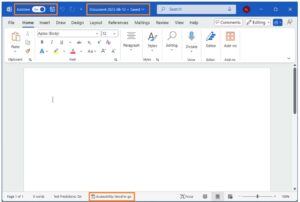
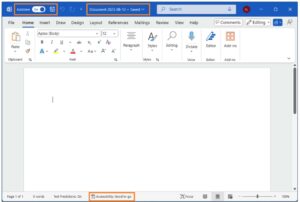
Primarily, users need to create a fresh document in Word and switch the AutoSave option on. Unlike the previous default document name- DocumentN, the autosave feature saves the files with the date.

Microsoft Word Update - Step 1

Source: Microsoft Tech Community

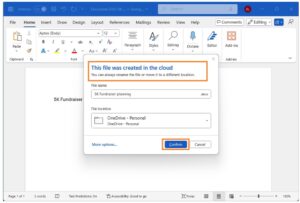
To change the name of the file and its location, users need to select Save or press Ctrl+S. After selecting the file name and location, press Confirm to save the changes.

Microsoft Word Update - Step 2

Source: Microsoft Tech Community

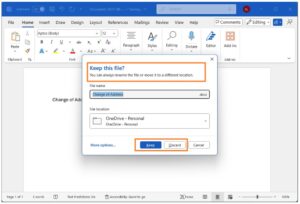
In case users try to close the file before it gets saved, a dialog displays on the screen asking whether they intend to Discard or Keep the file. If users try to close empty files, Word discards them without asking for confirmation.

Microsoft Word Update - Step 3

Source: Microsoft Tech Community

Availability of the Auto-Save Feature of Microsoft Word Update-

The AutoSave feature of Microsoft Word update is available to users with Version 2509 (Build 19221.20000) or newer. This advancement is set to enhance accessibility and address the challenge of lost files. Similar features have been introduced on Windows Excel and PowerPoint as well.

Advantages of the Latest Microsoft Word Update

Microsoft Word’s new auto-save feature will unlock several benefits for users. Alongside increased security, it offers flexible file management capabilities. Let us discuss other significant advantages-

Flexibility in File Storage and Control: Users can store and manage their files more flexibly than ever. As users are in charge of the documents, they can adjust file names and locations to save, organizing the files according to convenience.

Never Lose Your Files: The auto-save feature in Microsoft Word addresses the challenge of losing files due to not saving them manually. As soon as you start making progress in a file, it automatically gets saved.

Enhanced Security and Compliance: Files saved in your organization’s cloud servers already adhere to the set security guidelines and practices. Hence, users do not need to think about protecting the files separately.

Increased Accessibility: The auto-save feature enables enhanced accessibility of Word files. It can be accessed from diverse types of devices and platforms once shared, including Android, iOS, and web browsers. Changes made to the file will get synced on all devices and platforms.

Better Collaboration: The AutoSave feature has made collaboration within and across teams easier. Users can easily share the cloud file and initiate collaboration by making changes, adding comments, and resolving comments in real time.

Agentic AI Support: The Word files are now equipped with Copilot agentic AI support. Users can unlock AI-powered capabilities whenever they need to improve or update their documents. Nevertheless, to use Copilot in Word, a Microsoft 365 Copilot license is needed.

Additional Tips: 

  • Users will be able to easily change the location for new documents. Right-click on any cloud folder in the File section of Word, then select Set as Default Location to choose the location.
  • Users can manage how their files are created, whether in the traditional manner or automatically in the cloud, in the Save tab of Word Options, and opt in or opt out for Create new files in the cloud automatically.

Key Elements to Keep in Mind-

  • When a new Word session is started while another is running, the new file does not autosave. Hence, users need to close the previous file to enable the auto-save option for new files.
  • Users may sometimes encounter a delay in refreshing the recent files list while changing the name of a document.
  • If users disable the option for Show the Start screen when this application starts, remember that the first file they create will not autosave automatically.

Concluding Remarks!

Microsoft has been making significant advancements in its 365 Office platforms for better collaboration and enhanced productivity of diverse teams within an organization. With the integration of Copilot and flexible features, the firm is aiming to boost user experience and accessibility of the tools, including Word for Windows.

Learn about the major technological shifts and practices with KnowledgeNile!


FAQs:

1. What is the AutoSave feature in Microsoft Word?

Answer: The AutoSave feature in Microsoft Word lets users save their files automatically.

2. What is the purpose of AutoSave?

Answer: The AutoSave feature aims to reduce the challenges of data loss in unwanted circumstances, such as power shortages and device failures.

3. Where are AutoSave Word documents stored?

Answer: Automatically saved Word files are stored in cloud storage, like OneDrive.


Recommended For You:

Oracle identity cloud vs Microsoft Active Directory: Which to opt for and why?


Source link