Lean vs Agile | A Major Differences Between Lean and Agile


What is Lean?

Lean Management is a governance and task organization strategy based on Toyota’s production process that aims to improve a firm’s productivity, particularly the quality and value of its output. 

Lean Management improves processes by minimizing time consumed on value-less tasks (unneeded activities or transportation, waiting, overproduction, and so on), as well as quality issues and complexities. The two major goals of lean management are Maximum satisfaction of customers and Employee success. 

What is Lean Methodology?

Lean methodology is a corporate strategy that emphasizes continuous improvements and appreciation of people in order to increase the stream of value to consumers. The lean methodology paradigm is guided by these two basic notions in the following way:

  • Continuous Improvements: Leaders who use the lean model, think that there is always room for improvement. They might use software to monitor their company’s continuous improvement by planning, measuring, and documenting the lean initiatives and operations. These leaders frequently design their processes using an integrated reform cycle like DMAIC (Define, Measure, Analyze, Improve, and Control), PDSA (Plan, Do, Study, & Act), etc.
  • Appreciating People: According to corporations that use lean philosophy, individuals who are responsible for making the goods or services frequently have the best ideas. They cherish the opinions of their staff equally to the opinions of their consumers. Lean firms can more effectively find opportunities for improvement by enabling employees to contribute their observations and suggestions. 

As industry, technologies, and consumer demands change, the lean methodology evolves, but at its heart, it continues to foster sensible decisions, better access to knowledge, and a heavy focus on giving value to customers.

Agile Online Training

  • Master Your Craft
  • Lifetime LMS & Faculty Access
  • 24/7 online expert support
  • Real-world & Project Based Learning

What is Agile?

Agile is a cyclical technique used for project management & software design processes that enable teams to deliver value to clients efficiently with minimal hassles. A corporation that is agile adapts rapidly to changing markets as well as workplace conditions.  Such businesses recognize that change is unavoidable, so they assess their systems and practices on a regular basis to ensure that they have been favorable to optimal work engagement, satisfaction, and productivity.

  Become a Agile Certified professional by learning this HKR Agile Training !

What is Agile methodology?

The Agile methodology is a style of project management that divides a project into segments. It necessitates ongoing engagement with stakeholders as well as continual development at each stage. Teams revolve through a sequence of planning, implementing, and assessing once the job begins. Collaboration is essential among team members as well as project stakeholders.

In recent times, the usage of Agile as a project management methodology has skyrocketed. Agile development approaches will soon be adopted in 85% of any and all software creation projects, according to Gartner. It has evolved into a blanket term encompassing a number of planning, administration, and technological approaches and processes for iteratively managing projects, software development, and additional products and services. Some such examples are Scrum, by far, the most common and popular software development approach, Kanban, and XP (eXtreme Programming or Paired Programming).

Technical approaches that facilitate Automated Tests, Continuous Integration/ Seamless Delivery/ Distribution (CI/ CD), and an ever-shortening release cycle for software as well as other goods, are also included in Agile methodology. Most of these activities belong under the blanket term  – DevOps.

Similarities between Lean and Agile

Although different concepts, several similarities exist between the two methodologies, some of which are:

  • According to the Lean methodology, each activity should be examined and improved on a regular basis. As a result, this strategy places a strong emphasis on continual improvement or Kaizen. Regular inspections of the outcomes and the work design are also part of the Agile approach, which allows for the evaluation of potential improvements.
  • Both methodologies place higher importance on the people responsible for the project execution than the tools that are used.
  • Lean as well as Agile, strive to provide more value to customers by proactively responding to client feedback or paying attention to excellence. 

Project Management & Methodologies, lean-vs-agile-description-0, Project Management & Methodologies, lean-vs-agile-description-1

Subscribe to our YouTube channel to get new updates..!

Differences between Lean and Agile

Let us now look at how these two concepts differ.

1. Methodology

Persistent improvement and customer satisfaction are prioritized in agile development. The Agile method uses a cyclical development process and active client involvement from beginning to end by the Agile team. The Agile method uses a cyclical development process and active client involvement from beginning to end by the Agile team.

The goal of the Lean Methodology is to reduce risk and eliminate waste. The production time reduces and increases efficiency when you eliminate everything that isn’t helping the project achieve its final aim.

2. Area of Focus

The scope of the project and the utility to the client are at the heart of agile projects. You prioritize the value proposition at the conclusion of each sprint and make improvements in the next cycle.

Lean methodology, however, is mostly about increasing process efficacy and quality. The importance of process development and quality is highlighted, with a strong emphasis on the absence of faults.

3. Structure of Teams

A team following the Agile methodology consists of a group with limited members who, generally, are:

  • Self-organized: Teams decide on their own how to complete the assignment. 
  • Interdisciplinary: Team members have a variety of tasks and talents, but they all work toward the same goal. 

In Lean methodology, on the other hand, several Lean teams are created, which are made up of employees from various essential areas. A ‘Team Leader’ oversees the group and solo initiatives in each group. The  Lean team participants should be competent, but they don’t require to be self-organized or interdisciplinary all of the time.

4. User-friendliness

When the needs change frequently, the Agile methodology provides better flexibility and hence may prove to be more efficient to use.

In the midst of continuous change in requirements, Lean methodology is relatively rigid and may present complexities.

5. Timeline of Projects

To accomplish tasks more rapidly, agile teams operate in short development cycles. Loops and sprints are usually 2-4 weeks long.

By optimizing process flow, lean teams can minimize the duration of the project timetable. They usually limit their labor in procedures, which reduces the project’s overall time frame. There is no predetermined timeline, unlike Agile.

6. Approach

An Agile environment enables the construction of a project in brief iterative and cumulative cycles, known as sprints. It’s a strategy of dividing any project, down into segments, each of which includes planning, execution, testing, and assessment. This is accomplished by going a single step at a time till the goal is met.

By making small, continual adjustments all through the production process, the Lean approach strives to enhance efficiency. This can result in quicker development cycles, although it is not Lean’s main objective.

Top 30 frequently asked Agile Interview Questions !

Advantages of Lean

Here are some of the key benefits that you can avail by following the Lean Methodology:

  • Reduced waste: Lean methodology aids businesses in determining better resource allocations in order to reduce waste, give greater value to customers, and boost profit margins.
  • Better Productivity: It can help you increase the operational efficiency of your company by removing distractions and giving employees instructions that enable them to concentrate on critical tasks.
  • Increased Process Efficiency: Companies that use lean methodologies can optimize their procedures by embracing the concept of pull, which involves only creating things whenever there is a market demand for them. This enables businesses to guarantee that each stage of their value chain is running well.
  • Better Focus: By decreasing unproductive operations like downtime, extra inventory, and needless duties, lean methods can assist an entire organization to improve its focus. This frees up staff’s time to focus on tasks that add value to their clients.
  • Reduction in Costs: The paradigm of the lean technique focuses on maximizing profits by minimizing waste and determining the greatest price consumers can justify spending for an item.
  • Better Quality: Companies can increase the general value of their offerings by focusing solely on what delivers benefits to clients. They can also better satisfy the demands of their clients and provide them with fresh, inventive solutions. 

Agile Online Training

Weekday / Weekend Batches

 Advantages of Agile

Many benefits are accrued by those who follow the Agile methodology:

  • Better Quality Products: Testing is an integral aspect of the project implementation stage in Agile methodology, which implies the total grade of the finished product is higher. The client is kept informed throughout the development cycle and has the ability to request changes based on market conditions. 
  • Increased Customer Satisfaction: Customers are always included in the judgment cycle in Agile, which leads to higher customer loyalty.  You provide greater benefits to the customer and guarantee that the finished product is actually suited to their expectations by keeping them in the fold and making adjustments based on their input.
  • Improved control: Because of its openness, feedback inclusion, and quality aspects, Agile enables managers to have more influence over the process. All through the project’s execution phase, quality is assured, and all participants are kept informed with daily status reports using robust reporting instruments and processes.
  • Greater adaptability: When Agile is properly applied in a development team, it allows for unprecedented flexibility. Teams operate in shorter bursts, with the product owner providing frequent feedback and interaction.
  • Lower risks: Any project that follows the Agile technique should never fail, in theory. Agile operates in tiny sprints with the goal of delivering value continually. Even if a certain technique does not go as anticipated, there must be a small element that can be retrieved and utilized in the future. 

Disadvantages of Lean Methodology

While a valuable approach, Lean is not without its own sets of disadvantages:

  • Inventory Issues: Inventory is deemed inefficient in a lean organization, thus only a small amount of stock is maintained on hand to reduce carrying costs. While this seems beneficial, it also places greater reliance on suppliers, who must hope that they will be able to handle the necessary adjustments in order to produce swiftly and efficiently. A company’s success could be jeopardized if the inventory system is disrupted.
  • Costs of Implementation: Lean management is sometimes applied to an organization that has seldom utilized it before. All systems and manufacturing processes will very certainly have to come to a close in their present state. Companies that are not equipped for the additional costs of introducing new hardware will be hit hard by this event.
  • Difficult Transition: Owing to the facility’s complete transformation, transitioning from the previous method is difficult. This will necessitate a significant amount of patience and overhead, as well as a full revamp of work methods. As a result, it is critical for leaders to be open about future changes in the organization. 

Disadvantages of Agile

Some of the disadvantages of Agile are:

  • Inadequate resource planning: Since Agile is predicated on the premise that teams simply don’t know what their ultimate outcome (or perhaps even a few iterations of deliverables down the track) will be like from the start, it’s difficult to anticipate project costs, time, and resources from the outset.
  • Scarcity of documentation: Documentation occurs across an Agile project, and is frequently “just in time” for generating the output, rather than from the start. As a result, it gets less detailed and frequently falls to the bottom of the priority list. 
Conclusion

Both Lean, as well as, Agile provide a set of guidelines that can be used in application development to ensure that the appropriate product is provided as soon and efficiently as feasible. While the basic principles of Lean and Agile have been compared in this piece, it’s crucial to recognize that they are not mutually incompatible. When it comes to project management, companies could be both, Lean as well as Agile.


Source link

Leave a Reply

Subscribe to Our Newsletter

Get our latest articles delivered straight to your inbox. No spam, we promise.

Recent Reviews


Alteryx Competitors – Table of Content

What is Alteryx and why is it used? 

Alteryx is a data access, manipulation, analysis, and output software solution. This is performed once or on a recurrent (daily, weekly, monthly) basis (called a “workflow”). Alteryx creates workflows in such a way that they become a type of process documentation, allowing users to examine, collaborate on, support, and improve the workflow. Files, databases, and APIs can all be used for reading and writing data. Alteryx also has predictive analytics and geospatial analysis tools. 

Alteryx was founded on the ambition of three founders to create a company that provides a software platform that allows businesses to experience the excitement of searching for answers quickly. Alteryx was started in 1997 by Dean Stoecker, Olivia Duane Adams, and Ned Harding, and under their leadership and dedication, the company has revolutionized business through data science and analytics. Nowadays, Alteryx continues to distribute the commodities for IT, data scientists, data analysts, and business leaders by aiding them to collect deeper insights quickly and more efficiently than they could ever have imagined.

The platform of Alteryx is very robust and can be implemented by any industry or functional area. Alteryx is often used to perform and automate data operations more rapidly and efficiently. The processes vary in size and complexity and include the following features:

  • Using Spreadsheets to Combine and Manipulate Data.
  • Access to databases and SQL development as a supplement.
  • Accessibility for API, Cloud, and Hybrid locations.
  • Provides Data Science capabilities for publishing predictive models.
  • Ability to perform Geospatial Analysis for users.
  • Reports generation and Dashboards Visualizations.

Become a master of Alteryx Tools by going through this HKR Alteryx Training!

Alteryx Training

  • Master Your Craft
  • Lifetime LMS & Faculty Access
  • 24/7 online expert support
  • Real-world & Project Based Learning

Top 8 Competitors of Alteryx:

The following tools are the top 8 Alteryx competitors available in the market today.

1) Tableau

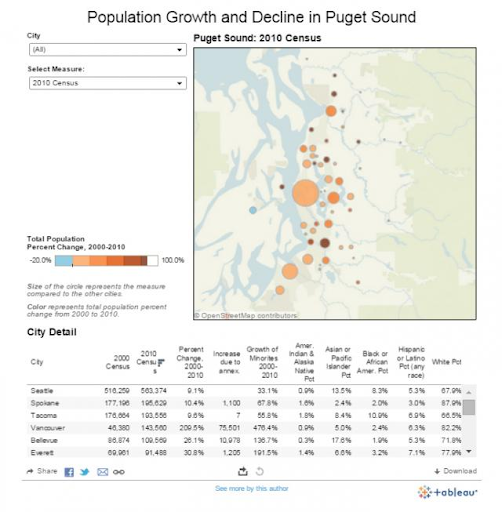
Tableau Software is an interactive data visualization software company based in the United States that focuses on business intelligence. It began in Mountain View, California, in 2003 and is now headquartered in Seattle, Washington. Tableau is a dashboard-based visual analytics engine that makes it easy to build interactive visual analytics. Non-technical analysts and end-users will find it easier to translate data into comprehensible, interactive graphics using these dashboards. Tableau makes it easy to combine data from public sources with your data, resulting in new and meaningful insights. Blending census data with your proprietary data, for instance, can provide normalized population results, which can provide new insights into activities.

Tableau visualization of census data

The following are some of the Tableau features:

  • Tableau Dashboards use visuals, visual objects, text, and other elements to provide you with a holistic picture of your data.
  • Tableau provides easy ways for users to collaborate and share data in real-time.
  • Tableau offers in-memory data access to both live data sources and data extraction from external data sources.
  • Tableau has a plethora of data source options from which you can connect and retrieve data.
  • Tableau comes with a lot of pre-installed map data, including cities, postal codes, administrative boundaries, and so on.

Tableau may be used to make forecasts, identify trends and outliers, produce maps, and more. Tableau employs drag-and-drop capabilities similar to Alteryx, but instead of imposing various transformations on data to clean it, you apply visualizations to data segments to see data in different ways in Tableau.

2) Microsoft

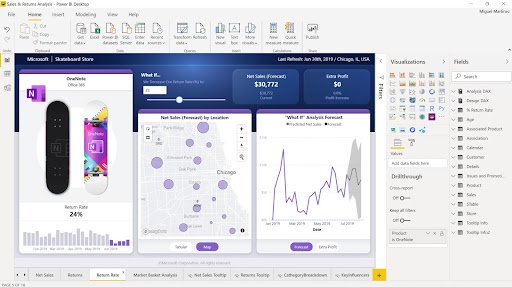
Microsoft Power BI was first released in July 2013 as part of Office 365. Microsoft Power BI is a broadly used application in a firm that deals with a vast amount of raw data and processes it for gathering actionable insights. It enables us to visualize dispersed and unfiltered data effectively and understandably. Most of the critical reports we create, both for external and internal usage, include data crunching, and all of them are created with Power BI.

Power BI Interactive Reports

The following are some of the Microsoft Power BI features:

  • It provides a diverse set of detailed and appealing visuals.
  • Users of Power BI can choose from a range of data sources using the Get Data feature.
  • Datasets can be filtered to create smaller subsets with only the most relevant facts and context.
  • Support for customizable dashboards.
  • Reports developed in Power BI can be shared with other users.

The best use of PowerBI is to create interactive dashboards. Alteryx will make it easier, quicker, and faster to create dashboards in PowerBI by allowing you to create visual workflows to modify data from different sources and produce powerful analytics models.

3) Qlik

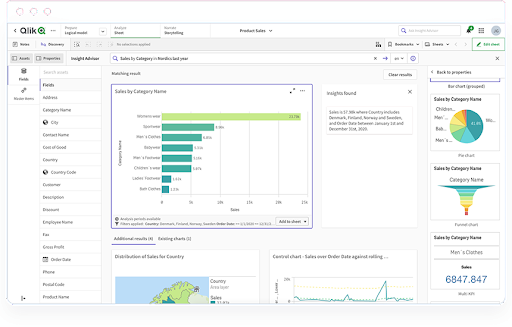
Qlik offers a platform for business analytics. The software firm was started in Lund, Sweden, in 1993 and is presently headquartered in King of Prussia, Pennsylvania. Qlik Sense Enterprise is a simple platform that allows you to design a variety of dashboards. The user experience is the same for both developers and end-users. It also helps us to organize the entire firm around strategic goals and provides cloud-based execution of its products. Developers may easily create a data model or code in the upload editor with Qlik on all main cloud platforms. It also combines data analysis and data discovery, with a wide choice of graphs and objects to show data in a user-friendly interface. The presentation is very clean, and you can design some attractive apps that present data neatly.

Dashboard Analytics in Qlik Sense

The following are some of the Qlik Sense features:

  • An associative model can be used in which the whole data that is loaded into Qlik Sense, from any data source, to be linked and associated.
  • Qlik Sense provides smart and powerful visualizations to help with data analysis.
  • Centralized Sharing and Collaboration of reports and applications.
  • Prepares data for loading to clean, transform, associate, and integrate it with other data sets being loaded.
  • Data security, monitoring, centralized management, and control are all ensured with Qlik Sense’s enterprise-class management services.

Alteryx licenses are based on a subscription model, which includes all product upgrades and customer support. Qlik Sense is a visual analytics and business intelligence (BI) platform that covers several analytic use cases.

Become a master of Alteryx Tools by going through this HKR Alteryx Training In Bangalore

4) IBM

Smart Cloud Enterprise, IBM’s public cloud product, was released on April 7, 2011. IBM Cloud® Paks are AI-powered tools that may assist enterprises in developing, modernizing, and managing apps securely across any cloud. They include containerized software that has been pre-certified and also core services that give customers common operations and integration frameworks. It provides a uniform experience for an infrastructure management control plane with AI, automation, and security. IBM® Cloud Pak for Data is a cloud-native solution that helps you to rapidly and efficiently put your data to work. Cloud Pak for Data boosts productivity by allowing users to search for existing data or request data access. The data fabric architecture offered by Cloud Pak for Data allows your firms to accelerate data analysis for better, faster insights.

Features of Cloud Pak for Data data fabric architecture include the following.

  • Without relocating data, data access can be simplified and automated access across several clouds and on-premises data sources.
  • Ensures that all data, regardless of source, is used safely.
  • Provide a self-service experience for locating and using data for business users.
  • Automate and orchestrate the data lifecycle using AI-powered capabilities.

If you want to Explore more about AlterYX? then read our updated article – AlterYX tutorial

Alteryx Competitors 3

Subscribe to our YouTube channel to get new updates..!

5) SAP 

SAP was founded in 1972 by five former IBM employees to develop standard software for real-time business operations. SAP (Systems Applications and Products in Data Processing) is an acronym for Systems Applications and Products in Data Processing. SAP Agile Data Preparation aids in the refinement of data gathered from different sources. The SAP Agile Data Preparation tool transforms the data before we can use it to build various Analytical Visualizations. The raw data contains a lot of unnecessary noise that can divert the end findings of Analytical Visualizations, thus we must process it properly.

SAP Agile Data Preparation

The following are features in SAP Agile Data Preparation:

  • SAP Agile Data Preparation is a self-service data preparation program that allows you to discover, integrate, and transform data.
  • The data can be transformed quickly into actionable, simple consumable information.
  • The tool can assist you in achieving greater success with analytics, MDM initiatives, and data migration
  • Data access and discovery are simplified and are more productive and agile.

6) Informatica

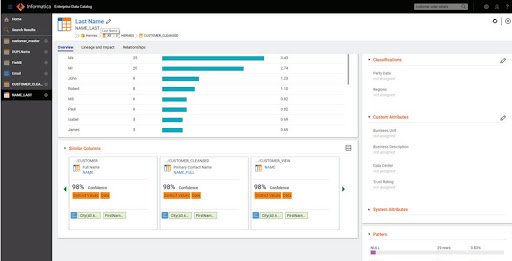
Informatica is an American software development company established in 1993. The core products of cloud Informatica comprises Enterprise Cloud Data Management and Data Integration. Informatica Enterprise Data Preparation assists you in making better decisions by allowing you to prepare data that can provide you with various deep and relevant insights. It’s simple to use and can connect to a wide range of various data sources. This product’s customer service team is quite helpful and responds to questions on time.

Informatica Enterprise Data Preparation

The following are features in Informatica Enterprise Data Preparation:

  • The Informatica CLAIRE® engine can be used to produce a dataset and recipe recommendations.
  • Perform quick data discovery, impact analysis, social curation, and collaboration.
  • Easily import, upload, or publish files on AWS S3 and Microsoft ADLS, including support for ADLS Gen2.
  • Support CSV file import, Avro, Apache Parquet; bring unstructured or structured data into pipelines.
  • Data can be processed at an enterprise scale using pre-built data integration transformations and aids with accuracy and consistency.
  • Record data preparation steps as reusable data pipeline mappings for easy execution using a user-friendly interface.

7) MicroStrategy

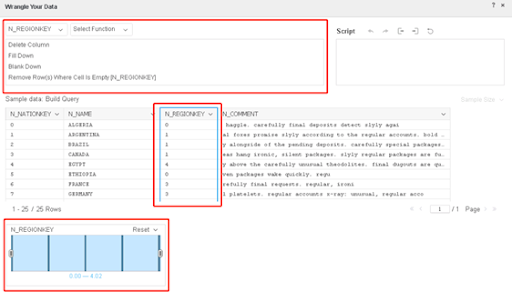
MicroStrategy was started in 1989 by Michael J. Saylor, Sanju Bansal, and Thomas Spahr. The company creates software for analyzing internal and external data and developing mobile apps. MicroStrategy offers a software development kit that allows you to customize the app and incorporate it with other apps. MicroStrategy has simplified access to every business resource, including mobile device management systems, cloud apps, databases, and a lot more. It supports a wide range of data formats and displays data in several ways. It comes with a reliable version that allows developers to hard code the dashboard to interact with input software. It allows businesses to make better decisions. The widgets are significant because of custom features and filters, and there are many widgets in the dashboard view.

Data wrangling in MicroStrategy

The following are a few features in MicroStrategy:

  • MicroStrategy’s data discovery feature enables it to connect to any data source and combine data from several sources.
  • With a broad set of built-in data wrangling and parsing capabilities, Data Wrangling aids with data transformation and modification.
  • The analytical capabilities incorporate third-party data mining tools. The Data Mining Services are used for building the predictive reports.
  • Includes the extensive library of analytical functions used for comprehending the relationships between data and creating metrics.
  • Offers the real-time dashboard for live data monitoring of the most existing information.

8) SAS

SAS is a statistical software suite for multivariate analysis, advanced analytics, data management, predictive analytics, criminal investigation, and business intelligence developed by SAS Institute. SAS was created at North Carolina State University between 1966 and 1976 when it was established as SAS Institute. SAS Data Preparation is the go-to tool for data preparation in any data analytics pipeline. SAS Data Prep provides advanced Exploratory Data Analysis (EDA) tools to help you assess whether and how much data preparation is needed. You can quickly uncover your data by looking for duplicates, basic statistics, and patterns. The technical and non-technical team members benefit from the point-and-click modern UI, which makes it intuitive and lengthens the learning curve.

SAS

The following are a few features in SAS:

  • Intuitive UI is used with embedded AI to access, profile, cleanse, and transform data.
  • Data can be accessed from multiple sources like flat files, relational data sources, data lakes, SAS data sets, Teradata, CSV or text files, etc.
  • The exploration, refinement, and transformation of data analytical readiness are aided by prebuilt transformations and data cleansing.
  • Create a seamless data discovery and data preparation user experience by automatically integrating prepared data into the analytics pipeline.
  • It is powered by SAS Viya, an architecture that is fully redesigned which is compact, cloud-native, and fast.

Explore Alteryx Sample Resumes Download & Edit, Get Noticed by Top Employers! 

Alteryx Training

Weekday / Weekend Batches

Conclusion:

Unlike many other products, Alteryx is simple to use for business customers who do not have an IT background. Alteryx is better in many aspects as compared with other competitors allowing teams to create processes that are more effective, repeatable, error-free, and risk-free. Alteryx is an excellent platform to choose for a digital transformation or automation endeavor because it can be used as a major building block.

Related Articles 


Source link