
You don’t have to be a Marriott Bonvoy loyalist to find ongoing value in the Marriott Bonvoy Boundless® Credit Card (see rates and fees).
The Marriott Bonvoy Boundless stands out in the Marriott card suite thanks to its solid lineup of perks, including an annual free night award (certain hotels have resort fees) and elite night credits, in exchange for a relatively low annual fee.
Whether you love being a frequent Marriott guest or want a few extra perks the next time you stay with the brand, the Marriott Bonvoy Boundless makes sense for a wide range of travelers. Card rating*: ⭐⭐⭐⭐
*Card rating is based on the opinion of TPG’s editors and is not influenced by the card issuer.
Marriott Bonvoy Boundless: The basics
The Marriott Bonvoy Boundless is a cobranded card between Marriott Bonvoy and Chase. The card earns Marriott Bonvoy points, which can be used to book free nights at more than 9,000 properties worldwide.
The best way to redeem Marriott points is for free nights at Marriott hotels and resorts. However, you can also transfer your points to airline partners.
Marriott Bonvoy Boundless provides a standout suite of perks, including an annual free night award and automatic Silver Elite status, for a $95 annual fee.

I find it especially impressive that a mid-tier hotel card with a modest annual fee offers such lucrative perks, especially the annual free night award. Certain hotels have resort fees.
Here’s a breakdown of the perks included with the Marriott Bonvoy Boundless:

Reward your inbox with the TPG Daily newsletter
Join over 700,000 readers for breaking news, in-depth guides and exclusive deals from TPG’s experts
You don’t have to go all in on Marriott to get a lot out of having this $95-annual-fee card in your wallet, and that’s what makes the Marriott Bonvoy Boundless worth considering.
Related: Marriott Bonvoy elite status ‘soft landing’ policy: How to requalify for status
Marriott Bonvoy Boundless pros and cons
| Pros | Cons |
|---|---|
|
|
Marriott Bonvoy Boundless benefits
The Marriott Bonvoy Boundless packs a punch for its reasonable annual fee. Here’s what cardholders can expect.
Anniversary free night award
Given TPG’s June 2026 valuation of Marriott points at 0.8 cents apiece, the 35,000-point certificate is worth up to $280. This is nearly three times the card’s $95 annual fee and is a fantastic benefit, especially since you don’t have to spend on the card to earn the certificate.
Elite status
While the Silver elite status on the card is the first level of Marriott’s elite program, it does offer a few useful benefits, such as a 10% points bonus on paid stays and priority late checkout.
If you put at least $35,000 of spend on the Marriott Bonvoy Boundless in a calendar year, you’ll earn Gold Elite status. This comes with more perks, such as a 25% points boost and enhanced room upgrade (when available).
However, this wouldn’t be a good idea for most cardholders, since a $35,000 spending requirement in exchange for a $95 annual fee card is quite steep.

If Gold Elite status is your goal, you may be better off combining the card’s 15 complimentary elite night credits with 10 paid nights; this totals 25 elite nights needed for Gold Elite status.
If you’re eligible for a business card, you can also pair the 15 elite night credits given by the Marriott Bonvoy Boundless with 15 elite night credits provided by the Marriott Bonvoy Business® American Express® Card. These 30 total elite night credits leave you with just 20 nights to earn Platinum Elite.
You can also reach a higher elite status by earning one elite night credit for every $5,000 spent on purchases with the Marriott Bonvoy Boundless.
Related: How to choose a no-foreign-transaction-fee credit card
How to earn and use Marriott Bonvoy points
Earning points
When you spend on the Marriott Bonvoy Boundless, you’ll earn:
- Up to 17 points per dollar spent on eligible Marriott stays, broken down as such:
- Up to 10 points per dollar spent as a Marriott Bonvoy member
- 6 points per dollar spent by paying with your card
- Up to 1 point per dollar spent from your Silver elite status, a benefit provided by being a Marriott Bonvoy Boundless cardholder
- 3 points per dollar spent on dining and at gas stations and grocery stores (on the first $6,000 spent in combined purchases each year, then 2 points per dollar spent)
- 2 points per dollar spent on all other purchases

Given TPG’s relatively low valuation of Marriott points, I only recommend paying for Marriott stays with the Marriott Bonvoy Boundless. There are other cards on the market that earn more valuable rewards on dining, gas and groceries.
Redeeming points
The best way to redeem your Marriott points is by booking free nights at one of the brand’s hotels.
Since Marriott uses dynamic award pricing (meaning the number of points needed fluctuates based on demand and availability), you may have to take extra time and effort to strategize for maximum value.
Marriott has an award calendar search function that can help narrow down the best deal for your points. For example, a night at the Moxy Boston Downtown in June could cost as few as 33,000 points per night or as many as 65,000 points per night, depending on when you book.
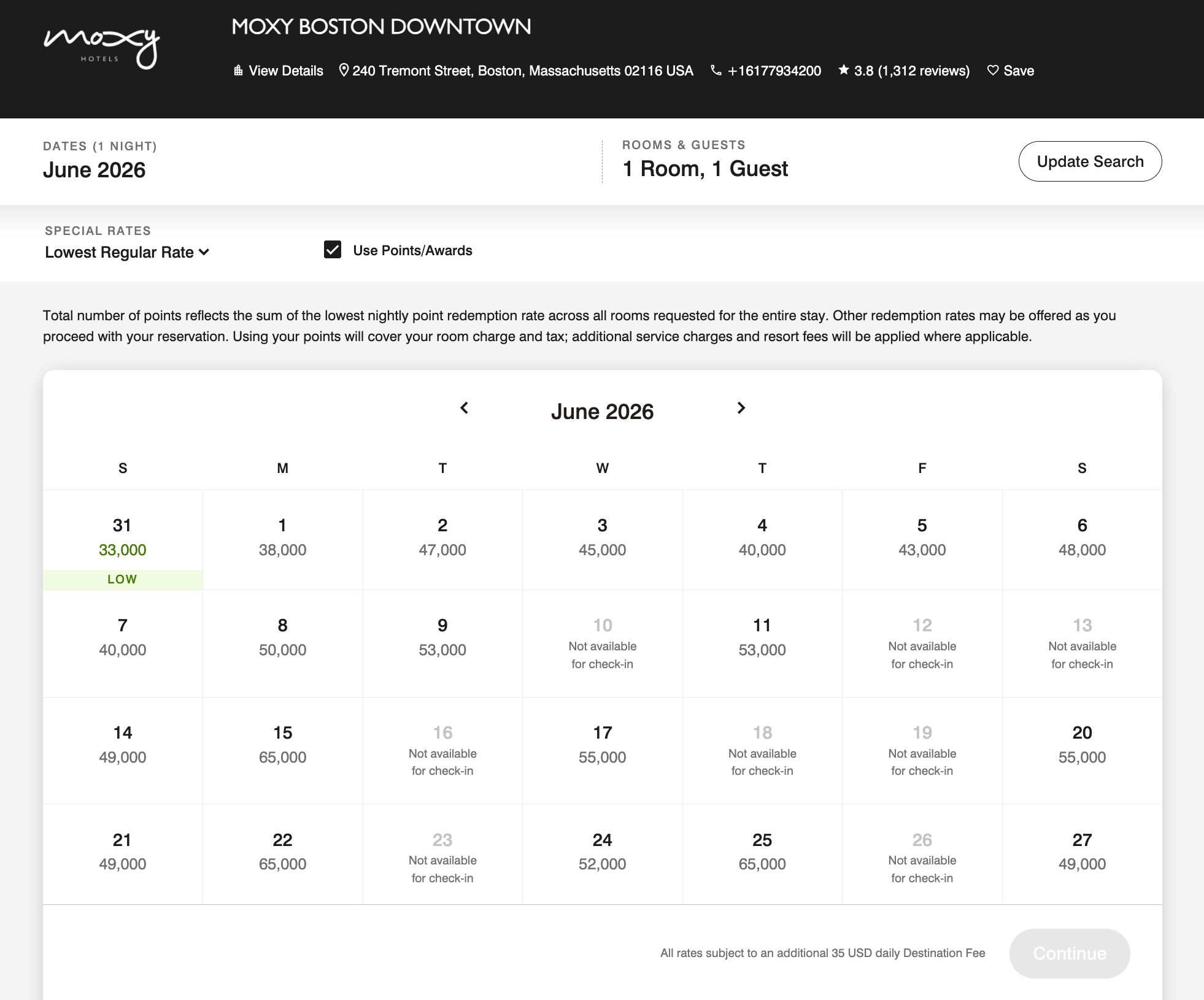
While TPG values Marriott points at 0.8 cents apiece, there are ways to get better value.
For instance, TPG lead writer Katie Genter recently redeemed 112,000 points for a five-night stay at the Courtyard by Marriott Toronto Vaughan for a music festival. Compared against a cash rate of $1,464, Katie got an impressive 1.31 cents per point from this redemption.
Also, keep in mind that Marriott offers a fifth-night-free benefit. When you book at least five consecutive nights on points, you’ll get the night that’s worth the lowest number of points for free. This can help you stretch your points for longer trips.
Transferring points
Marriott points are also transferable to nearly 40 airline partners at a 3:1 ratio. These include some hard-to-earn currencies, such as Frontier Airlines and Korean Air.
However, unless you have a specific airline redemption in mind and need to top off your account, transferring is unlikely to be the best use of your points.
Related: Can you mix hotel points and free night certificates for a fourth or fifth night free?
Where the Marriott Bonvoy Boundless falls short
The Marriott Bonvoy Boundless won’t be the perfect fit for everyone. Here are some shortfalls to consider:
- Marriott Bonvoy prices award nights dynamically, so rates can vary greatly and be steep at peak times.
- The anniversary free night included as an ongoing benefit on the card is limited to 35,000-point redemptions (though it can be topped off with 25,000 points).
- This card charges an annual fee.
- This card isn’t a good fit for Bonvoy loyalists looking for top-tier Marriott perks from a credit card.
- This card has poor earning rates on everyday spending; it’s only best for earning bonus points on Marriott stays.
Marriott Bonvoy Boundless vs. Marriott Bonvoy Brilliant
The Marriott Bonvoy Brilliant® American Express® Card is a premium sibling to the Marriott Bonvoy Boundless. It charges a much higher $650 annual fee (see rates and fees) but provides more benefits for Marriott loyalists.
These perks include higher Platinum Elite status, 25 elite night credits each calendar year toward status and an annual free night award valued at 85,000 points. (Certain hotels have resort fees.)
To learn more, read our showdown of the Bonvoy Boundless versus the Bonvoy Brilliant.
Related: 3 reasons why the Marriott Bonvoy Boundless is worth the $95 annual fee
When to apply for the Marriott Bonvoy Boundless
Currently, with the Marriott Bonvoy Boundless‘s bonus, you can earn 125,000 bonus points and a free night award* after spending $3,000 on purchases in the first three months from account opening. Additionally, you can receive up to $100 in statement credits (up to $50 biannually) after spending $500 on eligible airline purchases through June 30.
*Nights are valued at up to 50,000 points each. (Certain hotels have resort fees.)

We recommend applying for the Marriott Bonvoy Boundless when the welcome offer provides more than three free night awards or at least 125,000 bonus points. Either option provides a solid level of value for new cardholders.
If you max out the free night award and earn the statement credits for airline purchases, this bonus is worth up to $1,500, per TPG’s valuations.
Related: The best credit card welcome bonuses available now
Other cards to consider instead of the Marriott Bonvoy Boundless
The Marriott Bonvoy Boundless has multiple competitors. Here are a few to consider:
For additional options, see our list of the best hotel credit cards.
Related: Which credit card should you use for Marriott stays?
Bottom line
I find the Marriott Bonvoy Boundless to be an excellent choice for everyone, from Marriott loyalists who don’t want to pay a high annual fee to those who occasionally stay at the brand’s hotels and resorts.
This is because you get solid ongoing value from the annual free night award and high earning rates, without paying a high annual fee.
Of course, if you’re a fierce Marriott loyalist chasing status, a more premium card may be a better choice. And, if you want an option that earns higher-valued rewards at a better rate on everyday purchases, you may want to look at a general travel card that earns transferable rewards.
Overall, however, the Marriott Bonvoy Boundless certainly provides enough ongoing value in exchange for its modest $95 annual fee, making it worth keeping year after year.
Apply here: Marriott Bonvoy Boundless Credit Card
For rates and fees of the Marriott Bonvoy Brilliant Amex, click here.

Stacie Harris is a local resident and reporter of the Maple Grove area. Stacie reports on medicine and science for the Maple Grove Report.