Mille Lacs’ walleye return to same ‘hot spots’ to spawn


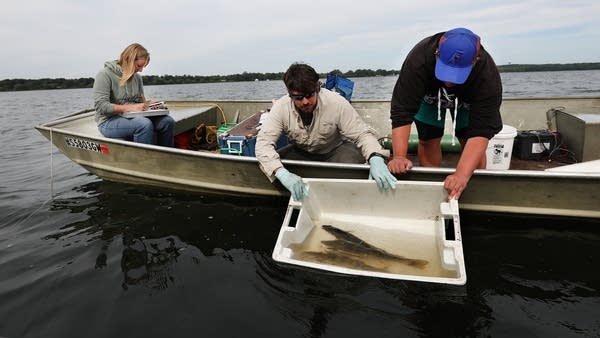
After the walleye are tagged and have recovered, they are released.

A newly released study found that walleye in Lake Mille Lacs consistently return to the same spots every year to spawn — preferably places with little or no shoreline development.

Researchers have tried to figure out why the central Minnesota lake’s walleye population declined in recent decades. The latest study suggests protecting certain places in the lake where walleye reproduce could boost their success.

Mille Lacs is one of the most heavily fished walleye lakes in Minnesota. It’s important both for recreational anglers and as a cultural and food resource for several Ojibwe tribes that retain harvesting rights under an 1837 treaty.

Previous studies found one of the primary causes of walleye’s decline is too few fish fry surviving to adulthood, said Kayla Lenz, a fisheries technician at the Great Lakes Indian Fish and Wildlife Commission. The commission partnered with the Mille Lacs Band of Ojibwe on the multi-year study.

Mille Lacs’ adult walleye “go out and spawn every year, but the percentage of the eggs that they lay that become adult fish is low,” said Lenz, who’s also a doctoral student at the University of Illinois Urbana-Champaign.

“So we want to make sure that these very early life stages have their greatest chance of success and survival,” she said.

Newly hatched walleye stay in spawning areas for a few weeks before they swim out into the larger lake, Lenz said. If the “nursery habitat” is good, they have a better chance of surviving longer, she said.

“The more fry that we can have, the more potential adult fish that we have,” Lenz said.

Tracking walleyes’ movement

Researchers placed a grid of more than 60 acoustic receivers at the bottom of Mille Lacs Lake in summer 2018. Then, they surgically implanted transmitters in about 70 adult walleye.

When the fish swam near one of the receivers, the transmitter recorded its location, depth, temperature and other information. The researchers collected data each spawning year from 2019 through 2021.
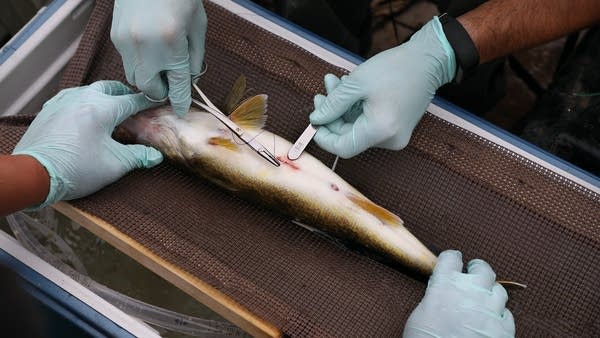
The procedure to insert the transmitter tag takes only a few minutes.
The Mille Lacs Band of Ojibwe received a nearly $200,000 grant from the U.S. Fish and Wildlife Service to use acoustic telemetry technology to study the walleye population on the popular central Minnesota lake.
Paul Middlestaedt for MPR News | 2018

They found 96 percent of the walleye detected returned to the same spawning area year after year — “a really high percentage,” as Lenz put it.

Researchers also identified three “hot spots” in Mille Lacs that are especially important spawning grounds. Those tended to be places with hard bottoms of sand or gravel, so walleye eggs were less likely to get buried in muck.

They’re also spots with a lot of wind and wave action, which helps scatter the eggs in a wider area, Lenz said.

Undeveloped shoreline is key

One of the key takeaways is shoreline development and alteration reduces walleye spawning habitat, Lenz said.

In all three of the spawning hot spots, the lakeshore was virtually undisturbed with little to no human development, such as houses, docks or marinas. Those untouched stretches of shoreline are relatively rare on Mille Lacs.

“Human activities on shore can cause stressors and damage the environment and inhibit spawning success,” Lenz said. “So it seems like they're kind of searching for what areas can have fewer of those stressors.”
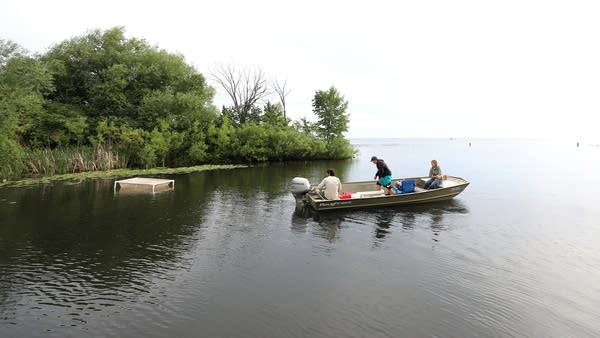
Researchers want to test a hypothesis that invasive species impact walleye.
Researchers used acoustic transmitters to track the movement of walleye in the lake, and learned the vast majority return to the same locations to spawn every year.
Paul Middlestaedt for MPR News | 2018

For example, removing trees and other vegetation along the shore can increase erosion. The dirt that washes into the lake can suffocate fish eggs, Lenz said.

Fertilizer applied to a lawn can wash into the lake and spur plant growth, which also can lessen walleye’s spawning success, she said.

If property owners are interested in helping protect spawning areas, they should maintain vegetation and limit their use of fertilizer and pesticides along the lakeshore, Lenz said.

They also should wait to install their dock until after walleye spawning season, which usually starts after the ice recedes and lasts for three to four weeks, she said.

Protecting spawning spots

The study recommended policy makers create conservation areas on or near the shoreline to protect walleye spawning areas in Mille Lacs.

To have abundant walleye for recreational anglers and tribes, “we need to help them get there and survive to adulthood,” Lenz said. “We can do that by helping to protect these spawning and nursery habitats.”

In a news release about the study, Kelly Applegate, natural resources commissioner for the Mille Lacs Band of Ojibwe, said the band cares deeply about the habitat of Ogaawag, the Ojibwe word for walleye.

“By learning more about important Ogaawag spawning sites, we can obtain valuable knowledge, allowing us to further build on our centuries-old reputation for successfully and sustainably managing our fisheries resources,” Applegate said.
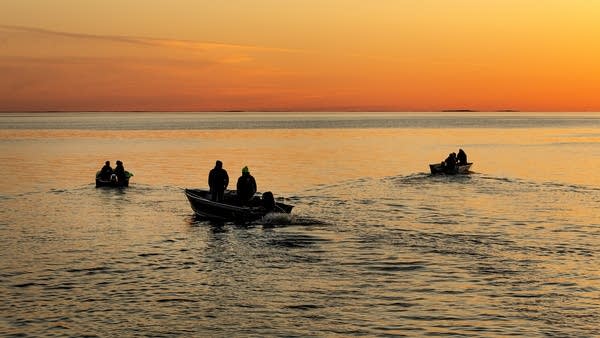
Fishing boats on a lake at sunset.
Fishermen head out from Liberty Beach in Isle to fish Mille Lacs Lake.
Paul Middlestaedt for MPR News | 2022

The study was published in the journal Frontiers in Fish Science. Its findings are useful not only for Mille Lacs Lake, but other lakes as well, Lenz said.

She said researchers are working on the next phase of the study, which involves getting more detail about the tagged walleye’s movements and behavior in the spawning hot spots.

Researchers acknowledged they tagged a relatively small number of walleye compared to Mille Lacs’ overall population, so there are likely other popular spawning locations around the lake.

Minnesota Department of Natural Resources officials said Mille Lacs’ walleye population has shown signs of recovery in recent years, in part due to stricter fishing restrictions.

As a result, the department has eased those regulations slightly. Anglers on Mille Lacs can keep up to three walleye of a certain size this summer.



Source link

Leave a Reply

Subscribe to Our Newsletter

Get our latest articles delivered straight to your inbox. No spam, we promise.

Recent Reviews


Being a founder is awesome. And it also really sucks.

It’s a huge amount of stress, disappointment and uncertainty, with little appreciation or guidance.

It’s perfectly normal to find yourself questioning what it all means.

I’ve been there myself… questioning whether the sleepless nights and stress was worth it. And now, I’m often the person founders turn to when they do the same.

In this essay, I wanted to talk about happiness, purpose, and how to get more of it when you’re constantly living in survival mode.

Three Types of Happiness

Martin Seligman, the father of positive psychology, describes three distinct paths to happiness: the pleasant life, the engaged life, and the meaningful life.

  • The pleasant life is about pleasure—closing a deal, hitting a milestone, getting some great customer feedback. As a founder, there’ll be phases where pleasure is hard to come by. Clearly, you can’t build a founder life on pleasure alone.
  • The engaged life is about flow—the state when you’re fully absorbed in solving a hard problem. Most founders have this in spades early on, but as their companies grow, their role can evolve away from flow. Being out of flow is often a signal you need to redesign your role.
  • The meaningful life is about purpose—the sense that what you’re doing matters. Unlike pleasure and engagement, meaning doesn’t require things to be going well. It sustains you through the hard times, not just in spite of them.

So when times are hard, meaning is what we can return to. Unlike pleasure and engagement, meaning is up to you.

And it’s work you can start right now.

How to Make Meaning

So how do you actually build meaning, even when you can barely see past next week? A meaningful life has three components:

  • A meaningful future
  • A meaningful past
  • A meaningful present

Creating meaning in each is an act of creativity. It’s an active process in which you assign meaning to things.

If you aren’t intentional about this, your brain will assign meaning for you. And if you’re not feeling great, your brain will come up with interpretations that match and then reinforce the negative feelings.

What I’m about to share with you is the process I run through when my clients start questioning themselves, and what they’re building.

1. A Meaningful Future

In Man’s Search for Meaning, Viktor Frankl documented the atrocities of the concentration camps. He writes:

“Any attempt to restore a man’s inner strength in the camp had first to succeed in showing him some future goal.”

A lot of modern therapy fixates on the past. But Frankl realised that getting clear on our future goal is even more powerful.

When it comes to founders, they often have goals… but unless you’re fully pumped, your goals need refinement. 

I commonly see three issues with a founder’s goals:

  • They have too many goals. We accumulate goals over time, but we rarely sit down and remove goals. For example, you had goals when you were 18 years old. Most of these have been parked, but some might still be guiding you now.
  • The goal isn’t big enough. For most founders, the more ambitious the goal, the more energy it unlocks. Just increasing the size of the goal can act as a powerful clarifying force for what matters.
  • The goal isn’t framed by its meaning. It’s the difference between ‘I want to make $100M’ versus ‘I want to help 10,000 customers avoid what happened to me’. One is financial, the other is personal.

Refining and reconnecting to your primary goal is critical for building a life of meaning.

Questions to work through:

  • What’s the biggest and most exciting goal you can dream up?
  • If that was your primary goal, what other goals stop being relevant?
  • What people or person could the bigger goal attract that would make it achieving it easier?

2. A Meaningful Past

Being a founder can sometimes feel like a full-contact sport. You can get hurt, through disappointment, bad luck, and even betrayal. That’s why painful events in the past need to be treated like a wound.

When we don’t process the past, unhelpful stories we tell ourselves to protect our ego can cause havoc in the present.

Treating the past means framing every single thing that happened in two ways:

  • A win: an accomplishment that we can celebrate.
  • A lesson: a failure that we learn from, that we can celebrate.

We leave everything else behind. If, for some reason, we can’t let something go, it means we haven’t learned something important from it. As my mentor used to tell me: failures will be repeated until learned.

This work can be done separately, but it’s even more powerful to do it in the context of a big goal. This way, the wins and lessons can be aligned to the vision that truly excites us.

Questions to work through:

  • What is the meaning of what you’ve been through?
  • How did those experiences serve you?
  • Where are they failing to serve you today?

3. A Meaningful Present

Here’s the thing: the future and the past don’t physically exist. They’re tools to help us act in the present.

Often, clarifying the meaning of a bigger future and a happier past makes changing the present obvious and necessary.

As founders, it’s easy to be driven entirely by the past: old goals, old activities, old habits. This stops us from growing. And a lack of growth is one of the fastest paths to feeling meaningless.

Most founders I work with don’t need to do more. They need the courage to do less.

Growth often requires us to:

  • Start doing something we haven’t done before
  • Stop doing something we’ve already mastered
  • Double down on getting even better at some things

The meaningful present is about making these changes — aligning how you spend your time with the future you’ve defined and the lessons you’ve drawn from the past.

Questions to work through:

  • What is the biggest bottleneck to making the big goal viable?
  • What do you need to stop doing—even if there’s a cost involved?
  • What do you need to delegate?

Happiness Isn’t Always Happy

A meaningful life isn’t always smiles and rainbows. It comes with difficulty, sacrifice, and discomfort. But it’s the thing that keeps you going when pleasure and engagement can’t.

If you’re a founder questioning what it all means, the answer isn’t to push harder or to quit. It’s to invest time in making meaning.

Start with the future. Let it reshape the past. And then rebuild the present around what actually matters.

Related Reading: 


Originally published on March 11th, 2026


How do top founders actually scale?

I’ve coached CEOs for 10,000+ hours—here’s what works.
Join 17,000+ founders learning how to scale with clarity.

Unsubscribe any time.


Source link