Minn. cities say they need more money for lead removal


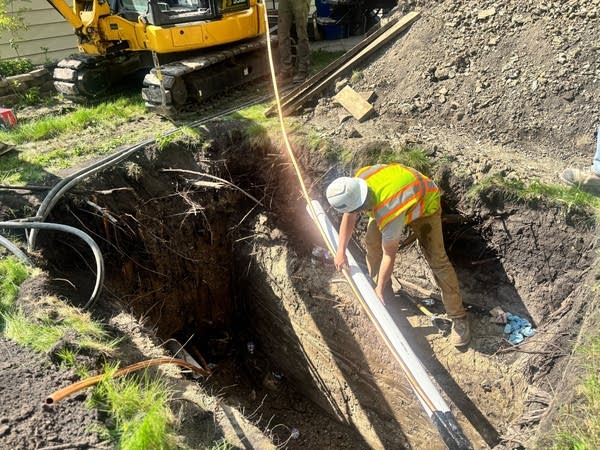
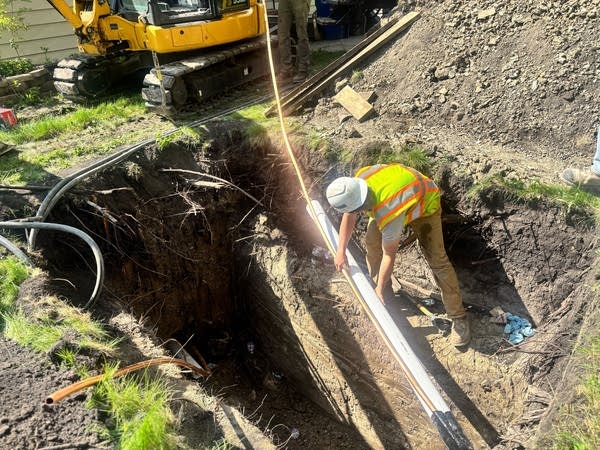
A construction worker lowers a copper line into a hole in the ground.

Lobbyist Bradley Peterson started the Minnesota legislative session with a quarter-billion-dollar ask. That’s how much money he said was needed to keep funding the replacement of lead service lines, which connect water mains to buildings.

It’s going to cost about a billion dollars total to replace all of the lead lines in Minnesota, and the money initially invested into the program is drying up. The state has already capped the money available for new projects.

Still, Peterson, who represents more than 100 local governments in the Coalition of Greater Minnesota Cities, knew that asking for that much more money would probably be a hard sell.

“The state's fiscal situation has changed, and so any dollar ask is going to be tough,” he said in February, referring to forecasts of future budget deficits. “But on lead service lines specifically, we think if the Legislature is going to spend money on anything, it should be something like this.”

As the legislative session started, the coalition lowered the request from $250 million down to $100 million.

But what they took away was far less.

When lawmakers finally passed the $1.2 billion buzzer-beater bonding bill in the waning hours of the legislative session, funding for the state’s lead replacement program came in at $15 million.

That’s 6 percent of what the coalition initially wanted.

“That's a pretty big disappointment, frankly," Peterson said. “A lot less work will be done. I mean, I'm sure the work won't stop completely, but you're just going to be able to do a lot less, and that's just math.”

Minnesota has taken the lead on lead

The Environmental Protection Agency’s Lead and Copper Rule requires lead service lines to be replaced by 2037. Minnesota’s goal is to get it done by 2033.

According to the state’s online inventory, water systems have identified more than 87,000 service lines in Minnesota that need to be replaced because they are either made of lead or galvanized steel, which can contain lead particles that enter drinking water.
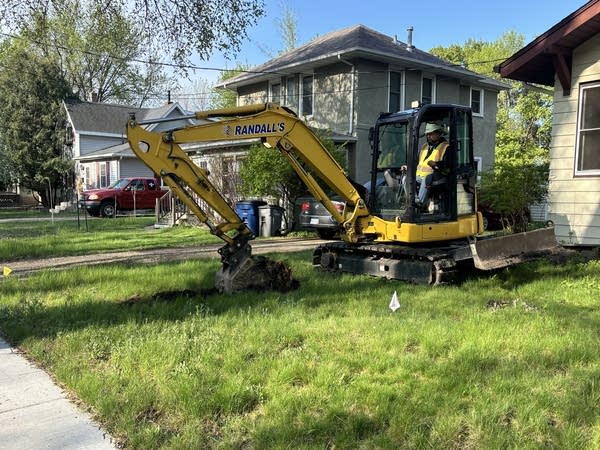
A yellow excavator digs in a house's yard.
Contractors break ground on a project to replace a lead service line in Moorhead, Minn., on May 20.
Harshawn Ratanpal | MPR News

Another 200,000 are made of unknown material and may contain lead.

Sometimes the pipes are easy to categorize — building records may contain info and the homeowner may be able to visually determine the material. But some pipes aren’t visible without digging deep underground.

In Moorhead for example, about 250 lead lines have been identified, and about 1,000 lines are unknown.

“There's a lot of work that needs to be done to fulfill that remaining portion, and that's going to be a couple years before we're done,” said Marc Pritchard, water plant manager at Moorhead Public Service.

A construction worker prepares a saw to use on a basement floor.
A contractor begins cutting into the concrete of a basement in Moorhead, Minn. to replace the home’s lead service line on May 20.
Harshawn Ratanpal | MPR News

In the meantime, Moorhead has begun to replace some lines. In 2024, a pilot project funded the replacement of 12. Another project last year funded the replacement of 30 lines, and that work is being wrapped up this spring.

Those projects were fully funded through the Minnesota Drinking Water Revolving Fund. Each one costs around $8,000 – $12,000, according to Jake Long, water distribution manager at Moorhead Public Service.

He said the process consumes a full day of work that involves a full crew of contractors and supervisors who dig holes in the basement and the front yard before installing a new copper service line.

“We've been able to receive the funding that works for Moorhead Public Service to replace the lines that we want to each summer,” Long said. “Of course, it could be different in the future with available funding, but it's been very, very nice to receive that funding to make these projects successful.”
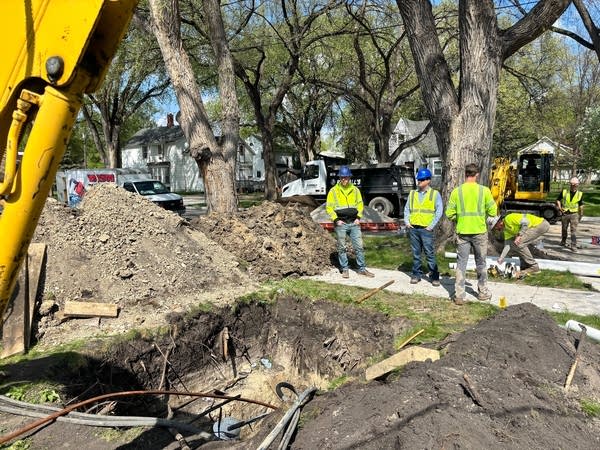
A group of construction workers in hi-vis vests stand next to an open hole in a yard.
Construction crews and inspectors stand near mounds of dirt and a pit in the front yard of a Moorhead home as they replace a service line made of lead on May 20.
Harshawn Ratanpal | MPR News

Smaller cities, like nearby Dilworth, haven’t begun replacing any lines yet. Their inventory process was done by a local contractor, Moore Engineering, and they found 34 lines that need to be replaced and more than 700 made of an unknown material.

“A lot of the records are just inconclusive, or they didn't have sufficient detail to determine precisely what the materials were, and so it's quite an undertaking to continue to refine those details,” said Andrew Aakre, project manager at Moore Engineering. “That's kind of where we're at … just continuing to refine the inventory to reduce the number of unknowns.”

Aakre said he expects replacements to begin “in the next year or so” but his firm doesn’t have any active contracts with the state.

And as more cities begin actually replacing lead lines, Long is worried the $15 million passed by the Legislature won’t be enough to sustain projects across Minnesota. According to the Minnesota Department of Health, most of the remaining funding will likely be used by the end of the 2027 construction season.

“I think to really make this successful, to really continue these lead service line replacement projects, there will need to be more funding available,” Long said. “It is costly for a homeowner to get it replaced, and, if the Minnesota Department of Health and the EPA really push to get these replaced, we're going to need grant funding to make it happen.”

Lead program already low on funds

In a document highlighting its intended use for the Drinking Water State Revolving Fund, the Public Facilities Authority has a long list of lead pipe replacement projects, but “the demand for funds exceeds available resources” and a “cap will be placed on the amount available to systems.”

That cap could have been removed if the Legislature appropriated more funds early this year, according to the document.

“The resources are tight, and the work has begun,” Peterson said. “There are lines that are being removed and cities have plans in place, and they're continuing to do the inventories to figure out what the last ones are that need to be identified, so it's a pretty significant disappointment that we couldn't have done better this session.”

The longer it takes to get those projects up and running, Peterson worries it will be tougher for Minnesota cities to retain the labor needed to complete them.
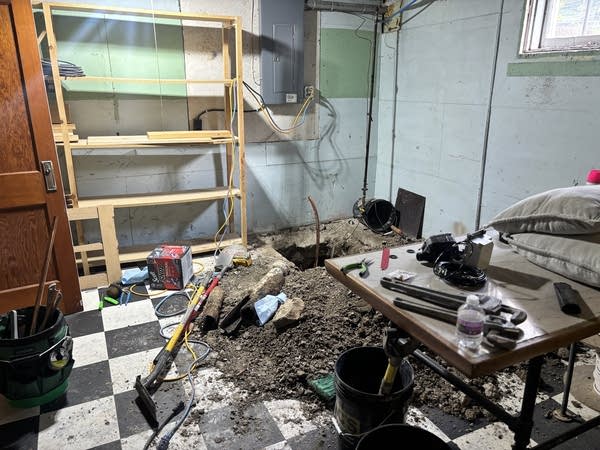
A shot of a basement, where a copper line is seen sticking out of the ground in the corner.
A newly-installed copper service line sticks out of a basement in Moorhead, Minn., on May 20.
Harshawn Ratanpal | MPR News

“We were actually probably nationally on the leading edge of that effort,” he said. “Now other states are catching up, and what that means is that the contractors and the workforce that we've been working with — if the money isn't there to continue the work into ‘27 and ‘28 — they'll go find work in other states, and it's really hard to get that momentum back once you lose it.”

Plus, the longer the lead lines stay in place, the longer people are exposed to lead, a toxic metal with no safe amount of exposure. Particularly damaging to children, lead exposure can cause brain damage, developmental problems and, in rare cases, death.

“Your total effects from lead are going to be from all of your cumulative exposures, so that would be from exposure over time,” said Stephanie Yendell, supervisor of the Health Risk Intervention Unit at the Minnesota Department of Health. “A longer duration of exposure is going to increase those effects.”

In the meantime, Peterson said he and the Coalition of Greater Minnesota Cities will try again next session.

“The next governor and the next Legislature are going to have to figure out how to reprioritize that issue and maybe look at something along the lines of a dedicated funding source, so that we don’t have to rely on the back and forth, ups and downs, maybe, maybe not, of a bonding bill from year to year,” he said.



Source link

Leave a Reply

Subscribe to Our Newsletter

Get our latest articles delivered straight to your inbox. No spam, we promise.

Recent Reviews


What is the purpose of SSRS?

The following are some of the most compelling reasons to use the SSRS tool:

  • When compared to Crystal Reports, SSRS is a more powerful tool.
  • Reports on related and multidimensional information are processed faster.
  • Allows for better and more precise results. The users’ decision-making mechanism.
  • Allows users to engage with data without the involvement of IT experts.
  • It connects to the World Wide Web for the purpose of distributing reports. As a result, reports are accessible over the internet.
  • Reports can be exported in a variety of formats using SSRS. Email can be used to transmit SSRS reports.
  • SSRS includes a number of security options that allow you to manage who has access to which reports.

Example of SSRS reporting

Assume the SSRS report of a health research facility that recruits individuals for numerous clinical trials.  For each patient, the institute’s staff builds a database record.  After they opt to engage in the trial, the hospital is paid by the pharmaceutical firm depending on the cost with which it is willing to participate. Before SSRS, the health institute would have to directly email a report well with an overall number of weekly registrants to the pharmaceutical business. The agency should also include information about each patient who took part in the experiment, the number of medications used, and any adverse events. 

As a consequence, the time it takes to collect and submit this information in the proper format could eat up a lot of time inside the clinic. If the institute kept track of data, they could use the SSRS tool to generate on-demand analyses in a pre-defined style. The drug business can retrieve the research on the cloud and run it at a certain time to acquire the most up-to-date information from the clinic using SSRS.

Want to Become a Master in SSRS? Then visit here to Learn SSRS Training !

SSRS’s Features :

  •  Provides a pluggable architecture and a Simple Object Access Protocol (SOAP) application.
  • Data can be retrieved from controlled, OLE ODBC, and database connections.
  • Allows you to produce and save ad hoc reports to the server.
  • Data can be shown in a variety of ways, including tabulated, free-form, and chart styles.
  • By using the report-processing extension, you can build custom controls.
  • Incorporate graphics and photos into the reporting. SharePoint can also be used to integrate with external material.
  • Custom reports can be saved and managed.
  • KPI data can be shown using the Chart and Gauge controls function.

Types of reporting services :

  • Integration services for Microsoft SQL Server that combine data from many sources.
  • The Microsoft SQL Server Analytical service assists in data analysis.
  • The Microsoft SQL Server Reporting service makes it possible to create a visual report of data.

How Does SSRS Work?

image

  • The people who utilize the reports are those who work with data and seek to gain insights from it. They send an SSRS server request.
  • The SSRS server locates the report’s metadata and issues a data request to the datasets.
  • The data from the raw data is combined well with the report definition to create a report.
  • The client receives the report once it has been generated.

SSRS Training

  • Master Your Craft
  • Lifetime LMS & Faculty Access
  • 24/7 online expert support
  • Real-world & Project Based Learning

SSRS Architecture :

IMAGE

The architecture of SSRS is fairly complicated. Development tools, administrative tools, and report viewers are all part of the report services architecture.

Important SSRS components are listed below.

It’s a client-side infomercial report publishing tool that runs on the client’s PC. It has an easy-to-use drag-and-drop interface.

The Report Designer program aids in the creation of a variety of reports. It’s a publishing tool for Visual Studio / Business Intelligence Development Studio (BIDS).

The report managers go over the report and make sure it meets the standards. Professionals adopt decisions based on the information in the reports.

It is a server that stores metadata information using the SQL Database engine.

It keeps track of metadata, report descriptions, sources, security configurations, and delivery information, among other things.

Data is retrieved from data sources such as databases and multimodal data sources via reporting services.

Reporting Life Cycle :

IMAGE

Every business follows a regular reporting lifecycle, which can be divided into the following categories:

The report author specifies the data layout and syntax in this phase. The SQL Server Development Studios, as well as the SSRS tool, were utilized in this process.

In this phase, you’ll be in charge of a published report that’s usually found on a website. You should think about network access over report execution at this point.

You must determine when the reports must be given to the client base during this phase. On-demand or pre-determined delivery options are available. You can also include a subscription automation tool that generates reports and sends them to customers automatically.

Click here to get frequently asked SSRS Interview questions & answers for freshers & experienced professionals !

HKR Trainings Logo

Subscribe to our YouTube channel to get new updates..!

What exactly is RDL?

RDL is the abbreviation for Report Definition Language. It uses an XML language that is verified through an XML schema to describe all potential report elements. RDL is used to define the report definition for each unique report. It provides guidance for generating the report’s design during runtime. The Report Definition Language (RDL) uses an XML grammar that is validated by an XML schema to specify all potential report elements. 

Type of SSRS reports : 

Parameterized reports Input values are used to finish reports or data analysis in this sort of report.

A linked report is a reference to another report. This report is generated out of a prevailing report as well as maintains the report definition from the original.

A snapshot report is a report that includes a structural framework and query results that may be retrieved at any time.

You can make a duplicate of the generated reports using the cashed report. They improve performance by minimizing the number of processing queries and the time it takes to obtain huge reports.

Drill-down reports aid in the concealment of complexity. Users can flip between concealed report items to choose how much background information is displayed. It must obtain all data that could be displayed in the report.

Drillthrough reports are regular reports that can be viewed by clicking on a hyperlink in the original report’s text box. It is used in conjunction with the main document and is the focus of a drill-down operation for just a report item such as placeholder text or perhaps a graph.

Sub-reports, as the name implies, are reports that display another report within the content of the primary report.

If you have any doubts on SSRS, then get them clarified from SSRS Industry experts on our SSRS Tutorial !

SSRS Training

Weekday / Weekend Batches

Advantages of using SSRS

  • It is both quicker and less expensive.
  • Availability of information stored both in MS SQL Server and Oracle databases for efficient reporting.
  • There’s no requirement for high-priced specialized knowledge.
  • Visual Studio.NET is integrated with the basic report designer in SSRS. It helps us to make an app as well as reports in much the same place.
  • Security is controlled by a role-based approach that may be extended to files and reports.
  • Users receive subscription-based reports automatically.
  • Reports on linear and cube data can be produced more quickly.
  • Real-time data to the business, allowing for better decision-making.

Disadvantages of using SSRS

  • There is no option to print. If you wish to print something, you must first export it to PDF, Excel, Word, or another format.
  • Users must accept parameters in order for reports to be accepted.
  • Making changes to source codes and debug expressions is tough.
  • It is not possible to include a page number or the total page number in the report body.
  • There is no way to send values from sub-reports to the main report.
  • Every new page has an extra space created by the page header.

Related Article :


Source link