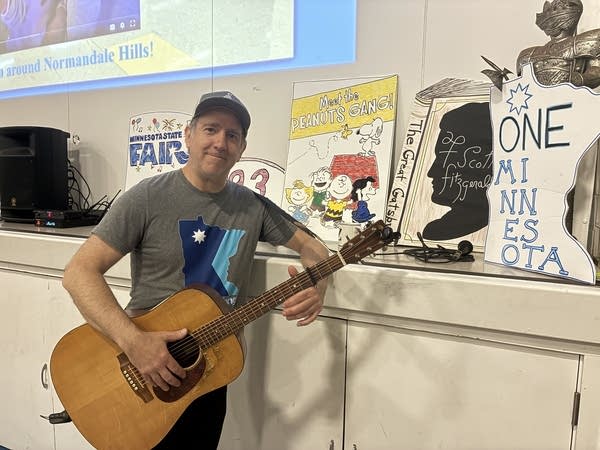
At an end-of-school-year rally at Normandale Hill Elementary, things kicked off with hundreds of students singing the school song.
“In the town of Bloomington, there's a school where the kids have fun,” they sing with full-hearted joy.
It’s a bright spot, considering this school year was marked by several events that weighed heavily on students and families, including a shooting at the Annunciation Church and School and increased immigration enforcement across the Twin Cities.
“I feel like since COVID, I've been waiting for the normal year,” said Mr. Zupfer, the school’s music teacher who composed the school song years ago.
“This was going to be the normal year, and Annunciation started out our year, and that was a gut punch.”
But in those difficult moments, Zupfer–or Mr. Z as he’s known by his students–has been using songs to remind kids that they aren’t alone.
“We had a rally right in the midst [after federal agents killed] Alex Pretti, and all those things. And you don't know what kids know or what they don't know,” said Zupfer. “But you just want to acknowledge that there are really hard things going on, and that you will get through it.”
Zupfer’s ability to create community through music was highlighted this year, when his song “One Minnesota” went viral on Instagram.
“I don't know how the algorithm works, but something happened with that, and just to see some of those verses go crazy was a lot of fun and exciting,” said Zupfer.
Despite having written it in 2019, Zupfer posted videos this year featuring his students singing the song’s verses, with little dance moves and gestures. The song highlights famous people from Minnesota, and pokes fun at the state’s sports teams and their losing streaks. It also includes lyrics like “there is a true tapestry of people gathered here from Sweden to Somalia.”
“It was fun to see kids in the room light up to be seen in that way,” said Zupfer.
Still, it was hard to ask the students to sing a joyful song in the midst of the immigration enforcement surge, which forced some students to stay home from school. Zupfer said, however, that singing it helped keep everyone grounded.
“And to somehow find some celebration in the joy in the midst of really hard stuff,” he said.
While “One Minnesota” might be his best-known song, Zupfer has a whole catalog of works that aim to help students develop their emotional intelligence. One of them, titled “OYA,” teaches kids that it’s okay to make mistakes—but that you have to own your actions. Another teaches them how to watch their rising emotions like they watch the weather.
“My passion has been writing songs that create a social emotional kind of infrastructure,” said Zupfer. “It's hard for kids to learn when they're dysregulated.”
The songs aren’t just for the kids though, Zupfer said. He also thinks he helps out the adults in the room with his creative work.
“In a public school, whatever's going on, you're going through it together,” he said. “To kind of have that outlet and that expression is a huge privilege.”