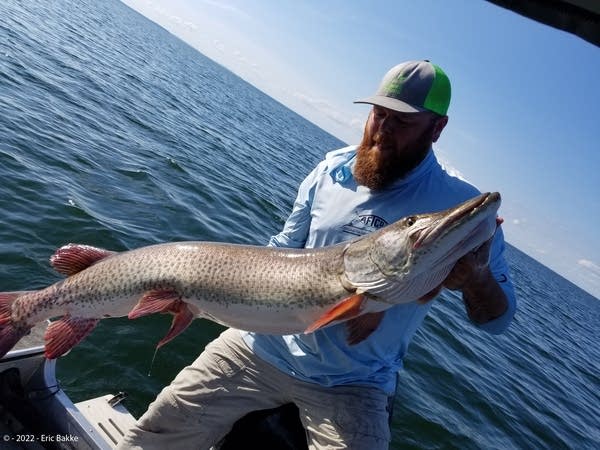
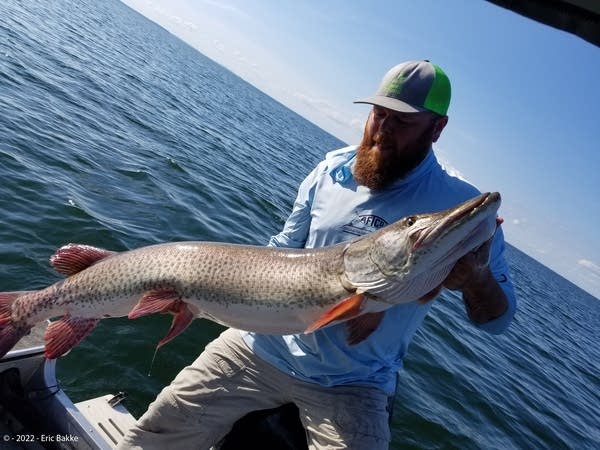
Muskie are notoriously elusive and clever fish, often stalking a lure right up to the boat without biting. For Jim Doyle, the thrill of muskie lies in the hunt.
“It’s the pursuit,” said Doyle, the Muskies Inc., Twin Cities chapter president. “It’s fishing for hours and hours and hours and not knowing when the next cast is going to produce something that is a near life-changing event.”
Doyle, along with other private clubs, businesses, local and tribal governments and researchers, spent the past three years working with the state developing the Department of Natural Resources’ long-range plan for muskie, short for muskellunge. It's the first long-term plan since 2008 and runs through 2040.
The goals include:
-
Improving muskie fisheries
-
Expanding fingerling and yearling production
-
Continuing the Twin Cities metro area program for tiger muskie
-
Debunking misconceptions that muskie deplete other fish populations.
Natural Resources fisheries section manager Brad Parsons said the biggest changes are about efficiency. While the past plan prioritized stocking new fisheries, the new plan will focus on elevating the state’s current and premier muskie waters.
“We’re not ruling out new waters, but we want to focus on the muskie waters we currently have and improving fishing in those lakes, rather than trying to expand into more lakes,” Parsons said.
The department will focus on lakes Minnetonka, Vermillion and Mille Lacs, which the plan identifies as “core lakes.” Those three represent the largest stocked muskie waters in the state and are among the most desirable to anglers, according to the plan.
“These waters historically absorbed substantial fishing pressure due to their unique size, habitat characteristics, geographic locations and the exceptional fisheries contained within them,” the plan reads. “These lakes have many access points and nearby services anglers may desire such as fuel, restaurants and retail. Vermilion and Mille Lacs lakes also have a storied history, economically driven by the many vacation resorts on their shores.”
Leech Lake was not included since it is overseen by the Leech Lake Band of Ojibwe.
Ben Olsen, co-owner of Thorne Brothers Custom Rod and Tackle in Blaine, who helped craft the plan, said smaller lakes will still receive their promised stock. But the health of the core lakes is imperative.
"They are getting the first priority in terms of stocking, in terms of management, in terms of study,” Olsen said. “And that is primarily a function of pressure and usage, right? Those are the three most heavily fished lakes."
From fingerlings to yearlings

To move to more efficient stocking, Natural Resources will shift from stocking primarily fingerlings to more yearlings.
Fingerlings are young muskie ranging from one inch to one year of age, according to Rob Jost, owner of the Minnesota Muskie Farm outside Alexandria. Fingerlings stocked by Natural Resources in October tended to average between 10 and 11 inches.
Yearlings are winterized and kept until the following season; they range from about 16 to 20 inches in size.
While grown muskie are an apex predator in lakes, fingerlings are particularly vulnerable to predators such as birds and otters. Production goals can also be hard to meet with the limited growing season, especially in northern Minnesota.
“We participated in a project in coordination with the DNR to look at that specifically in the southern part of the state, testing yearling and fingerling stocking on Lake Minnetonka, White Bear Lake and Bald Eagle Lake to look at survival of those fish over about a decade,” Doyle said. “It showed that there’s a much more effective way to produce and stock those fish, so that we get adult fish out the other end of the process at a better cost.”
Yearlings can cost triple what fingerlings cost given their needs, but the survival rate can be tenfold. In theory, that means more muskie. And to back up that theory, states such as Pennsylvania and New Jersey have seen success switching.
“If that fish is surviving anywhere from five to 10 times better, the cost benefit is certainly there,” Parsons said.
Tiger muskie
As part of the plan, the state will continue its program stocking tiger muskie — a cross between a muskie and northern pike — in lakes near the Twin Cities metro area. Tiger muskie can be easier to catch and offer urban and beginning anglers a chance to hook their first fish, according to Parsons.
“It’s really to provide that big fish trophy opportunity close to home here in the metro,” he said. “Tiger muskies tend to grow a little faster; they don’t tend to live quite as long. We’re focusing on fewer lakes with the tiger muskie management but making sure that it’s in lakes where it’s successful and lakes where we’re able to document the use people are finding.”
Since 2001, the state has relied on private muskie farms like Jost’s to assist raising tiger muskie. Now, Jost is the only one remaining in Minnesota and one of just two private muskie farms in the country.

While tiger muskie are somewhat easier to raise than the Leech Lake strain — often considered the gold standard of Minnesota muskie — Jost said it is still difficult work.
He starts with tens of thousands of fry he purchases from Natural Resources. They’re kept in water recirculating tanks of varying size until they can be moved to one- to two-acre ponds.
From the fry he starts with, Jost said he hopes to see around 10 percent mature to fingerling stocking size.
“It’s rewarding getting the fish up to a stockable size and actually deliver to a lake, watch the fish swim away and see how excited the people are who raised the money to buy them — watch the kids get excited,” Jost said. “That’s the ultimate goal: to sell your fish and put them in the water. That’s pretty cool.”
Natural Resources does buy some of his stock, but the bulk is private organizations such as Thorne Bros. and Muskies Inc., who funded the program for several years through contests and fundraisers, including raising $75,000 in 2025. Olsen said the state continuing to allow private groups to bolster tiger muskie stocking was welcome news.
"If we hit our quotas and the DNR produces its numbers and we’re allowed some private stocking on top of that, we will have good fisheries," he said.
Fish fears
For years, muskie have been controversial. They’re large, almost prehistoric looking predators.
Anglers of other species such as walleye and crappie feared they would deplete fish populations. Others feared they would attack swimmers with their prominent teeth.
“Muskie have been, at various times, a somewhat controversial fish,” Parsons said. “But we’ve really ramped up in the last 15 years or so the science that shows that muskie are a very, very functional part of the ecosystem. They’re not an indiscriminate predator.”
Recent studies have reached the same conclusion. A 2020 Natural Resources survey of stocked fish in lakes Bald Eagle, North Star and Shamineau found pike and largemouth bass consumed much more other fish than muskie. On Bald Eagle, pike, bass and walleye ate more than double what muskie did.
“We really did a lot of research in the last decade or so about muskie diets, their role in the ecosystem, and I think we’re in a really good spot with the public understanding that where these fish occur. They’re not only a tremendous fishing resource, but they’re good for the lake ecology as well,” Parsons said.
Part of the problem with gauging the role muskie play in lake ecosystems is the difficulty in studying their populations.
Most lakes don’t have refined population numbers because, unlike other species, they are solitary and move around. Catching one muskie is difficult enough, hence the moniker the “fish of 10,000 casts.”
Asking anglers to help
Population estimates vary but often range one muskie to every one to five surface acres per lake. That means a lake the size of Minnetonka could hold anywhere from 3,000 to 14,500 muskie.
Olsen said this is where anglers come in.
“If we want to maintain these fisheries for a long time, getting the DNR the data they need, we can do it more efficiently now with social media and the way we are connected,” Olsen said.
Natural Resources and other management agencies have either started or will begin multiple studies.
One on Leech Lake asks anglers to take a fin clip and deposit it at one of several sites around the lake. Researchers will genetically map the clippings to gain insight into the population.
Fish stocked by Natural Resources will also contain passive integrated transponder, or PIT, tags, similar to the ones people put in their pets. Anglers can scan the fish they catch and share that data with the department.
“So many of us, myself included, like to complain,” Olsen said. “Here’s a chance to put your money where your mouth is. If you don't like the data that's being generated, you have an opportunity in Minnesota, in a lot of cases, across a lot of fisheries, to have some input into how our fisheries are managed. I would just really encourage people to pay attention to that stuff and take advantage whenever possible.”
Muskies Inc. and Thorn Bros. have handed out dozens of free PIT tag scanners. Doyle said anglers should keep a scanner in their tacklebox, noting that at around $30, the tech costs less than most lures.
“They're a low-cost way to really collect a lot of information to help manage the resource,” he said.
With more data and the rest of the plan, Doyle said he hoped Minnesota fisheries would thrive into the future so he could continue sharing the hobby he’s loved for more than three decades.
“No matter how long you do it, it’s that explosion of energy and excitement after a long pause of not much going on,” he said. “Just almost not being able to believe your eyes that something swam up to the boat or hit my lure. It never gets old.”