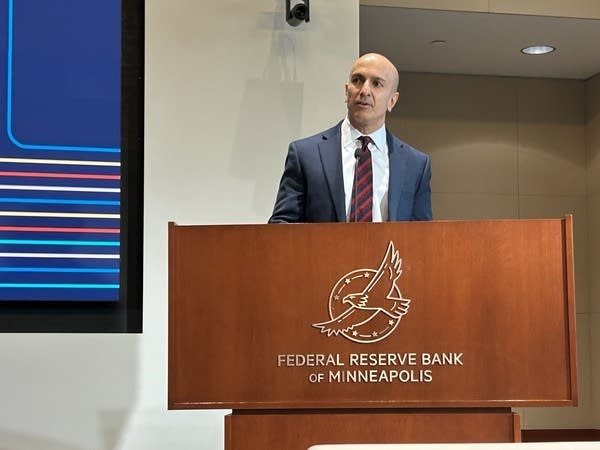
The president of the Federal Reserve Bank of Minneapolis, Neel Kashkari, is worried about the potential for the Iran War to heighten inflation.
Kashkari is currently a voting member of the Federal Open Market Committee, which sets a benchmark rate that aims to keep prices stable and unemployment low. He agreed with the committee’s recent decision to hold rates steady, but he disagreed with language in the committee’s policy statement that signals future rate cuts.
In its statement, the committee said, “In considering the extent and timing of additional adjustments to the target range for the federal funds rate, the Committee will carefully assess incoming data, the evolving outlook, and the balance of risks.”
That’s a signal that the committee is leaning toward cutting rates, Kashkari said, because it first introduced that language following a rate cut.
In an article titled “Why I Dissented” published Friday, Kashkari said the Iran war is causing too much uncertainty to indicate the committee will cut rates soon.
If the conflict ends soon, he said the best policy response could be to hold rates steady for an extended period before gradually lowering them. But he said if the Strait of Hormuz stays closed for long, prices could rise more than expected, and the Fed may need to raise rates.
“Given the uncertainty about the path of the conflict and the resulting effects on inflation, employment and economic growth, I believe the FOMC should offer a policy outlook that signals that the next rate change could be either a cut or a hike, depending on how the economy evolves,” he said.
Two other members of the committee agreed with Kashkari, while another voted in favor of cutting rates now.
Divisions in the Fed
The 8-4 vote is the most divided the committee has been on a decision since 1992.
That’s significant because it reflects growing uncertainty about today’s economy amid the war and rapid advancements in technology, said Louis Johnston, an economics professor at the College of St. Benedict and St. John's University in Minnesota who specializes in macroeconomics and economic history.
“It's analogous to the 1990s because we don't know what the effect of a big technological breakthrough is going to be on the economy, and so the Fed doesn't quite know what to do,” he said. “Back then it was the internet. How is this going to affect productivity? How is this going to affect the way people spend and save? How is this going to affect the way businesses do investment?”
Johnston said similar questions are in play today, “and the answers you come up with are going to affect whether you think interest rates need to be higher, lower or stay the same.”
Kevin Warsh, the Trump administration's pick to replace Jerome Powell as chair, for instance, wrote in the Wall Street Journal that, “AI will be a significant disinflationary force.” But others in the Federal Reserve have cautioned against cutting interest rates under that premise.
If confirmed, Warsh would replace Trump ally Stephen Miran on the Federal Reserve Board of Governors. Miran, who holds a seat with an expired term, was the sole vote to cut interest rates this week.
Powell stays on
The committee’s meeting was the last one with Powell as Fed chair. He announced Wednesday he intends to stay on the Federal Reserve Board of Governors, and therefore remain a voting member of the rate-setting Federal Open Market Committee, until the criminal investigation into him “is well and truly over.”
The investigation was dropped last week, but U.S. Attorney Jeanine Pirro said she will “not hesitate to restart a criminal investigation should the facts warrant doing so.”
The last time a chairman did not step down as a governor when their chair term expired was 1948.
“President Trump could have appointed two people to the board if he'd have been nice to Jerome Powell, but he's not, and so Powell is staying, and President Trump only gets to appoint Kevin Warsh and nobody else,” Johnston said.
“(Powell) is going to have a seat at the table and have a vote, and that's going to be there for up to two more years, rather than someone who might have a different perspective,” he added. “I think that could make a difference.”