
New Delta One Lounge opening at LAX in 2027


Delta is doubling down on Los Angeles International Airport (LAX).

The airline has announced plans to open its second Delta One Lounge at the airport soon, meaning LAX will be the only hub (so far) with two of the airline’s swanky international business-class lounges.

SEAN CUDAHY/THE POINTS GUY

The new Delta One Lounge at LAX will be in Terminal 2, while the existing Delta One Lounge at LAX is in Terminal 3. Delta operates out of both terminals, which are connected airside into one large operational hub.

The existing Delta One Lounge offers a private check-in entrance in Terminal 3, where passengers can pass through an exclusive Transportation Security Administration checkpoint before taking an elevator directly to the lounge entrance several levels above. The experience will presumably be similar at Terminal 2.

While details are still scant, the new LAX Terminal 2 Delta One Lounge promises its own private check-in area, complete with a security checkpoint and transportation directly to the lounge.

Delta One Lounge at Los Angeles International Airport (LAX). SEAN CUDAHY/THE POINTS GUY

The move comes as part of Delta’s increased focus on LAX as a hub, including the planned launch of new nonstop service from LAX to Hong Kong International Airport (HKG) on June 6 and LAX to Chicago’s O’Hare International Airport (ORD) on June 7.

The lounge also comes as part of a major infrastructure investment at the city’s airport ahead of the 2028 Summer Olympic and Paralympic Games, during which Delta will be the official airline of Team USA.

In addition to LAX, there are currently Delta One Lounges at several of the airline’s other hubs, including:

Reward your inbox with the TPG Daily newsletter

Join over 700,000 readers for breaking news, in-depth guides and exclusive deals from TPG’s experts

Interestingly, the airline does not yet have a Delta One Lounge at its megahub of Hartsfield-Jackson Atlanta International Airport (though one is currently in the works).

SEAN CUDAHY/THE POINTS GUY

As for the amenities at the new Delta One Lounge at LAX, the airline has not yet shared details. However, the existing lounge at LAX (as well as other Delta One Lounge outposts) offers a la carte dining and bars featuring specially created signature cocktails. The JFK location has its own shower suites, though the other ones share shower facilities with adjacent Sky Clubs. Some lounges feature relaxation and wellness areas with massage chairs (though no spa services are offered).

Both the Delta One Lounge and Delta’s massive Sky Club at LAX also have expansive outdoor decks overlooking the tarmac. So, perhaps planespotters will get yet another perch from which to watch takeoffs and landings.
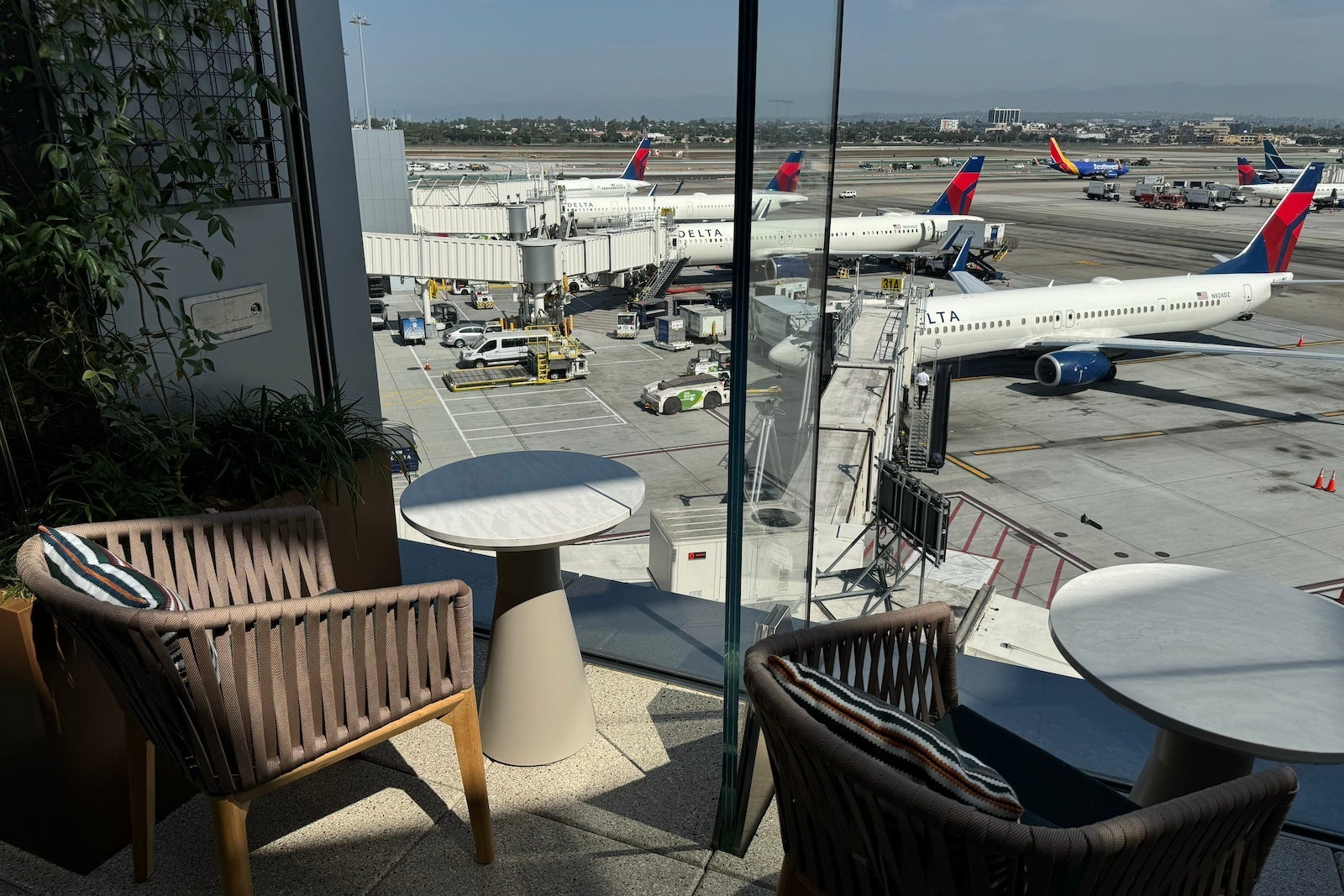
SEAN CUDAHY/THE POINTS GUY

Delta One Lounge access

Now for the big question: Who will be able to access the new lounge once it opens?

Unfortunately, carrying a premium credit card won’t help you. Instead, you’ll have to be one of the following:

  • A traveler flying on a same-day departing or arriving Delta One flight
  • An invitation-only member of Delta 360 departing or arriving on a same-day ticket in Delta first class
  • A traveler departing on a same-day or connecting flight on select partners in the following cabins: Air France La Premiere, Air France long-haul business class, LATAM Premium business class, KLM long-haul business class, Korean Air First Class and Prestige Class, and Virgin Atlantic Upper Class

Bottom line

Delta is bringing a swanky second Delta One Lounge to LAX sometime in 2027 ahead of the 2028 Olympic Games. That’s great news for flyers out of the airline’s increasingly important West Coast hub, and it should alleviate some crowding issues in the airline’s existing lounges at LAX. We’ll continue to report on this story as new details and developments emerge.


Source link

Leave a Reply

Subscribe to Our Newsletter

Get our latest articles delivered straight to your inbox. No spam, we promise.

Recent Reviews


What is a Mapplet?

A Mapplet is an object that can be reused. It will be created in the Mapplet Designer. It includes a set of transformations and allows us to reuse transformation logic in more than one Mapping. Let us understand Mapplets with an example. Consider you have some fact tables which need a series of dimension keys. We can create a Mapplet with a series of Lookup transformations to find every dimension key. We can use this Mapplet in every fact table Mapping instead of recreating the same search logic in every Mapping. As a reusable transformation, any changes to the Mapplet are inherited from every instance of the Mapplet. A Reusable transformation refers to any rule or transition logic defined on the data that will be transformed from source to destination via Mapping, and it can be provided more than once with various methods and logic. it can be used for other transformations.

Mapplet is applicable to mapped data. The source object and the target object will be defined and stored in the database. A logic to be transformed is defined by offering a Mapplet Input that transmits the data from Mapping to Mapplet. After that, a desired Mapplet output transform transmits the Mapplet data to Mapping. So the Input-Output transformations will evolve into cyclic Mapping, transaction logic and reused data without any impact on the data.

Become a Informatica Certified professional by learning this HKR Informatica Training  !

Why Mapplets?

The Mapplets are created to serve two primary purposes:

Whenever we load new data into a table, some space occurs in the source system, and whenever a new transformation is required to be configured on each Mapping. Mapplets are created to prevent this repetition of the creation of the transformation expressions and to end the unwanted space that is formed in the source system. 
On each workflow that is running in the system, a batch id will be formed according to the timestamp of the session using a Mapplet.

Become a Informatica Certified professional by learning this HKR Informatica Training In Hyderabad  !

Informatica Certification Training

  • Master Your Craft
  • Lifetime LMS & Faculty Access
  • 24/7 online expert support
  • Real-world & Project Based Learning

Informatica Mapplet features: 

  • A Mapplet is used to define key data source definitions as well as a source qualifier for providing the data for Mapping.
  • A Mapplet may not have the source definition of the data. Mapplet may accept this data as well from a mapping process via Mapplet input ports.
  • A Mapplet may have several transformations. 
  • The data may be transformed into several pipelines. A Mapplet may include several groups of output ports/groups which may be connected to one another via various pipelines in the Mapping.


Mapplet Components:

For using a Mapplet in Mapping, we must configure the Mapplet for input and output. Apart from the transformation logic we are configuring, a Mapplet includes the following components:

  • Mapplet ports
  • Mapplet input
  • Mapplet output 
Mapplet Ports:

It will be available only in the Mapping Designer. The Mapplet ports comprise the input ports of the input transformations and the output ports of the output transformations.

Mapplet Input:

The Mapplet input may come from the source definition or from the Input transformation within the Mapplet. Several pipelines can be created in a Mapplet. Utilize several source definitions as well as the input transformations or source qualifiers. Alternatively, you can use a mixture of input transformations and source definitions.

Mapplet Output:

The Mapplet output consists of transformation for passing the data through the Mapplet into the Mapping. At Least one output transformation is included in the Mapplet that includes at least one connected port in the Mapplet. Every port connected in the output transformation displays as a Mapplet output port in the Mapping. Every output transformation in the Mapplet is displayed as the output group in the Mapping. The output group may transmit data to several pipelines within the Mapping.

Want to gain knowledge in Informatica BDM? Then visit here to learn Informatica BDM Training!

HKR Trainings Logo

Subscribe to our YouTube channel to get new updates..!

Creation of a Mapplet in Informatica:

The creation of Mapplets involves three steps.

  • First, we must add, connect and then configure the transformations using a transformation logic.
  • Then we need to save the Mapplet using a unique name.
  • Now we can use this Mapplet in the Mapping.
     

When dealing with the Mapplets, mistakes can be avoided by:

  • One of the best ways to avoid mistakes in Mapplets is to comment on every input as well as output transformation that is made in Mapplets so that they will remind us why we have made them.
  • Avoid making modifications to source data datatype, data accuracy or select ports that are connected in the I/O transformation, from the passive to active Mapplet.
     

Follow the rule and guidelines while adding transformations to the Mapplet:

  • When you are using the sequence generator transformation, you should use the reusable sequence generator transformation.
  • When you are using the stored procedure transformation, you should configure the stored procedure Type as Normal.
  • The PowerMart, 3.5 style LOOKUP functions, cannot be included in a Mapplet.
     

Following are the objects that cannot be included in a Mapplet:

  • COBOL sources
  • Normalizer transformations
  • Other Mapplets
  • Target definitions
  • XML sources
  • XML source qualifier transformations
  • Pre and post-session stored procedures
  • Non-reusable sequence generator transformation
     

While reusable shortcuts and transformations in the Mapplet can be used, for protecting the Mapplet validity, use a copy of the transformation rather. Reusable transformations or shortcuts inherit modifications to their original transformations. This could disable the Mapplet and Mapping, which utilizes the Mapplet.

Top 30 frequently asked Informatica Interview Questions !

Informatica Certification Training

Weekday / Weekend Batches

Conclusion:

In this blog, we have learned about Mapplets, why we use Mapplets, Mapplets features, components of a Mapplet and how to create a Mapplet. We hope you found this information helpful!. For more blogs like this, stay tuned to HKR Trainings. 

Related Articles:


Source link