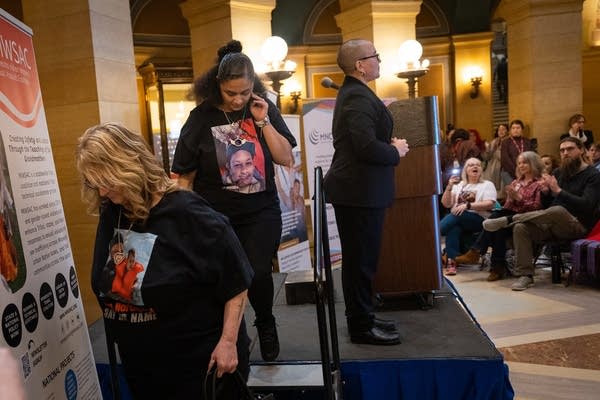
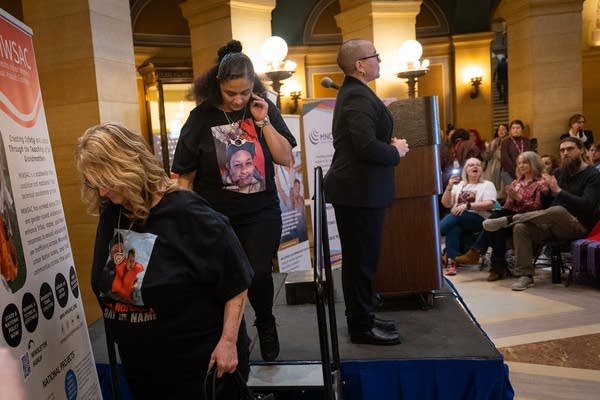
Some friends and family of the late Sam Nordquist, 24, from Oakdale, say they saw warning signs in his girlfriend’s controlling behavior. Still, they were mostly supportive of his plans to visit her in the Finger Lakes region of New York.
He had quickly fallen in love, over the phone and on TikTok, with a woman 14 years older than him and the mother of three children.
Nordquist, a transgender man, left Minnesota in September 2024 to visit Precious Arzuaga, then 38, at her Hopewell, N.Y. apartment. He had a ticket to return home the next month, but he never got to use it.
In February 2025, according to case court documents, one of his accused killers, Kyle Sage, led New York State Police investigators to Nordquist’s body in a rural field in Benton, N.Y. He was wrapped in black plastic bags, according to his mother.
Arzuaga and six others were charged in the killing, according to a Grand Jury indictment.
Kayla Nordquist is Sam Nordquist’s older sister. She speaks frequently about her younger brother at events centered on domestic violence. In January, she spoke at a Violence Free Minnesota gathering honoring those killed by their partners.
She said he was love and laughter, with a heart that trusted deeply. Kayla Nordquist dispelled a myth of relationships that turn unhealthy and abusive.
“Violence rarely starts with fists,” she said. Then she described her brother’s path.
“It starts with control designed as care, with isolation that looks like protection, with fear, slowly replacing love,” she told fellow survivors.
Meggie Royer with Violence Free Minnesota told MPR News that friends and family often look for signs of physical injury when they worry a loved one is in a troubled relationship. But she said emotional abuse can be harder to recognize.
Kayla Nordquist and her mother, Linda, look back at that time when Sam was in New York. They noticed Sam, who had always been talkative, communicating less and less with his family. At one point, after he was supposed to return home to Oakdale, Kayla Nordquist says he blocked her on Snapchat. That was their main platform for communicating, and she later learned it was Arzuaga who did the blocking.
Royer said that kind of withdrawal may signal that someone is being isolated by their partner.
“They're kind of being controlled in terms of where they can go and who they can talk to.”
But the people in a survivor’s or victim’s circle, like Kayla Nordquist, may not be able to address the behavioral shifts they see.
Sam’s sister said at the Violence Free event that her gut told her something was wrong.
“I watched him change. I watched him — watched pieces of him fade,” Kayla Nordquist said. “I live with that truth that the signs were there, even if I didn't have the language for them.”
Ashlee Youngs worked with Sam Nordquist at a group home in Shoreview. She said she had known Nordquist for six years. But in the year before her friend was killed, they had grown close.
“If you would just think of somebody goofy, like sagging in their pants, jumping around, just making goofy faces, that was Sam,” Youngs said.
Youngs said she first met Arzuaga over FaceTime, because Arzuaga and Nordquist would video chat while Nordquist was at work. Even if he had work to do, she said, Arzuaga insisted that he keep the phone on, so she could see what he was doing.
“He was not allowed to be off the phone with her,” she also said. Nordquist’s girlfriend would go to movies and would have him on FaceTime with her.
“It's not like they were talking,” Youngs said. The girlfriend would have the phone on the ground, or she would carry it.
It got to “the point that they fell asleep on the phone, and they would wake up, and they'd be on the phone,” she said.
If Sam’s phone died in the middle of the night, according to Youngs, his girlfriend would call in the morning.
“She would yell and scream like, ‘Why’d you hang up on me? What are you doing?’”
Youngs said she tried to say something to Nordquist.
“‘That's a red flag,’” she told him. “‘She's a little too clingy, like, she's 38, you're 24, and we have to be on the phone all the time? Like, that's not healthy.’”
Such situations are common, according to Royer. She hears it from survivors and from advocates working with survivors. It’s about power and control when it comes to communication, she explained.
“I think it’s also just excessive jealousy, like you're not allowed to be without me.”
Royer also says growth of technology — cell phones and social media — has played a role here.
“Abusive partners are using these tech devices to monitor, control and surveil their partners.”
Youngs said Nordquist didn’t seem to care. He said he was in love with Arzuaga and wanted to marry her, according to Youngs.
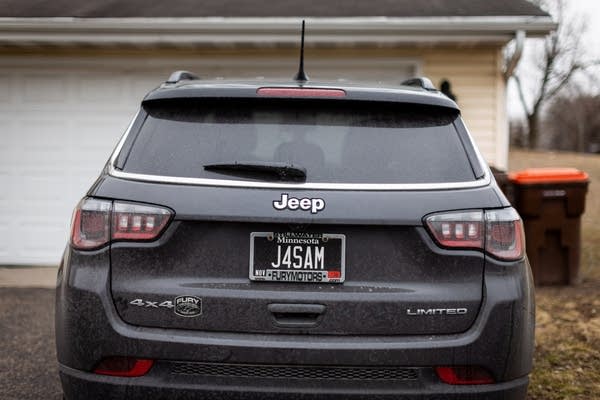
Before Sam Nordquist traveled to New York, Youngs and another colleague joked with Nordquist about his first time in the state. They came up with code words Nordquist could use if he was in trouble.
“We weren’t thinking with her, we were thinking of him alone in New York, like he wanted to explore while she was at work and got lost,” Youngs said.
The code was as follows: Green apple meant “Call me, get me out of here. I’m OK, but I need help.” Red Apple meant danger. Call 9-1-1 and the FBI.
“It was never like a real thing. It was just supposed to be a joke.”
One day, while Nordquist was still in Hopewell, N.Y., he was texting in a group chat with Youngs and another colleague. It was a few days before Nordquist was supposed to return to Minnesota.
“He was so excited to get home,” Youngs said.
That night in the chat, Nordquist asked his friends what time Super 8 Motel check-ins were. Later, while Youngs was asleep, Nordquist texted the group: “I’m in a red apple mood,” followed by a red apple emoji and a smiling face with a tear.
Youngs says she saw the message the next morning, but didn’t understand what he meant.
“I said, ‘What is going on?’ Two hours later, it was blocked. I never spoke to him again.”
She suspects the girlfriend blocked her.
Youngs says she called Linda Nordquist the day after Sam Nordquist was supposed to return to Minnesota. Linda Nordquist had called law enforcement to conduct a wellness check at the Hopewell apartment where Sam was staying. Sam Nordquist hadn’t come home.
According to Linda Nordquist, she learned from the police that they found Sam at the apartment.
“Sam and Precious both came to the door, and the police asked Sam if he was okay, and he said he was fine,” Linda Nordquist said. “They left where they should have separated them and talked to them.”
Linda Nordquist said if she had known then what she knows now, that the pair wasn’t separated, she would have asked police to check in with her son again.
“I would have absolutely would have called back immediately and said, ‘Well, do another one and separate them.’ But I didn't know.”
Royer says she doesn’t know the details of the situation but people might be more forthcoming if they are able to speak in private.
“If they're around other people or they're around their partner, they are probably afraid of saying anything otherwise, other than just, ‘I’m fine,’” Royer said.
“Private conversations are a good opportunity to share domestic violence resources to a potential survivor,” she added. The person may feel more comfortable sharing if they are in a dangerous situation.
In December 2024, Linda Nordquist says, she received an email from a social worker at the local Department of Social Services in New York.
The social worker told her in the email that Sam had visited her office and to call as soon as possible. Two days later, when Linda read it, she got on the phone.
“They told me that Sam couldn't remember my number by heart, and that Precious was controlling and keeping his phone, and that Sam wanted to come home, and that they were going to try and have an escape plan,” she said.
The social worker wanted to put Nordquist on a bus to Minnesota, his mother said.
“Escape plan for what? It was pretty simple, you could have locked that door, kept Sam there, locked the door, called the police, end of story,” Linda Nordquist said. “Sam would still be here.”
But they didn't do that, she added.
“They didn't even follow up, because Sam was supposed to come back and never showed up.”
Sam Nordquist would have turned 26 years old on June 18. His family celebrated his birthday at Cosetta’s in downtown St. Paul. After dinner, they visited the cemetery where Sam was laid to rest. His mother left him a vanilla mini-cheesecake on his grave.