
Report: Feds violated Minnesotans' human rights


An agent points a munition launcher

Human Rights Watch has released a comprehensive report detailing human rights abuses by the government during this winter’s immigration enforcement surge in Minnesota, which the group alleges also violates international human rights treaties that the U.S. is signed onto.

The 186-page report highlights how government agents stopped or detained thousands of people during the surge, including many U.S. citizens or people approved to live and work in the United States. The group alleges that many of the arrests made by federal agents were arbitrary, race-based and violated residents’ human rights.

A spokesperson for the U.S. Department of Homeland Security sent an extensive response to the report to MPR News, which disputed Human Rights Watch’s findings. The U.S. Department of Justice did not respond to requests for comment on this report.

“This story only reveals how the media manipulates data to peddle a false narrative that DHS is not targeting public safety threats,” a Homeland Security spokesperson said. “Nationwide our law enforcement is targeting criminal illegal aliens — including murderers, rapists, gang members, pedophiles and terrorists.”

Researchers documented a court case involving 23 residents who were allegedly stopped by federal agents for race-based reasons, including one citizen of Somali descent who believed she was stopped for wearing a hijab and the color of her skin.

“Many arrests or detentions appear to have been the product of racial profiling that violates the right to nondiscrimination, while others appear to have violated the rights to freedom of expression and assembly, including the rights of human rights defenders,” according to the report.

A Homeland Security spokesperson said in an email that allegations their agents use racial profiling are “disgusting, reckless and categorically FALSE.”

A teenager detained
Border patrol agents detain a 16-year-old who gave his name as Jamie on Blaisdell Avenue in Minneapolis on Jan. 21.
Ben Hovland | MPR News

Human Rights Watch also spoke to observers who were arrested after agents said they were “impeding” by following them, including those who had their vehicle windows smashed and were thrown to the ground and arrested.

“The threats and excessive use of force by federal agents terrified residents and had a chilling effect on their exercise of the rights to freedom of expression, association and peaceful assembly,” according to the report.

The group also seeks to counter claims from federal officials that they were targeting illegal immigrants with criminal records. Human Rights Watch researchers found that the majority of the immigrants detained had no criminal record, which MPR News and other news organizations have also reported.

Homeland Security disputed those numbers, alleging that more than two-thirds of immigrants arrested in the United States have criminal or pending criminal records, although they didn’t provide a source for that number. The Transactional Access Records Clearinghouse, which pulls together public documents and data, reports that about 70 percent of those detained nationally currently have no criminal record.

Researchers with the organization also spoke to people who were detained and who reported unhealthy conditions in detention facilities including overcrowding, dirty cells and a lack of access to health care. Attorneys and detainees also criticized the government for failing to immediately comply with court orders to release detainees. The report also found that detainees were often denied access to their attorneys while in detention, all of which Homeland Security has denied.

“At Whipple, many individuals were subjected to overcrowded dirty cells, continuous shackling and bright lights, and they had to sleep on cold floors without beds or bedding,” according to the report. “The conditions Human Rights Watch documented at Whipple violated the prohibition against cruel, inhuman or degrading treatment.”

Related Story Lawmaker decries conditions at Whipple

The report details the government’s response to Minnesotans who organized against them or observed them, which included surveillance, harassment and arbitrary arrest. It also documents the excessive force that agents routinely used against residents, including the use of chemical munitions, smashed car windows and the shooting of three Minneapolis residents.

A Homeland Security spokesperson said the First Amendment protects speech and assembly, “not rioting.” They defended the actions of agents as necessary to “protect our officers and the public from dangerous rioters.” The spokesperson also defended the killing of Renee Good, saying that the agent “fired defensive shots.”

MPR News covered numerous incidents where federal agents used force or chemical munitions on peaceful observers during the surge. A federal judge also took actions to temporarily ban the federal agencies from arresting or using chemical weapons on peaceful observers.
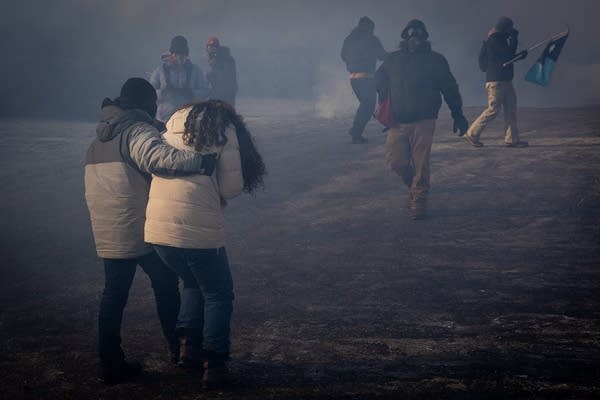
people walk through gas
People walk through a cloud of teargas near the intersection of 27th Street and Nicollet Avenue in Minneapolis after federal agents shot and killed 37-year-old Alex Pretti on Jan. 24.
Ben Hovland | MPR News

Human Rights Watch is calling on the government, and elected officials like prosecutors, to take steps to hold officials and agents who violated people’s rights during the surge accountable for violations of state criminal laws, violations of observers constitutional rights and unlawful surveillance.

The organization is also calling for both the U.S. Congress and the Minnesota state government to hold hearings to investigate what occurred in Minnesota over the winter. They also recommend that the United Nations make recommendations to the U.S. government to ensure accountability for human rights violations. Among the group’s recommendations to Congress is that they pass legislation restricting the use of masks and unmarked vehicles by federal law enforcement.

“Accountability has also been curbed by the widespread use of unmarked vehicles and face coverings by federal immigration agents, making them unidentifiable, potentially emboldening their abusive behavior and making it more difficult to report,” according to the report.

The organization’s staff interviewed 136 people for the report, including immigrants, attorneys and government officials. They also analyzed 52 videos and photographs taken during the surge after confirming they were real.

Human Rights Watch has requested access to the Whipple Federal Building, where many detainees are held, but have not received a response from Immigration and Customs Enforcement. The group has also sent summaries of the report to federal agencies including the U.S. Department of Homeland Security, but has not received a response.




Source link

Leave a Reply

Subscribe to Our Newsletter

Get our latest articles delivered straight to your inbox. No spam, we promise.

Recent Reviews


Being a founder is awesome. And it also really sucks.

It’s a huge amount of stress, disappointment and uncertainty, with little appreciation or guidance.

It’s perfectly normal to find yourself questioning what it all means.

I’ve been there myself… questioning whether the sleepless nights and stress was worth it. And now, I’m often the person founders turn to when they do the same.

In this essay, I wanted to talk about happiness, purpose, and how to get more of it when you’re constantly living in survival mode.

Three Types of Happiness

Martin Seligman, the father of positive psychology, describes three distinct paths to happiness: the pleasant life, the engaged life, and the meaningful life.

  • The pleasant life is about pleasure—closing a deal, hitting a milestone, getting some great customer feedback. As a founder, there’ll be phases where pleasure is hard to come by. Clearly, you can’t build a founder life on pleasure alone.
  • The engaged life is about flow—the state when you’re fully absorbed in solving a hard problem. Most founders have this in spades early on, but as their companies grow, their role can evolve away from flow. Being out of flow is often a signal you need to redesign your role.
  • The meaningful life is about purpose—the sense that what you’re doing matters. Unlike pleasure and engagement, meaning doesn’t require things to be going well. It sustains you through the hard times, not just in spite of them.

So when times are hard, meaning is what we can return to. Unlike pleasure and engagement, meaning is up to you.

And it’s work you can start right now.

How to Make Meaning

So how do you actually build meaning, even when you can barely see past next week? A meaningful life has three components:

  • A meaningful future
  • A meaningful past
  • A meaningful present

Creating meaning in each is an act of creativity. It’s an active process in which you assign meaning to things.

If you aren’t intentional about this, your brain will assign meaning for you. And if you’re not feeling great, your brain will come up with interpretations that match and then reinforce the negative feelings.

What I’m about to share with you is the process I run through when my clients start questioning themselves, and what they’re building.

1. A Meaningful Future

In Man’s Search for Meaning, Viktor Frankl documented the atrocities of the concentration camps. He writes:

“Any attempt to restore a man’s inner strength in the camp had first to succeed in showing him some future goal.”

A lot of modern therapy fixates on the past. But Frankl realised that getting clear on our future goal is even more powerful.

When it comes to founders, they often have goals… but unless you’re fully pumped, your goals need refinement. 

I commonly see three issues with a founder’s goals:

  • They have too many goals. We accumulate goals over time, but we rarely sit down and remove goals. For example, you had goals when you were 18 years old. Most of these have been parked, but some might still be guiding you now.
  • The goal isn’t big enough. For most founders, the more ambitious the goal, the more energy it unlocks. Just increasing the size of the goal can act as a powerful clarifying force for what matters.
  • The goal isn’t framed by its meaning. It’s the difference between ‘I want to make $100M’ versus ‘I want to help 10,000 customers avoid what happened to me’. One is financial, the other is personal.

Refining and reconnecting to your primary goal is critical for building a life of meaning.

Questions to work through:

  • What’s the biggest and most exciting goal you can dream up?
  • If that was your primary goal, what other goals stop being relevant?
  • What people or person could the bigger goal attract that would make it achieving it easier?

2. A Meaningful Past

Being a founder can sometimes feel like a full-contact sport. You can get hurt, through disappointment, bad luck, and even betrayal. That’s why painful events in the past need to be treated like a wound.

When we don’t process the past, unhelpful stories we tell ourselves to protect our ego can cause havoc in the present.

Treating the past means framing every single thing that happened in two ways:

  • A win: an accomplishment that we can celebrate.
  • A lesson: a failure that we learn from, that we can celebrate.

We leave everything else behind. If, for some reason, we can’t let something go, it means we haven’t learned something important from it. As my mentor used to tell me: failures will be repeated until learned.

This work can be done separately, but it’s even more powerful to do it in the context of a big goal. This way, the wins and lessons can be aligned to the vision that truly excites us.

Questions to work through:

  • What is the meaning of what you’ve been through?
  • How did those experiences serve you?
  • Where are they failing to serve you today?

3. A Meaningful Present

Here’s the thing: the future and the past don’t physically exist. They’re tools to help us act in the present.

Often, clarifying the meaning of a bigger future and a happier past makes changing the present obvious and necessary.

As founders, it’s easy to be driven entirely by the past: old goals, old activities, old habits. This stops us from growing. And a lack of growth is one of the fastest paths to feeling meaningless.

Most founders I work with don’t need to do more. They need the courage to do less.

Growth often requires us to:

  • Start doing something we haven’t done before
  • Stop doing something we’ve already mastered
  • Double down on getting even better at some things

The meaningful present is about making these changes — aligning how you spend your time with the future you’ve defined and the lessons you’ve drawn from the past.

Questions to work through:

  • What is the biggest bottleneck to making the big goal viable?
  • What do you need to stop doing—even if there’s a cost involved?
  • What do you need to delegate?

Happiness Isn’t Always Happy

A meaningful life isn’t always smiles and rainbows. It comes with difficulty, sacrifice, and discomfort. But it’s the thing that keeps you going when pleasure and engagement can’t.

If you’re a founder questioning what it all means, the answer isn’t to push harder or to quit. It’s to invest time in making meaning.

Start with the future. Let it reshape the past. And then rebuild the present around what actually matters.

Related Reading: 


Originally published on March 11th, 2026


How do top founders actually scale?

I’ve coached CEOs for 10,000+ hours—here’s what works.
Join 17,000+ founders learning how to scale with clarity.

Unsubscribe any time.


Source link