
SAP Ariba Network | A Complete Overview On SAP Ariba Network


Introduction to the Ariba Network:

Ariba is a hosted service that helps suppliers and buyers to establish a relationship and conduct transactions online. As a supplier, you might already have an existing relationship with customers who invite you to collaborate and form a relationship on the Ariba network. Most of the buying organizations (buyers), make use of the Ariba network to enable electronic processing of orders and invoices with existing suppliers. Once a supplier accepts an invitation, the buyers can able to view the supplier’s catalogs and place the orders. Now suppliers can receive your orders, create, and send order confirmations, advanced shipment notices, and invoices if the buyers accept these documents. Then buyers finally will send the payment documents to the supplier to document about invoices. Both the buyers and sellers use the Ariba network as a chain to establish their business network. 

 Become a SAP Arbic Certified professional by learning this HKR SAP AribaTraining !

Benefits of using the Ariba Network:

The following are the primary benefits of using the Ariba network;

Respond to the business opportunities

Ariba network enables suppliers to search for and attend to online sourcing opportunities created by buying organization views. A business opportunity might request various information such as RFI (remote function call), a request for quote (RFQ), and a request for proposal (RFP) or a negotiation.

Automate the business processes

Ariba network enables buyers and suppliers to automate their certain tasks such as creating business aspects, offering improved business practices, and also reduces the costs.

Publish and control access to electronic catalogs

with the help of the Ariba network, suppliers have full control over which customers hold access to their catalogs. This approach enables suppliers to generate catalogs that consist of the special items or any contract prices for specific customers.

Conduct business in a secure and reliable environment

Ariba network is one of the most secured e-commerce service providers and provides different reliability features. The reliability features include catalog security, transaction security, and transaction reliability.

SAP Ariba Training

  • Master Your Craft
  • Lifetime LMS & Faculty Access
  • 24/7 online expert support
  • Real-world & Project Based Learning

Types of Ariba business network:

Below are the types of Ariba business networks such as;

  • Buying organization view.
  • Suppliers view 
  • Purchase order life cycle  

Let us know them one by one;

Buying organization view

Buying organization view can make use of the SAP procurement solutions such as SAP Ariba buying and invoicing to create purchase orders and enable to send them through the Ariba network to the respective customers.
Buying an organization view can also able to use SAP Ariba commerce Automation to transmit cXML documents between the external ERP system and Ariba network applications. In the SAP Ariba network, each buying organizations have access to buying accounts on buyers.ariba.com. 

Buying organization uses the SAP Ariba network for the following purposes:

  • To search for suppliers with products and services they need 
  • To Invite suppliers to form a trading partnership 
  • To send purchase orders and receive invoices 
  • To Receive order confirmatIons and ship notices 
  • To Send payment documents
  • Run reports on their suppliers

With the help of SAP Ariba discovery, the buying organizations can search for suppliers, publish postings for the goods and services, receive bids, and reward supplier products.

Suppliers view

A supplier in an Ariba network that sells any type of products or services. One more benefit of using the SAP Ariba network for the suppliers’ view is that suppliers can hold more than one account on supplier.ariba.com. 

Below are the possibilities that Suppliers view the offer, they are;

  • Access a network of high-volume buying organizations. 
  • Connect with specific buying organizations that are interested in the supplier’s products or services. 
  • Publish catalogs containing information and pricing that are customized for specific customers. 
  • Categorize products and services so that customers can find them when searching by category.
  • Select a routing method for the documents that best fit the supplier’s business needs—suppliers can receive documents through email, fax, online (using your Ariba Network inbox and outbox), cXML, or EDI, and send documents online.
  • Conduct transactions electronically by sending purchase order confirmations, invoices, and other documents. Ariba Network provides fast transmission, tracking, and processing of transactions.

 Become a SAP Certified professional by learning this HKR SAP Training in Bangalore !

The purchase order life cycle

Once suppliers successfully create their catalog files that define the products and services, they upload each detail on the Ariba network portal for validations and publish catalogs to the specific customers. 

Below are the possibilities that the purchase order life cycle offer;

  • Their customer uses their procurement application to browse catalogs for products and services and initiate purchase requisitions, which are routed through their organizations for approval.
  • Upon approval, the customer’s procurement application automatically converts the requisitions to purchase orders and sends them in cXML format to Ariba Network. 
  • Ariba Network sends the purchase orders to the supplier’s account where they can view them in their online inbox and receive them according to the selected routing method.
  •  If the customer’s business rules allow suppliers to send order confirmatIons, ship notices, and invoices through Ariba Network, suppliers can then send order fulfillment information and invoices electronically to their customers. 

The below diagram illustrates the overall Ariba network type cycle:
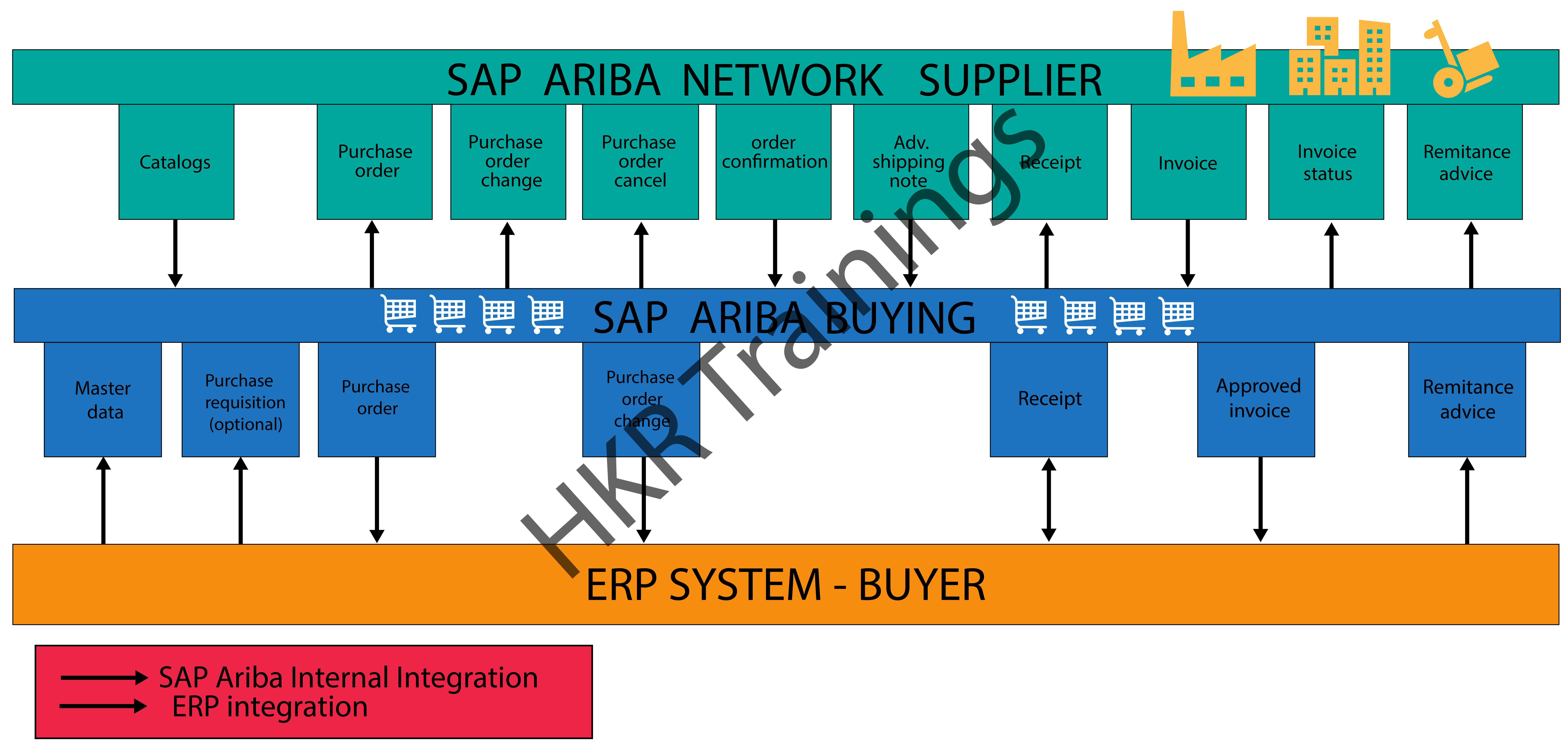
Ariba network type cycle

HKR Trainings Logo

Subscribe to our YouTube channel to get new updates..!

Ariba network sign-in configuration set up( with the help of SAP Cloud platform identity Authentication services):

Buyers users can login into the Ariba network’s buyers account with the help of SSO (single sign-on) authentication with SAML 2.0 through the SAP cloud identity authentication services. The main purpose is to configure the SAP Ariba network with a cloud platform is to provide secured authentications. These buyers support only new users onboarded using SAP identity access management. The Ariba network validates the username and distinguishes between native Ariba network users and users from the SAP cloud platform identity authentication service, whereas non-native users are redirected to the SAP cloud platform identity authentication service for authentication. So the native Ariba network users need to enter their password and sign in as usual. 

Here we are going to explain how the high-level workflow of users signing into the Ariba network is as follows:

1.A user enters the username in the Ariba Network sign-in page and clicks Next.

2. Ariba Network distinguishes between native and non-native Ariba Network users and redirects them to the relevant sign-in page.

Non-native users

1.Users are redirected to the SAP Cloud Platform Identity Authentication Service for authentication.

2. SAP Cloud Platform Identity Authentication Service validates the user-entered credentials and redirects the user to Ariba Network.

Native Ariba network users

1.Users are redirected to an Ariba Network sign-in page.

2. Ariba Network validates the user-entered credentials and displays the home page.

Connecting to Ariba Network using SAP Ariba cloud integration gateway:

The SAP Ariba cloud integration gateway is a fully self-service gateway that allows suppliers to integrate and configure to Ariba Network and perform online transactions seamlessly. 

With the help of the SAP Ariba cloud integration you can perform the below things:

  • Configure your integration between Ariba Network and your ERP application to manage one or more buyer-supplier trading relationships.
  • Specify the mapping configuratIon. 
  • Validate and self-test transaction documents.
  • Monitor and track the integration lifecycle overall.

 Become a SAP Arbic Certified professional by learning this HKR SAP AribaTraining in Mumbai !

SAP Ariba Training

Weekday / Weekend Batches

 Conclusion

The main aim of using the Ariba network is to have a good relationship between buyers and suppliers to sell or purchase their products and also enable them to do transactions over the internet. We hope that through this post you might have learned fundamental concepts such as introduction to the Ariba network, the purpose of using the Ariba network, Types, and the configuration setups.

Related Articles:


Source link

Leave a Reply

Subscribe to Our Newsletter

Get our latest articles delivered straight to your inbox. No spam, we promise.

Recent Reviews


Future Scope of IoT – Table of Content

What is the Internet of Things (IoT)?

The Internet of Things (IoT) is a network of interconnected systems that include sensors, electrical appliances, cameras, and other devices. They are programmed so that the Internet of Things (IoT) provides automation for the connected devices. Smart TVs, refrigerators, and air conditioners are examples of IoT devices that we see and use regularly. To operate these devices, we need to send commands to them using our smartphone application. We also use various portable IoT devices, such as smartwatches and wristbands, to monitor our pulse, blood pressure, and walking distance. All of this is possible thanks to the smart integration of technology and equipment to form an IoT product.

Furthermore, thanks to advances in AI and Machine Learning, the IoT’s future potential has grown significantly. The Internet of Things’ promise is not limited to healthcare. There are numerous other IoT implementations. This blog will discuss the Future scope of IoT in Agriculture, healthcare, automotive, and industry. Now, let us discuss the need for IoT.

Become a master of IoT by going through this HKR IoT Online Training!

Why is the Internet of Things (IoT) necessary?

Have you ever gone to the store and forgotten to turn off your air conditioner, fan, or lamp and felt helpless that you couldn’t return home to turn it off? This is where the Internet of Things (IoT) enters the picture. It will serve as a reminder for essential activities that you often forget. You can also use the smartphone application to connect your IoT-enabled home appliances from anywhere in the world.

The NFC (near field communication) smart ring is another fascinating IoT product.

These rings may be used for various purposes. They are rings made up of network connectivity, NFC chips, and sensors that allow you to share data. You can use NFC rings to pay your bills, access your car door with a simple swipe, and get smartphone messages. Isn’t it a fantastic idea that allows you to do anything by simply swiping the ring?

Much of this is made possible by the IoT devices’ links to Internet servers, allowing data to be shared and exchanged. This technology minimizes human labor and saves a significant amount of time.

Now, in this blog about the future of IoT, we’ll only look at how IoT devices function.

Working of an IoT

Smart mobile gadgets, local area networks, the Internet, cloud servers, and user applications make up the Internet of Things. A local network is used to link IoT devices.The information is then sent to the cloud servers through the Internet. The cloud servers also supply the IoT system with data or information from the end-user application.This knowledge exchange is a two-way interaction that aids in the operation of the IoT system.

As seen in the diagram below, an IoT structure consists of four main components.

IoT structure

  • IoT Devices: They are smart electronic devices with wireless sensors that assist in data sharing over the Internet.
  • Local Network: It aids in the retrieval of data from Internet-connected computers.
  • The Internet: It enables devices to communicate with consumer apps and servers.
  • Back-end Services: A remote server, user access and control, and smartphone applications are also included. 

These programs are still available to assist in exchanging streamed data from multiple IoT devices and end-user applications.

To effectively run an IoT device, these four components must be combined. Let’s take a look at some of the IoT’s future scope.

IoT Training

  • Master Your Craft
  • Lifetime LMS & Faculty Access
  • 24/7 online expert support
  • Real-world & Project Based Learning

IoT Future Scope

The Internet of Things (IoT) has risen to prominence as a global technology. It has grown in popularity in a short period. Moreover, advances in Artificial Intelligence and Machine Learning have made IoT device automation easy. In general, AI and machine learning programs are paired with IoT devices to provide proper automation. As a result, the Internet of Things (IoT) has broadened its field of application across various industries. We will address the implementations and potential IoT scope in the healthcare, automotive, and agriculture industries in this blog.

Scope of IoT in Healthcare

We’ll look at the future of IoT in the healthcare sector in this section. The Internet of Things has proven to be one of the most useful technologies in the healthcare industry. It aids in the provision of specialized healthcare to patients, doctors, and researchers. Smart diagnosis, wearable devices for tracking health, patient engagement, and several other services are available. Besides, IoT applications have alleviated undue pressure on the healthcare system.

On a secure network, healthcare devices can deliver patients’ health data directly to physicians. This enables physicians to diagnose patients in outlying areas.

The following are some of the reasons why IoT is useful in the healthcare industry:

1. Treatments by reducing errors

There is a reduction in manual errors in diagnosing patients due to IoT devices. As a result, patients will receive timely care. Besides, compared to manual diagnosis, 24/7 diagnosis by gadgets provides a clearer picture of patients’ wellbeing.

2. Cost reduction in treatments

In addition to other medical costs, manual diagnosis takes time and necessitates the use of a range of expensive equipment. In addition to other medical costs, manual diagnosis takes time and necessitates a range of costly equipment. Using IoT modules, we can reduce these costs. Besides, since patients can be diagnosed at their respective locations, hospital costs and congestion can be reduced.

3. Availability of specialists in remote locations

The Internet of Things addresses one of the healthcare industry’s major issues: the scarcity of doctors, especially specialists, in rural areas. The care of patients in the absence of doctors is now possible due to the Internet of Things. All that is required for the patients is that they must wear the device.The computer would then submit all of the real-time data about the patients’ wellbeing to the appropriate doctors for analysis.In this way, the Internet of Things’ reach is assisting the healthcare sector in providing adequate services to the needy.

frequently asked IoT Interview questions and Answers !!

others, future-scope-of-iot-description-1, others, future-scope-of-iot-description-2

Subscribe to our YouTube channel to get new updates..!

Scope of IoT in Agriculture

Food is one of the three essential human needs. We farm to meet the demand for food. However, as the world’s population grows, the agricultural industry is confronted with numerous challenges. Changes in weather and the environment also have a significant effect on the agriculture industry. The industry has turned to technology to boost productivity to meet the growing food demand. Precision farming, agricultural drones, and smart farming apps are all part of it. All of this is installed on top of an Internet of Things framework. 

Precision farming

Information and Communication Technology is a tool for smart farming in agriculture. Crop fields are monitored with the aid of IoT-based devices. Sensors are used in the technology to measure soil moisture, humidity, and temperature. It also allows effective use of water by using an automated irrigation system. Precision farming will enable farmers to keep track of their crops and increase productivity.

Drones used in Agriculture

One of the best Internet of Things applications is agriculture and farming drones. They’re used to make agricultural processes more effective. Drones are used in agriculture to plant crops, irrigate fields, spray pesticides, and track the fields. It’s easier to assess the health of crops with the aid of drones. All of this is made possible by smart IoT-based devices used to create agricultural drones.

Smart greenhouses

Farmers use greenhouse farming to enhance the productivity of crops. Manual intervention is used to monitor the environmental factors that influence crop growth in greenhouse farming. Manually regulating the process for crop development, on the other hand, is less productive. The Internet of Things (IoT) and technological advances have led to the creation of IoT-based greenhouses that include sensors, climate controls, and other devices.

These IoT devices aid in the measurement of different environmental factors under plant requirements. Since all sensors and devices communicate with each other through the Internet, they provide accurate information about the environment’s current state. The devices then trigger actuators that control greenhouse heaters, fans, windows, and lighting to match the environment.

This is how the Internet of Things is helping to boost agricultural production.

Scope of IoT in the Automotive Industry

The Internet of Things is revolutionizing the automobile industry in the twenty-first century. One of the most significant applications is creating self-driving vehicles, which has altered the automotive industry’s trends. Engineers developed Self-driving cars to reduce human mistakes and ensure a smooth ride. Self-driving cars are being developed by several firms worldwide, including Google, Tesla, Mercedes-Benz, Volvo, Audi, and others. Data Science, Artificial Intelligence, Deep Learning, and the Internet of Things are all included in these self-driving vehicles. IoT computers are programmed to assist in the creation of an autonomous self-driving vehicle infrastructure.

HD cameras, thermal sensors, smart navigators, speed controllers, rain sensors, wireless networking, and proximity sensors are among the IoT products. You must enter your place and destination while using these vehicles. The navigator then assists in locating the target and attempts to find the shortest path. Following that, IoT-based HD cameras help gather visuals of the environment and send the data to AI-based systems. These systems interpret and visualize data from the environment and adjust the self-driving cars’ responses accordingly. IoT-based speed controls assist in regulating the speed of these cars in response to traffic and congestion. This is how the Internet of Things is transforming the automotive industry’s trends.

Opportunities in IoT

India, as a developing world, has immense IoT potential. According to Naukri.com, India’s future potential for IoT is enormous, with 117,114 work opportunities for IoT Developers. In contrast, in the United States, demand for an IoT Developer has increased by more than 300 percent.

As we all know, any electronic computer today comes with an IoT system pre-installed. IoT has a promising future ahead of it. Take a quick look at the graph below to see the number of IoT Developer positions that have been available over time.

Opportunities in IoT

Salary of IoT Developers
In terms of compensation, an IoT Developer in the United States earns an average of US$164,417 a year. The average annual wage in India is 850k. This is an exciting package with which to begin your career.

This is all about the IoT’s future potential and how its technologies are transforming the world.


IoT Training

Weekday / Weekend Batches

Conclusion:

Due to various technological advancements and users’ ability to connect technologies such as smartphones with household computers, the future of IoT is virtually limitless. Wi-Fi has allowed people and machines to communicate on land, in the air, and at sea. As we approach the Fourth Industrial Revolution, both businesses and governments must have ethics in mind (Pye, 2014). Since there will be too much data flowing from device to device, technology protection will need to expand at the same rate as bandwidth to keep up with demand. Governments would undoubtedly have to make difficult choices about how far the private sector can go in terms of robotics and data sharing. The prospects are exciting; productivity will rise, and incredible things will result from global connectivity.

Related Article: 

IOT Project Ideas


Source link