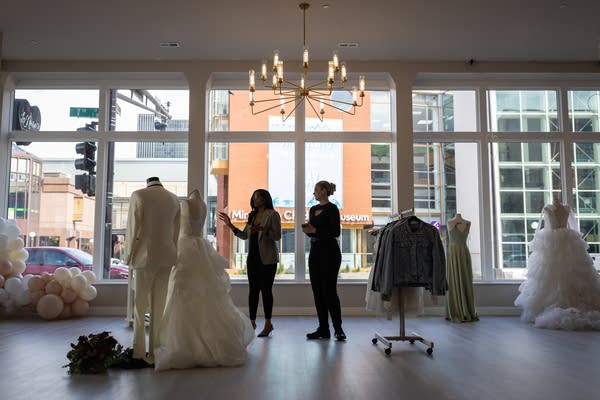
CHS Field in St. Paul’s Lowertown district is lively on a warm summer evening. The St. Paul Saints stadium is packed with families, the crowd roars at the crack of a bat and laughs at the team’s trademark, goofy between-innings skits.
But walk just a few blocks away into the heart of the city's cluster of downtown office towers and the sound of silence is unnerving. Sidewalks are mostly empty. A few cars roll by alongside the occasional bus tracking its lonely route.
Downtown St. Paul was long known for clearing out at 5 p.m., but the COVID-19 pandemic crippled the central business district as companies and office employees shifted to remote work. Many didn’t return, leaving a hole in the economy that’s crushed restaurants, retailers and other small businesses.
The office vacancy rate in downtown St. Paul was 37.1 percent in the first quarter of the year, according to the commercial real estate brokerage Colliers.
“It’s hard to imagine that people are going to come back five days a week, Monday to Friday, nine to five,” says Peter Brown, a visiting professor of practice at the University of Minnesota’s Humphrey School of Public Affairs. “I don't ever see that happening.”
A loose coalition of local government leaders, businesses, philanthropies and investors is working now to transform downtown St. Paul’s empty office corridors into a hybrid neighborhood defined by a vibrant mix of residents, offices, retail, and entertainment. But it’s a massive challenge.
"There's no question that the future of every downtown is that it's going to be partly a residential neighborhood," said Thomas Fisher, director of the Minnesota Design Center at the University of Minnesota. "The idea that downtowns are primarily for work, with just a few residents — those days are over."
Unforgiving math
While the pandemic created huge problems for downtowns, economists and urban planners lay much of the responsibility for the current problems on a decadeslong emphasis on building corporate office towers in central business districts without much thought to residential housing.
“We had the trend toward people starting to work more at home, the trend of online shopping. And so people weren't coming downtown to shop as much anymore,” said Fisher. The pandemic accelerated the trend, he added.
Local wounds deepened the damage in St. Paul. Madison Equities — the troubled real estate firm that was once downtown's largest office landlord — left prominent properties neglected and hollowed out.

Controversial policies including rent control discouraged new housing investment, and fear of crime kept downtown visitors from lingering after hockey games, concerts or other events.
The math is unforgiving. Fewer commuters downtown mean an absence of customers for restaurants and shops.
That lack of street-level vitality makes the sidewalks feel unsafe and uninviting, which causes more businesses to close and sidewalks and skyways to become even emptier, feeding a perverse, self-reinforcing downward cycle.
Hoping to break that cycle, more than $1 billion has been invested or committed through public and private initiatives, according to the nonprofit St. Paul Downtown Alliance.
That includes $242 million from the city for road improvements, parks, and a downtown vitality fund; $200 million to upgrade the Grand Casino Arena, matched dollar-for-dollar by the Minnesota Wild; and $230 million from Ramsey County, alongside an additional $30 million from the insurance company Securian and the Bush Foundation.
The concentration of investment money is creating some momentum. "If the city and Securian and the county and Bush and all these people start saying, 'Hey, we're doing this stuff,' it looks serious," said Brown. "That might attract some other people."
The Downtown Alliance says the goal is to add some 20,000 residents in coming years, more than doubling the current headcount.
"We've got a good plan, we're working together," said Joe Spencer, executive director of the Downtown Alliance. “You start to get the flywheel going in the right direction. I think that's the beginning of the journey that we're at right now.”
‘Creating a new downtown’
A successful journey depends on creating a positive feedback loop: More residents living downtown will encourage entrepreneurs to open retail businesses; retail vitality will convince employers that offices can attract top talent; more talent will choose to live near work; and sidewalks and skyways will finally come alive.
"We are creating a new downtown and it's not going to be like the old one, where I am just bringing businesses down here,” said St. Paul Mayor Kaoly Her, whose election last year upset the city’s political order. She’s made revitalizing downtown a key goal.
“It’s not something where it is all housing. If it's just all housing and there's no nightlife activity, people aren't going to be here either,” she added. “What is important for us to remember is that we're building a city now for the future of how people want to live — people want to be able to work and play and live all in the same places."
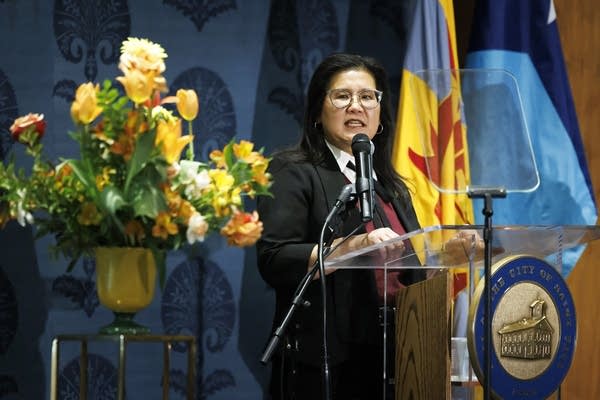
B Kyle, president and CEO of the St. Paul Area Chamber of Commerce, sees this shift into transforming downtown into a hybrid neighborhood as a generational change.
The policy mindset is certainly different. She spent 11 years at the St. Paul Port Authority, beginning two decades ago before leading the chamber.
At the port authority, “my mindset was that if there's an open block in St. Paul, let's put up a tower," Kyle said. "The learning for me has been that residents drive growth and drive that mix of the economy that any downtown needs to thrive. I have morphed my perspective. We need more people downtown.”
The core idea is simple in vision but complex and expensive in practice. For instance, transforming corporate towers into spaces where people can live is costly.
Landmark Towers, a 25-story office building from the 1980s, saw several of its floors converted to all-residential use last year at a price tag of $97 million. The former 16-story Ecolab headquarters is currently being converted into over 170 residential units at an estimated cost of $68 million.
While the number of office workers downtown is still low compared to the pre-pandemic years, St. Paul has seen some bright spots as employers have called workers back to their offices.
Around this time last year Gov. Tim Walz required executive branch employees to work in their offices at least half of the time. Insurance giant Securian wants its employees to be in the office at least three times per week is investing $50 million modernizing its downtown facilities.
American Public Media Group and its subsidiary Minnesota Public Radio, which includes MPR News, expect employees to work part of the week at the St. Paul headquarters.
Customer traffic for small businesses has picked up modestly in downtown food courts during the work week, largely thanks to these return-to-work hybrid policies.
Business start to sprout but ‘drought’ remains
The scale of St. Paul’s economic reclamation project is written into the experience of Lorraine Love.
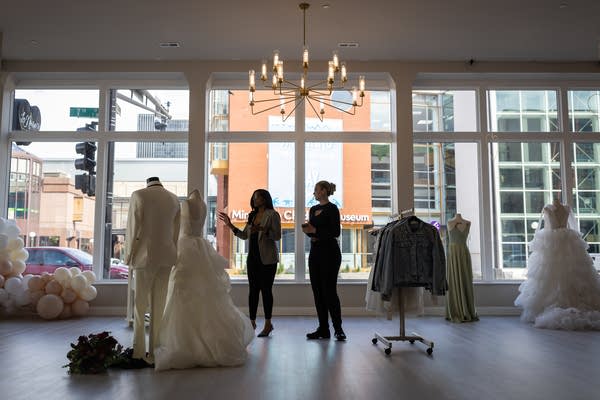
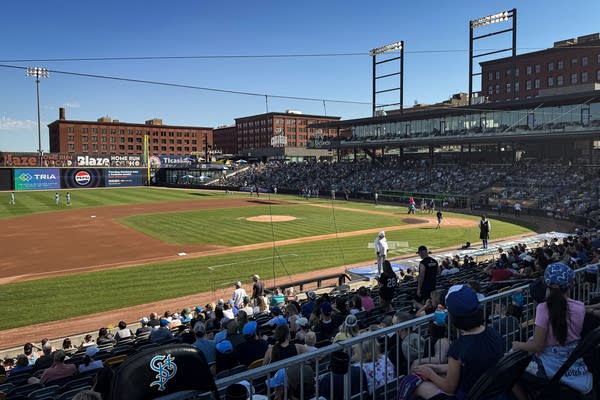
She owns La Noire, a bridal boutique on the ground floor of a historic building at the corner of 7th and Wabasha. Sunlight pours in through large, arched windows, illuminating an open floor plan lined with rows of wedding dresses.
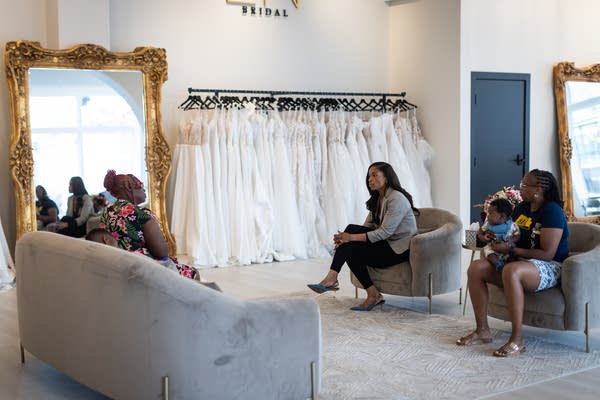
Love moved into the location last year after outgrowing her previous space a few blocks away, supported by a $30,000 city grant and a $100,000 loan. “Not only is it a bridal shop, but it is also a shop that catered to the community,” Love says. “If you're looking to host your bridal shower or micro-weddings, we have community events held in this space.”
What she doesn’t see is spontaneous foot traffic. "I thought with more visibility that people would see us, and they would want to come in and stop in," she says. "And there's still, for lack of a better word, like a ‘drought’ down here. The only time we truly see foot traffic is when there's events."
The lack of street activity has security costs, too. Love now keeps her doors locked during business hours; her front door has been busted, and people have broken into her shop. That said, she remains committed to downtown.
“We obviously want to be here for a reason. We believe in downtown St. Paul,” she says. “We want to be part of the growth and the development of it.”
St. Paul’s revitalization plan depends not only on entrepreneurs like Love sticking it out to better days but also attracting many more small business owners.
"Retail can only be supported if we have residents here, and residents only want to live here if they have access to the retail they want around them,” said Her. “You can't do one without the other."
‘Hoping for the best’
For the plan to work, it needs more people to follow the lead of retirees Joy Norquist and Ron Wawrzon.
They have a panoramic view from their two-bedroom high-rise condo downtown. They enjoy watching the steady rhythm of barge traffic on the Mississippi River, the trains going by below, and looking out toward St. Paul Downtown Airport — Holman Field — across the river.
The couple moved into their condo in 2024, trading a house in St. Paul’s historic Crocus Hill neighborhood where they had spent the previous 27 years. They are clear-eyed about the reality outside their lobby.
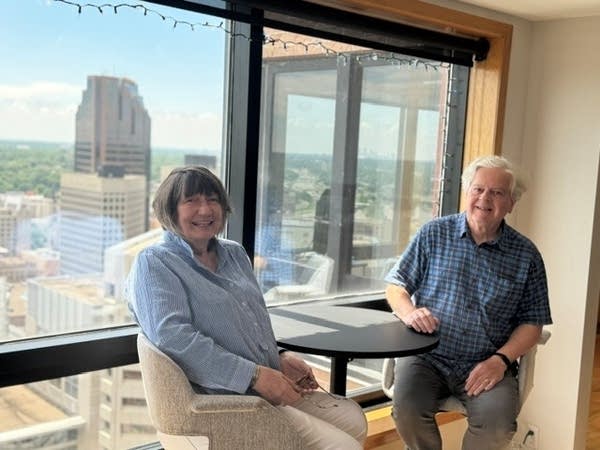
“We're hoping for the best,” says Wawzron. “I mean, it is kind of a wasteland out there at times, where there's just really nobody around.”
Yet, perhaps surprisingly, they have discovered a vibrant community downtown. They spend their time volunteering as gardeners at Mears Park, stay active with the local Skyway Walking Club, and meet with a weekly study group at the nearby Pillbox Tavern.
They highlight multiplying signs of revival, such as a new Aldi grocery store soon opening its doors, Minnesota Wild owner Craig Leipold leading an investment group to buy and renovate the storied St. Paul Hotel, and a Florida investor stepping in to purchase two vacant office towers.
“I see so much potential for downtown, and I just want to generate enthusiasm in other people,” said Norquist. “Because we see all of the positives and the positive momentum, and private developers coming in and buying these older buildings, and appreciating it, and understanding the vibe.”
The high-stakes bet on transforming downtown won’t happen overnight. It will require years of patient, unglamorous work to rundown and abandoned office buildings into a dynamic neighborhood.
“We all would like this to happen tomorrow, but there's no silver bullet. There's no magic real estate deal,” warns the Humphrey Institute’s Brown.
“The answer is going to be diligently tackling buildings one at a time and bringing people back and making the city more attractive to people. It's going to take a while, and it's going to be lumpy,” he said. “It's going to be a long slog.”
The barriers to success, let alone speed, are formidable. St. Paul has loosened its rent control laws somewhat, but the remaining rent cap continues to worry investors. The city's local tax burden ranks among the highest in the state.
Andy Behm, a Republican strategist and lawyer, warns that risk takers will remain wary until St. Paul political leaders change their reputation for being hostile to business. Layered on top of those hurdles are persistent worries over public safety. The many uncertainties weigh heavily on the high-stakes transformation.
St. Paul has laid its chips on the table, betting that community can replace commuting. Whether it is enough — and whether it arrives in time — is the question St. Paul is now living through, one block at a time.