Survey: Family summer travel still booming, but costs are having a big impact


Despite dramatically higher travel prices, families are still heading to airports and roads in force this summer.

The cost of airfare, hotels and attractions is higher, but that has not dissuaded most families from traveling — they’re simply traveling differently.

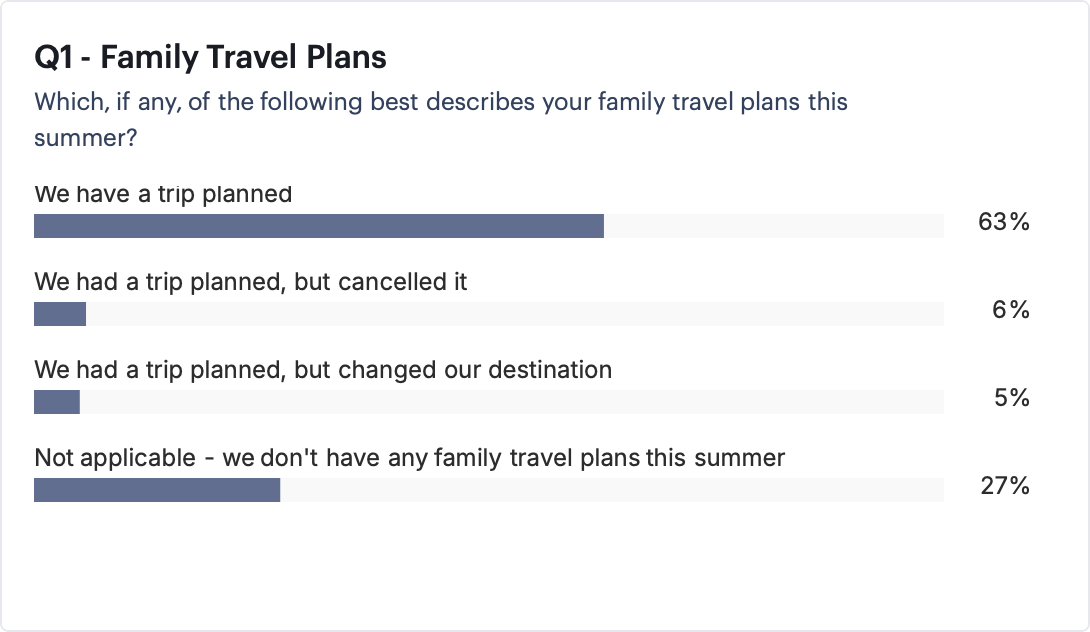
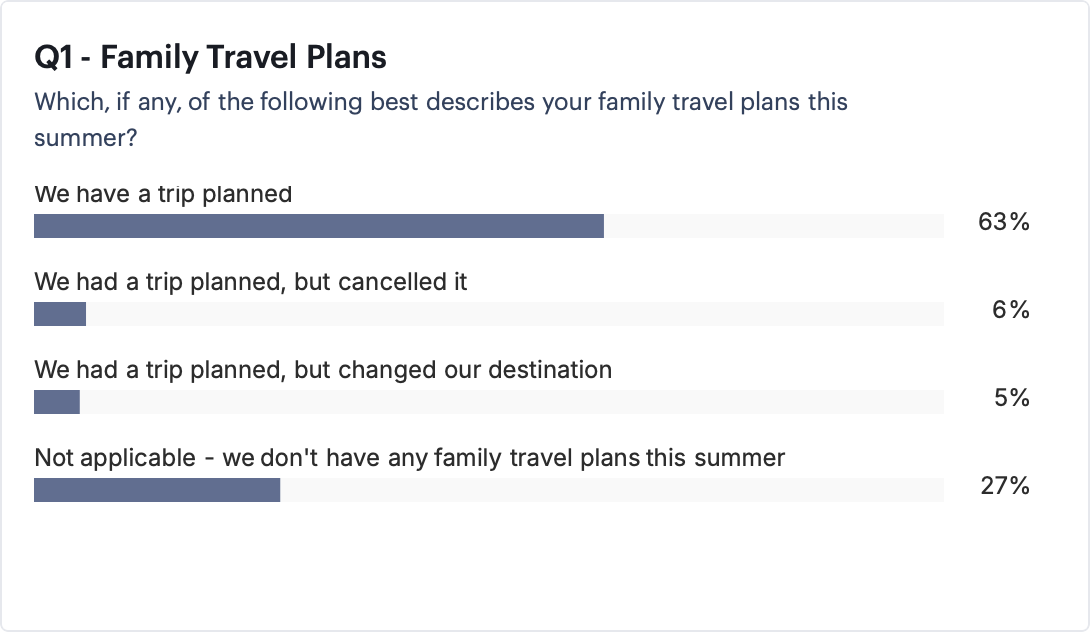
A new survey commissioned by TPG and conducted by YouGov found that 63% of parents with kids under 18 already have a family trip planned for this summer.
THE POINTS GUY/YOUGOV

Only 6% canceled a vacation outright, while another 5% swapped destinations. The survey of U.S. parents with children under 18 found that just 27% aren’t traveling at all.

The takeaway? Travel remains a priority despite higher prices. Families say cost is their top consideration, but they’re still taking trips. They’d rather adjust than cancel.

Here are some other interesting findings:

  • The survey suggests that while travel demand remains strong, today’s family travelers are becoming more flexible — changing destinations, redeeming rewards and involving kids in vacation planning.
  • Of those surveyed, 21% said they plan to use points and miles to help make family travel possible this summer, but only 5% say that availability of points/miles redemptions matters most when choosing destinations.
  • More families with summer travel plans changed their destinations than shortened trips or cut back on excursions and/or activities at their destination compared to previous years.
  • These families are making small compromises instead of canceling: tweaking things like trip length or where they stay.
  • Nearly two-thirds rank budget among their top three destination considerations.

For context, our earlier summer survey found that 71% of all travelers planned to travel the same amount or more than last summer.

These findings came even as prices are much higher. In May, airfare was 27% higher than last year, according to federal inflation data.

Reward your inbox with the TPG Daily newsletter

Join over 700,000 readers for breaking news, in-depth guides and exclusive deals from TPG’s experts

But there is some good news: Prices have begun to fall a bit. While you’ll pay about 14% more than last year, in the latest check of our data from our partnership with Points Path, a domestic coach ticket booked between three and five weeks in advance was cheaper than last month. And August fares are running about 6% cheaper than the same month last year.

How to save this summer: Explore our summer travel hub

Families are chasing value, not luxury

Still, higher prices are affecting some family travel decisions.

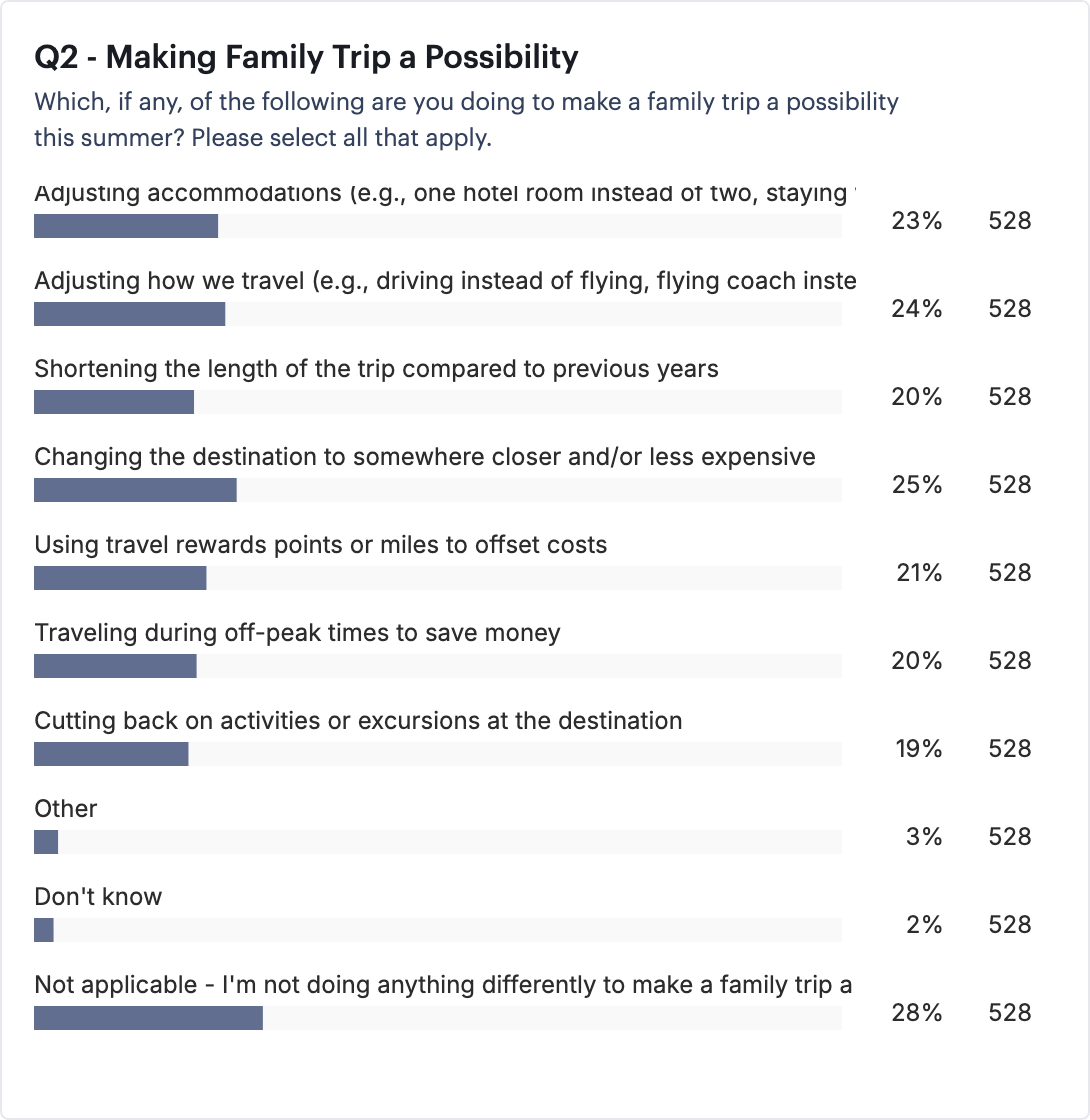
One-quarter (25%) of parents with summer travel plans say they are changing their destination to one that is closer or less expensive, making it the most common money-saving strategy.
THE POINTS GUY/YOUGOV

Nearly as many (24%) are changing how they travel, whether that’s driving instead of flying or booking economy instead of premium cabins. Another 23% are saving on accommodations by booking fewer hotel rooms or staying with relatives.

Many of these families are also shortening trips compared to previous years (20%), traveling during off-peak dates (20%) and trimming activities or excursions once they arrive (19%).

Of course, one of my favorite findings was that more than one in five families (21%) are using travel rewards points or miles to help make their vacation happen.

That’s exactly why TPG exists. We always say “earn ’em and burn ’em,” so if you’ve been saving points for a family vacation, this is the kind of year where they can make a big difference.

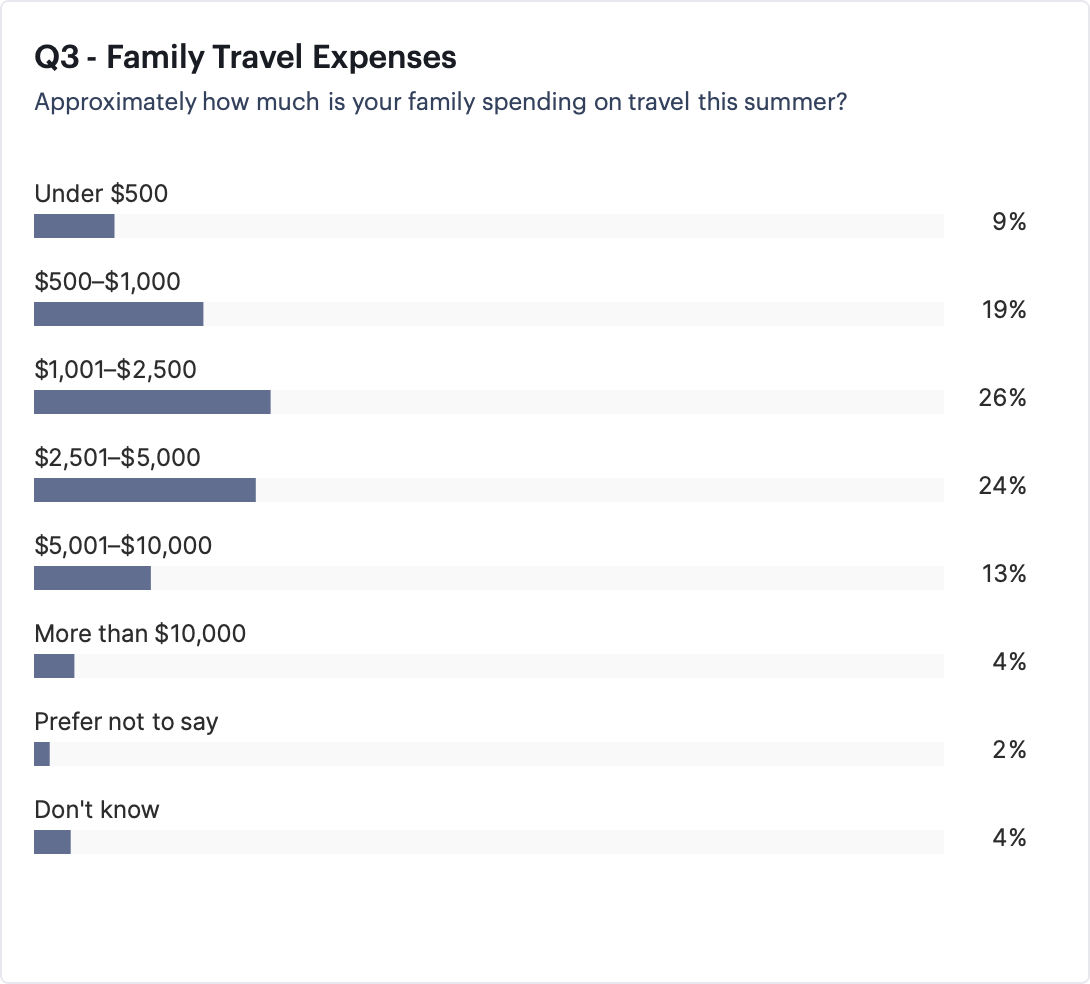
The amount people are spending is also pretty revealing.
THE POINTS GUY/YOUGOV

Half are spending $1,001 to $5,000, and 13% are spending $5,001 to $10,000; meanwhile, just 4% are spending more than $10,000.

Cost matters — but so do the kids

Budget may be king, but it’s far from the only thing driving vacation decisions.

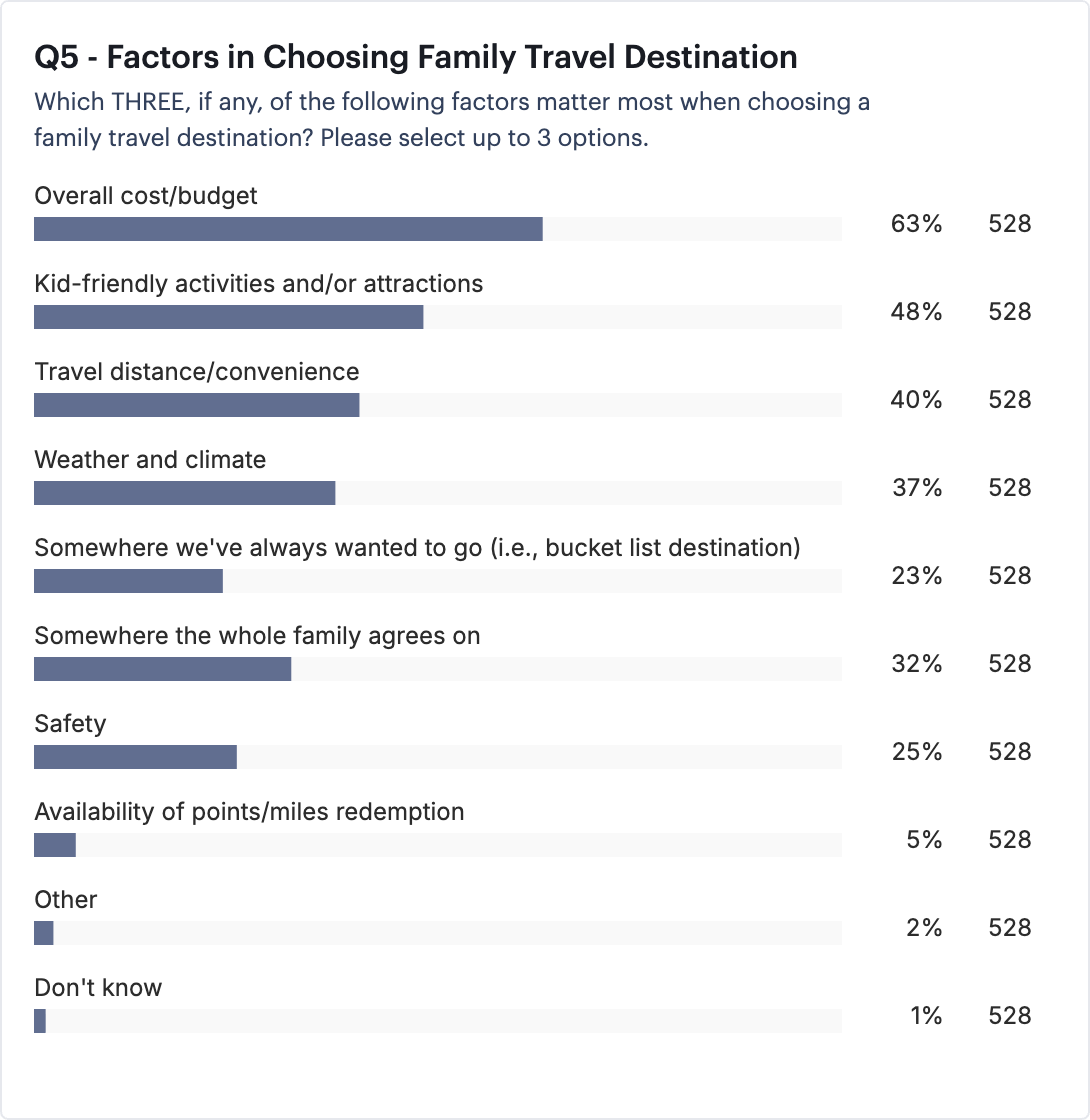
Nearly two-thirds (63%) say overall cost is one of the three biggest factors when choosing a destination. Kid-friendly attractions rank second (48%), followed by travel distance and convenience (40%), weather and climate (37%), and simply choosing somewhere that everyone in the family agrees on (32%).
THE POINTS GUY/YOUGOV

Interestingly, only 5% say award availability with points or miles is a deciding factor.

This is a reminder that most families don’t choose destinations because awards are available — they choose where they want to go first, then figure out how to make the trip affordable.

Just a reminder that if you can add flexibility both in dates and even destinations, you can save quite a bit.

Family vacations have become a team effort
THE POINTS GUY/YOUGOV

Forget the days when Mom or Dad simply announced where the family was headed.

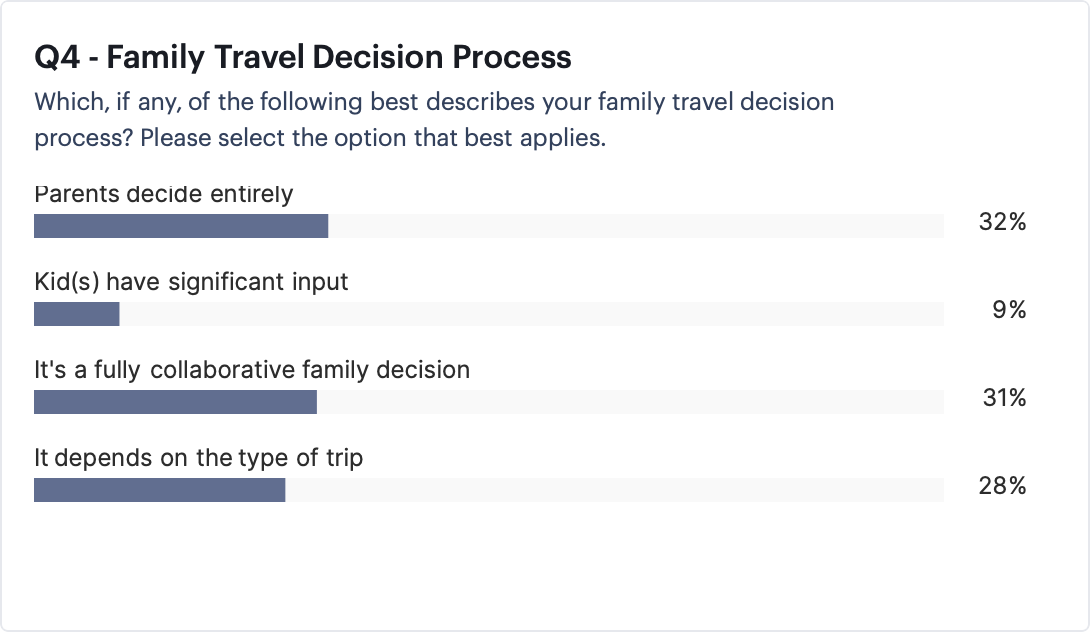
The survey found that vacation planning has become increasingly collaborative.

About 32% of parents say they make the decisions themselves, but nearly as many (31%) say planning is a family collaboration. Another 28% say it depends on the trip, while 9% report that their children have a significant influence over the destination.

Of course, kids have opinions.

When asked where their kids would most like to go, beach vacations topped the list, with 45% of parents saying their children requested destinations like Florida, Hawaii or the Outer Banks in North Carolina.

SHELBY SOBLICK/THE POINTS GUY

Water parks came in second (36%), followed by camping and outdoor destinations (26%). Theme parks remain perennial favorites, with 23% asking for theme parks more broadly and another 22% requesting Disney World or Disneyland.

National parks also tied Disney at 22%, showing that plenty of families are mixing outdoor adventure with traditional attractions.

Here are some interesting facts on destinations:

  1. Beach vacations remain America’s favorite family trip. They easily outpace Disney and other traditional family attractions.
  2. Outdoor travel is thriving. Camping (26%) and national parks (22%) suggest that families continue to seek nature-based vacations.
  3. Disney isn’t everything anymore. Beaches, water parks, camping, and national parks collectively outperform Disney as requested destinations.
  4. Families are staying relatively close to home. Low interest in international trips (11%) and the emphasis on convenience suggest domestic travel remains dominant.

Sometimes parents still have to say no
Declining Kids' Travel Destinations POLL FROM TPG AND YOUGOVE
THE POINTS GUY/YOUGOV

Every parent knows vacation planning involves a little negotiation.

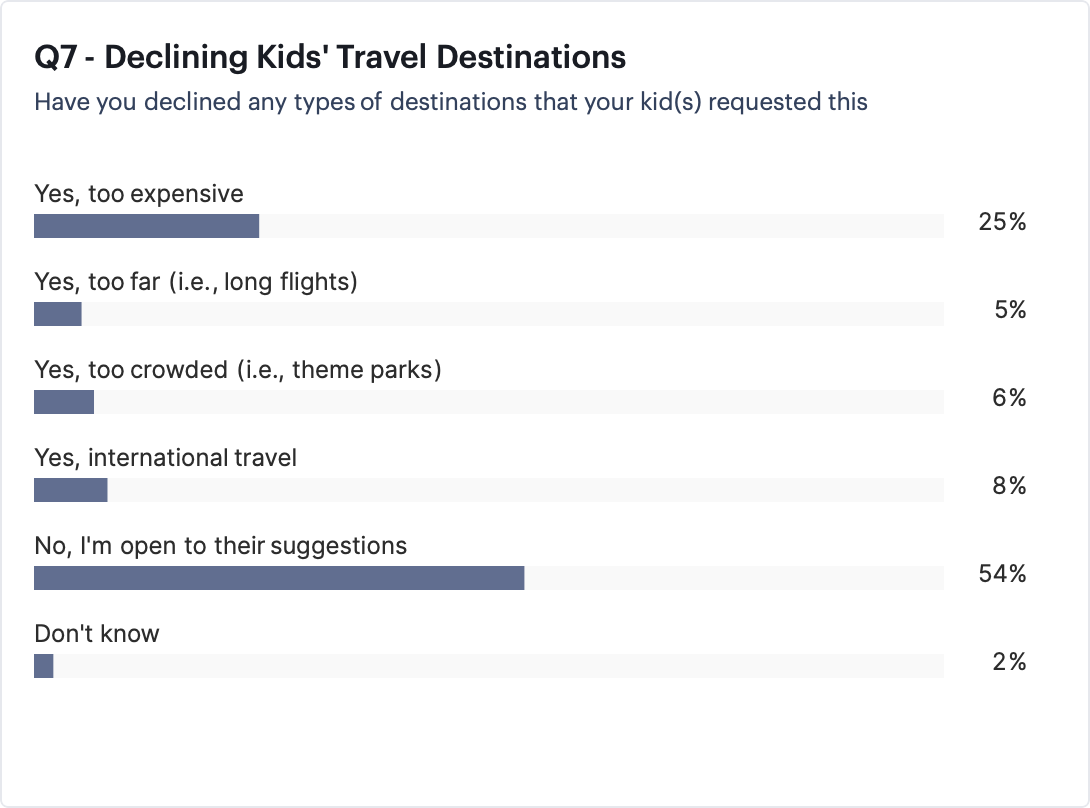
More than half (54%) say they’re open to their children’s destination ideas.

But when parents veto a trip, it’s usually because of cost.

One-quarter (25%) said they’ve turned down a destination because it was simply too expensive. Far fewer cited it being too far (5%), crowded attractions (6%) or international travel (8%).

In other words, the family budget — not the kids — is often the deciding vote.

Parents worry less than you might think
Kids Travel Fears poll from The Points Guy and Yougov
THE POINTS GUY/YOUGOV

Traveling with children comes with plenty of stress, but parents appear more confident than stereotypes might suggest.

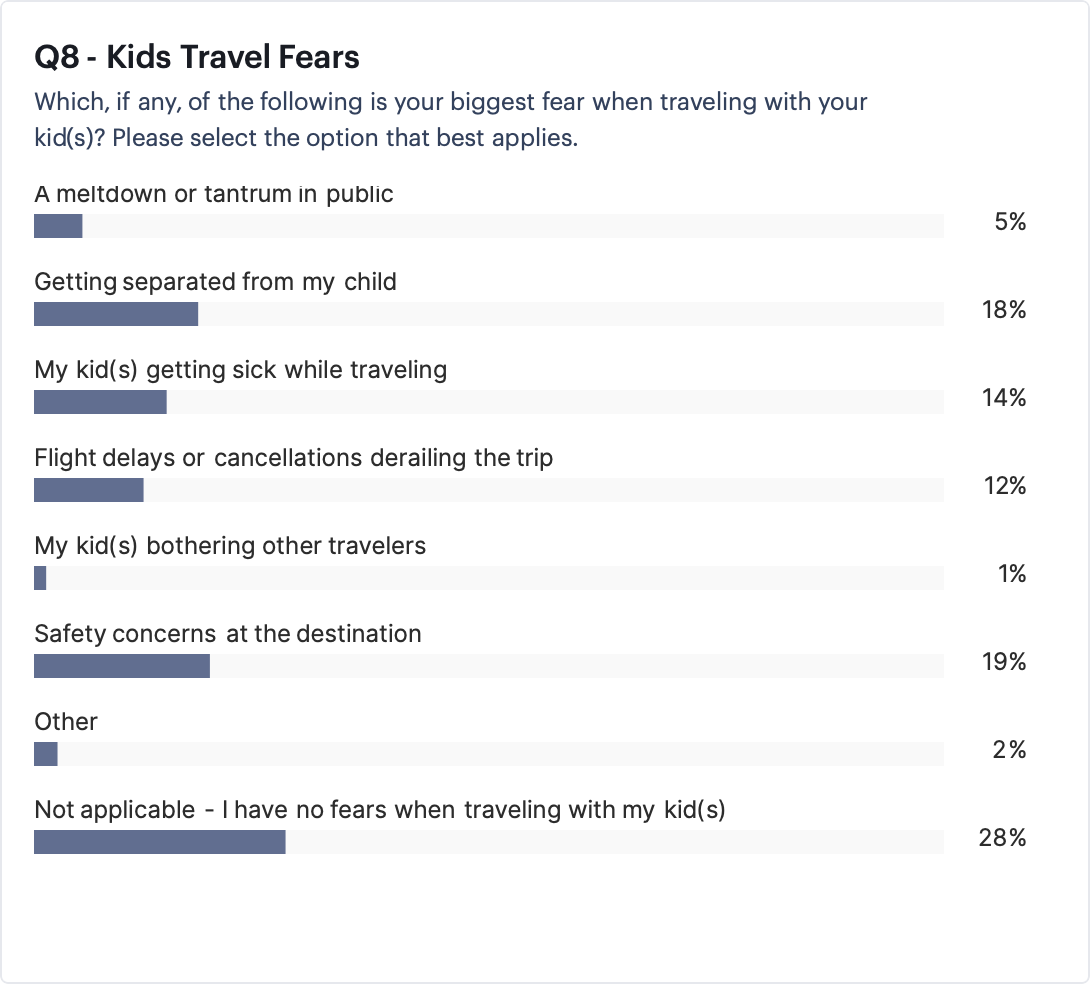
In fact, 28% say they have no major fears about traveling with their kids.

Even so, safety concerns at the destination (19%) top the list of worries, followed closely by the risk of getting separated from a child (18%). Parents also worry about children getting sick while traveling (14%) and airline delays or cancellations disrupting carefully planned vacations (12%).

Surprisingly, only 5% cite public meltdowns as their biggest concern, and just 1% worry about their children bothering other passengers.

The biggest travel frustrations? It’s not the kids
THE POINTS GUY/YOUGOV

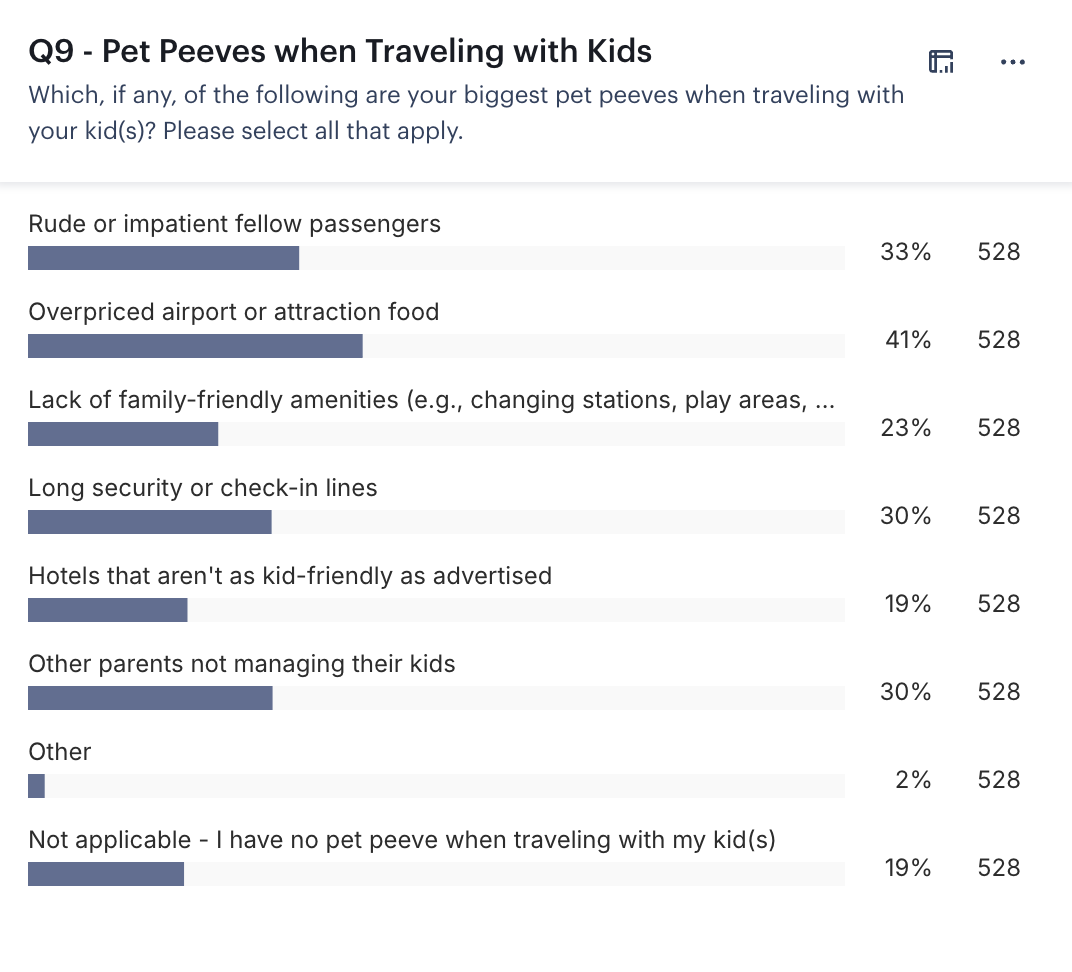
Parents may worry about logistics, but their biggest pet peeves often have little to do with their own children.

The biggest complaint? Overpriced food at airports and attractions was cited by 41% of respondents.

Rude or impatient fellow travelers (33%) ranked second, followed by long security or check-in lines (30%). Another 30% said that other parents failing to manage their own children is one of their biggest frustrations.

Nearly one in four (23%) cited a lack of family-friendly amenities, such as play spaces and changing stations, while 19% said hotels sometimes overpromise and underdeliver when it comes to being “kid friendly.”

Snacks still beat screens — barely
THE POINTS GUY/YOUGOV

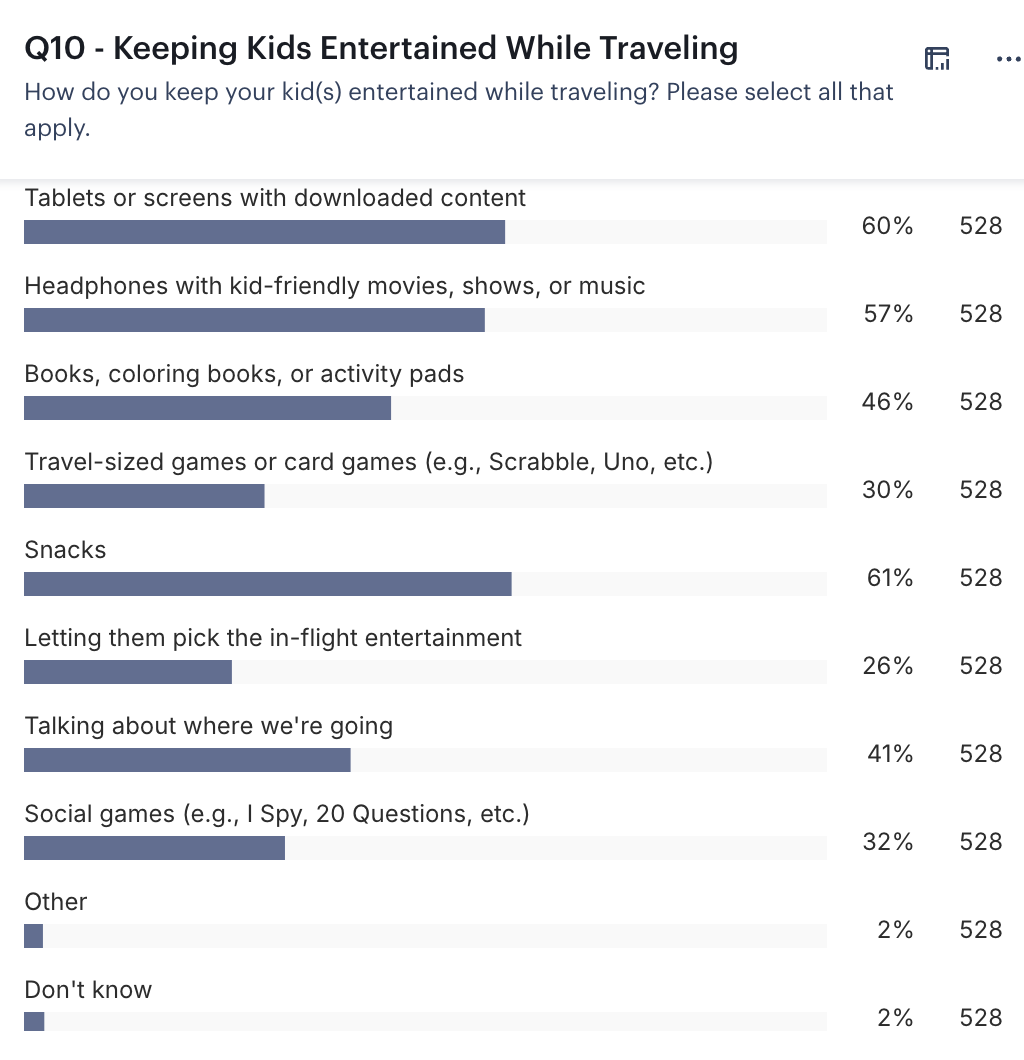
Parents have plenty of tricks for surviving travel.

Snacks remain the ultimate travel hack, with 61% relying on them to keep kids happy.

Close behind are tablets loaded with downloaded content (60%) and headphones for movies and music (57%).

Nearly half (46%) still pack books, coloring books or activity pads, while 41% spend time talking with children about the destination before they arrive.

Old-school road trip games haven’t disappeared either. About one-third still play games like “I Spy” or “20 Questions” (32%), and 30% pack travel-sized games such as Uno or Scrabble.

Bottom line

Family Traveling on Airplane Together
RYANJLANE/GETTY IMAGES

There are very few signs that family travel is slowing this summer, with just 6% saying they canceled a planned trip even though there are much higher prices across the board.

Instead, parents are stretching budgets with smarter planning.

It’s also fascinating that parents are involving kids in vacation decisions, redeeming points and miles when it makes sense, and focusing on experiences over extravagance.

There are still plenty of ways to create memorable family vacations without blowing the budget.

If you’re still planning a last-minute getaway, flexibility remains your biggest advantage. Consider nearby destinations, travel midweek if possible, and don’t overlook your stash of airline miles or hotel points. As this survey shows, families don’t need to spend more to make lasting memories — they just need to travel smarter.

Read on for more of our money-saving tips and check out our new summer travel hub for everything you need to know to travel better.

Related reading:

The Points Guy commissioned YouGov Plc to conduct the survey. All figures, unless otherwise stated, are from YouGov Plc. The total sample size was 783 U.S. parents of children under 18, of whom 528 reported having summer travel plans. Fieldwork was undertaken between 16th and 21st June 2026. The survey was carried out online. The figures have been weighted and are representative of all US parents with children under 18(aged 18+).


Source link

Leave a Reply

Subscribe to Our Newsletter

Get our latest articles delivered straight to your inbox. No spam, we promise.

Recent Reviews


Expedite your Tibco Business events with our recently designed HKR’s Tibco Business Events Interview Questions with answers. This blog is specially designed under the guidance of the SME team to help the fresher as well as experienced professionals. The Tibco Business event is one of the popular business tools to offer complex event processing or CEP. As the Tibco business events market is growing like anything and you can expect huge job openings across the world. As per the latest research, almost 0.67% of the software products are developed on the basis of Tibco business events tools.

Most Frequently Asked Tibco BE Interview Questions

What is the Tibco business event tool?

Ans: Tibco business event is a popular tool used to process any complex business events. These business events in software systems are later used to predict any business changes and to perform in a better way.

Become a  Tibco BE Training Certified professional by learning this HKR Tibco BE Training!

What are the key features of using Tibco Business Event?

Ans: Below are the important key features of using Tibco Business event;

  • Tibco business event is a high-performance event processing platform for applications that are used to monitor, analyze, and respond to parallel event streams.
  • Tibco business event extreme drivers deliver dramatic new levels of performance, scalability, and robustness for demanding complex event processing (CEP) and real-time event-driven applications.
  • This platform automatically manages consistency for efficient parallel processing and high vertical scalability.
  • A hybrid rules and java programming model enables applications to maximize the capabilities of languages, seamlessly share data and events.

What is the role of channels and destinations in the Tibco Business event?

Ans: Channels are nothing but resources used to establish the connectivity and communication between various business events. The events are like JMS sources, RV sources, and HTTP sources.

Destinations are specified with channels and explain the source and sink for the Tibco business messages.

Mention the product compatibility used in Tibco Business events?

Ans: The Tibco business Events Extreme data grid feature is compatible with Tibco Active spaces enterprise edition version 2.0.2 hot fix 9.

What are the packages installed in the Tibco business event?

Ans: Below are the important packages installed in Tibco Business events such as;

  • rpm –q compat-expat1 –compat-expat1-1.95.8-8.el6.x86_64
  • rpm-q pstack –pstack-1.2-7.2.2
  • rpm –q gdb –gdb-7.0.1-42.el5.
  • rpm –q sysstat –sysstat-7.0.2-11.e15

Tibco BE Training

  • Master Your Craft
  • Lifetime LMS & Faculty Access
  • 24/7 online expert support
  • Real-world & Project Based Learning


Explain the hardware required to install the Tibco business event?

Ans: Below are bowsers which are supported;

1. Chrome 16

2. Firefox 9

3. Internet Explorer 9

4. Safari 5

The disk space and memory requirements;

Disk space – 4 Gb

Memory – 2 Gb RAM

Java compatibility:

Tibco business event uses the two JRE versions:

1.7.0_45 –default JRE

1.6.0_30.

How events are generated in the Tibco Business event?

Ans: The events can be generated in Tibco business event using instance created on the base of input channels.

What do you mean by RMS and mention its uses?

Ans: RMS is also known as Rule management Server this is a business event component. This is used to manage decision projects and also provides various mechanisms.

  • This RMS offers user authentication, authorizing project decisions, and also consists of project management features.
  • This RMS enables the decision manager to communicate the rule management server and also helps users to check project decisions, decision tables of local copies, and commit changes.

How can we prioritize and de-prioritize rules for a business event?

Ans: In the Tibco business event tool, to perform a specific event, users can have multiple event rules. The rule priority value can be decided on the base of the sequence where rules are triggered. The value which is closer to 1 means that we can have a higher priority.

. Describe the flow messages used in the Tibco Business event?

Ans: Steps:

1. In the Business events the messages will be received through various channels along with appropriate destinations.

2. At first, the event preprocessor will be executed.

3. Here all the incoming messages will be converted to business events.

4. Rules will be triggered on the basis of these available events.

. What is CDD and what’s its significance?

Ans: CDD stands for Cluster deployment description, this is an XML file. This file consists of required information related to the deployment of the Tibco business event project.

. Why scorecards are used in the Business event?

Ans: Scorecards are a type of concept used in business events. Scorecards are sometimes used as a static variable in various programming languages, this scoreboard offers project-wide scope and single instance. These scoreboards are used to keep track or store the information which is later used throughout the project interference agent.

. Mention the steps involved in the Tibco business event installation process?

Ans: The steps included are;

1. Installation guide -> this gives complete installation information

2. Application Architect’s guide -> this consists of details like architectural details or rule programming.

3. Application Developer’s guide -> this consists of details like programmer documents used in rule programming.

4. Decision manager user’s guide -> this gives details like user documentation and decision tables information.

5. Web studio user’s guide -> consists of user documentation available on Web studio.

6. Architect’s guide -> Consists of architectural details on the application platform.

7. Java developer’s guide -> Contains whole java programmer documentation

8. Performance tuning guide -> Application performance documentation which holds tuning information.

9. System guide -> which consists of machine resources information for the application.

10. Code snippets -> source code for the programming snippets and java developer’s guide.

. Mention the difference between Tibco BW and Tibco BE?

Ans: Tibco BW is also known as the information bus company warehouse tool. This is an information, integration, and analytical tool. Tibco BW software is used to manage, integrate, and monitor the business level enterprise tool. This is widely used because of its flexibility, scalability, and reliability.

Tibco BE is a tool used to process complex business events. These business events are used to predict any business changes and enable them to perform in a better way.

. What is an event preprocessor and explain?

Ans: An event preprocessor is the same as a rule function. This type of rule function is used to process any incoming messages before these messages are converted into business events.

. What is the relationship between decision tables and virtual rule functions?

Ans: Decision tables are considered as an implementation for virtual rule functions. And virtual rule functions consist of one or more decision tables.

Final words:

I hope I have tried my best to explain the very important Tibco Business event interview questions and answers. Learning only this article is not enough to get into top companies. You should have a thorough knowledge of industry-based projects, to become a master in this tool please visit our website www.hkrtraining.com.

. Define Rules and how TIBCO BE rules work.

Ans: Rules in TIBCO BE state the actions that need to be taken on specific conditions. Moreover, rules will activate when specified conditions are met based on events.

HKR Trainings Logo

Subscribe to our YouTube channel to get new updates..!

. What is the use of TIBCO BE Concepts?

Ans: The concepts are built to hold any entity’s properties. In the Rules and Rules Functions, Concepts’ instances are often produced using data from the events.

. What is the use of Routers?Ans. Routers help move messages between the different EMS servers.

Ans: Routers help move messages between the different EMS servers.

Related Article: Tableau Prep Training

. List out the various acknowledgement modes in TIBCO EMS.

Ans: These acknowledgement modes available in TIBCO EMS for message delivery included.:-

  • Auto
  • Client
  • Explicit
  • Dups_ok
  • Transitional
  • No_ack

. What is the way to Configure a Client for Fault Tolerant Connection?

Ans: Here, it needs to mention different servers as a comma-separated list of various URLs, and both URLs should use the same protocols. Such as TCP or SSL. 

. Name the various messages used in EMS.

Ans: The following types of messages are used in EMS.

  • Text
  • Stream
  • Bytes
  • Simple
  • Map
  • Object 
  • XML Test

. How can we develop RESTful Web Services in TIBCO?

AnsTIBCO offers a plugin for JSON and REST, which help develop RESTful Web Services within TIBCO Designer.

. Define the process of integrating TIBCO BE with TIBCO BW.

Ans: Based on the configured channel type in TIBCO BE, you can easily send messages to TIBCO BW and get responses. For example, if TIBCO BE configures a JMS channel, you can send JMS messages to specific destinations from TIBCO BW. Then you will get a response through the Recieve JMS Message activity.

. What does a Flow Control Property state in TIBCO?

Ans: It states the maximum size of messages pending on the server.

. Name the storage methods used in TIBCO EMS Server.

Ans: There are two storage methods- Database and File Based.

. Mention the various Delivery modes supported by TIBCO EMS.

Ans: The following are the various delivery modes that TIBCO EMS supports:-

  • Persistent
  • Non-persistent
  • Reliable

Tibco BE Training

Weekday / Weekend Batches

. Define Shared State in the fault-tolerant operations in TIBCO.

Ans: In TIBCO, the fault-tolerant servers connect with Shared State, which includes persistent messages and client information.

. Distinguish between Rendezvous (RV) and EMS.

Ans: Both are different products and have different architectures. TIBCO EMS uses a client-server architecture, and RV uses distributed architecture. Further, EMS uses the TCP protocol, whereas RV uses the TRDP protocol offered by TIBCO. In EMS, the producer sends messages to the central server, whereas in RV, the producer directly sends messages to the consumer.

. What is meant by Fail Safe in TIBCO BE?

Ans: The Fail Safe attribute controls whether the server writes persistent messages asynchronously or synchronously to the disk. Also, the messages sent are securely stored on the disk before they are sent. It ensures that no messages are lost.

. What is the Message size that TIBCO EMS supports?

Ans: The maximum message size that TIBCO EMS supports is 512MB.

About Author

author-image

Kavya works for HKR Trainings institute as a technical writer with diverse experience in many kinds of technology-related content development. She holds a graduate education in the Computer science and Engineering stream. She has cultivated strong technical skills from reading tech blogs and also doing a lot of research related to content. She manages to write great content in many fields like Programming & Frameworks, Enterprise Integration, Web Development, SAP, and Business Process Management (BPM). Connect her on LinkedIn and Twitter.

Upcoming Tibco BE Training Online classes

Batch starts on
7th Jul 2026
Mon & Tue (5 Days)
Weekday
Timings – 08:30 AM IST
Batch starts on
11th Jul 2026
Mon – Fri (18 Days)
Weekend
Timings – 10:30 AM IST
Batch starts on
15th Jul 2026
Mon & Tue (5 Days)
Weekday
Timings – 08:30 AM IST


Source link