Operation Metro Surge has ended but many Minnesotans are still protesting the federal immigration operation, including one group of men in a Minneapolis coffee shop.
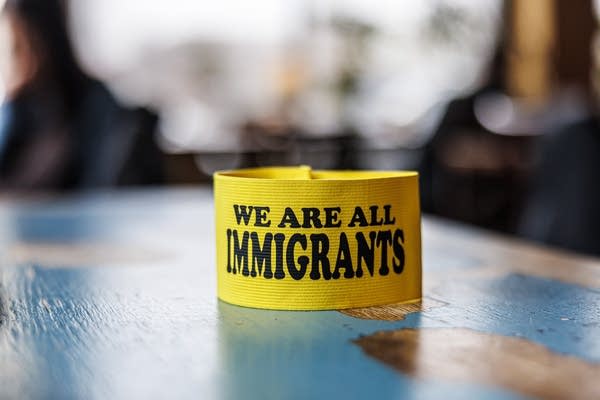
Four of these men wear yellow bands on their arms. They say in large black letters, “We are all immigrants.” They look like gear a soccer captain might wear on the field.
“The idea just emerged out of the horrible way that this current administration was dealing with people who they identified as immigrants,” Peter Kramer explained. “It just seemed totally unfair, given the fact that we all essentially came from somewhere else.”
These men haven’t let up on their own form of quiet resistance. The yellow armbands are intentional conversation-starters.
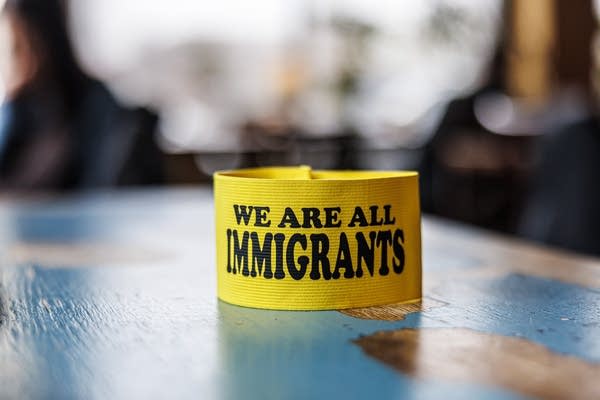
“People will stop me and say, you know, ‘What is that about?’” Kramer said.
An architect by trade, Kramer said he felt compelled to make some sort of statement as U.S. Immigration and Customs Enforcement agents and other federal officers ramped up enforcement in Minnesota.
Kramer meets weekly with this group of friends. On this day, five mostly retired white men met at Sovereign Grounds coffee shop in Minneapolis. They spoke in a common language of inside jokes and women’s basketball.
Kramer printed the first batch of armbands near the end of January. He has made and handed out around 500.
“I ran into a guy who said, ‘I'm not an immigrant. I was born here,’” Kramer recalls.
“And I said, ‘So was I, but my grandmother wasn't. She was born in Ireland, and if she hadn't come here as an immigrant, I wouldn't be here.’”
“My parents spoke Polish in the house when we were growing up, and especially when they didn't want us to understand what they were saying,” said Gerry Kaluzny, a retired legal aid attorney.
“But I was able to go on to school and become a lawyer, and I chose a path in law to represent disadvantaged people, many of whom are immigrants,” he added.
“We've never sat around this table and asked what do you think the best immigration policy should be, because I don't know that we would come to an agreement. But we do, I think, agree that there's humane ways that we ought to be enforcing the law well,” said Jay Wilkinson, another retired legal aid attorney.
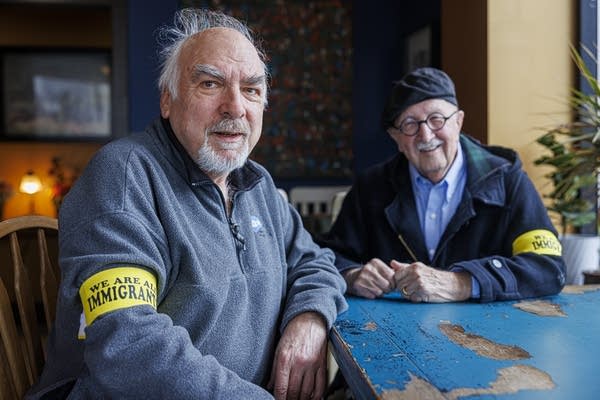
Phillip Jacobson, another man at the table, said he finds the views of his friends to be a little simplistic.
“They're reacting emotionally to things. There's a lot of virtue signaling,” said Jacobson, who doesn’t wear the pro-immigration arm band. “They don't want to say anything negative about immigrants. It's just easier to say, ‘ICE out.’ Seems virtuous.”
Wilkinson said the virtue signaling is intentional.
“Well, there is no question about saying ‘ICE out’ as being virtuous. And, yeah, these are virtue signals. I just know that (federal agents) shouldn’t be dealing with anybody, whether they're a criminal or a or an innocent 5-year-old child … the way they did.”
Jacobson is insistent. He said the arm bands send a divisive message. “I think that doesn't move the needle at all. ‘We are all immigrants’ is obviously true. But what does it mean?”
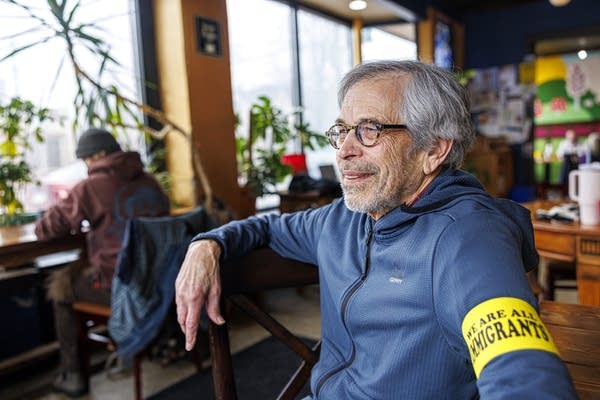
This table is somewhat divided. It’s easy to imagine similar conversations playing out among groups of people like this at coffee shops across Minnesota.
And it’s easy to understand why this group tends to keep the conversation on women’s basketball.
“Probably everybody can agree that the immigration system has been broken for a long, long time,” said Howard Schneider, another man at the table.
This group might not all agree with each other, but their arguments stay civil. They jab at each other, continue with their inside jokes.
And they're going to continue wearing their armbands and having those conversations.