Top 30+ IOS Interview Questions and Answers [Updated – 2025]


Are you ready to learn one of the exciting technologies of our generation? Then here you go. Do you know that IOS operating system is used to run all the Apple application devices? It may be anything like the iPhone, IPad, Mac notebooks, and laptops. Apple is one of the biggest software giants, this has a huge customer base. Becoming an IOS developer is nothing greater than learning any other technologies. If you are looking for the top IOS development interview questions and answers, we have come up with a frequently designed IOS development interview questions and answers article. This article will help you to crack any complex interview questions and get into top companies. Let’s start to begin learning.

Most Frequently Asked IOS Interview Questions and Answers

What are the important characteristics of IOS?

Ans: Below are a few important characteristics of IOS:

  • The display is paramount regardless of its size
  • Device orientation can change
  • Apps respond to gestures, not clicks
  • People interact with one app at a time
  • Onscreen users help is minimal 
  • Safari’s on IOS provides the web interface.

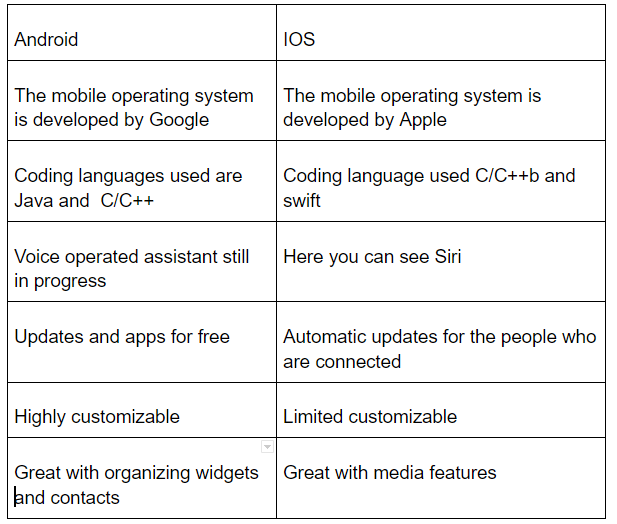
Mention the differences between IOS and Android devices?

Ans: 
 differences between IOS and Android devices

Mention the differences between IOS and Windows devices?

Ans: The below table will explain the major differences between IOS and Windows
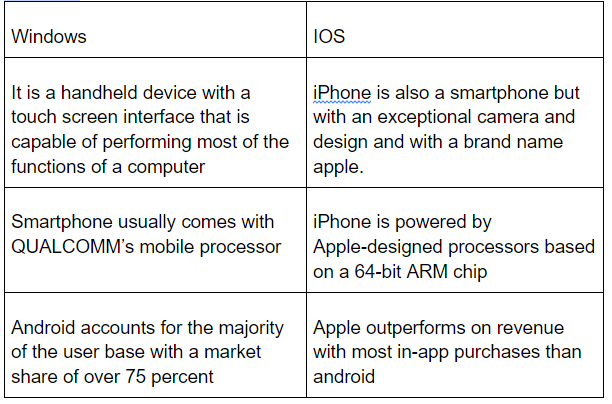
differences between IOS and Windows devices

Which JSON framework is supported by IOS (iPhone OS)?

Ans:

  • SBJSON framework is mainly supported by IOS devices. This framework is available in the form of a JSON parser and generator for object-oriented programming language. JSON framework is a superset of the programming language called C and offers object-oriented features and capabilities.
  • SBJSON APIs is a flexible application programming interface and offers additional controlling features to handle JSON easier way.

Name the framework that is used to construct the application user interfaces for IOS?

Ans: 

UIkit framework: this type of framework is mainly used to develop user interfaces. The following are the few features of using the UIKIT framework;

  • Event handling
  • Drawing model
  • Windows
  • Views
  • Controls.

UIkit. The framework offers the complex infrastructures required to construct and manage IOS application devices.

  • UIkit’s windows and view architecture used to manage user interfaces
  • Event handling infrastructures needed to respond to the user inputs.

How can you respond to state transitions on your app?

Ans: There are 4 methods used to respond to state transitions such as;

  • ApplicationDidBecomeActive () method: this method is used to run the foregroup apps
  • ApplicationDidEnterBackground () method: this method is used to execute the codes
  • ApplicationWillEnterForeground () method: this method is used to execute the codes which are running background
  • ApplicationWillTerminate () method: this method is called to terminate the apps.

What are the features added in IOS 9?

Ans: You can see the following features added in IOS 9:

  • Intelligent search
  • Siri voice recognition app
  • Deeper search capabilities
  • Performance improvements
  • Wireless car play support
  • Optional iCloud drive app

What is the difference between RETAIN and ASSIGN?

Ans: ASSIGN is used to create references from one object to another, the below program will explain this;

If (_variable ! = object)

{

  [_variable release];

  _variable = nil;

  _variable = object;

}

RETAIN used to create the differences between one object and another;

If (_variable! = object)

{

  [_variable release];

  Variable = nil;

  _variable = [object retain];

}

Which are the ways of achieving concurrency in IOS?

Ans: Below are the three ways to achieve concurrency;

  • Threads
  • Dispatch queues
  • Operation queues.

Interested in learning IOS Join hkr and Learn more on IOS Training

. Explain the different types of IOS application states?

Ans: The different application states of IOS included are;

Not running state: this state is used when the app has not been launched yet, or that was terminated by the system.

Inactive: this state is used when the application is running in the foreground and not receiving any events.

Active state: when applications are running in the foreground and receiving events by that time this state is used.

Background state: this state is used to run the application in the background and execute the codes.

Suspended state: this state is used to terminate the program.

. Which is the application thread from where UIKIT classes should be used?

Ans: A UIKIT class uses the application thread from the application’s main thread.

IOS Certification Training

  • Master Your Craft
  • Lifetime LMS & Faculty Access
  • 24/7 online expert support
  • Real-world & Project Based Learning


. When would you say that an app is not in a running state?

Ans: Below are the two ways which explain this;

  • When it is not yet launched
  • during the running time, when the app is terminated by the system.

. What are layer objects in IOS?

Ans: The layer objects are nothing but data objects which represent the visual features, views and render the contents. These layers are custom layers that are added to the interfaces to execute any complex animations.

. What is Sprite kit and Scene kit?

  • Sprite kit is a framework used for the easy development of animated 2D objects.
  • Scene kit is a framework used to inherit OSX objects with 3D graphics.

. What is SWIFT?

Ans: A SWIFT is one of the programming languages used in the development of IOS applications. SWIFT language adopts safe programming patterns and offers many modern features to make programming easier to implement, flexible, and more fun to write.

. What is meant by ARC?

Ans. ARC, or Automatic Reference Counting, is a compiler-level feature used by Swift to track and manage an application’s memory usage. It helps release the memory of class instances when there is no need for memory reserved. It does so by initializing and deinitializing system resources. In iOS development, the role of ARC concepts is highly crucial.

.Define iBeacons.

Ans. iBeacons is newly introduced by Apple, a Bluetooth wireless technology. It’s a new technology useful for iPhone and iOS users to get location-based information and services. These small-scale wireless transmitters use Bluetooth low-energy technology to transmit data or signals to nearby smart devices.

. Explain what GCD is in iOS?

Ans. In iOS, GCD refers to Grand Central Dispatch, a low-level API that helps you manage different concurrent operations. It can also help you enhance your app’s responsiveness by delaying computationally rigorous tasks to the context.

. What is meant by Operator Overloading?

Ans. In iOS, operator overloading refers to adding new operators by altering existing operators to perform different activities. It allows us to alter the way of working of existing operators using some specific structures. The various operators includes +, *, /, etc. symbols.

. Explain KVO in iOS.

Ans. KVO stands for Key-Value Observing, a technique for observing changes to the property value. If we have an object including some cited variables, then KVO enables other objects to monitor the modifications to any of these variables.

. What do you mean by Dynamic Dispatch?

Ans. In iOS, the term Dynamic Dispatch means that a program decides at run time which implementation of a specific function it needs to invoke. It is useful when we need to call on our methods similar to the object method.

. Explain Cocoa and Cocoa Touch in iOS.

Ans. Cocoa is an app development environment useful for OS X and iOS. Also, it helps in creating software codes to run on iOS and includes the Foundation and Appkit frameworks. Further, we can use it for referring to any class or object based on the Objective-C runtime.

Cocoa Touch is an app development environment for iOS written in Objective-C language. It also consists of Foundation and UIKit frameworks. Cocoa Touch is useful in developing software apps for the products like iPhones, iPad, etc.

We have the perfect professional SEO Tutorial for you. Enroll now!We have the perfect professional SEO Tutorial for you. Enroll now!

HKR Trainings Logo

Subscribe to our YouTube channel to get new updates..!


. What do you understand from TVMLkit?

Ans. The term TVML refers to Apple TV Markup Language. TVMLkit acts as a link between JavaScript, TVML, and tvOS apps. We can use a JavaScript environment to build TVML objects, styles, and views. Moreover, the TVMLkit framework allows you to include JavaScript and TVML files into your binary apps. Also, it helps to build various client-server apps.

. Define Bundle ID.

Ans. The bundle ID is defined in each app which is useful for both OS X and iOS. A bundle identifier can easily identify your apps’ updates. Moreover, Bundle ID is mentioned in XCode. A single XCode project can include many targets and output different apps.

. List out the most important data types found in Objective-C.

Ans. The following are the most important data types found in Objective-C.

  • Bool
  • NSString
  • NSUInteger
  • NSInteger

. Name the different programming languages used in iOS Development.

Ans. The following coding languages are used in iOS development.

  • JavaScript
  • HTML 5 
  • .Net
  • Swit
  • Objective-C

. Define Synchronous and Asynchronous Tasks.

Ans. Synchronous refers to the tasks that will execute in order. In this type of operation, the thread must wait for the completion of the activity before proceeding further. 

Asynchronous is the opposite of synchronous or “out of order .”In this call, the tasks may or may not be executed in order. These tasks allow a user to process different requests at the same time. It helps to complete more tasks within a short time.

. Define NSError in Swift.

Ans. In Swift, the NSError class is a Cocoa class. The NSError object holds the information about an error condition in an extendable and object-oriented way. Moreover, it consists of attributes like a predefined error domain, a domain-specific error code, and a user details dictionary that includes app-specific information.

. What do you mean by Enum or Enumerations?

Ans. It is a user-defined data type or a class type defined by the keyword “Enum .”Further, it includes a certain set of values that allows a user to work with those values in a type-safe or intact way within the code.


. Define Guard Statement and its benefits.

Ans. A guard statement is used when one or more requirements are not met. Further, passing a program control out of a domain or realm is useful.

The following are the various benefits of a Guard Statement

  • It offers an early exit from the function.
  • It provides a way to unwrap optionals safely.
  • Also, it doesn’t include nested if let statements.

. Explain Atomic and NonAtomic properties in iOS.

Ans. Atomic properties have default behavior and are not much faster, and they guarantee always to return a completely initialized object. Also, the Atomic properties come at the expense of performance. 

On the other hand, nonatomic properties don’t have default behavior and are much faster. But they cannot deal with many incoming requests at the same time.

. What are the benefits of using Swift language?

Ans. The following are the important benefits of Swift language.

  • It’s easy to read and maintain.
  • Swift is highly fast and includes dynamic libraries.
  • It’s a very safe and secure programming language.
  • Also, it has concise code and effectively helps in managing memory.

IOS Certification Training

Weekday / Weekend Batches


. Define Tuple in Swift.

Ans. It’s a temporary container for various values which holds a list of comma-separated types, and the same is bounded in parentheses. You can use it as a function’s return type to allow the function to return a single tuple that holds different values.

. What is the use of KVC?

Ans. KVC or Key-Value Coding is useful for accessing a value using a string. In other words, it means indirectly accessing an object’s properties using strings to locate properties.

. Define Responder chain iOS.

Ans. In iOS, the Responder chain is a hierarchy of objects that have the chance of responding to the events received. It is a series of events that occurs once the user interacts with the iPhone’s application.

About Author

author-image

As a content writer at HKR trainings, I deliver content on various technologies. I hold my graduation degree in Information technology. I am passionate about helping people understand technology-related content through my easily digestible content. My writings include Data Science, Machine Learning, Artificial Intelligence, Python, Salesforce, Servicenow and etc.

Upcoming IOS Certification Training Online classes

Batch starts on
28th Jun 2026
Mon – Fri (18 Days)
Weekend
Timings – 10:30 AM IST
Batch starts on
2nd Jul 2026
Mon & Tue (5 Days)
Weekday
Timings – 08:30 AM IST
Batch starts on
6th Jul 2026
Mon & Tue (5 Days)
Weekday
Timings – 08:30 AM IST


Source link

Leave a Reply

Subscribe to Our Newsletter

Get our latest articles delivered straight to your inbox. No spam, we promise.

Recent Reviews


Informatica MDM is a widely used Master Data Management tool, offering a unified platform for organizing and managing data safely and reliably. It provides insights into customer and product relationships, aiding in effective data management for business success. The following list includes common Informatica MDM interview questions, ranging from beginner to advanced levels.

Most Frequently Asked Informatica MDM Interview Questions and Answers

1. Explain about MDM?

Ans. Master Data Management (MDM) is a strategic approach employed by organizations to consolidate critical data into a unified master file, often referred to as the master data. This master data serves as a pivotal reference point for key business decisions, enabling consistent data sharing across various departments.

     Want to enhance your skills to become a master in Informatica MDM Certification, Enroll Now!

2. What does the term MDM mean?

Ans. MDM, or Master Data Management, denotes a holistic technique vital for enterprises in centralizing their crucial data into a single master file. This master file acts as a foundational reference point and enhances data coherence across various organizational sectors.

3. List out different components of Powercenter?

Ans. PowerCenter, a robust data integration tool, comprises several key components such as the Metadata Manager, PowerCenter Domain, Repository Service, Administration Console, Integration Service, PowerCenter Repository Reports, PowerCenter Client, Web Services Hub, and the Data Analyzer.

4. Explain to us about Data Warehousing?

Ans. Data Warehousing encompasses the collection and management of data from diverse sources, aiding organizations in deriving insightful analysis. It involves the integration of various technologies and components, facilitating structured data utilization for informed decision-making.

5. Explain to us about various fundamental phases of data warehousing?

Ans. Data Warehousing evolves through several phases: Offline Operational Databases, Offline Data Warehouse, Real-time Data Warehouse, and Integrated Data Warehouse. Each phase represents a distinct stage in data processing and management, contributing to efficient business operations.

6. What are the most significant technical and management challenges in adopting MDM?

Ans. Adopting MDM involves navigating both technical and managerial hurdles. Technically, it’s about ensuring the seamless integration of diverse data sets. From a management perspective, the challenge lies in demonstrating the tangible ROI of MDM initiatives to stakeholders.

7. What is meant by Dimensional Modelling?

Ans. Dimensional Modelling in data warehousing is characterized by its distinct structure, separating it from the third normal form. It primarily consists of two types of tables: fact tables, which measure business processes, and dimension tables, providing context to these measurements.

8. What is meant by dimension table?

Ans. A dimension table in data warehousing is a collection of hierarchies, categories, and logic. These tables play a crucial role in facilitating deeper analysis by allowing users to navigate through various hierarchy levels.

9. Explain various methods to load the data in dimension tables?

Ans. Data loading into dimension tables can be done using two primary methods: the Conventional (Slow) method, where data integrity checks are performed before loading, and the Direct (Fast) method, where constraints are temporarily bypassed for swift data loading.

10. Define fact tables?

Ans. In the context of data warehousing, a fact table is a central entity characterized by its storage of quantitative data and metrics related to business processes. It’s linked to dimension tables through foreign keys and forms the core of the star or snowflake schema.

11. Explain the term Mapping?

Ans. Mapping in data integration refers to the process of defining the data flow between source and target systems. It involves a set of rules and transformations that dictate how data is to be converted and formatted during the transfer process.

12. Define Mapplet?

Ans. A Mapplet in Informatica PowerCenter is a reusable object comprising a set of transformations. It allows the reuse of transformation logic in multiple mappings, thereby enhancing efficiency and consistency across data integration processes.

13. Explain to us about Transformation?

Ans. Transformation in data integration contexts is a process where data is modified and refined. In Informatica, a transformation is a repository object that performs operations on data, facilitating its movement and modification according to business rules.

14. What is Data Mining?

Ans. Data Mining involves extracting valuable insights from large datasets. It employs sophisticated algorithms to uncover hidden patterns and relationships, assisting in areas such as market analysis, fraud detection, and scientific discovery.

15. List out various objects that cannot be used in the Mapplets?

Ans. In Informatica, certain objects are incompatible with Mapplets, including COBOL source definitions, Normalizer transformations, Joiner transformations, non-reusable sequence generator transformations, and a few others.

16. What are the foreign columns in fact and dimensional tables?

Ans. In data warehousing, foreign keys in fact tables correspond to primary keys in dimension tables. Conversely, in dimension tables, foreign keys typically link to primary keys in entity tables, establishing a relational structure.

Informatica mdm Training

  • Master Your Craft
  • Lifetime LMS & Faculty Access
  • 24/7 online expert support
  • Real-world & Project Based Learning

17. Explain different ways used in Informatica to switch one environment to another?

Ans. Transitioning between environments in Informatica can be achieved through methods like copying folders/objects, exporting and importing repository data, and utilizing deployment groups or XML dumps of mappings.

18. Differentiate Mapping variables and Mapping parameters?

Ans. Mapping variables in Informatica are dynamic, changing during a session, while mapping parameters are static, set before a session starts and remaining constant throughout its duration.

19. Explain various ways to eliminate duplicate records from Informatica?

Ans. In Informatica, duplicates can be removed by employing strategies like using the ‘select distinct’ option in the source qualifier, applying SQL queries with specific conditions, or grouping and aggregating fields.

20. How to find invalid mappings in a folder?

Ans. Invalid mappings within a folder in Informatica can be identified using a specific SQL query that checks for mappings not validated against the repository’s criteria.

21. Explain different repositories that can be created using the Informatica Repository Manager?

Ans. Various types of repositories can be established using Informatica Repository Manager, including Standalone Repositories for independent operations, Global Repositories for centralized object sharing, and Local Repositories for domain-specific operations.

22. Explain different data movement modes that are available in Informatica Server?

Ans. Informatica Server supports two primary data movement modes: ASCII Mode for standard character data processing and Unicode Mode for handling diverse character sets, facilitating global data integration practices.

23. Explain different types of Locks that are used in Informatica MDM 10.1?

Ans. In Informatica MDM 10.1, locks are used to manage data access and modifications. Exclusive Locks restrict access to a single user, while Write Locks allow multiple users to concurrently modify the underlying metadata.

24. List out the tools that do not require Lock-in Informatica MDM?

Ans. Certain tools in Informatica MDM, such as the Hierarchy Manager, Data Manager, Merge Manager, and Audit Manager, operate without requiring a lock mechanism, streamlining certain data management tasks.

25. List out the tools that require Lock in Informatica MDM?

Ans. In Informatica MDM, tools like Message Queues, Users, Databases, Tool Access, and Security Providers require locks for making configuration changes to ensure data integrity and controlled access.

26. Explain about OLAP and OLTP?

Ans. OLAP (Online Analytical Processing) and OLTP (Online Transaction Processing) are two distinct types of data processing systems. OLAP is used for complex analytical queries, while OLTP is designed for managing daily transactional data in businesses.

27. What is the expiration module of automatic look in Informatica MDM?

Ans. In Informatica MDM, the automatic lock expiration module ensures that locks on data records expire after a set period, typically after 60 seconds, to maintain data flow and prevent prolonged data access blocking.

28. Explain various components of the Informatica hub console?

Ans. The Informatica hub console is composed of various components such as the Design Console for deployment configurations, Data Steward Console for data review, and Administration Console for database administration and security management.

29. List the tables that can linked to the staging date?

Ans. In Informatica MDM, staging data can be linked to various tables like Raw Table, Staging Table, Landing Table, and Rejects Table, each serving a specific purpose in the data integration process.

30. Tell us about various loading phases in MDM?

Ans. The loading phases in MDM include Land, Stage, Load, Match, and Consolidate. Each phase represents a step in the data management process, from initial data capture to final data consolidation and integration.

31. Tell us about the Informatica Powercenter?

Ans. Informatica Powercenter is a prominent ETL (Extract, Transform, Load) tool used for building enterprise data warehouses. It efficiently handles data extraction from multiple sources, transformation according to business needs, and loading into target systems.

 If you want to Explore more about Informatica MDM? then read our updated article – Informatica MDM Tutorial.

HKR Trainings Logo

Subscribe to our YouTube channel to get new updates..!

32. Describe all the biggest management and technical challenges in adopting MDM?

Ans. Adopting MDM presents challenges like ensuring Model Agility for flexible data management, implementing robust Data Governance for quality control, setting suitable Data Standards, ensuring accurate Data Integration, and maintaining effective Data Stewardship.

33. What is Data Warehousing?

Ans. Data Warehousing involves the collection, storage, and management of large volumes of business data. It serves as a crucial component for decision-making processes by facilitating comprehensive data analysis and query execution.

34. Define Dimensional Modeling?

Ans. Dimensional Modeling is a data structuring technique used in data warehousing. It involves organizing data into Fact tables, which store business metrics, and Dimension tables, which provide context and additional calculations.

35. Describe various fundamental stages of Data Warehousing?

Ans. Data Warehousing progresses through stages like Offline Operational Databases, Offline Data Warehouse, Real-time Data Warehouse, and Integrated Data Warehouse. Each stage represents a development in data storage and processing for business intelligence.

36. Define Informatica PowerCenter.

Ans. Informatica PowerCenter is an ETL tool used for building data warehouses. It streamlines the process of data extraction, transformation, and loading, and includes components like client tools, a server, a repository, and a repository server.

37. Name various components of Informatica PowerCenter.

Ans. Key components of Informatica PowerCenter include the PowerCenter Repository, Domain, Client, Administration Console, Integration Service, Repository Service, Data Analyzer, Web Services Hub, and PowerCenter Repository Reports.

38. What is Mapping?

Ans. Mapping in Informatica involves defining how data flows from sources to targets. It includes setting up transformations and rules for data manipulation and conversion during the integration process.

39. What is a Mapplet?

Ans. A Mapplet in Informatica is a reusable set of transformations that can be employed in multiple mappings. It facilitates the reuse of established data processing logic, enhancing efficiency and consistency.

40. What is Transformation?

Ans. Transformation in Informatica refers to the modification of data during the ETL process. It encompasses a range of operations that adapt and refine data, ensuring it meets business requirements and objectives.

41. What is Data Mining?

Ans. Data Mining, or Knowledge Discovery in Data (KDD), involves analyzing extensive data sets to extract hidden patterns, relationships, and insights. It’s crucial for discovering valuable information that can guide business strategies and decisions.

42. What is a Fact Table?

Ans. In data warehousing, a fact table is central to a star schema and contains quantitative data related to business processes. It’s key for measuring and analyzing business activities.

43. What is a Dimension Table?

Ans. A Dimension Table in data warehousing forms part of the star, snowflake, or starflake schemas. It contains measurements and context for the data in the fact table and plays a vital role in dimensional modeling.

44. How to connect the foreign key columns in dimension and fact table.

Ans. In data warehousing, connecting foreign key columns involves linking primary keys of dimension tables with corresponding foreign keys in fact tables, and vice versa, establishing relational integrity.

45. Describe different methods to load dimension tables.

Ans. Loading data into dimension tables can be done using Conventional Loading, where data integrity checks are performed beforehand, or Direct Loading, where data is loaded first and checked for integrity afterward.

46. Name various objects that can’t be used in a mapplet.

Ans. In Informatica, certain objects are not compatible with Mapplets, including COBOL source definitions, target definitions, XML source definitions, joiner transformations, and others.

47. Define different ways used in Informatica to migrate from one environment to another.

Ans. Migrating environments in Informatica can be accomplished by exporting and importing repositories, using deployment groups, copying objects or folders, or transferring mappings as XML files.

48. What are the ways for deleting duplicate records in Informatica?

Ans. To eliminate duplicate records in Informatica, methods like using ‘select distinct’ in source qualifiers, applying specific SQL queries, or employing group by and aggregator functions are effective.

49. Differentiate between variable and mapping parameters.

  • Ans. Mapping parameters in Informatica are static values set prior to a session, while mapping variables are dynamic, changing their values during a session and storing the updated value for subsequent sessions.

50. Describe various repositories that can be generated using Informatica Repository Manager.

Ans. Informatica Repository Manager can create various types of repositories, including Global Repositories for shared objects, Local Repositories for specific domain use, Standalone Repositories for independent operations, and Version Control Repositories for object versioning.

51. How to find all the invalid mappings in a folder?

Ans. To identify invalid mappings in a folder in Informatica, a specific SQL query can be executed, targeting mappings that fail to meet validation criteria in the repository.

52. Name various data movement modes in Informatica.

Ans. In Informatica, data movement modes include ASCII Mode for standard data handling and Unicode Mode for managing data with diverse character sets, accommodating global data integration needs.

53. What is OLTP?

Ans. OLTP, or Online Transaction Processing, involves managing real-time data transactions, capturing and processing transactional data effectively in a database system.

54. Describe the parallel degree of data loading properties in MDM.

Ans. In Informatica MDM, the parallel degree of data loading properties determines the level of parallelism during data loading, affecting performance based on database CPU and memory resources.

      If you have any doubts on Informatica MDM, then get them clarified from Informatica MDM Industry experts on our Informatica MDM Community!

55. Explain various types of LOCK used in Informatica MDM 10.1.

Ans. Informatica MDM 10.1 utilizes Exclusive LOCK for single-user access and Write LOCK for multi-user concurrent access to metadata, ensuring controlled and secure data management.

56. What is the expiration module of automatic lock-in Informatica MDM?

Ans. The automatic lock expiration module in Informatica MDM refreshes the hub console every 60 seconds, releasing locks held by users if they switch databases or terminate the console.

Informatica mdm Training

Weekday / Weekend Batches

57. Name the tool which does not require Lock in Informatica MDM.

Ans. In Informatica MDM, tools like the Merge Manager, Audit Manager, Data Manager, and Hierarchy Manager do not require a locking mechanism, facilitating uninterrupted data management workflows.

58. Name various tools that require LOCK in Informatica MDM.

Ans. Tools in Informatica MDM that necessitate locks for database configuration changes include Tool Access, Message Queues, Security Providers, Databases, Users, and the Repository Manager.

59. Name the tables that are linked with staging data in Informatica MDM.

Ans. Tables associated with staging data in Informatica MDM include the Raw Table, Landing Table, Rejects Table, and Staging Table, each serving distinct roles in the staging process.

60. What is OLAP?

Ans. OLAP (Online Analytical Processing) software performs multidimensional analysis on large volumes of data. It collects, processes, manages, and presents data for analysis and management. 

61. What are the processes involved in Informatica MDM?

Ans. The data from different sources undergoes complex processing and the processes in Informatica include:

  • Landing – the data is acquired from the source system and pushed into the MDM landing tables. 
  • Staging – all the data in the landing tables is cleansed, standardised and then pushed into the MDM staging tables. 
  • Load – the data from the staging table is collected and loaded into the BO table.
  • Tokenization – the tokenization process is used after the configuration of match rules to generate match tokens. 
  • Match – the match process plays an integral role in helping match the records.
  • Merge or Consolidation – all the records that have been matched are consolidated during the merge process.

62. What is a stage process?

Ans. The stage process refers to moving data from landing tables to stage tables, using specific stage mappings. This process includes data cleansing and standardization.

Conlusion:

This article is designed to prepare candidates for common interview questions, enhancing their knowledge and confidence. Readers are encouraged to suggest any new questions faced during their interview for further updates.

About Author

author-image

As a senior Technical Content Writer for HKR Trainings, Gayathri has a good comprehension of the present technical innovations, which incorporates perspectives like Business Intelligence and Analytics. She conveys advanced technical ideas precisely and vividly, as conceivable to the target group, guaranteeing that the content is available to clients. She writes qualitative content in the field of Data Warehousing & ETL, Big Data Analytics, and ERP Tools. Connect me on LinkedIn.

Upcoming Informatica mdm Training Online classes

Batch starts on
28th Jun 2026
Mon – Fri (18 Days)
Weekend
Timings – 10:30 AM IST
Batch starts on
2nd Jul 2026
Mon & Tue (5 Days)
Weekday
Timings – 08:30 AM IST
Batch starts on
6th Jul 2026
Mon & Tue (5 Days)
Weekday
Timings – 08:30 AM IST


Source link