

Trump signals swift return of sanctions on Russian oil


Three world leaders sit at a table while talking.

The United States could soon reimpose sanctions on Russian oil shipments after President Donald Trump and fellow leaders at the Group of Seven summit of major industrialized democracies moved Tuesday to put the war in Ukraine back on top of their agenda, more than four years after Russia launched its full-scale invasion.

The Iran conflict has in recent weeks overshadowed Ukraine, but following his announcement of an agreement to end the 3 1/2-month-old conflict in the Gulf, Trump said he now wants to focus on Ukraine.

Trump said Iran will soon be “back in the rearview mirror.”

Asked if he would reinstitute sanctions on Russia that were eased to help lower oil prices, Trump said the restrictions can go back in place as more oil moves through the Strait of Hormuz.

“Soon we’ll be able to do that because the oil is now flowing,” Trump told reporters. “We’re in a position to do that soon.”

The U.S. in March temporarily eased some sanctions on some Russian oil shipments as crude prices sharply increased. The waiver has been extended as the war in the Gulf stretched on.

Ukrainian President Volodymyr Zelenskyy joined the G7 leaders for talks on the war in his country that wrapped quickly, as leaders gathered for just 75 minutes.

Zelenskyy said Ukraine is serious about peace while Russia toys with world leaders. “The entire ‘Seven’ supports Ukraine unanimously today,” Zelenskyy said.

The Russian side, meanwhile, is failing to show any serious activity toward peace, Zelenskyy said, calling Russia’s actions “a game.”

Zelenskyy added that G7 leaders supported Ukraine’s need for more Patriot missiles and discussed how to increase production by licensing production. Patriot missiles are able to counter Russian ballistic missile attacks on Ukraine’s power grid and cities.

As the U.S. under Trump has cut back aid to Ukraine, France and its European allies are now the biggest providers of military and financial support to Kyiv.

In Evian, the French spa town close to the Swiss border that is hosting the summit, Trump downplayed the impact of the Russia-Ukraine war on the U.S. but lamented the death toll.

“The whole thing is ridiculous,” Trump said. “So, yeah, I’m going to do whatever I can.”

Meanwhile, the U.K. announced a new set of sanctions targeting the “ shadow fleet ” Russia uses to ship oil and gas, and the finance networks used by Moscow to evade Western sanctions. The ships targeted include several vessels recently purchased by Russia to transport liquefied natural gas from its sanctioned Arctic LNG 2 project.
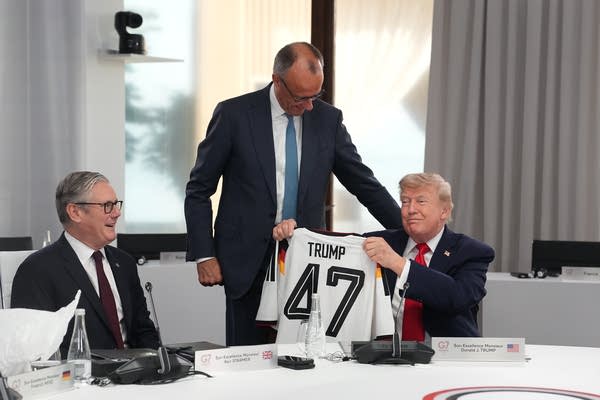
A man presents President Trump with a jersey.
U.S. President Donald Trump, right, holds up a jersey with the number 47 on it as British Prime Minister Keir Starmer, left, and German Chancellor Friedrich Merz look on during a working session at the G7 summit in Evian-les-Bains, France, Tuesday.
Thibault Camus | Pool AP

Trump has been frustrated by a lack of movement toward Ukraine-Russia resolution

Hours before the summit began, Russia fired hundreds of drones and dozens of missiles at Ukraine’s biggest cities in a barrage that killed 11 people and set fire to a religious landmark.

The attacks on Ukraine's biggest cities came after Zelenskyy and Putin spoke separately by phone with Trump on Sunday, the U.S. leader's 80th birthday.

While campaigning in 2024 for a return to the White House, Trump claimed he could end the Russia-Ukraine war within 24 hours of taking office. However, negotiations have stuttered and Trump has since acknowledged it has proved much harder than he initially thought.

Ukraine on Monday officially started European Union membership negotiations, launching a process that will require its government to commit to years of political reforms even as it fights the Russian invasion.

Ukraine sees EU membership as a security guarantee for a stable future once the war ends. Its best guarantee would be membership in the NATO military alliance, but the Trump administration insists that cannot happen, and others are wary of Ukraine joining while the war continues.

The U.S.-Iran ceasefire deal also got plenty of attention at Tuesday’s sessions, with Trump voicing his openness to sending the deal to Congress for review.

The president made the move at the start of a meeting with United Arab Emirates President Sheikh Mohammed bin Zayed Al Nahyan on the sidelines of the summit.

“I like the idea, send it to Congress please,” Trump said. He added, “I mean who wouldn’t approve it?”

Republicans on Capitol Hill say they want Trump to provide more information about the agreement between the United States and Iran, with some expressing skepticism that the deal can deter Iran from pursuing a nuclear weapon.

Trump also held one-on-one talks with the Emir of Qatar, Sheikh Tamim bin Hamad al-Thani. The Gulf nations are not part of the G7, but French President Emmanuel Macron extended invitations to their leaders to take part in the summit at a fraught moment for the region.

Trump also expressed frustration over Israel’s continued hostilities with the Iranian-backed militia Hezbollah in Lebanon, telling reporters he’s “not happy with the way Israel has handled themselves with Lebanon and with Hezbollah.”

“They should have been able to deal with them faster,” Trump added about Israeli operations to target Hezbollah. “It just goes on forever. And when that happens, it throws a negative light on the big deal. And that’s the deal with Iran.”

U.S. allies also seek rapid progress that could ease the economic impact of rising oil prices caused by the blockade of the Strait of Hormuz.

Macron said France and other Western partners are “ready to take action very quickly” to help reopen the strait peacefully. France and the U.K. have championed a mission to restore maritime security in the strait as soon as conditions allow.

The G7 comprises France, the United States, Canada, Germany, Italy, Japan and the United Kingdom. Other guest nations at this summit, including Brazil, India, Kenya and South Korea, were invited to participate in some discussions.




Source link

Leave a Reply

Subscribe to Our Newsletter

Get our latest articles delivered straight to your inbox. No spam, we promise.

Recent Reviews


Being a founder is awesome. And it also really sucks.

It’s a huge amount of stress, disappointment and uncertainty, with little appreciation or guidance.

It’s perfectly normal to find yourself questioning what it all means.

I’ve been there myself… questioning whether the sleepless nights and stress was worth it. And now, I’m often the person founders turn to when they do the same.

In this essay, I wanted to talk about happiness, purpose, and how to get more of it when you’re constantly living in survival mode.

Three Types of Happiness

Martin Seligman, the father of positive psychology, describes three distinct paths to happiness: the pleasant life, the engaged life, and the meaningful life.

  • The pleasant life is about pleasure—closing a deal, hitting a milestone, getting some great customer feedback. As a founder, there’ll be phases where pleasure is hard to come by. Clearly, you can’t build a founder life on pleasure alone.
  • The engaged life is about flow—the state when you’re fully absorbed in solving a hard problem. Most founders have this in spades early on, but as their companies grow, their role can evolve away from flow. Being out of flow is often a signal you need to redesign your role.
  • The meaningful life is about purpose—the sense that what you’re doing matters. Unlike pleasure and engagement, meaning doesn’t require things to be going well. It sustains you through the hard times, not just in spite of them.

So when times are hard, meaning is what we can return to. Unlike pleasure and engagement, meaning is up to you.

And it’s work you can start right now.

How to Make Meaning

So how do you actually build meaning, even when you can barely see past next week? A meaningful life has three components:

  • A meaningful future
  • A meaningful past
  • A meaningful present

Creating meaning in each is an act of creativity. It’s an active process in which you assign meaning to things.

If you aren’t intentional about this, your brain will assign meaning for you. And if you’re not feeling great, your brain will come up with interpretations that match and then reinforce the negative feelings.

What I’m about to share with you is the process I run through when my clients start questioning themselves, and what they’re building.

1. A Meaningful Future

In Man’s Search for Meaning, Viktor Frankl documented the atrocities of the concentration camps. He writes:

“Any attempt to restore a man’s inner strength in the camp had first to succeed in showing him some future goal.”

A lot of modern therapy fixates on the past. But Frankl realised that getting clear on our future goal is even more powerful.

When it comes to founders, they often have goals… but unless you’re fully pumped, your goals need refinement. 

I commonly see three issues with a founder’s goals:

  • They have too many goals. We accumulate goals over time, but we rarely sit down and remove goals. For example, you had goals when you were 18 years old. Most of these have been parked, but some might still be guiding you now.
  • The goal isn’t big enough. For most founders, the more ambitious the goal, the more energy it unlocks. Just increasing the size of the goal can act as a powerful clarifying force for what matters.
  • The goal isn’t framed by its meaning. It’s the difference between ‘I want to make $100M’ versus ‘I want to help 10,000 customers avoid what happened to me’. One is financial, the other is personal.

Refining and reconnecting to your primary goal is critical for building a life of meaning.

Questions to work through:

  • What’s the biggest and most exciting goal you can dream up?
  • If that was your primary goal, what other goals stop being relevant?
  • What people or person could the bigger goal attract that would make it achieving it easier?

2. A Meaningful Past

Being a founder can sometimes feel like a full-contact sport. You can get hurt, through disappointment, bad luck, and even betrayal. That’s why painful events in the past need to be treated like a wound.

When we don’t process the past, unhelpful stories we tell ourselves to protect our ego can cause havoc in the present.

Treating the past means framing every single thing that happened in two ways:

  • A win: an accomplishment that we can celebrate.
  • A lesson: a failure that we learn from, that we can celebrate.

We leave everything else behind. If, for some reason, we can’t let something go, it means we haven’t learned something important from it. As my mentor used to tell me: failures will be repeated until learned.

This work can be done separately, but it’s even more powerful to do it in the context of a big goal. This way, the wins and lessons can be aligned to the vision that truly excites us.

Questions to work through:

  • What is the meaning of what you’ve been through?
  • How did those experiences serve you?
  • Where are they failing to serve you today?

3. A Meaningful Present

Here’s the thing: the future and the past don’t physically exist. They’re tools to help us act in the present.

Often, clarifying the meaning of a bigger future and a happier past makes changing the present obvious and necessary.

As founders, it’s easy to be driven entirely by the past: old goals, old activities, old habits. This stops us from growing. And a lack of growth is one of the fastest paths to feeling meaningless.

Most founders I work with don’t need to do more. They need the courage to do less.

Growth often requires us to:

  • Start doing something we haven’t done before
  • Stop doing something we’ve already mastered
  • Double down on getting even better at some things

The meaningful present is about making these changes — aligning how you spend your time with the future you’ve defined and the lessons you’ve drawn from the past.

Questions to work through:

  • What is the biggest bottleneck to making the big goal viable?
  • What do you need to stop doing—even if there’s a cost involved?
  • What do you need to delegate?

Happiness Isn’t Always Happy

A meaningful life isn’t always smiles and rainbows. It comes with difficulty, sacrifice, and discomfort. But it’s the thing that keeps you going when pleasure and engagement can’t.

If you’re a founder questioning what it all means, the answer isn’t to push harder or to quit. It’s to invest time in making meaning.

Start with the future. Let it reshape the past. And then rebuild the present around what actually matters.

Related Reading: 


Originally published on March 11th, 2026


How do top founders actually scale?

I’ve coached CEOs for 10,000+ hours—here’s what works.
Join 17,000+ founders learning how to scale with clarity.

Unsubscribe any time.


Source link