Use points and miles to save money at Universal theme parks


Theme park vacations aren’t all fun and games. Between park tickets, hotel rooms, skip-the-line passes and souvenirs, the expenses add up quickly. In the search for savings, families can use points and miles to book trips to theme parks like Universal Orlando, Universal Studios Hollywood and Universal Kids Resort, which just opened in Texas.

You can use points to cover things like hotel stays, theme park tickets and more. One thing to note, Universal Studios Hollywood does not have any on-site hotels at this time, but there are a handful of points hotels within walking distance. Universal Kids Resort has an on-site hotel, but it is currently only available through the Amex Travel portal. (It only recently opened, so it could become available through other booking portals in the near future.)

Here are some ways to save at Universal theme parks throughout the United States.

Use Chase Ultimate Rewards points

Redeem Ultimate Rewards points for Universal hotels

The Chase Ultimate Rewards program can be a jack-of-all-trades for covering the costs of a Universal Orlando vacation. Let’s consider your lodging.

Universal Orlando Resort has four Signature Collection hotels: Loews Royal Pacific Resort, the Hard Rock Hotel Orlando, Loews Portofino Bay Hotel and Universal Helios Grand Hotel.

hotel with water in the foreground
Loews Portofino Bay Hotel. TARAH CHIEFFI/THE POINTS GUY

Reservations at Royal Pacific, Hard Rock and Portofino Bay include Universal Express Unlimited, Universal Orlando’s skip-the-line pass. So, if you want Universal Express Unlimited, it’s worth doing the math to see if you can save (or at least break even) by staying at one of these properties.

Helios Grand is Universal’s newest hotel and is located inside the new Universal Epic Universe theme park. While it doesn’t come with Universal Express, staying here is worth it for the theme park views and proximity alone.

hotel room
Universal Helios Grand Hotel. TARAH CHIEFFI/THE POINTS GUY

The lower tiers of Universal Orlando hotels don’t include Universal Express Unlimited passes but do offer early access to select Universal theme parks each day, allowing you to get into popular areas like The Wizarding World of Harry Potter before they become super crowded.

Some of the Universal hotel options can also be really family-friendly. For example, Universal Endless Summer Resort’s Dockside and Surfside properties and Universal Cabana Bay Beach Resort have roomy two-bedroom suites at budget-friendly prices.

Reward your inbox with the TPG Daily newsletter

Join over 700,000 readers for breaking news, in-depth guides and exclusive deals from TPG’s experts

Related: Roller coasters and room service: How hotels made Universal Orlando a top vacation destination

Universal Orlando’s hotels can often be booked through the Chase Travel℠ portal. The value of your Chase points will vary depending on your card.

You’ll get the highest value if you have the Chase Sapphire Reserve® (see rates and fees), as your points are worth up to 2 cents each toward booking travel, depending on the specific redemption (see your rewards program agreement for full details).

Universal Endless Summer Resort — Dockside Inn and Suites. SUMMER HULL/THE POINTS GUY

The Chase Sapphire Preferred® Card (see rates and fees) and the Ink Business Preferred® Credit Card (see rates and fees) both offer slightly less (up to 1.5 cents per point on select hotels, depending on the specific redemption) in value per Ultimate Rewards point redeemed for travel.

Lastly, the Chase Freedom Flex® (see rates and fees) will provide you with a value of just 1 cent per point. However, if you have the Sapphire Reserve, you can transfer the points you have earned on your other Chase Ultimate Rewards cards, like the Freedom Flex, to your Sapphire Reserve account and then redeem them at up to 2 cents each, depending on the specific redemption. See your rewards program agreement for full details.
CHASE.COM

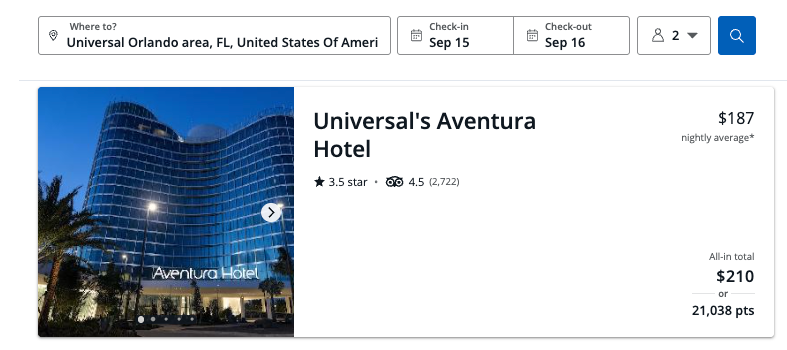
Points prices and cash prices vary by date. On a test date in mid-September, the Universal Orlando hotels ranged from 21,038 to 86,962 Ultimate Rewards points per night for a user with the Chase Sapphire Preferred Card.

Buy Universal tickets with Ultimate Rewards points

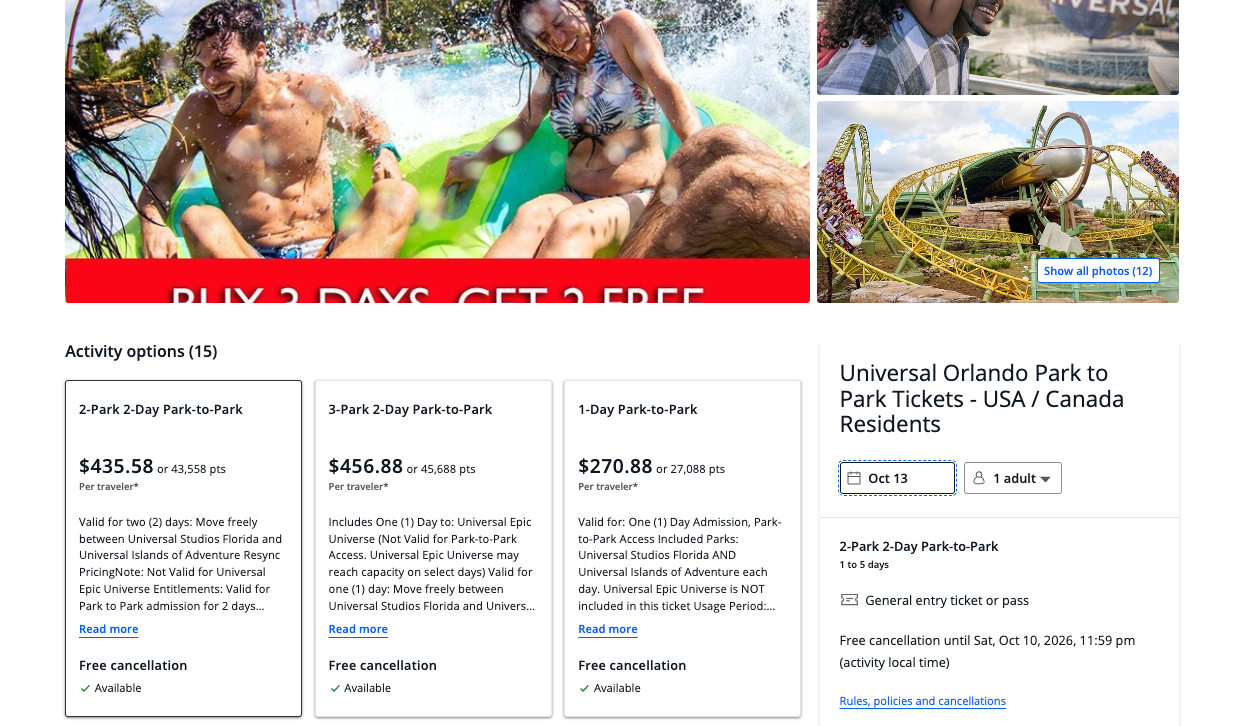
You can purchase a variety of Universal Orlando and Universal Studios Hollywood park tickets through the Chase Ultimate Rewards portal. When doing so, you’ll get the same redemption rates as you’d get when booking hotels through the Ultimate Rewards portal.
theme park ticket pricing
CHASE.COM

If tickets are available, you can find them in the “Activities” section of the travel portal. Search for “Orlando,” enter your dates and any available ticket options will populate in the search results.

Use Citi ThankYou Rewards points

Just as you can use Chase Ultimate Rewards points at a fixed value to book an official Universal Orlando hotel room, you can use your Citi ThankYou Rewards points to do the same via the Citi travel portal. You can also purchase Universal Orlando tickets through the Citi travel portal and even take advantage of some of the limited-time offers that Universal frequently advertises to save money on multiday trips.

dragon themed land
How to Train Your Dragon – Isle of Berk. TARAH CHIEFFI/THE POINTS GUY

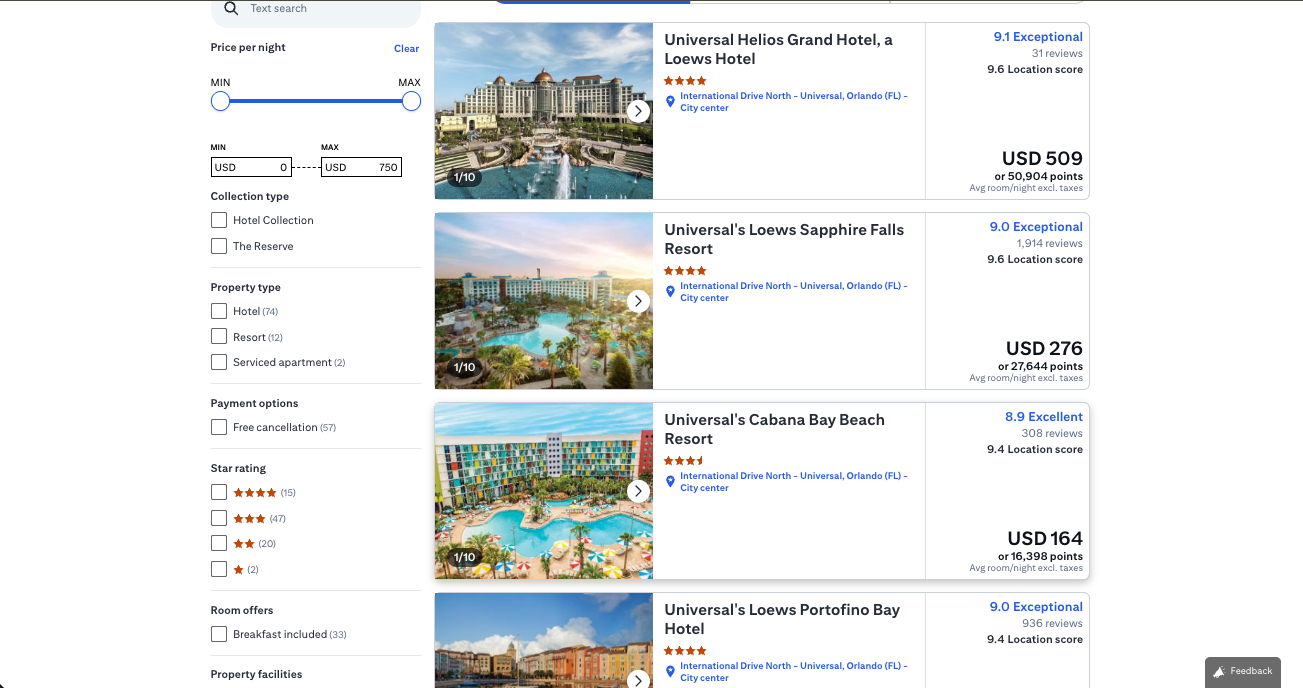
While you can book most Universal Orlando hotels through the Citi travel portal, you’ll only get 1 cent per point in value. As of June 2026, TPG values ThankYou Rewards points much higher than that, so you’ll want to consider if there are other ways to get better value for your Citi points.
hotel pricing
CITI

If you have the Citi Strata Premier® Card (see rates and fees) or Citi Prestige® Card (no longer open to new applicants), you can use your annual cardholder benefits at Universal hotels and those nearby. Premier cardholders can get $100 off a hotel reservation of $500 or more (excluding taxes and fees), available once per year. Prestige cardholders can get a fourth night free on stays of four or more nights, available twice a year. Both benefits require booking in the Citi Travel portal.

The information for the Citi Prestige has been collected independently by The Points Guy. The card details on this page have not been reviewed or provided by the card issuer.
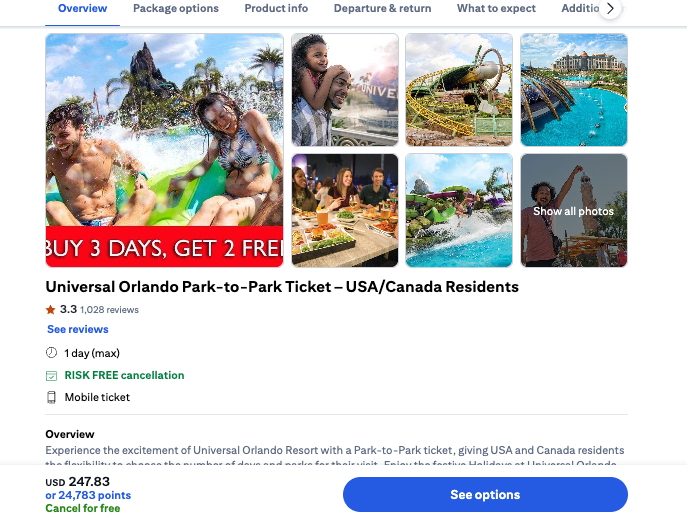
theme park ticket pricing
CITI.COM

You can also book theme park tickets and other activities through the Citi travel portal, often with the same discounts you can get by booking directly.

Related: Best ways to redeem Citi ThankYou points

Use American Express Membership Rewards points

Redeem Amex Membership Rewards points for Universal hotels

All of Universal Orlando’s on-site hotels are available for booking through the American Express Travel portal using either cash or points. Cash pricing is typically the same as what you’ll find by booking directly with Universal, but you can earn 5 Membership Rewards points per dollar spent on prepaid hotels booked through the American Express Travel® portal with American Express Platinum Card® or The Business Platinum Card® from American Express.
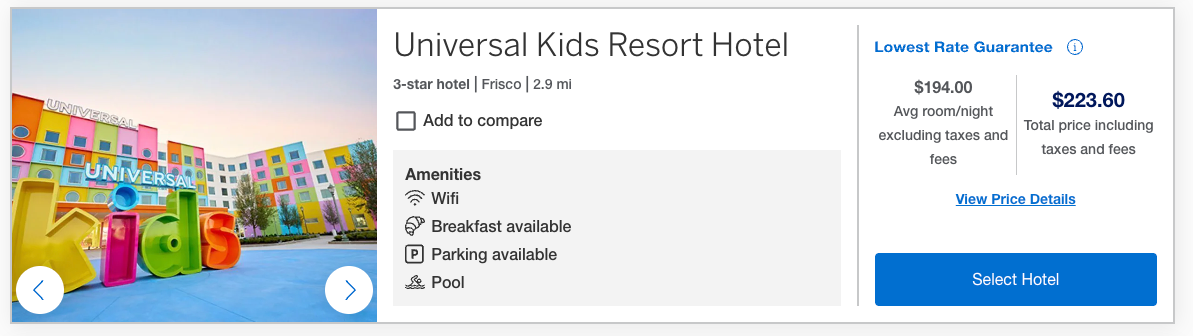
hotel pricing
AMEXTRAVEL.COM

All Universal hotels, including the one at the new Universal Kids Resort in Frisco, Texas, are bookable through Amex Travel.

Take advantage of American Express Fine Hotels + Resorts perks

Speaking of American Express, Loews Portofino Bay Hotel, one of the three hotels that offer complimentary Universal Express Unlimited passes, is bookable through the American Express Fine Hotels + Resorts program, available to those with the Amex Platinum or the Amex Business Platinum.

Amex Fine Hotels + Resorts welcome amenity at Loews Portofino Bay Hotel. TARAH CHIEFFI/THE POINTS GUY

When booking a stay at this property via the Amex Fine Hotels + Resorts program, you get Universal Express Unlimited passes for everyone staying in the room, a room upgrade (based on availability), daily complimentary breakfast for two, free Wi-Fi, early check-in (if available), late checkout and a $100 food-and-beverage credit per stay.

Plus, as an Amex Platinum Card or Amex Business Platinum Card holder, you’ll get up to $600 annually (distributed as up to $300 in biannual hotel statement credits) when paying for your stay with your Amex card. These perks go a long way toward offsetting the lower redemption value.

Use Capital One miles

There are a few different ways you can use Capital One miles to help with a trip to one of Universal’s theme parks.

Jaws parade float
UNIVERSAL ORLANDO RESORT

First, you can book a Universal vacation package that includes lodging and pay with one of your Capital One Venture cards. That lets you use your Capital One miles to cover the charge at 1 cent per mile.
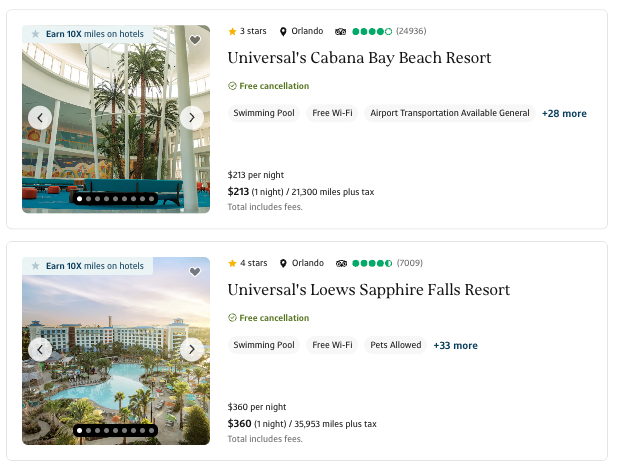
hotel pricing
CAPITALONE.COM

You can also book Universal Orlando hotels through Capital One Travel using cash or miles. Best of all, you can earn up to 10 miles per dollar spent (depending on the card you use) if you pay with cash and still use your miles to cover the charge after it appears on your statement.

Remember to check the rates on Capital One Travel versus other online travel agencies and booking directly, though, as there can be price disparities.

This can be especially helpful for hotels that offer Universal Express Unlimited passes. While you’ll still need park tickets, Universal Express Unlimited passes can be very pricey. Getting these included with your hotel room can be a great way to save money on your Universal Orlando vacation.
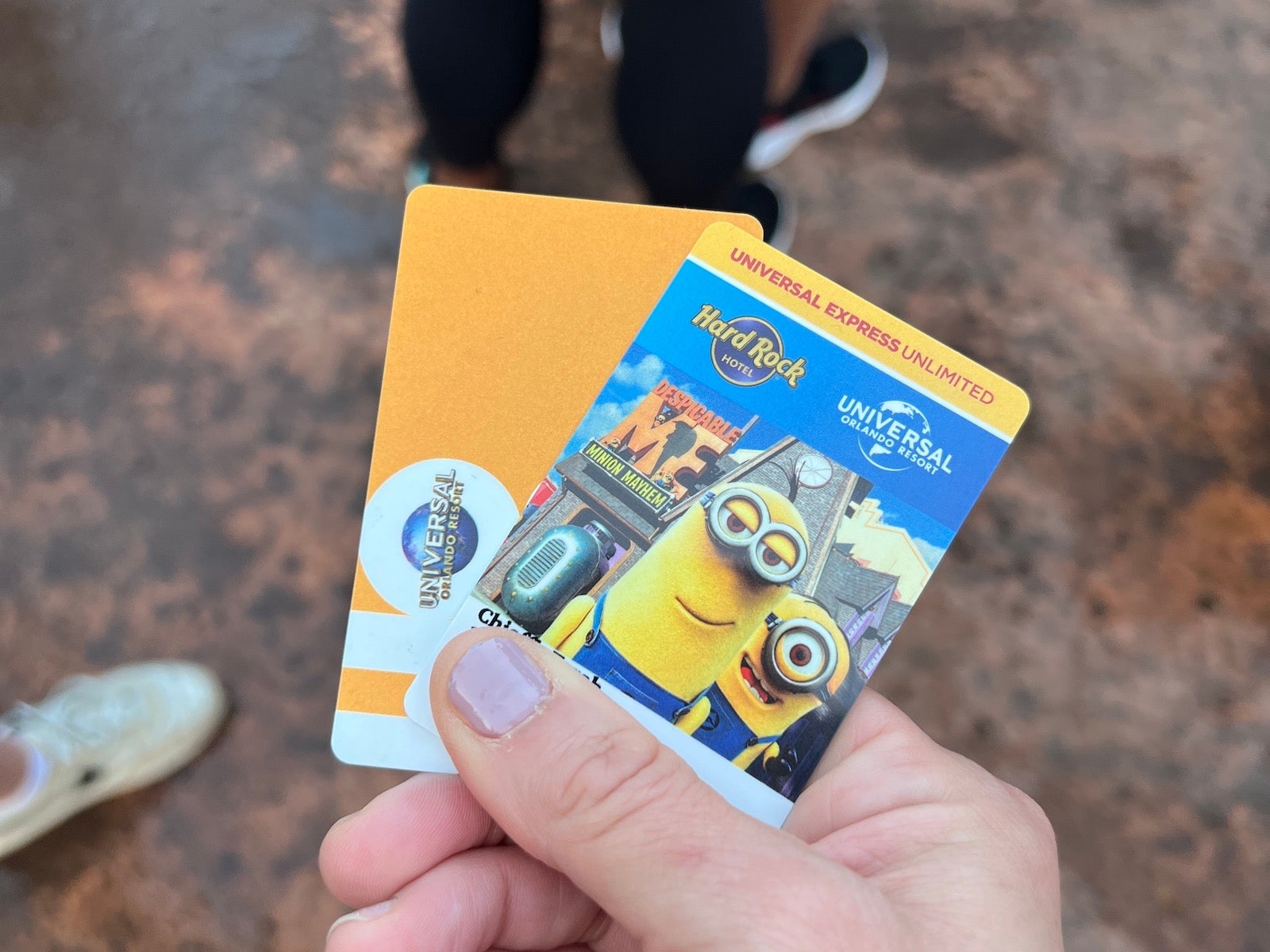
Universal Express Pass
Universal Express Pass. TARAH CHIEFFI/THE POINTS GUY

For folks who hold a premium card such as the Capital One Venture X Rewards Credit Card, you can also use your $300 annual travel credit to offset some of the cost of a Universal hotel booked through Capital One Travel.

Lastly, some third-party theme park ticket sites like Undercover Tourist code as travel. If you purchase your tickets through one of these companies and it codes as a travel purchase, you could also use miles to remove the transaction from your statement.

Use Universal Rewards points

child playing
Universal Kids Resort. TARAH CHIEFFI/THE POINTS GUY

There are two Universal Rewards credit cards: the no-annual-fee Universal Rewards Plus Visa Signature® Card earns 2 points per dollar on qualifying Universal purchases and 1 point per dollar on all other purchases. The $99-annual-fee Universal Rewards Plus Visa Signature® Card earns 4 points per dollar on qualifying Universal purchases, 2 points per dollar on travel, gas and dining purchases, and 1 point per dollar on all other purchases, among other perks. You can add the points you earn to a Universal FUNds prepaid card to cover eligible Universal purchases.

The real value of these cards lies in the in-park discounts and welcome offers. Both come with access to perks like 10% off select merchandise and food and beverage purchases at Universal theme parks and a welcome bonus statement credit for new cardholders.

While not the most lucrative return, if you are planning a major Universal vacation, you may find value in the welcome offer for new cardholders, bonus points on Universal purchases and in-park discounts, such as 10% off select merchandise and food and beverage purchases at Universal theme parks.

The information for the Universal Rewards Plus and Universal Rewards cards has been collected independently by The Points Guy. The card details on this page have not been reviewed or provided by the card issuer.

Use hotel points for off-site Universal hotels

DreamWorks Land at Universal Orlando
DreamWorks Land at Universal Orlando. TARAH CHIEFFI/THE POINTS GUY

Several chain hotels are located near Universal parks, giving you many opportunities to use points from all major hotel brands.

Hotel Landy is a Marriott Tribute Portfolio hotel less than a seven-minute drive from Universal Orlando. Nightly rates start as low as $95 or 25,000 Marriott Bonvoy points per night.

If you want to stay even closer to the parks and redeem Hilton Honors points, check out the DoubleTree by Hilton Hotel at the Entrance to Universal Orlando (yes, that is the real name). Rates start at around $117 or 34,000 Hilton Honors points per night.

Though not technically a Universal property, the Hilton Los Angeles Universal City, is within walking distance of Universal Studios Hollywood and has rooms with spectacular park views. Rates start at $209 or 70,000 Hilton Honors points per night.

And, if you want to earn or redeem points near the Universal Kids Resort in Texas, check out the Courtyard by Marriott Dallas Frisco. It’s only about a five-minute drive from the park. Rates here start at $148 or 14,800 Marriott Bonvoy points per night.

Related: The best credit cards for hotel stays

Bottom line

The cost of a Universal vacation (well, any vacation) can quickly surpass your budget if you aren’t careful. Leveraging points and miles to lessen the cash cost of your stay can make a big difference.

Beyond that, just having the right credit card in your wallet can make a difference when it comes to discounts and maximizing points for your next vacation. With each ice, cold Butterbeer costing about $8, you need all the help you can get.


Source link

Leave a Reply

Subscribe to Our Newsletter

Get our latest articles delivered straight to your inbox. No spam, we promise.

Recent Reviews


Azure IoT Hub – Table of Content

What is Azure IoT Hub?

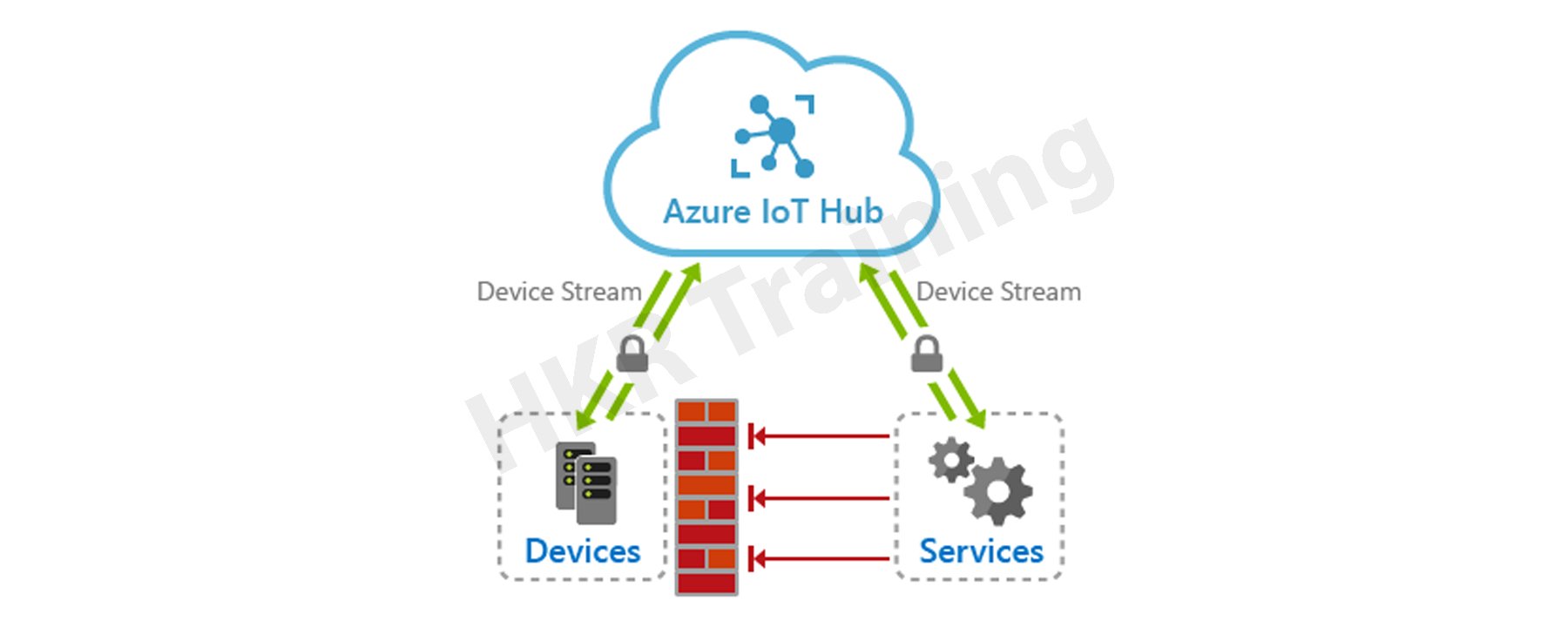
Microsoft’s Azure IoT Hub is a cloud-hosted manageable IoT service that acts as a central hub for messages. It provides bi-directional communication between the millions of devices it manages and the IoT apps. Further, it enables completely scalable IoT solutions, and virtually, we can connect multiple devices with Azure IoT Hub. It supports various messaging patterns like telemetry data from Device-to-cloud, file uploading from the device, and request-to-reply methods to control devices through the cloud. Moreover, through hybrid communication, it can connect from cloud to device and device to cloud. This feature makes IoT Hub more popular in the market. 

Azure IOT HUB

Azure IoT Hub helps to track and monitor multiple events like development, failurr, and connecting devices. It supports various IoT workloads for the users by scaling to millions of devices concurrently. Also, it rises to millions of events quickly, enhancing productivity. It enables the building of completely scalable IoT solutions such as tracking and monitoring valuable healthcare assets, managing various manufacturing equipment, etc. Further, Azure IoT Hub also offers a secure communication channel with enhanced security. However, Azure IoT Hub provides reliable and safe solutions to various businesses by connecting millions of devices and applications. 

Become a master of IoT by going through this HKR IoT Online Training!

Azure IoT Hub offers

  • Device library professionals are available for most commonly used systems and languages, allowing for simple device connectivity.
  • Stable communication with various device-to-cloud and cloud-to-device hyper-scale communication channels.
  • Processing of per-device state data as well as meta-data that can be queried.

IoT Hub device management:

The needs and priorities of IoT operators vary markedly across industries, from transportation to manufactured goods to agriculture to utilities. There is also a wide range of different devices used by IoT operators. IoT Hub can provide developers with the abilities, patterns, and code libraries they need to create management tools which can manage large amounts of data.

Related Article: IoT Solutions Architect

Microsoft Azure Certification Training

  • Master Your Craft
  • Lifetime LMS & Faculty Access
  • 24/7 online expert support
  • Real-world & Project Based Learning

Device configuration and control

Devices that are connected to the IoT Hub can be handled using a variety of built-in features. That is to say-

  • All of your devices’ metadata and state data can be saved, synchronized, and queried.
  • Device states can be set per-device or in groups based on common power devices.
  • Using message routing integration, a device’s state change can be instantly reacted to.

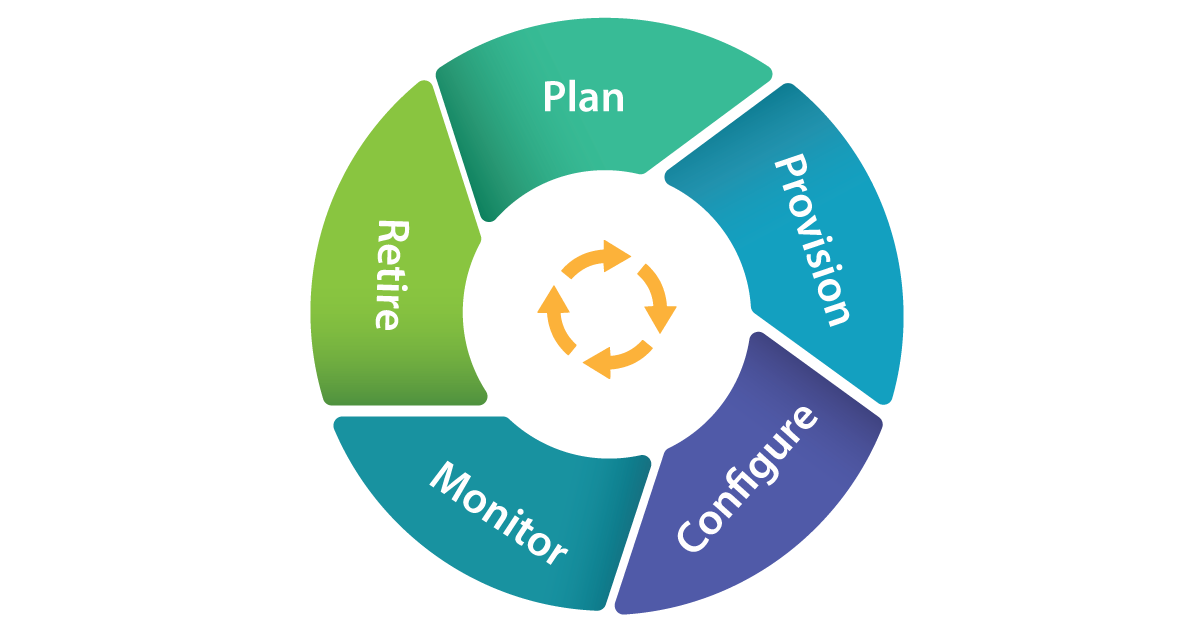
The LifeCycle of Devices with IOT Hub:

lifecycle of devices with IOT Hub

Plan Operators could really generate a device metadata scheme which really aims to facilitate bulk risk management with ease.

Provision

  • New devices can indeed be safely added to IoT Hub, and operators could indeed soon realize about mobile applications. Device identifications and credentials are created using the IoT Hub identity registry.
  • Configure Data management activities, including such configuration changes and software installations, can be performed in bulk or directly while maintaining system security.
  • Monitor Operators could be quickly notified to any problems that arise, while also monitoring the device collection’s wellbeing and the position of every continuing operation.
  • Devices must be substituted, retired, or dismantled. To withdraw device identifications and qualifications, the IoT Hub identity registry is used.

Plan

It enables operators with a plan to build a device metadata scheme that allows them to easily and accurately perform bulk management activities. You can use the device twin to save device metadata in the style of properties and tags. 

Configure

Azure IoT Hub allows device management activities such as configuration changes in bulk and firmware updates. You can do these operations either in bulk or by direct methods. 

Monitor

Using IoT Hub, we can alert operators on the occurrence of issues by monitoring device collection health. Also, we can check the status of multiple ongoing activities. Here, we can apply a device twin that enables devices to report the conditions of real-time operations and update operations status.

Retire

At the end of the lifetime of service, the devices need replacement or deactivation after a failure or cycle update. Here, we can use the IoT Hub identity registry to rescind the credentials and identities of devices securely.

Device Management Operators:

  • IoT Hub contains a range of device management patterns, such as,
  • Factory Reset Reboot
  • Firmware update for configuration
  • Progress and status updates
  • These patterns can be tailored to your specific situation. Alternatively, these templates can be used to create new patterns.

Connecting Devices:

By using Azure IoT device SDK, you can create applications that run on your devices and interact with IoT Hub. Platforms supported include Windows, Linux distributions, and real-time operating systems. Currently supported languages includes C,C#,Java ,Python, and Node.js.IoT Hub is a key component of the solution accelerators and can be used to address IoT challenges in the implementation such as:

  • Device connectivity and management at a high volume.
  • Ingestion of large amounts of telemetry.
  • Device command and control
  • Enforcing device security.

Integrating with Other Devices:

IoT Hub can be combined with other Azure services to create complete, end-to-end solutions. As an example, use:

  • Azure Event Grid enables your company to respond quickly to critical events while remaining reliable, scalable, and secure.
  • To streamline business operations, use Azure Logic Apps.
  • Azure Machine Learning can be used to incorporate machine learning and AI models into your solution.
  • Using Azure Stream Analytics, you can perform real-time analytic calculations on information broadcasting from one’s devices.

frequently asked IoT Interview questions and Answers !!

HKR Trainings Logo

Subscribe to our YouTube channel to get new updates..!

Messaging Patterns:

Azure IoT Hub includes a variety of messaging patterns, such as,

  • Telemetry from a device to the cloud
  • Device-based file upload
  • Methods of request-response that allow devices to be monitored from the cloud.

Related Article: Future Scope of IoT

Messaging routing and event grid

Streaming data from your connected devices is possible thanks to IoT Hub message routing and IoT Hub integration with Event Grid. There are, however, distinctions.Message routing lets customers to route device-to-cloud messages to the a variety of endorsed service endpoints, including Event Hubs and Azure Storage containers, whereas IoT Hub assimilation with Event Grid is a highly scalable routing service that can be increased in to the third-party enterprise applications.

Routing the device data:

The message routing capabilities are built into Azure IoT Hub. This enables you to automate message fan-out based on rules. Message routing allows you to direct at which your hub sends telemetry from your devices. Routing messages to seamless access is free of charge.

Building end to end solutions:

Incorporating IoT Hub with other Azure services allows for the creation of end-to-end solutions. As an example,

  • Azure Logic Apps can be used to optimize business operations.
  • Using Azure Stream Analytics, you can perform real-time analytic computations on data from your devices.Azure Machine Learning could be used to add AI models and machine learning.
  • With Azure Event Grid, you can react promptly to important incidents.

Azure IoT Hub and Azure Event Hub

Azure IoT Hub and Azure Event Hub both are cloud services capable of ingesting, processing, and storing large amounts of data. They were, however, created for distinct purposes.Event Hub was created for big data streaming, whereas IoT Hub was created to connect IoT devices at scale to the Azure Cloud. As a result, which one you use will be determined by the needs of your company.

Security:

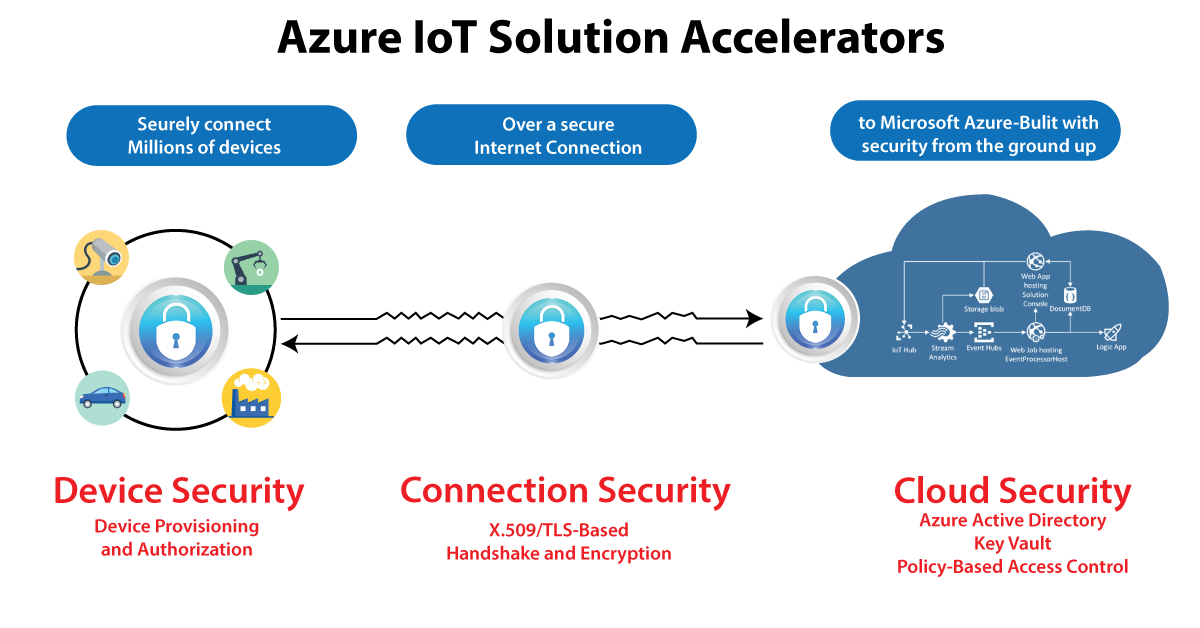
Businesses face new security, confidentiality, and compliance challenges as a result of the Internet of Things. Security for IoT solutions entails securely provisioning devices, step is implementation among devices and the cloud, and ensure security data security in the cloud all through handling and preparation.

Azure-IoT-Hub-2

IoT Hub enables information to be processed over secure channels of communication. So every device securely connects to a hub and can be handled securely. You could indeed gain access on a per-device basis, and devices are made available to the appropriate hub when they first boot up.

There are also a variety of authentication methods available depending on mobile applications, such as SAS SAS token-based authentication, individual X.509 certificate authentication for secure, standards-based authentication, and X.509 CA authentication.

HA and disaster recovery

The goals for uptime differ from one company to the next. Azure IoT Hub provides three main High Availability (HA) and Disaster Recovery (DR) features, which are as follows:

  • Intra-region HA: The IoT Hub provider implements layoffs with almost all layers of the service to provide intra-region HA. The SLA published by the IoT Hub service is achieved through the use of these redundancies, which are made available to developers automatically. However, while using cloud computing, transient faults must be anticipated; thus, appropriate retry regulations must be built into components that can be interacted with the cloud services.
  • DR across borders
  • Issues may occur when a datacenter experiences prolonged outages or other physical inability. It is rare, but intra-region HA capability will be unable to assist in these circumstances.IoT Hub, on the other hand, has a range of potential solutions for regaining from elongated outages or physical failures. In these cases, a consumer can choose between a Microsoft-initiated failover and a manual failover.

Obtaining cross-region HA

If the RTOs supplied either by the Microsoft initiated failover or manual failover are insufficient to meet your throughput goals, you can incorporate a per-device automatic cross-region failover component. The IoT solution in this framework operates in two separate data centers, one primary and one secondary.If the primary region experiences an outage or a lost opportunity of network connectivity, the technologies could use the secondary location.

Selecting the Best IoT Hub Tier

Azure IoT hub is divided into two tiers: basic and standard. If data is to be collected from devices and analyzed centrally, the basic tier, which is unidirectional from devices to the cloud, is preferable.However, when you require bi-directional interaction, such as the ability to control connected devices, the standard tier is preferable. The security and authentication features are the same in both tiers.

Azure IoT Hub Benefits:

There are multiple benefits of using Azure IoT Hub in real-time.:

  • Azure IoT offers different shortcuts for fast prototyping and deployment of code. It allows less coding to develop app templates, SDKs, plug-and-play device connections, etc. However, Microsoft has developed the best and simple IoT platform for multiple users.
  • Each Azure IoT service provides perks such as pre-built app templates with desired use cases within Azure IoT Central. In this regard, Azure Maps is the best example that enriches your IoT App with geospatial data. 
  • Each service in this platform has a flexible pricing model based on its particular feature sets. Its simple approach and transparency help to separate the Azure IoT Hub. 
  • Azure IoT has a strong support of partner networks similar to AWS. These include manufacturers of IoT hardware and solution developers. 
  • Moreover, the major benefit of Azure IoT Hub is its strongest security feature. Further, Microsoft invests billions of dollars in Cybersecurity solutions every year. 

What are the Microsoft Azure IoT Hub features?

Scaling your solution

  • Azure IoT Hub helps scale concurrently connected millions of devices and events/second. 
  • It supports multiple IoT workloads easily. Thus, it gives you a highly scalable solution to ease your workload.

Securing your communications

Azure IoT Hub offers a safe and secure connectivity channel for smart devices to send and receive data. 

  • It provides complete control over device access and connections with each device. 
  • Each device authentication allows them to connect with IoT Hub securely, and they are securely managed. 
  • Further, it supplies devices and appliances to the right IoT Hub upon booting the device. 

Routing device data

IoT Hub offers an in-built message routing functionality with the flexibility to set up an automatic rule-based message expansion.

  • At first, use message routing to manage where your hub sends device telemetry. 
  • There will be no extra cost for routing messages to various endpoints. 
  • Further, no-code routing protocols will take the place of unique message dispatcher codes. 

Integrating with other services

Azure IoT Hub provides integration with other Azure services to develop full-fledged solutions. The following integrations it supports:-

  • Azure Event Grid integration helps your business respond securely and reliably to important events. 
  • Moreover, Azure Logic App integration will help automate various business processes
  • Azure Stream Analytics is useful for real-time analysis of data streams in your device. 
  • Further, the Azure Machine Learning combination will add ML and AI models to the solutions. 

Configuring and controlling your devices

Using an order of various in-built functions, you can easily control your devices linked with IoT Hub. 

  • At first, it needs storing, syncing, and inquiring about device metadata and the status of all the devices.
  • Next, device condition setting, whether per-device or based on common features of devices. 
  • Finally, through message routing combination, it automatically responds to a device-reported condition change. 

Connect your devices

To create applications that run on your devices and interact with IoT Hub through Azure IoT device SDK libraries. It supports various languages, such as:-

  • C, C#, Python, Java, Node.js, etc.

Also, there are some protocols that IoT Hub and the device SDKs support to link devices. These include:-

  • HTTPS
  • MQTT
  • AMQP
  • MQTT over WebSockets
  • AMQP over WebSockets

Organizing bidirectional communication with millions of IoT devices

  • Utilize device-to-cloud measuring data to know the condition of your devices and define message routes to other Azure services without putting down the code. 
  • Further, in the cloud-to-device messages, send commands and notifications to the linked devices and track message delivery with the approval of receipts.

Developing and running hybrid IoT apps throughout data centers

  • Azure Stack Hub is an extension of Azure helpful to offer a path to run apps in an on-premises ecosystem. And it delivers Azure services within your data centers. 
  • Additionally, partners & customers will have the flexibility to create hybrid IoT apps that run wholly or partially on-premises. It is possible with Azure IoT Hub’s availability on Azure Stack Hub.

Create An Azure IoT Hub

Developing an Azure IoT Hub needs to follow the below steps.

  1. Creating Azure IoT Hub
  • First, you must register and sign in to the Azure portal using credentials.
  • Then, you have to select the “Create a Resource” tab. After thiss, you need to enter “IoT Hub” within the search marketplace field.
  • Then, choose “IoT Hub” from the search outcomes and select the “Create” option.

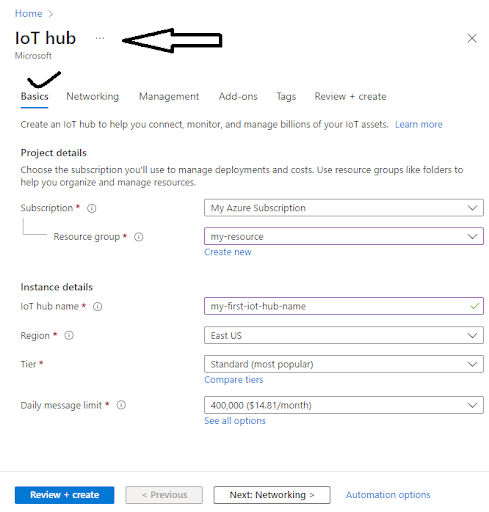
Now, navigate to the Basics tab and complete the fields given:

  • Subscription: Choose the appropriate subscription to use within the IoT Hub.
  • Resource Group: Select the required “Resource Group.” Although, to build a new group, select “Create New” and enter the name you wish to use for it. 
  • Region: Select the exact region/place for the IoT Hub location.
  • IoT Hub Name: Enter a unique/uncommon Azure IoT Hub name.

Creating IOT HUB

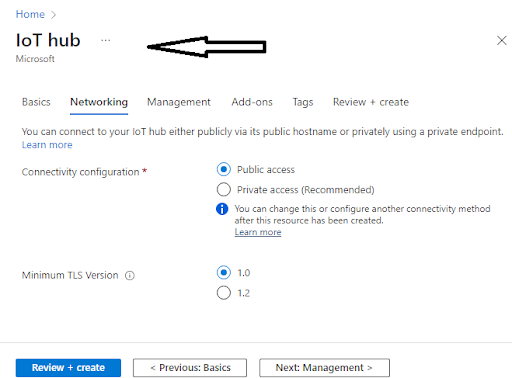
Then select “Next: Networking>” to continue Hub creation.

  • Here, you can choose the endpoints to connect to your IoT Hub. Further, you can select the default setting as Public EndPoint & Private EndPoint. 

Next Networking

Now, go to Next: Management> to continue the process of IoT Hub creation. 

Here, you will be given the option to accept the default settings. 

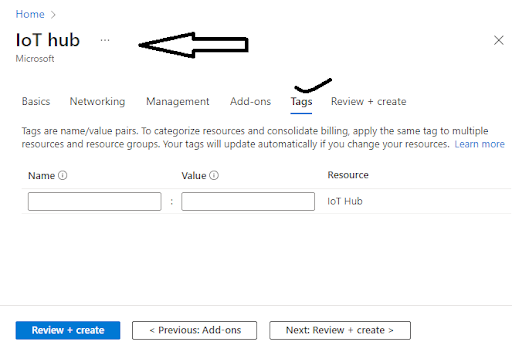
Then, to move to the next screen, you need to select the “Next: Tags” choice. 

  • Here, Tags include name/value pairs where you can assign the same tag to different resources and their groups to divide them and combine billing.

IOT HUB Tags

After completing the above, choose the “Next: Review + Create” tab to review/check your choices. Then go to the “Create” option to build your new IoT Hub.

  1. Changing/Updating the IoT Hub

Here, you can modify the settings of your current IoT Hub that you built from the Azure IoT Hub pane. Below are the various properties that you8 can set for the IoT Hub.:-

  • Scale & Pricing: This property will be helpful to migrate to a new tier or to set the number of IoT Hub Units. 
  • IP Filter: This property is useful to set the range of IP addresses the Azure IoT Hub can accept or reject. 
  • Properties: It consists of various properties like resource ID, group, resource location, etc., available for copying and use anywhere else.

Shared Access Policies

Go to Settings and click on the “Shared Access Policies” option to view or change the list of various Shared Access Policies. Further, these policies mention the necessary consent to connect the devices and services with the IoT Hub. 

Click the button Add and you will see a window “Add Shared Access Policies” opens. Here, it allows you to insert the new policy name and the permissions list that you wish to link with this policy. The permissions include the following:-

  • Registry Read and Write Policy
  • Service Connect Policy
  • Device Connect Policy

After this, click on the “Create” tab to add this new policy to the current list of guidelines.

  1. Registration of New Devices to the IoT Hub

To register a new device-

  • Go to the IoT Hub navigation menu and open IoT devices.
  • Then insert a name for the new device within Create Device. After giving the device name, choose the “Save” option to create the device identity of the Azure IoT Hub.
  • Finally, go to the IoT Devices pane after device creation and open the device from the list. Then to connect with the IoT Hub, you need to copy the Primary Connection String. 
  1. Message Routing for Azure IoT Hub
  • For this, click on the “Message Routing” option within the “Messaging” section to see the Message Routing pane. 
  • Then you have to mention the custom endpoints and routes for the IoT Hub.  
  • Further, Message Routing is useful to manage how data is sent to your endpoints from the IoT devices. 
  • Here, the first and foremost step is to add a new route. Then it allows you to add an existing endpoint to the Route or build a new one of the various types that supports it—for example, Blob storage.

Routes

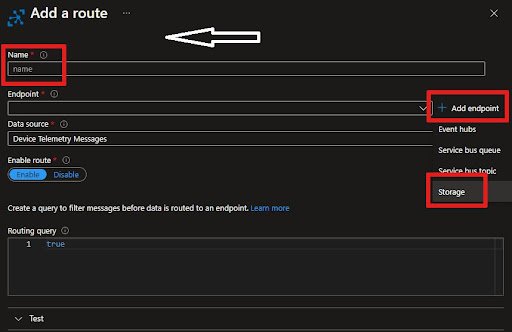
  • You will find “Routes” as the first tab on the Message Routing Pane. Then click the +Add, to add a new route.
  • Then insert a Name for the Route.
  • After that, you will see Endpoint, from which you will have a dropdown list, or you can add a new one. To add it, click +Add Next to the Endpoint list and choose Blob Storage.
  • Then, after adding the Endpoint name, click on “Pick a Container” to select the Storage Account and the container.
  • For the “Data Source,” choose the Device Telemetry Messages. 
  • Further, you need to add a Routing Query. In this instance, the messages with an Application property with the name “Level” equal to “Critical” are directed to the storage account.  
  • Finally, you have to save the Routing file. Then you can go back to the Message Routing Pane and see a new “Routing Rule” appear.

Routes

Custom Endpoints 

Go to the “Custom Endpoints” option, where many are already built. 

  • Here, you can easily build new or remove the existing Endpoints. 
  • Moreover, you can only specify up to 10 Custom Endpoints for the Azure IoT Hub.
  1. Finding a particular IoT Hub

First Step:-

  • Go to the homepage in Microsoft Azure and choose the IoT Hub from the given list.
  • You click on the “Resource Groups” if you already know the resource group to which the Azure IoT Hub belongs.
  • Now select the option- “Resource Group,” and the drop down list will display.
  • Then the “Resource Group” screen presents all that group’s resources along with the Azure IoT Hubs. 
  • After that, you choose your IoT Hub. 

Second Step-

  • Click on the “All Resources” tab. You will find a dropdown list over there.
  • Then click on the Drop Down list and uncheck the Select All option.
  • After that, find “IoT Hub” and check the same.
  • Finally, click on the appearing “Drop Down” list to close it. It filters all the entries and displays them on your IoT Hubs.
  1. Deleting/Removing the IoT Hub

You can also delete your IoT Hub in the following way.:-

  • Go to the Azure Portal.
  • Select the “Delete” option to remove the IoT Hub.

Microsoft Azure Certification Training

Weekday / Weekend Batches

Conclusion

In the above blog post we discussed the Azure IOT hub, configuration, integrations,routing, communication and security in a more detailed way. Had any doubts please drop your queries in the comments section. 

Related Article:

Azure IoT Edge Overview


Source link