Legal advocates and people who have been detained at the Bishop Henry Whipple Federal Building in the Twin Cities testified in court this week that the federal government has violated detainees’ rights to talk to lawyers.
Those claims are the focus of a federal lawsuit brought earlier this year by the nonprofit Advocates for Human Rights, amid the federal immigration enforcement surge in Minnesota. Many people detained by federal agents were held at the Whipple building.
U.S. District Judge Nancy Brasel issued a temporary restraining order last month, ordering improved access to attorneys at Whipple. In court Thursday, attorneys for the plaintiffs asked her to issue a preliminary injunction extending that order.
Attorney Jeffrey Dubner told Brasel that the temporary order has improved access to legal counsel, with more attorneys allowed inside the building to meet with clients and better access to phone calls for detainees.
But he said an injunction is needed to maintain that progress, and stop ongoing issues with access to counsel. He said some detainees still are not informed of their rights when they’re arrested. Some have been transferred to Texas within hours of being detained, in violation of the judge’s order to keep them in the state for three days.
“More will suffer that fate without a preliminary injunction,” Dubner said. “These aren’t hardened criminals or safety risks. … these are just ordinary people caught up in a sweeping dragnet. They needed the meaningful assistance of counsel.”
Attorneys for the Department of Homeland Security said an injunction is not necessary. They argued that meetings between detainees and attorneys are going smoothly, in part because less people are detained at Whipple as the immigration enforcement operation draws down.
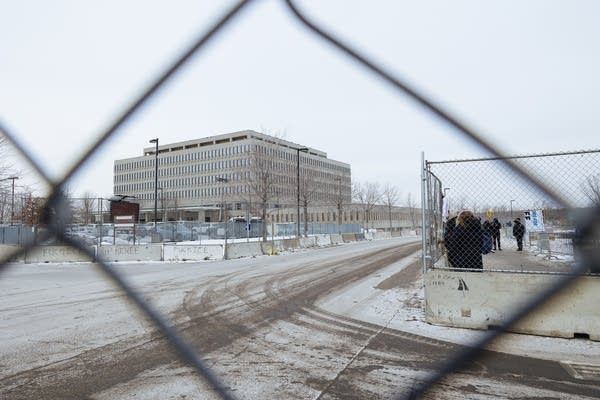
They said detainees are spending less time on average at Whipple, too. According to lawyers for the federal government, the average detainee holding time is now between one and three hours, down from an average stay of 12 hours before the court issued its temporary restraining order.
“Things have returned to a more manageable pace,” Justice Department attorney Christina Parascandola said during Thursday’s hearing.
But attorneys for the plaintiffs pointed to a track record of rights violations at the Whipple Building, and said the government hasn’t indicated they have any intention to stick to improved practices without a court order.
Two plaintiffs in the class action lawsuit spoke in court, appearing via video calls with a Spanish interpreter. Both were detained at Whipple in January.
They said they were allowed limited phone calls to family members and their lawyers while at Whipple.
One of them — a man identified by the initials JJB — described being held in a packed cell, with a phone on the wall that didn’t work. He said was only allowed limited calls to his mother, and one call to his lawyer, after begging agents to let him use the phone. He said he called from desk phones in offices at the Whipple building, and agents stood next to him while he made the calls.
On his second day detained at Whipple, JJB said he was taken into a van and told he’d be flown to Texas. Then, without explanation, he said he was brought back to Whipple and returned to a holding cell. At no point in the process was he allowed to call his lawyer.
“I didn’t know what was going to happen to me,” JJB said.
The next day, agents took him out of the cell and told him he was being let go. They asked him to sign paperwork in English. The only word he could read was “out.”
When JJB asked for more information about what he was signing, he said an agent told him it was just paperwork that would let him leave. He was not allowed to call an attorney before he signed it.
Both plaintiffs who testified Thursday identified themselves only by their initials, and said they were worried that U.S. Immigration and Customs Enforcement would retaliate against them and their families if they used their full names in court.
Two attorneys told the judge that it was nearly impossible to meet with their clients at the Whipple building between the start of the immigration surge and mid-February, when the court issued its temporary order in the case granting better access.
Attorney Hannah Brown said she spent four hours at the building one day in January attempting to meet with clients. She tried to follow the process of requesting a meeting that had typically worked prior to the start of the immigration surge. But in January, an employee at a front desk in the Whipple building said she couldn’t meet with clients.
Brown told the court that the employee said there were too many people detained at Whipple for it to be practical for them to all meet with lawyers.
“I very specifically remember her saying, ‘imagine the chaos,’” Brown said.
Attorney Kira Kelley said they attempted to meet with clients at the Whipple building about 10 times between January and mid-February; they were only able to get a meeting once. Both attorneys said they struggled to reach anyone at a Homeland Security phone number they were instructed to call.
“I’ve listened to that number ring for more hours at this point than I can count,” Kelley said.
Attorneys for the plaintiffs in the case said they’re worried about a return to these conditions if the court doesn’t issue the injunction.
Court was in session for about seven hours Thursday, and the hearing will continue Friday afternoon. There’s no timeline for when Brasel might rule on whether to grant the preliminary injunction.