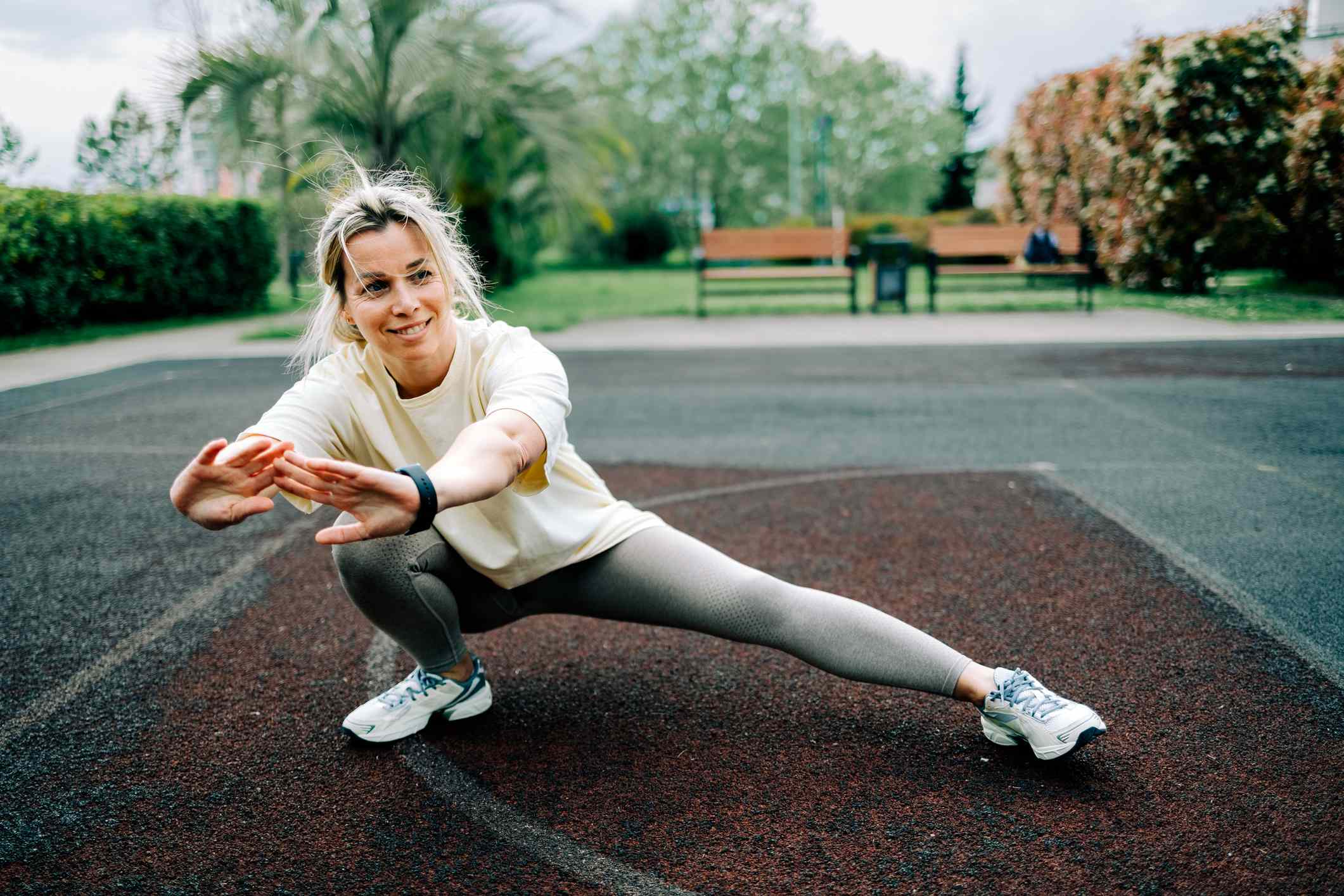
:max_bytes(150000):strip_icc():format(jpeg)/Health-GettyImages-FullBodyExercisesAdultsUnder60-27def00bc4c84083ae80480d4559ef20.jpg "Smiling mature woman stretching her leg in residential neighborhood")
- Exercise becomes more important with age because it supports long-term health, mobility, and independence.
- Simple movements like squats, deadlifts, side planks, and dead hangs can improve strength, balance, posture, and overall function.
- Consistency matters more than intensity, and even short daily workouts can provide meaningful health benefits.
There's a certain point in life when the "why" behind working out changes. Exercising is no longer about trying to look good (although that's a bonus if that's the result). Instead, as we age and life expands to include children, professional challenges, injuries, stress, aging parents, and shifting hormones, the aim of working out becomes much more acute: we exercise to maintain health over the long-term, or healthspan. Now, the goal is to live our best lives for as long as possible, and regular exercise is key to our success.
Exercise helps us feel good, decrease stress, prevent injury, maintain function, and establish the foundation for health in older age. Research has found that just 15 minutes of exercise per day (half the recommended amount) offers significant benefits for longevity.
Unfortunately, adults today are sedentary for an average of 9.5 hours per day, and starting an exercise routine can feel overwhelming. But any movement is better than no movement. You don't need an expensive gym membership or two extra hours in the day to reap the benefits of exercise. Practicing the four movements listed below is a great start.
1. Squats
Squats are arguably the most important exercise to maintain health and independence. Not only does lower-body strength correlate with better health measures in older age, but it also correlates with better function. Being able to stand up from a chair independently (the sit-to-stand task) indicates better balance and reaction time, and is correlated with a longer lifespan.
How to do it:
- Stand with your feet slightly wider than hip distance. Angle your toes outward about 30 degrees.
- Start the movement by flexing at the hip, shifting back as if you're going to sit down in a chair. Continue bending the knees until they reach about 90 degrees of flexion. Your arms can reach forward for balance.
- Press down into your feet, fire your glutes, activate the quads, and return to a standing position with straight legs.
How to modify it: If you need to start with something a little easier, stand in front of a chair or bench, facing away from it. Squat down with proper form to sit in the chair, then press up to return to standing.
How to progress it: Adding weight—either dumbbells, a kettlebell, or a barbell—to your squat will help you build more muscle. Performing squats on a BOSU ball or foam pad can challenge balance and proprioception.
2. Deadlifts
Besides strengthening the hip extensors and back muscles, the movement pattern of deadlifts mimics that which you do when bending over to pick something up. For that reason, I love to include deadlifts in my daily training. What's more, the biomechanics of this compound movement increase strength and mobility across several joints, including the hips, knees, spine, shoulders, and ankles, while improving core muscle endurance and reducing lower back pain over time.
How to do it:
- Stand with your feet hip-distance apart, with the barbell resting on the floor over your midfoot.
- Bend forward to grip the bar at shoulder distance, keeping the shins vertical, your weight in your heels, and the back neutral. Your knees will bend slightly.
- Engage your abs and push through your feet to stand up straight, keeping the bar close to your body, bringing your hips over your feet.
- Slowly lower the barbell back down to the floor with control, keeping it close to the body and bending your knees as needed. Maintain a neutral spine and strong shoulders throughout the motion.
How to modify it: Practice a deadlift without weight first. You can hold a broomstick in place of the dumbbell.
How to progress it: As you get stronger, challenge your strength and balance by trying a single-leg deadlift with a single dumbbell or kettlebell. Hold the weight in the opposite hand as the standing leg.
3. Side Planks
The side plank avoids the rounded-forward position of a traditional plank, recruiting the obliques and serratus anterior to help you stabilize the shoulders in a different plane. It works the muscles of the shoulders and back a bit more than the traditional plank, directly strengthening the muscles that prevent a hunchback. Also, the side plank places more emphasis on your glutes and hip abductors, as your bottom leg pushes up against gravity.
How to do it:
- Start sitting on a floor or mat with your legs off to one side. Rest your forearm down on the mat, with your elbow directly under your shoulder. Straighten your legs to bring your feet in line with your hips. Your other hand can rest on your hip or the floor in front of you, for balance.
- Start the movement by lifting out of the shoulder joint, even before your hips leave the floor. This engages the shoulder stabilizers to ensure you're lifting from your core rather than your accessory muscles.
- Press down into your forearm and lift the hips, creating a straight line from head to heel.
- Hold this position for at least 10 seconds, increasing to 30 and then 60 as you progress.
- Repeat on the other side.
How to modify it: If this feels too challenging or if you experience pain, start with the knees bent. Keep your knees stacked on the floor, in line with your hips, and lift to a straight line from knee to head.
How to progress it: Once you can hold the position for 30 seconds, try lifting your top leg. Or lift and lower your hips repeatedly in a slow, controlled manner (side plank dips).
4. Dead Hangs
The dead hang targets grip strength, which is associated with better bone mineral density, cognition, sleep, and quality of life—all crucial to healthy aging. On the other hand, lower grip strength is associated with higher mortality risk. The dead hang strengthens the shoulders and decompresses the spine, combating the effects of gravity over time.
How to do it:
- Find a pull-up bar that is secure enough for your body weight. If there is a chair or ladder below, you'll be able to modify the hang more easily.
- Grip the bar at shoulder distance with your feet supported.
- Start by letting one leg hang. If you don't experience any pain or problems, let the second leg hang, too. Keep your shoulders supported by drawing them down your back, away from your ears.
- Start by holding for 10 seconds, then work your way up to 30 and 60 seconds.
How to modify it: If hanging with two feet is too hard, start with just one leg hanging. Or, use a pull-up support band under your feet to help distribute the load.
How to progress it: Hold the dead hang for longer, or try a single-arm dead hang. Or if you're really into it, try a pull-up!
How to Start a Full-Body Routine Safely
If you're just starting your workout journey, here are a few tips to keep in mind:
- Talk to your doctor: Be sure that you're cleared for all movements before beginning any new exercise routine.
- Honor your rest days: Perform strength exercises every other day, giving your muscles a day in between to rest.
- Start slow and progress: Muscle is built with consistency over time, not in occasional power sessions.
- Listen to your body: If you experience pain, ask a trainer or physical therapist to check your form.
- Accuracy before power: Make sure your form is dialed in before adding weight.
- Ask for help: If you have questions, schedule a session with a personal trainer to help you perfect your form.
Tips for Staying Consistent and Motivated
Consistency is key to seeing progress over the long haul. If you miss a day or even a week here and there, it won't break your progress, as long as you recommit. Here are some tips to stay motivated:
- Track your progress: Whether it's journaling, tracking workouts, taking photos, or just noting how you feel, you're more likely to stick with it if you notice the results.
- Take a break when you need it: If you burn out quickly, you'll have a much harder time starting over. Slow, steady progress is the name of the game, and it requires listening to your body to avoid overtraining.
- Workout with a friend or coach: Accountability does wonders for motivation. If showing up is half the battle, keeping a workout date with a friend or scheduling a paid personal training session can keep you on track.
- Dress for success: If you're able to, dress in your workout clothes first thing in the morning, before the day gets away from you. Even if you have some errands to run or emails to answer before you hit the gym, being dressed and ready removes one more obstacle in getting there.
- Move in a way that feels good: Enjoyment is the determining factor for consistency. Exercise in a way that feels good to you, and you'll keep returning to exercise over and over again.







:max_bytes(150000):strip_icc():format(jpeg)/GettyImages-2253385503-49d609f27e75489cbb35796a15282f5b.jpg "Hong Kong - November 26, 2025 : Lululemon store at Hong Kong International Airport.")