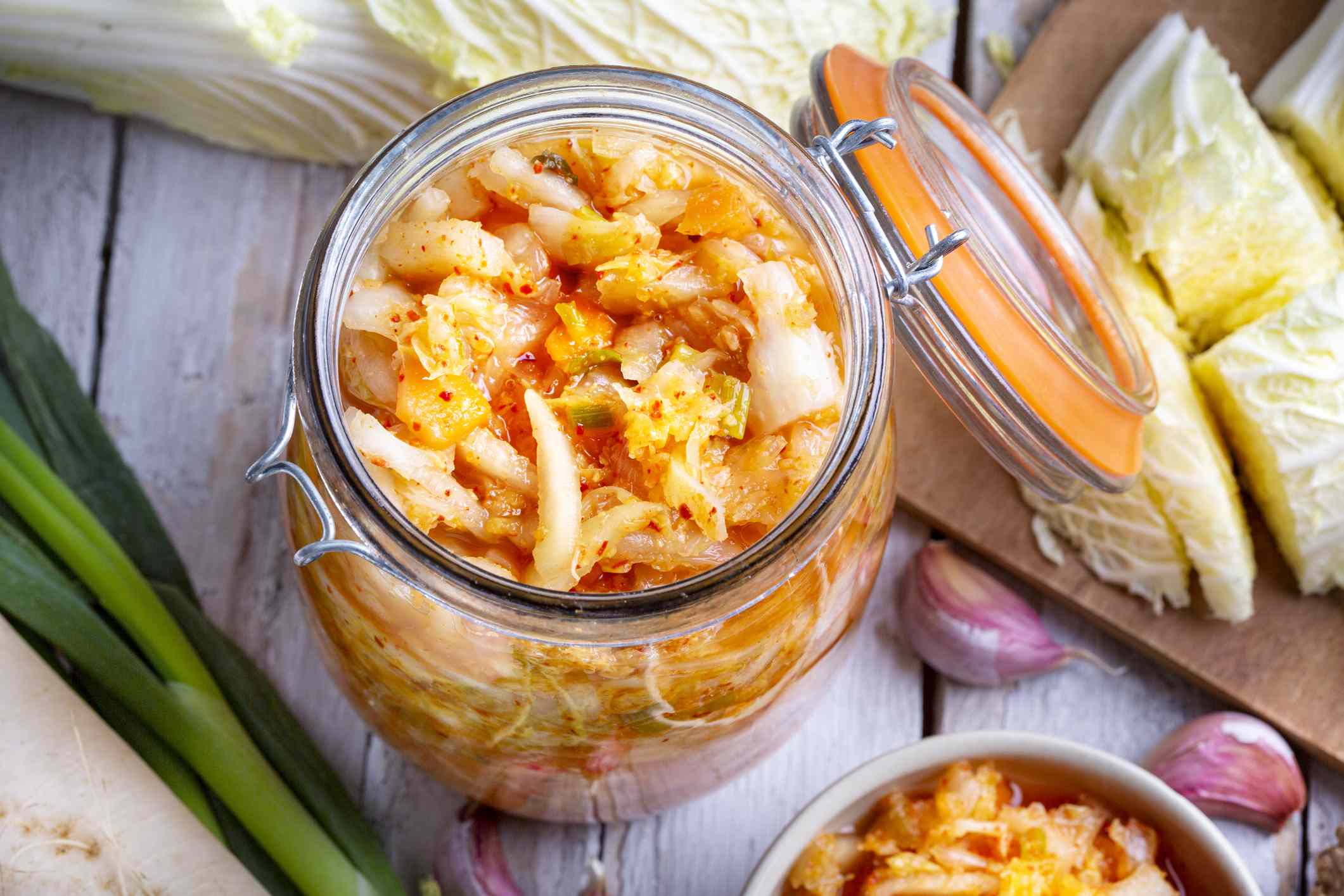
5 Foods High in Probiotics That Support Gut Health


Medically reviewed by Kumkum Sarkar Patel, MD

Probiotic foods like kimchi and kefir can help support a healthy gut microbiome.Credit: ollo / Getty Images
Probiotic foods like kimchi and kefir can help support a healthy gut microbiome.
Credit: ollo / Getty Images
  • Probiotics are live microorganisms that you can consume.
  • These microbes may increase the bacterial diversity of your gut microbiome.
  • Foods high in gut-supporting probiotics include kefir and kimchi.

Your gut microbiome—a community of microorganisms, like bacteria, viruses, and fungi living in your digestive tract—plays a key role in digestion, metabolism, and immune system regulation. When harmful microbes outweigh the beneficial ones, probiotics—live microorganisms that you can consume—can help restore balance. Here are five probiotic-rich foods that support gut health.

1. Kefir

Credit: iprogressman / Getty Images

Kefir is a fermented milk beverage that contains many probiotics. It’s made by mixing milk with fermented kefir grains, which is a culture of yeast and lactic acid bacteria. A culture is a laboratory method that gives microorganisms the time, space, and food they need to multiply. The fermentation process introduces a mix of bacteria and yeast that serve as probiotics. 

Kefir has a tangy taste and can be described as a type of drinkable yogurt. It can be on its own or added to smoothies. It’s also a good source of protein and calcium and is often fortified with vitamin D. Because of how it’s processed, it’s usually quite low in lactose, so most people with lactose intolerance can tolerate kefir.

2. Kimchi

Credit: kool99 / Getty Images

One of Korea's most popular foods, kimchi has more recently gained ground in the United States as people have become more interested in probiotics. It’s a condiment made by fermenting vegetables. Often, it includes cabbage, radishes, cucumbers, and onions. It’s especially high in lactic acid bacteria, one type of probiotic. Kimchi can range from mild to spicy.

Studies have found that fermented kimchi helps decrease the concentration of potentially harmful gut bacteria and promotes healthy blood glucose, blood pressure, and cholesterol levels.

Not only is kimchi a good source of probiotics, but it’s also rich in fiber—another key nutrient for gut health. Fiber also supports healthy cholesterol levels and blood sugars, complementing the health benefits of kimchi even more.

3. Kombucha

Credit: Sheila Alonso / Getty Images

Kombucha is a carbonated, fermented beverage made from tea, sugar, yeast, and bacteria. It is often fermented with fruit to add flavor. Active yeast transforms the sugar during the fermentation process, so there is a very small amount of alcohol in it.

Many health benefits of kombucha have been demonstrated in research, but more research is needed. One study highlighted that certain kinds of kombucha can be good for your health thanks to its probiotics, vitamins, and antioxidants, but they aren’t well-regulated. Pregnant people and those who are immunocompromised should take caution and talk to their healthcare provider before consuming it.

4. Sauerkraut

Credit: Kinga Krzeminska / Getty Images

Sauerkraut is a traditional Chinese food that is also popular in many areas of Europe and the United States. It's somewhat similar to kimchi, except the only vegetable included is cabbage. The cabbage is fermented in lactic acid bacteria, which serves as a probiotic. One study found that sauerkraut maintains most of its beneficial bacteria throughout the fermentation process and packaging, making it a great probiotic food.

Even though you may only think of sauerkraut as a hot dog topping, it also goes great on burgers, sandwiches, and salads. You can even add it to a charcuterie board or topping for mashed potatoes.

5. Yogurt

Credit: Westend61 / Getty Images

One of the most common food sources of probiotics is yogurt. It’s a fermented milk product, similar to kefir. It’s made by heating milk, adding bacteria, and letting it ferment for a few hours. Note how the heating happens before the bacteria is added, so the probiotics don’t get cooked off.

Most yogurt containers list the probiotics they contain so you can see the specific strains they’ve added during the fermentation process. Lactobacillus and Bifidobacterium are the most common species.

Yogurt, especially Greek or Icelandic Skyr yogurt, is also a good source of protein. It also contains calcium and vitamin D.

Yogurt can be enjoyed on its own, added to smoothies, or made into a parfait with fruit and granola.

Tips for Consuming More Probiotics

If you want to prioritize consuming more probiotics, check the label of a probiotic food to ensure it contains live active cultures. The label should list the cultures it contains so you can be sure they weren’t cooked off or otherwise destroyed during processing. 

Store probiotic foods as recommended by the manufacturer. That often means refrigerating them to ensure the microorganisms stay alive and the product doesn’t spoil. Heating probiotics to a high temperature typically causes them to die off.

Here are some tips for consuming more probiotics:

  • Add yogurt or kefir to your smoothies
  • Use kombucha or another probiotic beverage to make a mocktail
  • Add kimchi or sauerkraut to sandwiches and burgers
  • Use Greek yogurt to make salad dressings and marinades
  • Top oatmeal or pancakes with yogurt and berries

Side Effects of Probiotics

Our current research shows that probiotics, especially the most common Lactobacillus and Bifidobacterium species, are generally safe for most people to consume. 

Researchers have found that minor gastrointestinal (GI) symptoms like gas are the main side effects. Introducing probiotics slowly can give your body time to adjust and reduce the risk of unpleasant digestive symptoms.

Probiotics may cause serious infections, but this is rare. Some products may contain strains other than the ones listed, which could have harmful effects. Preterm infants and people with severe illnesses or who are immunocompromised are at the highest risk for side effects from probiotics.




Source link

Leave a Reply

Subscribe to Our Newsletter

Get our latest articles delivered straight to your inbox. No spam, we promise.

Recent Reviews


Last updated on
Jun 12, 2024

What is VPC in AWS – Table of Content

What is Amazon VPC?

Amazon Virtual Private Cloud or Amazon VPC is an AWS service that provides you with a separate area of the cloud. Having this separate area, you can launch your own defined AWS services in a virtual network.

Here, in VPC you have complete control of your virtual environment which includes IP address range, the configuration of route tables, the creation of subnets, and network gateways. Also, the network configurations can be easily customised for the Amazon VPC. 

Like all the other AWS services, Amazon VPC provides top-notch security. It has multiple layers of security which include network access control lists and security groups to manage the Amazon EC2 instances’ access in each subnet.

We have the perfect professional AWS Training course for you. Enroll now!

Now to understand the entire scenario of VPC, even better, let’s have a look at the architecture of VPC.

Architecture of VPC

Architecture of VPC

  • The above picture shows the architecture of VPC, so there’s an outer region and inside that outer region there’s an Internet Gateway and Virtual Private Gateway.
  • Internet Gateway and Virtual Private Gateway are what help in the connection with the VPC. These connections pass through the router which directs the coming traffic to the router table.
  • The two Router Tables then direct the traffic to Network ACL, which is like a firewall for security purposes. 
  • The Network ACLs can either accept or deny the roles. Also, the IP Address can be blocked on the Network ACL. 
  • The respective Network ACL signals to their respective security groups to access lines against the EC2 Instance. 
  • Now, there are two subnets – Public Subnet and Private Subnet. 
    As the name suggests, in the public subnet internet can be accessed by the EC2, while in the private subnet EC2 instance cannot be accessed through the internet. 
  • There’s also a process called “Jump Boxes” which enables you to connect the EC2 Instances (the public subnet can be connected to the private subnet’s instance).

Now, when we know about the architecture of VPC, it’s time to understand the different elements of VPC. 

Top 50+ Frequently Asked AWS Interview Questions !

AWS Training

  • Master Your Craft
  • Lifetime LMS & Faculty Access
  • 24/7 online expert support
  • Real-world & Project Based Learning

Elements of Amazon VPC.

The elements included in the Amazon VPC are:

IPv6 and IPv4 address blocks

VPC IP addresses use CIDR (Classless Interdomain Routing) IPv6 and IPv4 blocks to define their ranges. Primary and secondary CIDR blocks can be added to the VPC if the secondary Classless Interdomain Routing block comes from a similar address range as the primary block.

Subnet Creation

The EC2 Instance that is launched runs inside a specific VPC subnet. And, each subnet’s CIDR as a subset of the VPC Classless Interdomain Routing block. Every subnet separates its respective traffic from all the other VPC subnet traffic. It must be noted that a subnet can only have one CIDR block and different subnets are to be designated to handle diverse traffic types. 

Route Tables

Route Tables are actually the rule book that decides how much network traffic must be directed inside the VPC and subnets. A default route table is created by the VPC called the main route table. And, this main route table has an automatic association with other VPC subnets. 

There are two options – either the main route table can be updated and used to direct network traffic OR a new route table can be created for individual subnet traffic.

Internet Connectivity

Each VPC configuration is able to host one Internet Gateway and hence provide NAT or the Network Address Translation services using a NAT Gateway or NAT instances.

Elastic IP Addresses (EIPs)

Elastic IP Addresses or EIPs are IPv4 addresses permanently allocated to the user’s AWS account. The EIPs enable public internet access to the following:

  • An instance
  • Elastic Network Interface or ENI
  • Miscellaneous services that require a public IP address.
Network/Subnet Security

In the VPC architecture, you had seen there’s something called the “security group,” so VPCs use those security groups to give protection for instances. These security groups are referred to as firewalls by AWS.  

Additional Networking Services

There are several more services provided by a VPC. The VPC can also be used to configure the following: 

  • Virtual Private Networks or VPNs
  • Direct connectivity between VPCs or VPC peering
  • Gateways
  • Mirror sessions

Now, when you are well versed with the basics of Amazon VPC, let’s have a look at what you can do with a VPC.

HKR Trainings Logo

Subscribe to our YouTube channel to get new updates..!

What can you do with a VPC?

  • Instances can be launched in a subnet that you choose. 
  • Custom IP address ranges can be assigned in each subnet
  • Route Tables can be configured between subnets.
  • An internet gateway can be created and attached to your VPC. 
  • You get excellent security over your AWS resources.
  • Security groups can be assigned to individual instances.

Conclusion 
By now you would be well versed with everything you need to begin with Amazon Virtual Cloud. In the beginning, we learnt the basics of Amazon VPC and continued to learn its architecture. While at the architecture of VPC, we saw different parts of it and saw each of them briefly. 

Once you knew all the architectural parts, you saw the elements of VPC and studied them in brief. Finally, after learning about different elements and several other basics of Amazon Virtual Cloud, we saw the applicability of the same.

AWS Training

Weekday / Weekend Batches

 Related Articles:


Source link