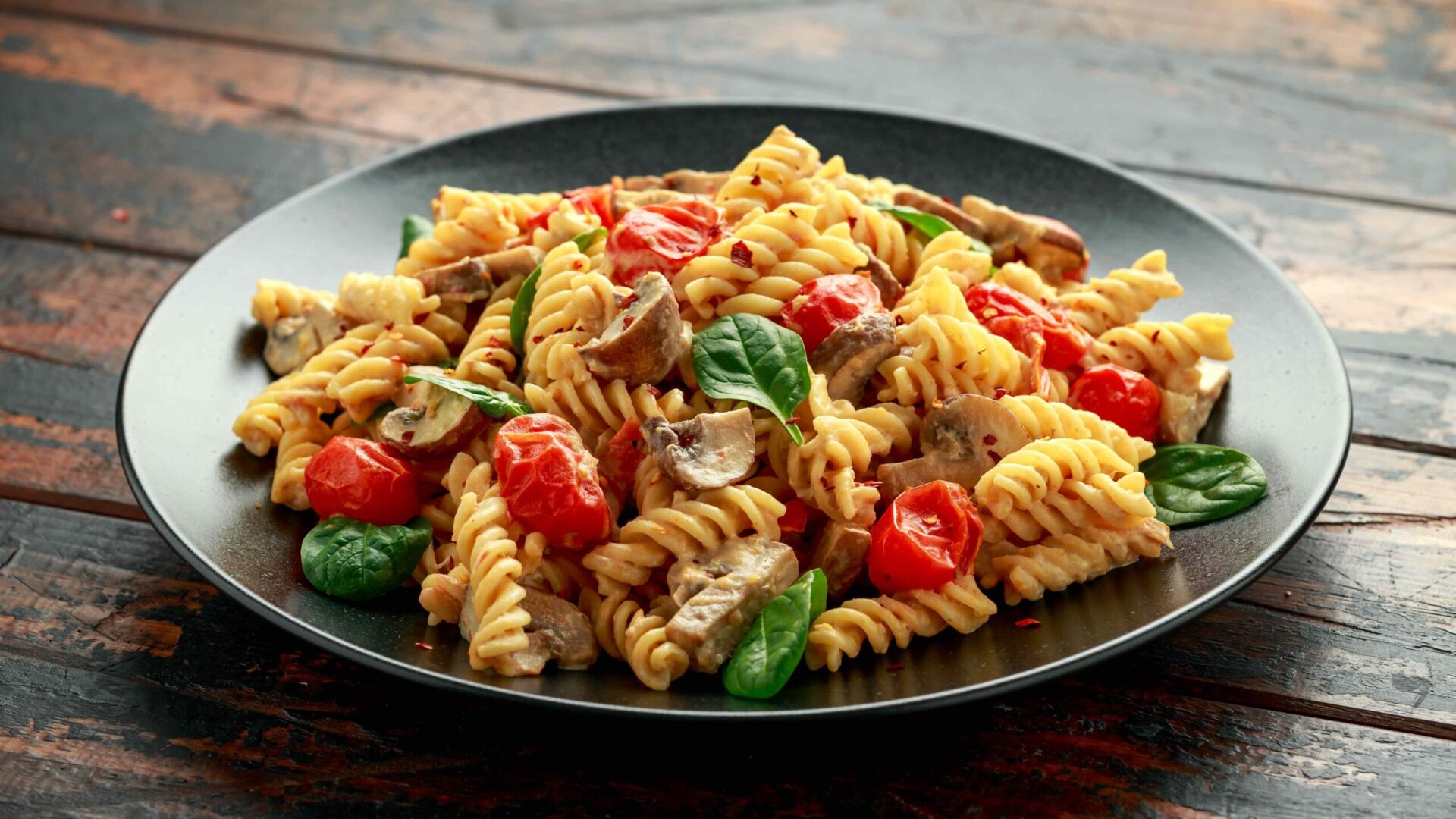
5 Pastas With More Protein and Fiber Than Regular Noodles


Pasta made from whole grains or legumes provides more protein, fiber, and minerals.Credit: DronG / Getty Images
Pasta made from whole grains or legumes provides more protein, fiber, and minerals.
Credit: DronG / Getty Images
  • As compared to traditional pasta, whole-grain and legume-based pastas are often more nutritious choices.
  • Pasta made from lentils, whole wheat, and chickpeas, for example, often have more protein, fiber, or both.
  • These healthier pasta varieties are also often lower in fat, have fewer carbohydrates, and may be gluten-free.

Traditional pasta noodles have 13 grams of protein and 3 grams of fiber per 100-gram dry serving—but varieties made from whole grains or legumes often contain more protein or fiber, or sometimes both, making them a healthier choice.

1. Lentil Pasta

Credit: DorotaM / Getty Images

Lentil pasta is made from lentil flour in varying amounts. A lentil pasta made from 100% red lentil flour has about twice the protein of regular pasta. It also contains fewer carbohydrates and fats.

A 100-gram serving of 100% dry red lentil pasta has:

  • Protein: 26 grams (g)
  • Fiber: 7.6 g
  • Calories: 320
  • Carbohydrates: 50 g

Red lentils are also rich in iron, magnesium, zinc, and folate.

A study found that people who ate lentil pasta ate less during the meal than people who ate regular wheat pasta. They also felt fuller and more satisfied afterward.

Lentils are also gluten-free, but always check the labeling to be sure.

2. Chickpea Pasta

Credit: Almaje / Getty Images

Chickpea pasta is made from chickpea flour, often mixed with semolina or other grains. Chickpea flour is rich in protein, fiber, potassium, folate, iron, magnesium, and zinc.

Pasta with 30% chickpea flour provides about 3.4 grams more protein and 2.6 grams more fiber than regular pasta. Pasta with a higher chickpea flour content will have even more protein and fiber.

A 100-gram serving of dry pasta with 30% chickpea flour has:

  • Protein: 16.4 g
  • Fiber: 7.3 g
  • Calories: 355
  • Carbohydrates: 66.3 g

Chickpeas are rich in resistant starch. The body cannot digest resistant starch, so it acts like fiber. For this reason, chickpea pasta can help regulate blood glucose (sugar) levels.

You can boost resistant starch by cooling cooked chickpea pasta in the fridge for 24 hours, then reheating it before eating.

3. Whole Wheat Pasta

Credit: Pam Walker / Getty Images

Whole wheat pasta is usually made of about 50% or more whole wheat flour, with the rest being semolina (ground durum wheat).

It has more fiber, protein, B vitamins, and minerals than regular pasta.

A 100-gram serving of dry whole wheat pasta has:

  • Protein: 13.5 g
  • Fiber: 10.1 g
  • Calories: 362
  • Carbohydrates: 73.1 g

A serving of cooked whole wheat pasta provides about 65% of the Daily Value (DV) for selenium, 47% for magnesium, 11% for zinc, and 10% for iron. It also contains most of the B vitamins in varying amounts.

4. Buckwheat Pasta 

Credit: GMVozd / Getty Images

Buckwheat pasta, also called soba noodles, is made from 60–100% buckwheat flour. Pasta with more buckwheat flour has more protein, fiber, and minerals. Buckwheat is also a gluten-free grain.

The U.S. Department of Agriculture doesn't have the fiber content listed for standard soba noodles, though researchers generally agree the noodles are a good source of dietary fiber. Otherwise, a 100-gram serving of dry soba noodles contains:

  • Protein: 14.4 g
  • Calories: 336
  • Carbohydrates: 74.6 g

Buckwheat flour is rich in iron, magnesium, and zinc. It also has more essential amino acids than wheat flour. The body cannot make essential amino acids, so you must get them from your diet to build proteins.

5. Quinoa Pasta

Credit: PAVEL IARUNICHEV / Getty Images

Quinoa pasta offers a good source of protein but is higher in carbohydrates. It also provides more calcium, iron, potassium, magnesium, and zinc.

A 100-gram serving of dry quinoa pasta has:

  • Protein: 12.2 g
  • Fiber: 4.3 g
  • Calories: 392
  • Carbohydrates: 70.7 g

Pasta made with germinated quinoa flour has even more protein, essential amino acids, and much less phytic acid than regular quinoa. Phytic acid can make it harder for your body to absorb minerals, so less is better.

You can germinate, or sprout, other grains too, like wheat, barley, and lentils. This increases nutrients and decreases compounds that prevent nutrient absorption, such as phytic acid.

Quinoa is also a gluten-free grain, but always check pasta for gluten-free labeling. Some gluten-free pasta also mixes several gluten-free grains, such as brown rice, chickpea, lentil, and quinoa flours.




Source link

Leave a Reply

Subscribe to Our Newsletter

Get our latest articles delivered straight to your inbox. No spam, we promise.

Recent Reviews


Difference between SCCM and WSUS – Table of Content

Introduction to SCCM

Microsoft system center configuration manager (SCCM) is a Microsoft product developed to manage and update the software products. SCCM configuration manager provides a highly flexible, automated solution to the full deploy and configures personal desktops, laptops from any initial state, including bare-metal deployments. This enables IT, administrators, to provide an end-to-end solution for the installation and configuration of windows, by delivering the applications, updated patches, and security fixes in a single distribution. This also allows a large number of computers can run on many operating systems. The operating systems may be Windows, Linux, UNIX, and IOS.

Get ahead in your career by learning SCCM through hkrtrainings Microsoft SCCM online course

Introduction to WSUS

Windows software update system is also a product of Microsoft Corporations. Previously it was known as software updates services. WSUS is a computer program and network service system developed to enables the administrators to manage the software update distributions and also serves as a hotfix for the recent release of Microsoft products to computers to work effectively in various corporate environments. WSUS is considered to be an essential product for all the Windows Microsoft servers. WSUS helps to update the connected computer devices once you download it from Microsoft. The various functions of WSUS are such as, Critical updating, Software security updates, and service pack drivers, etc.

Difference between WSUS and SCCM

WSUS

  1. A software update service developed by Microsoft Corporation that enables the administrators to manage the distribution of updates and hotfix released for Microsoft products to the computer in corporate environments
  2. Stands for windows server update services
  3. Package management and remote administration software
  4. Mainly updates the distributions to the connected services in the network
  5. Basic software information is included as a part of the application
  6. Extended software and support information as a part of the application
  7. Software command options are used in the form of deployment types
  8. Multiple deployment options- a single application can contain multiple deployment types
  9. Deployment takes place in the form of application
  10. Deployment type used based on requirements
  11. Revision history is maintained
  12. Programming of additional software code in an open interface

SCCM

  1. A systems management software of Microsoft that manages a large group of computers running on various operating systems
  2. Stands for system center configuration manager
  3. A system management software
  4. Mainly perform system managements
  5. Basic software information is included as a part of the package
  6. Extended software and support information as a part of the package
  7. Software command options are used in the form of programs
  8. Multiple deployment options – a can contain multiple programs
  9. Deployment takes place in the form of package and programs
  10. Only one program per deployment
  11. Revision history is not maintained
  12. Develop a statistical function for calculating particular metrics

SCCM Training

  • Master Your Craft
  • Lifetime LMS & Faculty Access
  • 24/7 online expert support
  • Real-world & Project Based Learning

The technical advantage of cache SCCM management :

There are a lot of advantages of using SCCM, let me explain them one by one,

  • Microsoft system center configuration manager helps you to empower people to use the devices and applications they need to be productive while maintaining corporate compliance and control management.
  • SCCM is available in the form of a unified infrastructure that gives the single pane of glass to manage physical, virtual, and mobile events.
  • Offers tools and comprehensive solutions for change and configuration management for the Microsoft platform, enabling organizations to provide relevant software and updates to users quickly and cost-effective.
  • SCCM collects the hardware and software inventory distributing.
  • Distributing and installing software applications.
  • Distributing and installing updates to the software. E.g. Security fixes
  • Deploying the operating system
  • Metering software usage.
  • By an affordable comprehensive IT management solution
  • Track database growth in SQL server database
  • Remotely controlling computers to provide troubleshooting support
  • Gain visibility into your IT environment
  • By an affordable comprehensive IT management solution.


If you want to Explore more about sccm? then read our article SCCM Tutorial !

The Technical Advantages of Cache WSUS management:

The following are the primary advantage of WSUS;   

  • Offers more updates for Microsoft products
  • Ability to automatically download updates from Microsoft update by product and type
  • Additional language support for the customers worldwide (18 different languages)
  • Maximized bandwidth efficiency through background intelligent transfer services (BITS)
  • Ability to verify that updates are suitable for each computer before installation (this future runs automatically for critical and security updates)
  • Flexible deployment options
  • Reporting capabilities
  • Flexible database options
  • Data migration and import/export capabilities
  • Extensibility through the application programming interface (API)
  • Better options for client configuration.
HKR Trainings Logo

Subscribe to our YouTube channel to get new updates..!

SCCM Patch Management:

SCCM patch management provides a suite of endpoint protection tools and, with the correct configuration can operate as a full life cycle management system for IT departments with a high number of windows systems. Non-windows systems like MAC, Linux, UNIX, Symbian, and others, can be still managed through SCCM as the end-clients, although this process still requires a server to run.

Check out here for frequently asked  sccm interview questions & answers

WSUS patch management:

WSUS Patch management is the process of testing, acquiring, and installing patches (code changes) on a computer system that uses WSUS. WSUS was previously known as Software update services is a computer program and network services developed by Microsoft Corporations that enables administrators to manage the distribution of updates and hotfixes released for Microsoft products to computers in a corporate environment.

SCCM Training

Weekday / Weekend Batches

Conclusion
In this blog, I have tried my best to explain the key differences between SCCM and WSUS, their advantages, and installation guidance.SCCM and WSUS both are Microsoft products; SCCM is used to update the system management whereas WSUS is used to update the packages and administrative tasks.This blog may help a few of those who are Windows server professionals,and also for Microsoft social community forums.

Other related article:

1. SCCM Deployment

2. SCCM Overview

3.SCOM Vs SCCM

4.What Is SCCM And Working

5.SCCM Client Installation

6.SCCM Certification


Source link