6 Fish Packed With Vitamin D for Stronger Bones and Immunity


Medically reviewed by Kayla Girgen, RD

A can of sardines can offer 22% of the Daily Value of vitamin D.Credit: MirageC / Getty Images
A can of sardines can offer 22% of the Daily Value of vitamin D.
Credit: MirageC / Getty Images
  • Vitamin D is an important nutrient for bone health and immunity. You can get some of it through your diet.
  • Fish is known for being a solid source of dietary vitamin D.
  • Rainbow trout, salmon, and sardines are some of the common types of fish that provide a significant Daily Value of vitamin D.

Vitamin D is a fat-soluble vitamin your body can make itself when exposed to the sun. However, 22% of adults in the United States are moderately deficient in the vitamin, suggesting the importance of dietary intake as well. Fatty fish are one of the most reliable and concentrated dietary sources of vitamin D. Here are some commonly consumed fish that can provide high amounts of vitamin D per serving.

1. Rainbow Trout

Credit: Zoryana Ivchenko / Getty Images
  • Vitamin D content: 645 International Units (IU), 81% of the Daily Value (DV)
  • Serving size: 3 ounces (oz), cooked using dry heat

In addition to vitamin D, rainbow trout is rich in omega-3 fatty acids, vitamin B12, and selenium, which can improve heart health, cognitive function, and immunity.

2. Salmon

Credit: Vladimir Mironov / Getty Images
  • Vitamin D content: 570 IUs, 72% of the DV
  • Serving size: 3 oz, cooked, sockeye variety

Salmon's vitamin D content can vary widely based on the type of salmon and how it's prepared. Canned pink salmon, which is a more accessible and affordable variety, contains about 493 IU of vitamin D per 3-ounce serving.

Canned salmon is often packed with bones intact, which are soft and edible and can provide an additional source of dietary calcium. Salmon also contains an antioxidant pigment called astaxanthin, which can help protect against cardiovascular, neurodegenerative, and immune-related conditions.

3. Swordfish

Credit: Cris Cantón / Getty Images
  • Vitamin D content: 566 IU, 71% of the DV
  • Serving size: 3 oz, cooked using dry heat

As predators, swordfish accumulate nutrients from the prey they consume over their lifetimes, resulting in high nutrient concentrations. In addition to vitamin D, swordfish is a good source of vitamin B12, which supports DNA synthesis and fatty acid metabolism.

However, swordfish contains higher levels of mercury than most other fish. Mercury is a metal that can cause several health problems, including damage to the nervous system, kidneys, and skin. For this reason, it's recommended that people who are pregnant or breastfeeding, as well as young children, avoid swordfish.

4. Mackerel

Credit: Vladimir Mironov / Getty Images
  • Vitamin D content: 547 IU, 69% of the DV
  • Serving size: 3 oz, raw, Atlantic variety

Mackerel has high levels of fat-soluble vitamins. Mackerel is also rich in omega-3 fatty acids and vitamin B12, which help in cognitive and neurological function.

There are several types of mackerel. Atlantic mackerel contains lower levels of mercury compared to larger mackerel species, such as the king mackerel. This makes the Atlantic mackerel a better option for a wider group of people.

5. Sardines

Credit: Karl Tapales / Getty Images
  • Vitamin D content: 178 IU, 22% of the DV
  • Serving size: One 3.75-oz can

Eaten whole, including the bones, sardines provide not just vitamin D but also calcium, omega-3 fatty acids, vitamin B12, and protein.

Sardines are considered a lower-mercury seafood. They are classified as a "best choice" under joint guidance from the U.S. Food and Drug Administration and the Environmental Protection Agency, making them suitable for consumption two to three times per week, including by children and pregnant people.

6. Herring

Credit: AndreySt / Getty Images
  • Vitamin D content: 158 IU, 20% of the DV
  • Serving size: 1 cup, pickled, Atlantic variety

Atlantic herring is a small fatty fish. It has a higher amount of vitamin D when pickled. When served raw, 3 ounces of boneless raw herring have 142 IU.

Being a small schooling fish, herring accumulates substantially less mercury than larger predatory species. This makes it a suitable option for regular consumption, even for pregnant people.

Vitamin D Benefits

Vitamin D plays several essential roles in your body. It plays a part in doing the following:

  • Promotes calcium absorption in the gastrointestinal tract
  • Improves muscle strength
  • Improves the immune system
  • Reduces cardiovascular risk factors, including elevated blood pressure and adverse lipid profiles

Research has also suggested associations between vitamin D and reduced risks of dementia, certain cancers, and adverse pregnancy outcomes, but more studies are needed to confirm these findings.




Source link

Leave a Reply

Subscribe to Our Newsletter

Get our latest articles delivered straight to your inbox. No spam, we promise.

Recent Reviews


What is Cloud FinOps?

A functioning structure and informational flux that gathers businesses, finance, and technological operations alongside each other to drive up the businesses through cloud transformation.

It promotes data-powered decision-making in due time and results in financial responsibility. The collaboration of finance, operations, and business teams makes it possible to achieve it.

FinOps is a field that integrates principles of financial management with cloud engineering and operations to give organizations an analysis of their cloud expenditure. It also allows them to make well-versed decisions on the allocation of their cloud budget and costs. Its goal is to increase the revenue or the business value with the help of the cloud. It also helps organizations control their cloud expenditure while still maintaining the performance level, dependability, and security required to assist their business operations.

Principles of Cloud FinOps

Accountability

With a set of pre-defined KPIs and benchmarks, the teams responsible for value realization reporting and costing amendment can be held accountable. This makes decision-making a process with standards.

Business Value Realization

Decisions taken from the perspective of business make Cloud FinOps successful.

Flexibility

Encourage constant budget allocation, IT spending, and forecasting to push ahead with agile budgeting and planning procedures in the IT industry.

Clarity of Costs

All organizational levels have access to instantaneous cost and billing data.

Partnerships

For cloud finance management, collaborate with departments like IT, finance, app development, and architecture.

Fluctuating nature of the cloud

Accept the pay-as-you-go aspect of cloud and gain from providing dynamic customer service to meet their ever-changing requirements.

Five Key Elements that Make Cloud FinOps

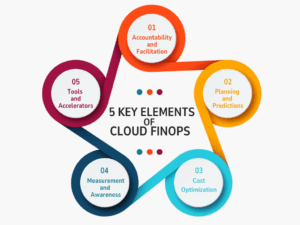
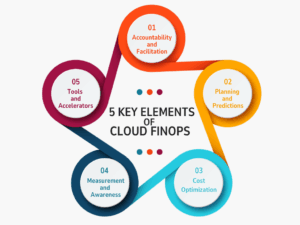
5 Key Elements of Cloud FinOps

1. Accountability and Facilitation

This element centers on setting up centralized, multi-functional teams that include engineering, finance, operations, architecture, and app developers, while also setting up governance and benchmarks for cloud expenditure.

2. Planning and Predictions

For cloud planning and predictions to be effective, an organization must allocate resources, benchmark efficacy, and gain a deeper understanding of the cost drivers.

3. Cost Optimization

This element, which is an ongoing, repetitive process that focuses on identifying key cost-optimization drivers, offers a consistent methodology to manage cloud consumption in the most economical way.

4. Measurement & Awareness

This key element focuses on building a key set of KPIs and business-value metrics to calculate the transformation’s success. Customers frequently begin with a set of cost-optimization metrics before switching to unit economics or business value metrics, like cost per transaction or cost per customer served.

5. Tools and Accelerators

To sum up, using the right tools and accelerators is crucial for efficiently managing and monitoring cloud spending. It comprises:

  1. Using Google Cloud cost-management tools to examine cost and billing data in real time
  2. Creating a reporting dashboard for tracking values and managing cloud spending
  3. Putting automation scripts into place to create budget alerts and account guardrails

Benefits That Cloud FinOps Offer

Business Value Realization

Initial focus on cloud migration often leaves the business goal of infrastructure in the rear. Proper cooperation between various departments makes FinOps effective and a success. This allows the reconsideration of business values while lifting cloud management to new heights.

Better Decision Making

Making decisions to make business better than today is the whole point here. Using the insights from cloud data and financial analytics, the FinOps team is able to make informed decisions regarding the business’s cloud computing commodities. This also makes them focus on the business goals.

Art of Predictions and Cloud Reporting

FinOps teams analyze cloud spend and set standards for future cloud costs using analytics, reporting, and forecasting cloud FinOps tools. They can create budgets fittingly and evade unplanned surplus costs thanks to the jacked-up cost visibility.

Accountability for Clear Cloud Use

By providing clarity into resource ownership and cloud spending, FinOps promotes accountability while leveling the time and effort needed for research and change implementation.

Challenges That FinOps Come With

Before Cloud FinOps begins to show results, you must surpass many predicaments. These may include issues with organizational processes, technical implementation, or how the teams as a whole perceive the changes.

Governance

Incorporating new methods, tools, and challenges requires all the things to be in place and well-governed. The processes to be incorporated ought to adhere to existing laws, rules, and compliance standards. It can be challenging to describe these approaches, create policies, and implement them.

Technical Glitches

There might be considerable technical glitches in putting the suggested modifications into practice, from planning effective cost data collection and processing to putting per-instance optimizations, element migration, and access management into practice.

All of the alterations should certainly be based on practicality, as well as administering the right balance between cost-effectiveness and effort, while taking into account the gross solution’s business value.

Cultural Alterations

As the FinOps framework requires processes to be established at every level of an organization, an actual cultural transformation must take place for FinOps methodologies to be implemented successfully. This entails setting up a culture of financial responsibility and accountability while maintaining the requirements of the company and the objectives of the other players in mind.

It could be challenging to bring in this culture, as it needs not only the establishment of appropriate processes but also a shift in the team’s mentalities. So, it is a task!

From Chaos of Cloud to Clarity: An Imperative for Businesses

Cloud FinOps is the way of the future for businesses, but excessive cloud spending can undermine the very advantages that companies are trying to achieve. Cloud FinOps management transforms from a standalone finance function into a vital business capability with FinOps.

Businesses that adopt Cloud FinOps not only reduce cloud expenses but also acquire the flexibility to change course more quickly, the assurance to make more intelligent investments, and the transparency to match IT with business value.

The ability to forecast precisely, budget dynamically, and optimize continuously is not a luxury in a world where cloud usage is only increasing; rather, it is a competitive necessity.

To learn more, visit KnowledgeNile!


FAQs for Cloud FinOps

1. What is another name for FinOps?
Answer: FinOps is the blend of “Finance” and “DevOps”. It shows the collaboration between business and engineering groups. It is also known by terms like Cloud Financial Management and Cloud Financial Optimization.

2. When did FinOps start?
Answer: It began in 2019 as an open community comprising individuals and organizations where knowledge of cloud financial management could be shared.

3. What is the future of FinOps?
Answer: FinOps’s future depends on comprehensive innovation and teamwork. FinOps and ITAM combination will be essential as cloud infrastructure develops to trim the financial waste, promote sustainability, and improve AI-powered optimization.


Also Read:
Cloud Migration Process Explained in Easy Steps
Edge and Cloud Computing for IoT and Their Key Roles
What is The Distributed Cloud: Advantages and Disadvantages


Source link