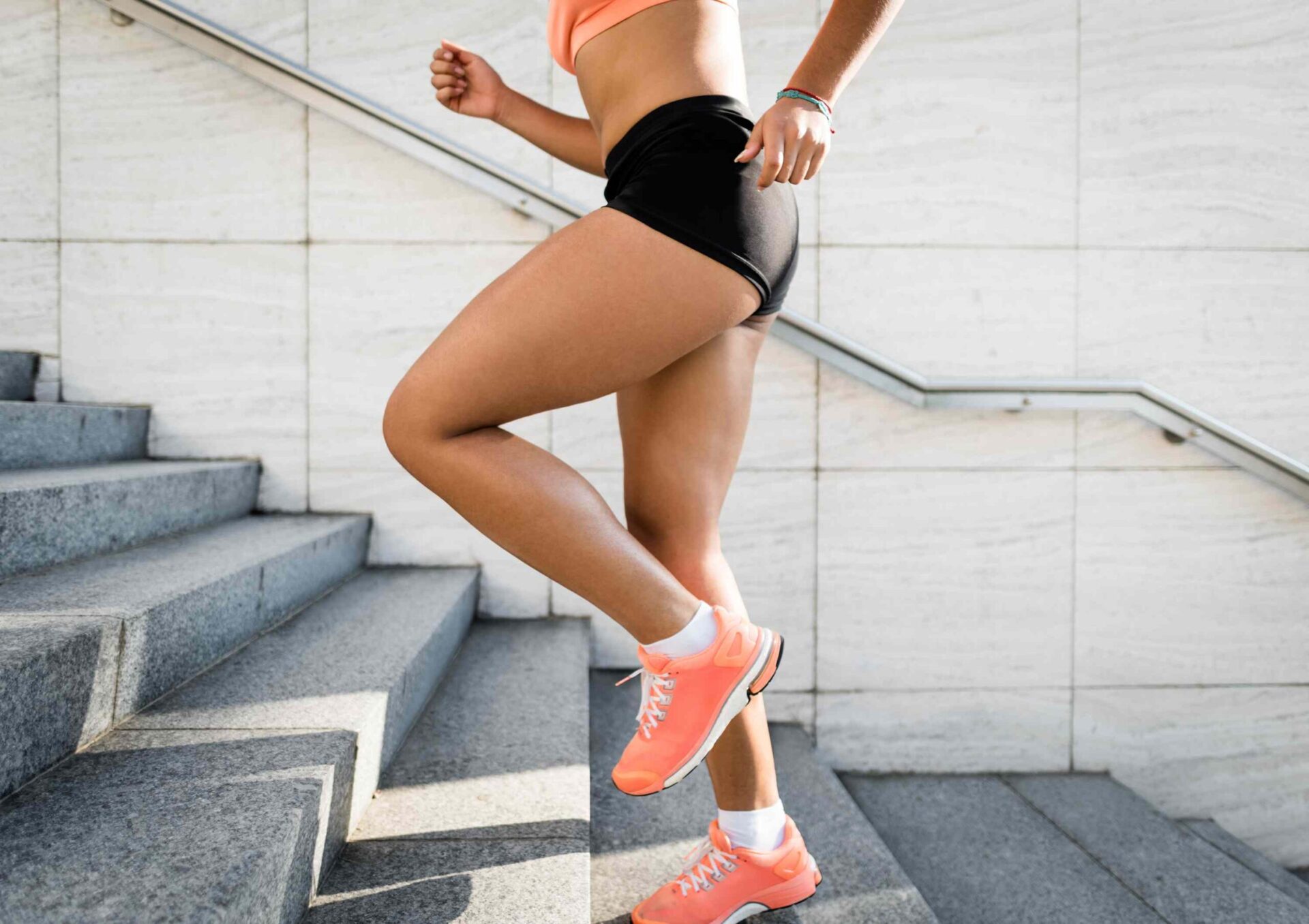
:max_bytes(150000):strip_icc():format(jpeg)/Health-GettyImages-628952872-ef79b7dd7e8e4dfea97659aa7e0bd792.jpg "A person running upstairs focused on legs and sports attire")
Credit: Martin Novak / Getty Images
- Regular movement can help improve blood flow, especially after long periods of sitting or traveling.
- Exercises that target your ankles, calves, and quads—like calf raises, marches, and squats—can help circulate blood throughout your legs.
- Talk to your healthcare provider if you have symptoms of poor circulation, such as pain and swelling.
Poor circulation can leave your legs feeling tired, heavy, swollen, and stiff. Getting regular movement can help improve blood flow and ease discomfort. These simple exercises are easy to perform at home and can be modified depending on your mobility level.
1. Ankle Pumps
Ankle pumps are one of the simplest exercises to promote circulation in your lower legs. This exercise activates your calf muscles, which help move blood from your lower legs back to your heart. This can be especially helpful during periods of prolonged sitting, while traveling, or after recovering from surgery.
To perform the exercise:
- While seated or lying down, point your toes away from your body.
- Then, point your toes back towards the front of your lower legs, or your shins.
- Perform three sets of 10-15 repetitions.
2. Walking
Walking is one of the most efficient ways to improve circulation, since it activates a variety of muscle groups throughout your lower body. Each step you take creates a pumping action that encourages blood flow throughout your legs.
Aim for daily walking if possible, but even short movement breaks throughout the day can be beneficial. A five-minute walk every hour may help counteract the effects of prolonged sitting.
3. Calf Raises
Since your calf muscles are known to push blood upward against gravity towards your heart, they are sometimes referred to as your body’s “second heart."
To perform this exercise:
- Stand with your feet hip-width apart, holding onto a wall or stable surface.
- Slowly rise onto your toes, then lower your heels back to the floor with control.
- Perform three sets of 10-15 repetitions.
4. Marching in Place
Marching in place is a great exercise to do if you’re not able to get outside or use a treadmill for a walk. This exercise, similar to walking, activates a variety of muscles in your lower body and encourages blood flow without requiring much space.
To perform this exercise:
- Stand tall, holding onto a wall or stable surface if needed.
- Alternate lifting one knee to your chest and then the other, as if you are marching.
- Continue for 30-60 seconds at a comfortable pace, two to three times.
5. Seated Leg Extensions
Seated leg extensions are a great exercise if you spend long periods of time sitting at a desk or traveling. This exercise activates your quadriceps, or the muscles in the front of your thighs, while also promoting circulation throughout your lower legs.
To perform this exercise:
- Sit upright in a chair and slowly straighten one knee until your leg is lifted parallel to the floor.
- Lower it back down and repeat on the opposite side.
- Perform three sets of 10-15 repetitions per leg.
6. Bodyweight Squats
Squats work some of the largest muscles in your lower body, including your quadriceps, hamstrings, and glutes. Activating these muscles can increase blood flow throughout the body.
To perform this exercise:
- Stand with your feet about shoulder-width apart.
- Bend your hips and knees as if you’re sitting back into a chair.
- Return to standing. Perform three sets of 10 repetitions, or work your way up to this amount.
7. Heel-to-Toe Rocks
Heel-to-toe rocks help activate the muscles on both the front and back of your lower legs. This exercise is especially helpful during long periods of standing.
To perform this exercise:
- While standing and holding onto a stable surface, lift your toes while keeping your heels on the floor.
- Reverse the movement by lifting your heels and rising onto your toes.
- Repeat 10-20 repetitions for three sets.
How To Support Healthy Blood Flow Beyond Exercise
Exercise is an important part of supporting proper circulation throughout your body, but daily habits matter just as much. Staying hydrated, changing positions regularly, and avoiding sitting for prolonged periods of time can help promote healthy blood flow throughout the day.
If you experience persistent swelling, pain, numbness, skin discoloration, or other symptoms of poor circulation, speak with your healthcare provider. While exercise can support vascular health, some circulation concerns may require further evaluation and treatment by a healthcare professional.