Medically reviewed by Katrina Carter, DPT
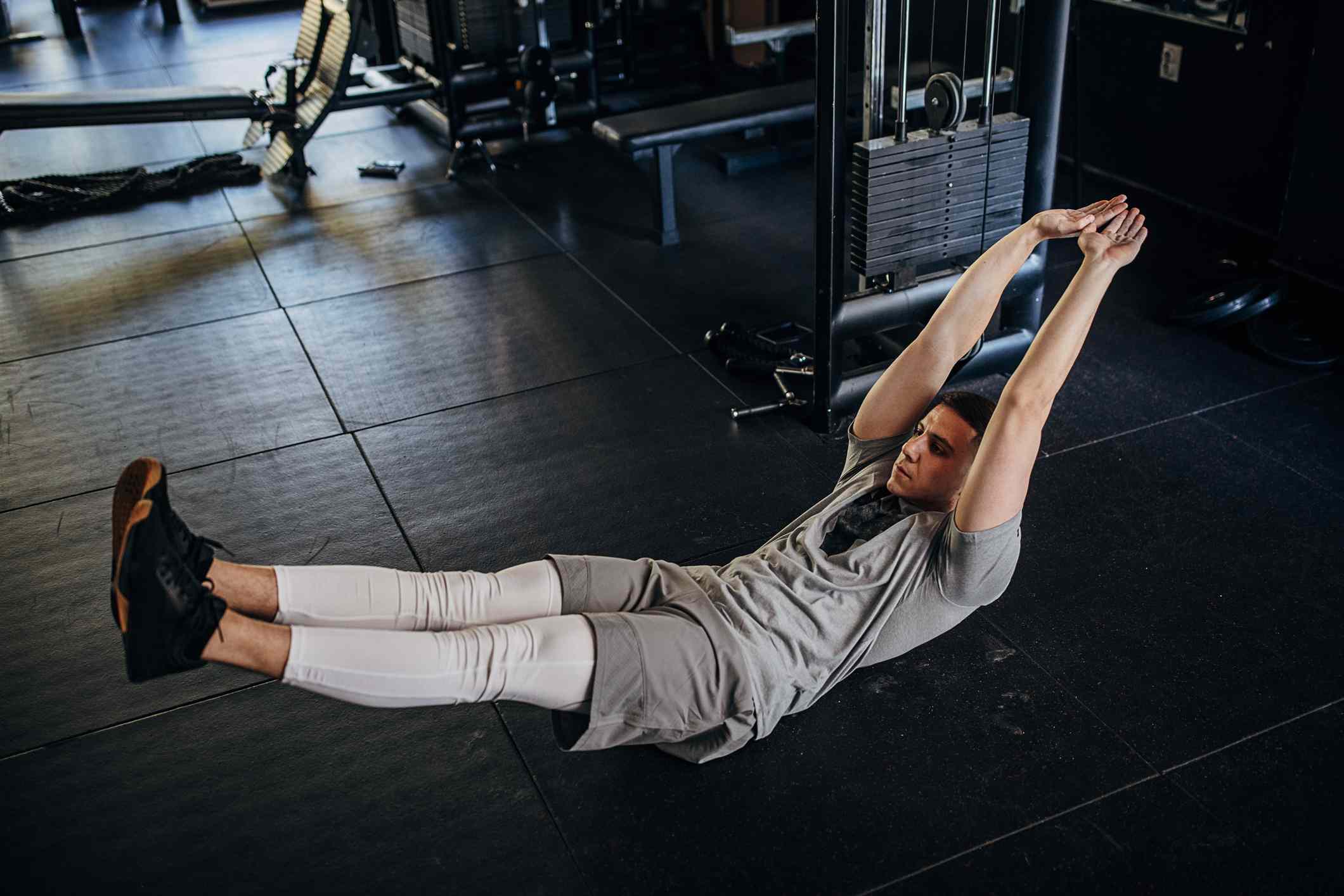
:max_bytes(150000):strip_icc():format(jpeg)/Health-GettyImages-1408670689-bc8ab4a5531a4ea994468dabe1b19052.jpg "A young man wearing gray and white workout clothes performs a hollow hold exercise in a gym setting.")
Credit: Hirurg / Getty Images
- Hollow holds engage your deep core muscles for improved strength and stability.
- Lying leg raises target your lower abs and support pelvic stability.
- Doing lower ab exercises has benefits for your stability and balance.
Lower abdominal exercises are essential for achieving a fully developed core. A strong core supports your posture, protects your spine, and enhances your overall movement. Lower ab workouts, in particular, help strengthen the deepest parts of your core, giving you better stability, strength, and control.
1. Hollow Hold
The hollow hold works your entire core from bottom to top with an emphasis on the lower region. This exercise activates the transverse abdominis (the deepest ab muscle, which wraps your abdomen horizontally) and rectus abdominis (the top layer of your abs, also called the "six-pack") through sustained tension.
This exercise also builds isometric (static) strength in the core muscles, which is critical for stability. Follow these steps to perform a hollow hold:
- Lie on the floor on your back with your arms extended overhead and legs straight.
- Engage your core and lift your arms, head, shoulders, and legs a few inches off the floor.
- Make sure to keep your lower back pressed firmly into the ground so you only feel your abs working.
- Hold the position for 30–60 seconds, rest, and repeat.
Modification: If the original exercise is too challenging, sit up into a V-shape, balancing on your butt while you keep your knees slightly bent, feet off the floor, and arms by your sides. Hold the position for as long as you can.
2. Lying Leg Raises
Lying leg raises target your lower abs by keeping your torso static while creating tension by lifting your legs off the floor straight into the air. This isolates the lower half of the rectus abdominis and works the hip flexors, which support pelvic stability.
Follow these steps to perform lying leg raises:
- Lie on your back with your legs extended and hands under your hips, right below your butt.
- Keeping your legs straight and engaged, flex your stomach and lift your legs toward the ceiling until about 90 degrees.
- Slowly lower your legs, stopping to hover them a couple of inches above the floor. Avoid letting your lower back arch off the floor.
- Repeat for 5–15 reps.
Modification: If you find the full range version too challenging, bend your knees more and don’t bring your legs down as far. This will help offload your core and make it a bit easier.
3. Butterfly Kicks
Butterfly kicks target your lower abs similarly to leg raises and hollow holds. However, this exercise incorporates dynamic movement into your legs, making it even more challenging for your lower abs.
Follow these steps to perform butterfly kicks:
- Lie flat on your back with your hands under your glutes.
- Brace your core and lift your legs a few inches off the floor while your head and neck stay on the ground.
- Kick your legs in small up-and-down fluttering motions while keeping your lower back flat and abs tight throughout.
- Perform for 30–45 seconds.
Modification: To make this exercise less challenging, bend your knees and lift your legs a little higher off the ground while you do the fluttering motion.
4. Dead Bug
This movement is highly effective for targeting your entire core and exercising spinal stability while emphasizing your lower abs. It engages the deep core muscles by opposing arm and leg movement, all while maintaining a neutral spine.
Follow these steps to perform dead bug:
- Start on your back with your arms extended toward the ceiling and knees bent at 90 degrees.
- Slowly lower your right arm and left leg toward the floor while keeping your back flat, pressing into the floor beneath you.
- Return to the starting position, then alternate sides.
- Do 10–12 reps per side.
Modification: If your lower back comes off the floor as you do the exercise, you can modify by reducing how far you extend your legs and arms. This will make the movement easier and prevent your lower back from rising up.
5. Russian Twist
Although it’s often thought of as an oblique exercise, the Russian twist engages your entire core, including your lower abs. The twisting motion strengthens your rectus abdominis and internal and external obliques, while holding the declined position keeps your lower abs engaged.
Follow these steps to perform a Russian twist:
- Sit on the floor with your knees bent and feet slightly lifted.
- Lean back slightly to form a V-shape with your body.
- Twist your torso side to side while holding a light weight. Go slowly enough so that each twist feels intentional. Keep your abs engaged throughout the movement.
- Complete 10–30 total reps.
Modification: If the exercise is too challenging, don’t hold a weight and just focus on the rotation instead. If you want to increase the challenge, use a heavier dumbbell or medicine ball.
6. Mountain Climbers
This exercise combines core activation with upper body strength, particularly for the shoulders and triceps. The rapid knee-driving motion keeps your lower abs under continuous tension while recruiting your other upper body muscles for support.
Follow these steps to perform mountain climbers:
- Start in a high plank position with your shoulders stacked over your wrists. Keep your back flat and core engaged.
- Drive one knee toward your chest, and then bring it back to a straight position as you bring the other knee up to your chest. Continue switching your legs back and forth, increasing your speed to create a continuous motion.
- Maintain a consistent pace while keeping your hips low and core engaged.
- Perform for somewhere between 30 and 60 seconds.
Modification: You can make this exercise easier by slowing down your pace, or increase the difficulty by going faster and holding for longer.
7. Alternating Leg Drops
Leg drops are similar to the dead bug exercise. They’re a slow, controlled movement that challenges your core through eccentric (lengthening) muscle contraction. The movement forces you to stabilize your spine and control the descent of your legs, which engages the lower part of your abdominal muscles.
Follow these steps to perform alternating leg drops:
- Start on your back with legs lifted straight up at 90 degrees.
- Slowly lower one leg toward the floor, aiming your heel toward the ground.
- Stop just before your heel touches the floor and raise your leg back to the starting position before switching legs, going back and forth.
- Repeat for 12–15 reps, keeping your back pressed into the floor beneath you for maximal core engagement.
Modification: If your lower back is lifting off the floor or feels like it's supporting part of the exercise, try placing your hands under your hips to take the pressure off your back. You can also make this exercise more challenging by keeping your legs straight as you go through the motion.
How To Create a Lower Ab Workout
You can safely exercise your core multiple times per week. Try incorporating your lower ab workouts into the rest of your workout. This way, you can be efficient and not have to set aside separate time exclusively for your lower abs. Pick a handful of exercises and complete 3-5 sets of each. Over time, you’ll want to increase the difficulty of the exercise by adding more sets and reps or complexity.
Benefits of Lower Ab Workouts
Training your lower abs and improving your core strength has several benefits, including:
- Increased stability: Strengthening your lower ab muscles improves the stability of your torso and pelvis.
- Reduced back pain: By enhancing spinal stability, core exercises can help decrease lower back pain.
- Better balance: A strong core leads to more controlled and coordinated movement.
Safety Tips
When doing core exercises, it's important to avoid activating your lower back, which can cause unnecessary strain. This can happen if your pelvis and spine aren’t in a neutral position. Aim to keep a flat back during all core exercises and maintain intraabdominal pressure by flexing your stomach muscles.





:max_bytes(150000):strip_icc():format(jpeg)/Health-Anchovies-vs-Sardines-abf78393ed254f7fb6103ad3b603bfd0.png "Comparison between canned anchovies and sardines, side by side.")