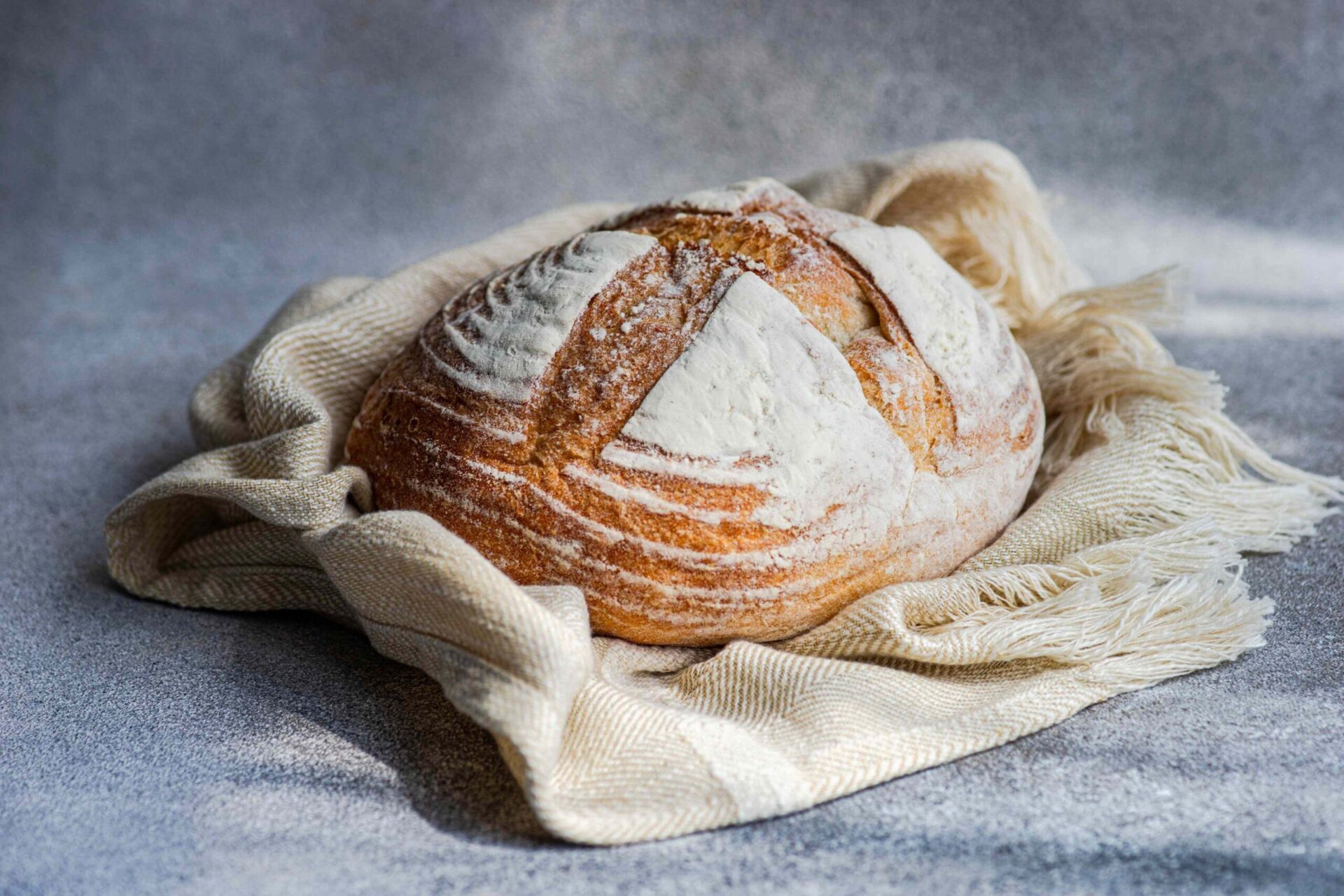
9 Foods With More Fiber Than a Slice of Sourdough Bread


Medically reviewed by Lindsey DeSoto, RD

Foods with more fiber than sourdough bread include legumes, chia seeds, and berries.Credit: annabogush / Getty Images
Foods with more fiber than sourdough bread include legumes, chia seeds, and berries.
Credit: annabogush / Getty Images
  • Fiber is a carbohydrate that helps maintain healthy digestion, steady blood sugar levels, and benefits heart health.
  • Black beans, lentils, raspberries, chia seeds, sprouted-grain bread, and avocados provide more fiber than sourdough bread.
  • Gradually add high-fiber foods to your diet and drink plenty of water to meet daily fiber goals and avoid bloating.

Dietary fiber is a carbohydrate that supports digestive health, controls blood sugar, and boosts heart health. One slice of sourdough bread has about 1 to 2 grams of fiber, depending on whether it is made with white or whole-grain flour, and many other foods provide much more fiber in a single serving.

1. Lentils

Credit: OlgaLepeshkina / Getty Images

Fiber content: 15.8 grams per cooked cup, about 56% of the Daily Value (DV)

Lentils are one of the highest-fiber plant foods. Just 1 cooked cup provides more than half of the daily fiber goal for most adults. Lentils are also rich in plant-based protein, offering about 18 grams per cup.

The fiber and protein in lentils slow digestion and help you stay full longer. This supports healthy weight management and steady blood sugar. Lentils also provide iron and folate, which are important for energy and red blood cell health.

Add lentils to soups, stews, grain bowls, or salads for a fiber boost, or mix them into veggie burgers for extra plant-based protein.

2. Black Beans

Credit: bhofack2 / Getty Images

Fiber content: 15 grams per cooked cup, 53% of the DV

Black beans contain both soluble and insoluble fiber. Soluble fiber helps control cholesterol and blood sugar. Insoluble fiber supports digestion and prevents constipation.

Research shows that a diet rich in legumes, such as black beans, may help lower low-density lipoprotein (LDL) cholesterol and reduce the risk of heart disease. One cup of cooked black beans also provides 15 grams of protein and essential minerals like calcium and potassium.

Black beans work well in tacos, rice dishes, soups, and grain bowls. They can also be blended into a dip for a fiber-rich snack.

3. Avocado

Credit: Andregric / Getty Images

Fiber content: 13.5 grams per average-sized avocado (201 g), 48% of the DV

Avocados provide a substantial amount of fiber in a single fruit, along with heart-healthy monounsaturated fats. The combination of fiber and healthy fat slows digestion and increases fullness, which can help reduce between-meal hunger and support weight management.

Avocados are also rich in potassium and folate. Potassium regulates blood pressure and supports muscle and nerve function. Folate supports DNA production, red blood cell formation, and healthy cell growth.

Spread avocado on whole grain toast, slice it into salads, or use it as a base for guacamole or other dips.

4. Chia Seeds

Credit: OvsiankaStudio / Getty Images

Fiber content: 9.75 grams per 1 ounce (2 tablespoons), about 35% of the DV

Chia seeds pack a remarkable amount of fiber in a small serving. The soluble fiber in chia seeds absorbs liquid and forms a gel-like texture in the digestive tract. This slows digestion, helping balance blood sugar levels and leaving you feeling satisfied after meals.

Chia seeds are also a good source of heart-healthy omega-3 fatty acids, calcium, and magnesium. Stir them into yogurt, oatmeal, smoothies, or use them to make chia pudding.

5. Raspberries

Credit: Liudmila Chernetska / Getty Images

Fiber content: 8 grams per cup, about 29% of the DV

Raspberries deliver an impressive amount of fiber, providing nearly one-third of your daily fiber needs in just 1 cup.

They also supply vitamin C and plant compounds called polyphenols. Polyphenols have antioxidant properties and may help reduce inflammation and support heart health. Research suggests the fiber and polyphenols in raspberries may help control blood sugar by slowing how quickly sugar enters the bloodstream.

Add raspberries to oatmeal, yogurt, or smoothies, or enjoy them on their own as a naturally sweet, high-fiber snack. Pair them with nuts or cheese for added protein and a more filling snack.

6. Pears

Credit: Veena Nair / Getty Images

Fiber content: 5.5 grams per medium pear, roughly 20% of the DV

Pears provide nearly 20% of the daily fiber target in a portable, easy snack. Much of the fiber is in the skin, so keep it on rather than peeling. Pears contain both soluble and insoluble fiber, which support digestion and help maintain normal cholesterol levels.

Research suggests pears contain antioxidant plant compounds, especially in the peel, that may help reduce inflammation and support healthy blood sugar and cardiovascular health.

Their natural sweetness makes pears easy to pair with other high-fiber foods like oatmeal, leafy green salads, or whole-grain bread.

7. Artichoke Hearts

Credit: Juanmonino / Getty Images

Fiber content: 9.69 grams per cooked cup, about 35% of the DV

Artichoke hearts are one of the most fiber-rich vegetables you can add to your diet. They contain a prebiotic fiber called inulin. Prebiotics feed beneficial gut bacteria, supporting digestion and immune function, and may help reduce systemic (body-wide) inflammation.

Artichokes also contain antioxidant plant compounds, including cynarin and silymarin. These may help support liver function and improve LDL cholesterol levels.

Artichoke hearts work well in salads, pasta dishes, grain bowls, dips, or spread on flatbreads.

8. Sprouted Grain Bread

Credit: Arx0nt / Getty Images

Fiber content: 3 grams per slice, approximately 10% of the DV

Sprouted grain bread is made from whole grains that have germinated before baking. The sprouting process may improve your body's absorption of certain vitamins and minerals, including iron and B vitamins, compared with standard whole-grain or white bread.

Sprouted grain bread is denser and heartier than white breads like sourdough, making it a filling and nutritious base for sandwiches and toast. It is also tasty dipped into soups and stews.

9. Oats

Credit: Arx0nt / Getty Images

Fiber content: 4 grams per cooked cup, about 14% of the DV

Oats provide a good amount of fiber per serving, much of it from a soluble fiber called beta-glucan. Beta-glucan may help lower LDL cholesterol and support steady blood sugar after meals.

They also supply important nutrients, including calcium, iron, and B vitamins. These nutrients support energy production, metabolism, and bone health. Oats also contain a modest amount of plant-based protein.

Start your day with oatmeal topped with fruit and nuts for added fiber, or use oats in smoothies, overnight oats, or homemade energy bites.

Adding Fiber to Your Diet

Most adults need 22 to 34 grams of fiber per day, but many people fall short. Gradually increasing fiber intake with a few simple swaps can make a big difference. Swapping sourdough bread for sprouted-grain bread and adding beans and vegetables to meals can help you reach your fiber goals and support your overall health.

Increase fiber slowly to minimize gas and bloating, and drink plenty of water to help it move through your digestive system. Aim to include a variety of fruits, vegetables, whole grains, beans, nuts, and seeds in your diet every day.




Source link

Leave a Reply

Subscribe to Our Newsletter

Get our latest articles delivered straight to your inbox. No spam, we promise.

Recent Reviews


Python List Length – Table of Content

What is a list in python?

A list is a data structure that contains an ordered sequence of elements.It is a mutable or changeable object. The values in the list are called items.The values can be of different types.We can gather related set of values together that belong to a group and store them in a list. It enables us to perform any operation on all the data present in a list at once.The items should be enclosed in square brackets and separated by a comma (,). We can create a list with a combination of numbers and string characters. A list can be defined in the following ways.

ListA = [1, 2, 3, 4];

ListB = ['Hi', 'Hello'];

ListC = ["Hi", "Hello"];

   Become a python Certified professional  by learning this HKR Python Training !

Find the length of a list

The length of a list in python can be found through two methods. 

Len() Method

It is a built-in function provided by python for getting the total number of items in a list, array, dictionary, etc. It takes the name of the list as an argument and returns the length of the given list. The len() method is the most commonly used method in python for finding the length of a list. Here is the syntax of the length method.

len()

is the name of the list 

Let’s look at an example program.

ListA = [1, 2, 3, 4, "Hello", "World"]

print ("Number of items in the list = ", len(ListA))

The output will be as follows. 

Number of items in the list =  6

We can also give the list directly as an argument to the len() method.

Length = len([1, 2, 3, 4, "Hello", "World"]);
print("Number of items in the list = ", Length);

The output will be as follows. 

Number of items in the list =  6

Length_hint() method

This method is not much known to programmers. It takes in a list or list name as an input argument and returns the number of items in the list. Here is a sample program that shows the use of the length_hint() method.

from operator import length_hint 

ListA = [1, 2, 3, 4, "Hello", "World"]

print ("Number of items in the list = ", length_hint(ListA))

The output for the above program is as follows.

Number of items in the list =  6

Naive Method

Apart from the len() method, there is another way to find the length of a list in Python. The naive approach is one of the most common methods when there is no alternative. It allows you to run the loop and count the items. Let us see its implementation :-

ListA = [1, 2, 3, 4, "Hello", "World"];

print("Input List = ", str(ListA));

count = 0;

for i in ListA:

count = count + 1

print("Number of items in the list = ", count);

The output for the above program will be as follows.

Input List =  [1, 2, 3, 4, 'Hello', 'World']

Number of items in the list =  6

This is the most basic method for finding the length of a list. But the len() method is always preferable to use.

Acquire Keras certification by enrolling in the HKR Keras Training program in Hyderabad!

Python Training Certification

  • Master Your Craft
  • Lifetime LMS & Faculty Access
  • 24/7 online expert support
  • Real-world & Project Based Learning

Performance analysis of the three methods

Before choosing a method, we can do performance analysis and choose based on that. Let’s take a sample program that calculates the time taken to run each method. 

from operator import length_hint 

import time 

ListA = [1, 2, 3, 4, "Hello", "World"];

print("Input List = ", str(ListA));

#Navie method

naive_start = time.time() 

count = 0

for i in ListA: 

    count = count + 1

naive_end = str(time.time() - naive_start) 

print ("Time taken using naive method = ", naive_end) 

# len() method

len_start = time.time() 

list_len = len(ListA) 

len_end = str(time.time() - len_start) 

print ("Time taken using len() method = ", len_end)

# length_hint() method

hint_start = time.time() 

list_len_hint = length_hint(ListA) 

hint_end = str(time.time() - hint_start) 

print ("Time taken using length_hint() method = ", hint_end)


The output for the above program will be as follows.

Input List =  [1, 2, 3, 4, 'Hello', 'World']

Time taken using naive method =  4.76837158203125e-07

Time taken using len() method =  1.6689300537109375e-06

Time taken using length_hint() method =  9.5367431640625e-07

We can see that the len() method has taken less time than the other methods.

Big Data Analytics, python-list-length-description-0, Big Data Analytics, python-list-length-description-1

Subscribe to our YouTube channel to get new updates..!

Using length method in a loop

The len() method not only returns the length of the list, but it can also return the length of each string in the list. We can loop through the list, apply the len() method on them to get the number of characters of an item specified within the list. We can only apply it on the string items given in the list. Let’s see how we can do that.

ListA = ["Hello", "World", "Welcome", 3, 4]

print ("Number of items in the list = ", len(ListA))

for i in ListA:

print("Length of item = ", len(i))

   Top 50 frequently asked Python interview Question and answers !

The output for the above program will be as follows. 

Number of items in the list =  5

Length of item =  5

Length of item =  5

Length of item =  7

As you can see here, it only returned the length of only string items.

Checking whether a list is empty or not

We can check if a list is empty or not in our python program using the len() method. Based on the return value of the len() method, we can specify a set of actions to be performed. Let’s take a look at a sample program of it. 

ListA = ["Hello", "World", "Welcome", 3, 4]

ListB = []

print ("Number of items in ListA = ", len(ListA))

print ("Number of items in ListB = ", len(ListB))

if len(ListA) == 0:

print("The ListA is empty")

else:

print("The ListA is not empty")

if len(ListB) == 0:

print("The ListB is empty")

else:

print("The ListB is not empty")

The output for the above program will be as follows.

Number of items in ListA =  5

Number of items in ListB =  0

The ListA is not empty

The ListB is empty

Python Training Certification

Weekday / Weekend Batches

Conclusion

The len() is the method used by all the programmers today.Now that you know the utility of the len() method, you can use it in various ways, as explained in this post. Start experimenting with finding the length of a list in your code. For more information on python,refer to the python tutorials and blogs on our website.

Related Articles:

1. Python Partial Functions

2. Python Split Method

3. Python Generators

4. Enumerate ( ) in python 

5.Python for DevOps


Source link