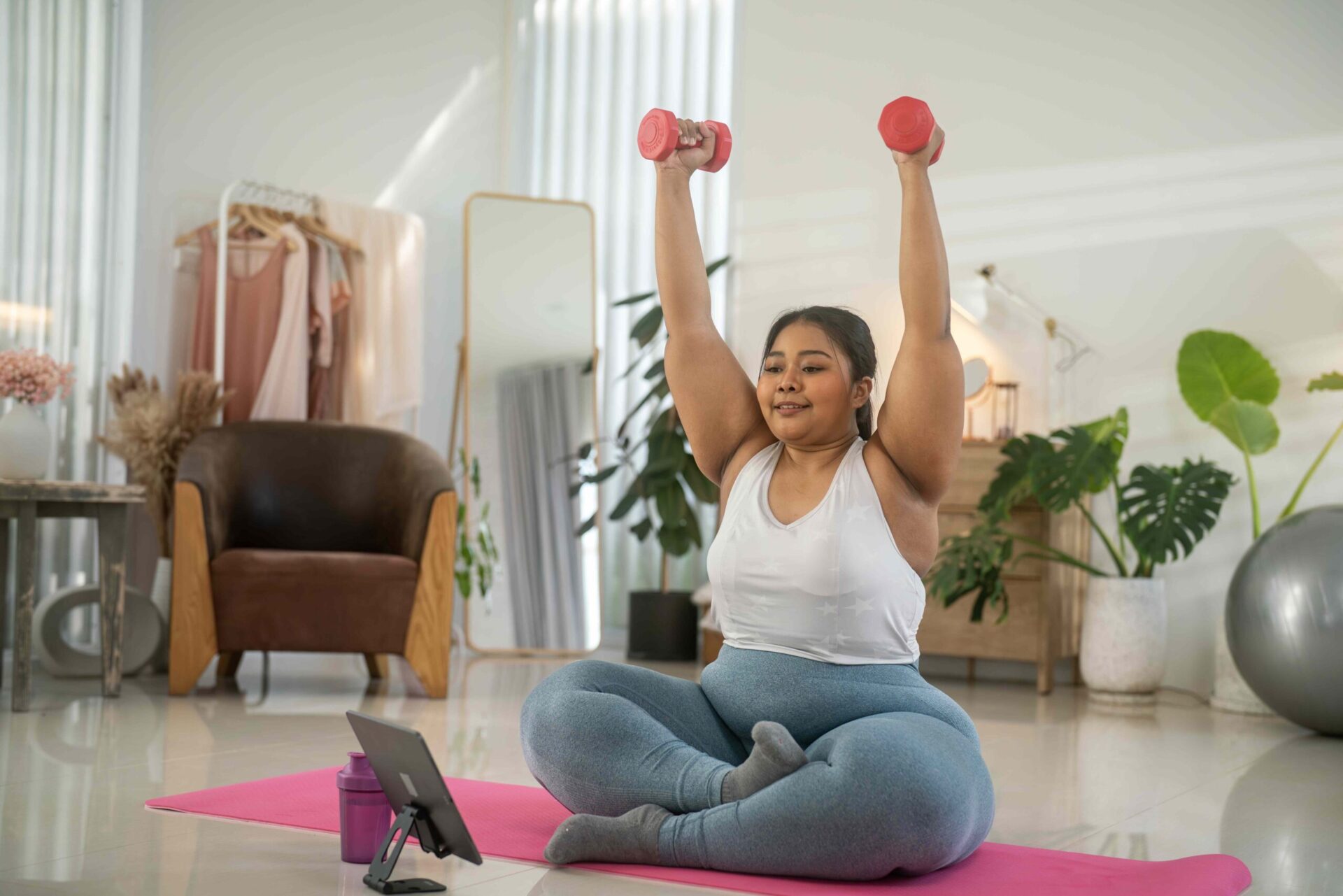
:max_bytes(150000):strip_icc():format(jpeg)/Health-GettyImages-2253438005-ecbcc26138894e9596726f94135010b3.jpg "Person exercising at home with dumbbells sitting on a yoga mat with arms raised.")
Credit: Witthaya Prasongsin / Getty Images
- GLP-1s can cause both fat loss and muscle loss, which can jeopardize overall health and functional movement.
- Targeting all the major muscle groups with regular strength training can preserve muscle while taking GLP-1s.
- Proper nutrition and adequate sleep also play a vital role in maintaining and increasing muscle mass.
GLP-1 drugs can help you lose weight, but they don't just promote fat loss—studies show that anywhere from 15%–60% of the weight people lose on GLP-1s is lean mass, or muscle. However, a fitness routine that includes strength-training exercises can help you preserve your muscle, which is critical for overall health and everyday movement.
1. Weighted Step-Up
One study found that, compared to other glute-building exercises like squats and lunges, the weighted step-up had the highest level of glute activation. The step-up also helps you build strength for movements you do every day, including climbing stairs or getting in and out of a vehicle.
Here's how to do it:
- Hold a dumbbell in each hand with your arms at your sides. Stand in front of a bench or step with your feet shoulder-width apart.
- Keeping your chest lifted and your core engaged, bend your right knee and place your right foot onto the bench.
- Push through your right foot to stand up, lifting your left foot to meet the right.
- Pause, then step down with the left foot, then the right foot.
- Repeat on the opposite side.
2. Push-Up
Research shows that push-ups are an effective way to grow muscle in the chest and triceps (back of the upper arms)—in fact, they may as effective as bench pressing a moderately heavy weight.
Maintaining chest and arm muscles is especially critical for older GLP-1 users or anyone at risk of falls—upper body strength can help people get up from the floor or prevent serious fall-related injuries.
Here's how to do a proper push-up:
- Start face-down in a plank position with your wrists and elbows directly under your shoulders. Engage your core, and keep your back flat and neck neutral. (Your body should form a straight line from head to heels.) If you'd like to make the movement easier, you can modify by lowering your knees to the ground.
- Bend your elbows and lower your chest until it’s within an inch or two of the ground.
- Press into the ground and extend your arms, lifting back into a plank position.
3. Deadlift
Deadlifting builds strength and muscle mass in some of the body’s largest muscle groups, including the glutes and the hamstrings (back of the thigh).
Doing deadlifts is another way to build functional strength—the movement reinforces proper mechanics for lifting heavy boxes, furniture, or other household objects.
Here's how you do it:
- Stand with your feet about hip-width apart, with your arms at your sides and a weight in each hand.
- Keep your back flat as you hinge at your hips, pushing them back as you lower the weights in front of your legs toward the ground. Once you feel a pulling sensation in the back of your legs, stop.
- Squeeze your glutes as you bring your hips forward and return to a standing position.
4. Bent-Over Row
The bent-over row targets the back and shoulder muscles. Not only does the movement build strength, but it may also help you stand tall and keep your body in alignment; research shows that back strength is linked to better posture.
Here's how you do a bent-over row:
- Stand with your feet about hip-width apart and hold a dumbbell in each hand, arms at your sides.
- Keeping your back flat and neck neutral, hinge forward at your waist until your chest is about parallel to the ground. Allow your arms to hang straight down from your shoulders.
- Engage your core and use your back and shoulder muscles to draw the weights up toward your rib cage.
- Slowly extend your elbows down to lower the weights.
5. Jumping Squat
The benefits of the jumping squat are twofold: The dynamic movement engages the glutes, quads, calves, and core to build muscle strength, plus it delivers a plyometric (jumping) stimulus that promotes moderate muscle growth.
Here's how you do it:
- Stand with your feet a little wider than hip-width apart.
- Keeping your chest up and back flat, hinge at your hips and push your butt back. Bend your knees to lower into a squat.
- Once your thighs are parallel to the ground, or you’ve gone as far as you can go, push through the soles of your feet to extend your legs and jump straight into the air.
- Land softly and immediately lower into the next squat.
6. Overhead Press
The overhead press builds muscle in the shoulders, arms, and chest. Plus, it demands core and back strength as you move the weights above your head, stabilizing your body.
Here's how you do the movement:
- Stand with your feet about shoulder-width apart and hold a dumbbell in front of each shoulder, palms facing in.
- Engage your core and, keeping your shoulders down and away from your ears, drive both weights directly overhead.
- Pause, then lower the weights back down to shoulder height.
Additional Tips for Maintaining Muscle Mass When Taking a GLP-1
Beyond adding strength-building exercises to your routine, the following strategies could also help you preserve muscle while you lose weight with a GLP-1:
- Train consistently: For strength training to be effective, you need to exercise regularly. Aim for two or three full-body strength workouts every week.
- Prioritize protein: Protein is the nutritional building block for muscle growth and tissue repair, and research suggests people taking GLP-1s usually don't get enough. Adults need at least 0.8 grams of protein per kilogram of body weight to stay healthy. But updated federal dietary guidelines now suggest people may want to get 1.2–1.6 grams of protein per kilogram of body weight. However, ideal protein intake depends on age, gender, activity level, and other factors.
- Make sleep non-negotiable: Research shows that poor sleep can impair the biological process of building and repairing muscle tissue. Make sure you get 7-9 hours of sleep every night.
If you're taking a GLP-1 drug, talk to your doctor or a dietitian about how to protect muscle mass and ensure you're losing weight safely, especially since everyone responds to GLP-1 drugs differently.