How rare are standard awards at Waldorf Astoria Maldives?


One of the most aspirational properties in the Hilton Honors portfolio is certainly the Waldorf Astoria Maldives Ithaafushi. It’s often considered one of the best Waldoft Astoria hotels, but nightly rates start at an eye-watering $2,988.

Meanwhile, standard room rewards cost 250,000 points per night (if you can find availability). Otherwise, you’ll only see premium room rewards that cost at least four times as many points per night.

I managed to piece together a three-night standard room reward stay at the Waldorf Astoria Maldives in 2024. But, it can certainly feel like there’s rarely two standard room reward nights together, much less enough nights to make it worth the mandatory $1,235 per person return transfer between the international airport in Male and the resort.

But, just how limited is standard room reward availability at the Waldorf Astoria Maldives Ithaafushi? And how difficult is it to piece together a trip if you only want to book standard room reward nights? Let’s dive into some data from Gondola (a free hotel search and direct booking platform for frequent travelers) to answer these questions.

Award pricing at the Waldorf Astoria Maldives

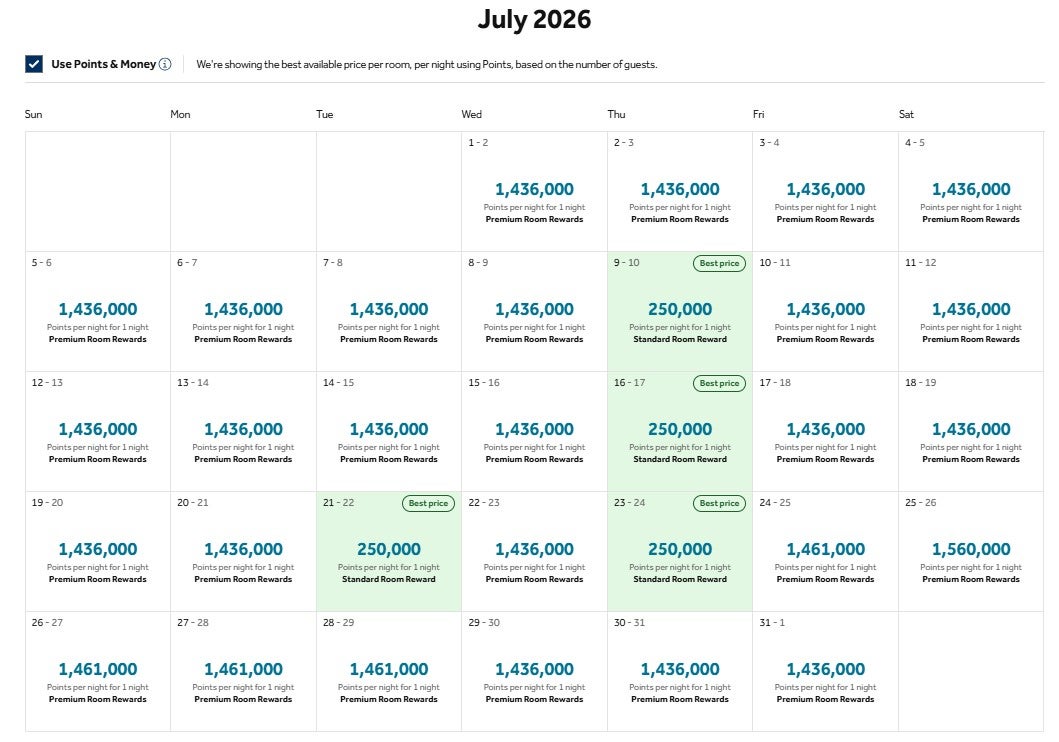
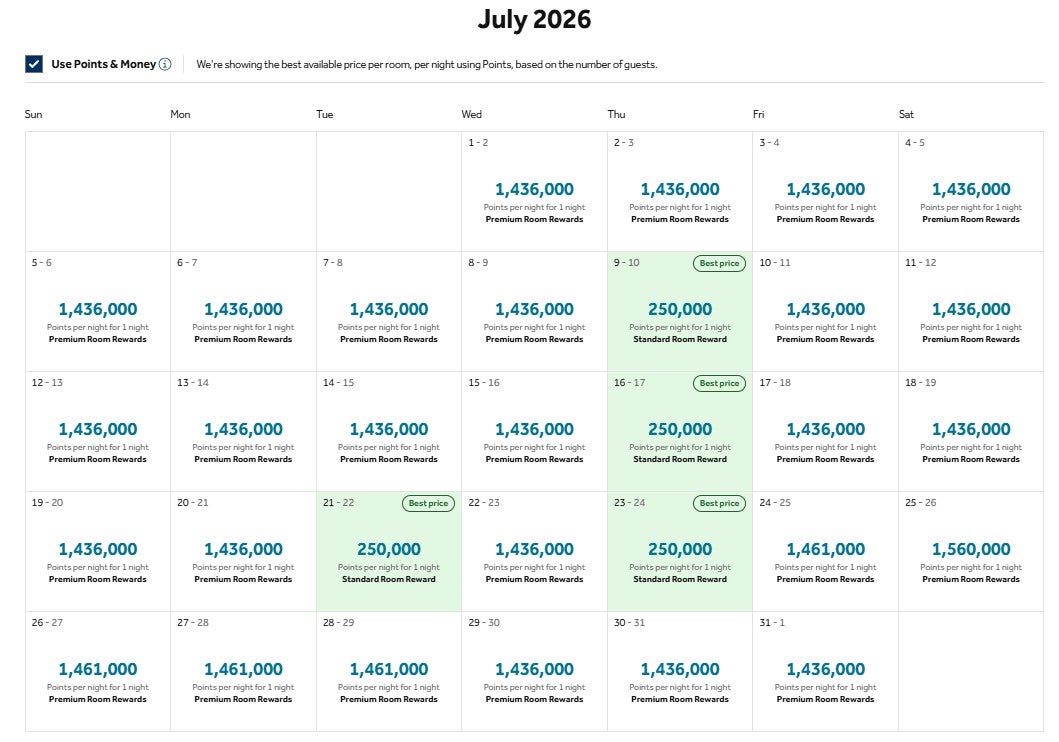
If you’ve never tried to book an award stay at the Waldorf Astoria Maldives Ithaafushi, you might be shocked when you do a flexible award search. For example, July’s flexible award calendar shows just four nights with standard room rewards of 250,000 points. These standard room rewards are what you’ll need if you want to redeem a Hilton annual free night reward certificate.
Hilton award pricing calendar for the Waldorf Astoria Maldives
HILTON

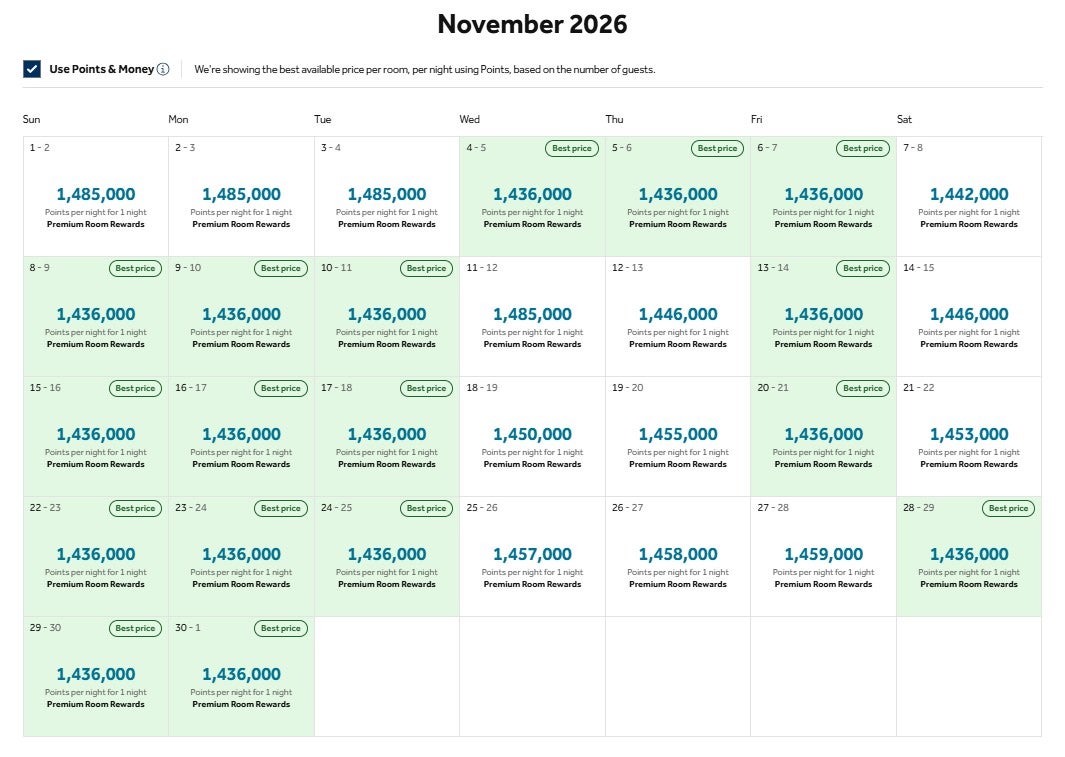
Some months, such as November, may have zero nights with standard room rewards.
Hilton award pricing calendar for the Waldorf Astoria Maldives
HILTON

Based on data from Gondola, here’s a breakdown of what the least expensive award rates looked like for one-night stays at the Waldorf Astoria Maldives Ithaafushi across the next 10 to 11 months when they searched on March 29:

Award type Points per night Number of dates Average comparable cost per night Average redemption rate

250,000

31

$3,240

1.3 cents per point

1,155,000

28

$3,816

0.33 cents per point

1,411,000 to 1,634,000

250

$3,480 to $4,026

0.24 to 0.25 cents per point

3,540,000 to 3,589,000

8

$8,850 to $8,989

0.25 cents per point

Of the nights bookable with points, only 10.8% offered standard room rewards. But, as you can see from the average redemption rates, you’ll get a very low redemption rate from premium room rewards at the Waldorf Astoria Maldives Ithaafushi. For reference, TPG’s April 2026 valuations peg Hilton points at 0.4 cents.

The small comparable price difference between standard room rewards and the lowest-cost premium room rewards makes sense given the room types. The rooms available with standard room rewards at this property are the “two queen bedded reef villa with pool” and the “king reef villa with pool.” Meanwhile, beach and overwater villas with similar layouts and sizes (and yes, private pools) carry premium room reward pricing but just marginally higher paid rates.

Reward your inbox with the TPG Daily newsletter

Join over 700,000 readers for breaking news, in-depth guides and exclusive deals from TPG’s experts

Waldorf Astoria Maldives room types bookable with points
HILTON

So, if you’re going to use points at the Waldorf Astoria Maldives Ithaafushi, booking standard room rewards will give you by far the best value. And, these are the only type of awards you can book with Hilton free night certificates.

Related: 6 ways to maximize Hilton Honors redemptions

Frequency of standard award nights at the Waldorf Astoria Maldives

In the above section, we considered award availability at the Waldorf Astoria Maldives Ithaafushi for searches on a specific date. But, Gondola checks paid and award rates across about 320 future check-in dates every 36 hours. So, across Gondola’s approximately 19 checks in March 2026, here’s how many unique check-in dates within each month they found with 250,000-point standard reward night availability at least once:

  • March 2026: 30 dates appeared at least once (seven dates on average at any given time)
  • April 2026: 30 dates appeared at least once (10 dates on average at any given time)
  • May 2026: 17 dates appeared at least once (four dates on average at any given time)
  • June 2026: 22 dates appeared at least once (five dates on average at any given time)
  • July 2026: 30 dates appeared at least once (eight dates on average at any given time)
  • August 2026: One date appeared at least once (No dates on average at any given time)
  • September 2026: Six dates appeared at least once (One date on average at any given time)
  • October 2026: 12 dates appeared at least once (Two dates on average at any given time)
  • November 2026: 11 dates appeared at least once (One date on average at any given time)
  • December 2026: Three dates appeared at least once (No dates on average at any given time)
  • January 2027: Seven dates appeared at least once (One date on average at any given time)

From this data and my personal experience searching for award nights at this property, two important learnings emerge:

  • First, standard reward nights often tend to pop up for check-in dates within the next month or so. Many travelers plan their Maldives vacations well in advance, but you may be able to snag multiple standard reward nights if you can travel in the next month or two.
  • Second, standard reward nights do frequently appear. So, periodically searching (or setting award alerts) for standard room rewards on dates around those you’ve already secured can pay off (especially in some months).

Note that you’ll want to book quickly once you find standard room reward availability that works for you. Data from seven consecutive searches by Gondola shows just how volatile standard room reward availability is at the Waldorf Astoria Maldives Ithaafushi:

Date of search Standard room reward nights that were bookable across the next 10-11 months Standard room reward nights that appeared between the previous check and this check Standard room reward nights that disappeared between the previous check and this check

45

44

5

6

42

6

8

42

12

12

30

5

17

32

10

8

31

6

7

Another way to look at the standard reward-night volatility is to consider data on how long a specific check-in date remains available at 250,000 points once it appears. Here’s a look at this measure of volatility across Gondola’s 19 checks in March (for check-in dates in April and beyond):

  • One check only: 14 check-in dates
  • Two to five checks: 20 check-in dates
  • Six to 10 checks: 14 check-in dates
  • 11 to 19 checks: 12 check-in dates

So, while some standard room reward nights stay available for days or even weeks, others disappear quickly.

Related: 34 Maldives resorts you can book with points and miles

Bottom line

I loved my three-night stay at the Waldorf Astoria Maldives Ithaafushi in 2024, and I am happy I got to experience one of the most aspirational hotels you can book with points. I’ll likely try out other Maldives resorts on future trips. But, it’s nice to see the data back up my take that you can often string together multiple standard room reward nights at this property by diligently checking award space and booking using points or free night certificates when standard room reward nights become available.

That said, it’s highly unlikely you’ll be able to book five standard room reward nights together in a single booking (which is what you’d need to get a fifth night free if you have Hilton elite status) unless you book a last-minute stay. And, keep in mind that the on-site food, drink, experiences and mandatory airport transfers will still add up to an expensive stay even if you secure standard room reward nights. But if you have the Hilton Honors American Express Aspire Card, you can at least use your Hilton Aspire resort credit (up to $200 in statement credits biannually) to offset some incidental costs.

Gondola is a free hotel search and direct booking platform for frequent travelers, making it easy to compare cash and points rates across brands while earning up to an extra 7% cash back.


Source link

Leave a Reply

Subscribe to Our Newsletter

Get our latest articles delivered straight to your inbox. No spam, we promise.

Recent Reviews


Introduction to Array length in JAVA:

The length of the array describes the number of elements used in Java. As java is not a Size associated, so Array length helps to overcome it.

Here length applies to array in java, and Size applies to a Java   ArrayLISTcollection object.

Wish to make a career in the world of Java? Start with HKR’S  Java Training ! 

Java ‘Length’ Attribute:

The number of elements is used in the array during its declaration; we can call it as Size or length of the array. For example;

int len1 = myArray.length1;

The below program illustrate the length attributes of the Array elements in JAVA:

Import java.util.*; // built-in library

Class Main1

{

   Public static Void main1 (string [] args)

    {

      Integer [] intArray1 = {1, 3, 5, 7, 9}; // integer value

       String [] strArray1 = { “one”, “two”, “three”}; // string array elements

                   //Print each array and their corresponding length

        System.out.printIn (“integer array contents: “+ Array.to string (intArray1));

        System.out.printIn (“the length of the Integer array stored: “+intArray1.length);

       System.out.PrintIn (“string Array contents: “+ Arrays. ToString (strArray1));

       System.out.PrintIn (“The length of the String array: “+ strArray1. Length);

      }

}

 The output:

Integer Array Contents: {1, 3, 5, 7, 9}

The length of the Integer array: 5

String Array Contents: [one, two, three]

The length of the String array: 3
The above java program reads the length of the given elements and displays the length along with the contents of two different arrays (integers and strings).

Till now I have explained the simple program, now it’s time to learn how to use array in different situations.

They are:

·        Mainly to search for the specific element value in the array.

·        While searching for minimum or maximum values in the array.

Let’s discuss these two different situations in details:

Searching for a value using Length attributes:

As we discussed earlier, iterations can be done through an array using its length attributes. The loop condition in any program will iterate all the array elements one by one until it reaches (length-1) elements. (Since array count in java starts from 0).

Here we are going to use Loop condition to search if a specific value is present in the array or not. To do this, you need to traverse through the whole array until the loop reaches the last element. While performing traversing, each element in the condition will be compared with the existing value to be searched. If any value matches then loop traversing will be stopped as well as program will be terminated.

The below program explains the searching for a data value in an Array:

Import java.util.* ; //built-in library

Class Main

{

Public static void main (string [] args)

      {

         String[] strArray1 = { “UNIX” , “Python”, “ Ruby”, “ Java”, “C” }; // array of string


   // searching for the string using a search value function 


System.out.printIn (searchValue (strArray, “R”)?” value R found” : “value Java not found”);

 System.out.printIn (searchValue (strArray, “Ruby”)?” value Ruby found”: “value Ruby not found”);

}

 Private static Boolean search value (String [] search array, string lookup)

   {

    If (searchArray! = null)

          {

          int arraylength = searchArray. Length; // compute array length

             for (int i=0; I
                {

                    String value = searchArray[i];

                     If (value. Equals (lookup))

                             {

                                 Return true;

                             }

                    }

        }

 Return false;

       }

The Output:

Value R not found

Value Ruby found

Top 20 frequently asked EMC Interview Questions !

Java Certification Training

  • Master Your Craft
  • Lifetime LMS & Faculty Access
  • 24/7 online expert support
  • Real-world & Project Based Learning

In the above program example, we have an array of a few programming language names. We have used the function “search value”, this function searches the particular programming language names. In this example, we have used the for loop in the search value function to iterate through the array and it will be searched for the specified names.

Once the correct name is found, then the SearchValue function returns true. If the name is not found then the SearchValue function returns false.

Related Article: Java Full stack Developer Skills !

Find the Minimum and maximum values in an Array:

In this section, here you can also traverse the array values using the attribute lengths and which enables you to find the minimum and maximum elements in an array.

As we know that the array may or may not be sorted. To perform this finding minimum and maximum the array elements, you have to do the comparison with each element once all the elements in an array get exhausted and at last, you can find the maximum or minimum elements in an array, the following programs explain the concept.

The below programming example is for minimum elements in an array.

Import java.util. *;

Class Main

 {

Public static void main (String [] args)

    {

      Int [] intArray1 = {72, 42, 21, 10, 53, 64};   //int array

          System.out.printIn (“the given array: “+ Arrays. ToString (intArray));

       Int min_val = intArray1 [0];            //assigning first element to min value

       Int length = intArray1. Length;

        For (int I = 1; I
       {

                Int value = intArray1 [i];

                 if (value
              {

               Min_val = value;

            }

   System.out.printIn ( “ the min value in the array: “ +min_Val);


       }

}


Output:

The given array: [72, 42, 21, 10, 53, 64]

The minimum value in the array is: 10

In the above programming example, we have the array elements as a reference element. Then we compare all the elements in a program one by one with the reference element which we have already mentioned in the program. The SearchValue function will be picking one by one until we reach the end of the array in a program.

The next program explains how to find the largest element in an array. The program logic is similar to the previous program, but instead of finding the element which is less than the reference element, we find the greater element than the reference.

The below program illustrates how to find the greater element;

Import java.util.* ; // built-in library

Class Main

   {

  Public static void main (String [] args)

   {

      Int [] intArray1 = {72, 42, 21, 10, 53, 64};  // inserting int array elements

      System.out.printIn (“the given array elements are: “ + Arrays.tostring (intArray1));

     int max_val = intArray1 [0]; //reference elements

     int length = intArray1.length;

     for (int i=1; I
    {

       Int value = intArray1 [i];

        If (value > max_val)

          {

                 Max_val = value;

           }

      }

      System.out.printIn (“the highest value in the array: “+max_val);

   }

 }

The output:

The given array elements are: [72, 42, 21, 10, 53, 64]

The highest value in the array: 72
In the array length, not only int elements, but we can also find the length of floating-point numbers and string elements.

The syntax is as follows:

Float size = array. Length []  // float value length

String size = array. Length [] // string values length

Acquire Liferay Fundamental certification by enrolling in the HKR Liferay Fundamentals Training program in Hyderabad!

Programming & Frameworks, array-length-in-java-description-0, Programming & Frameworks, array-length-in-java-description-1

Subscribe to our YouTube channel to get new updates..!

Programming example:

Public class test1

 {

Public static void main (string [] args)

  {

      Int [] array = new int [5]; //array name is of integer type

      Float [] array = new float [0.1]; //array name is of float type

         String [] array = new string [5]; // array name is of string type

          System. Out. PrintIn (“the size of “+ “the array is “+ array. Length);

         System. Out. PrintIn (“the size of “+ “the array is “+array. Length);

          System. Out. PrintIn ( “ the size of “+ the size of “ + “ the array is “ + array. Length);

 }

}


Output:

The size of the array is 4 // integer value

The size of the array is 0.09 // floating-point integer

The size of the array is [4] // string value
One important thing is that the array in java does not any methods to get the length of an element.

The following program illustrates the use of the function to get the length of an array.

Public class ArrayLengthJava

  {

  Private static void printArraylength (String [] myArray1)

  {

    If (myarray1 == null) // to find whether the array values are empty or not

    {

          System.Out.print (“the length of the array can’t be determined. “);

         }

    Else

{

    Int arraylength = myArray1. Length;

System. Out.printIn (“ the length of the array is: “ + arraylength);

  }

 }


Public static void main(String [] args)

  {

   String [] javaArray1 = { “ My”, “name”, “Adam”};

   String [] javaArray2 = { “K”, “A”};

String [] javaArray3 = {“1”, “2”, “3”, “4”};

String [] javaArray4 = { “Java”};

   PrintArrayLength (null);

   PrintArrayLength (JavaArray1);

   printArraylenghth (javaArray2);

PrintArraylength (javaArray3);

 PrintArraylength (javaArray4);

}

}

The output:

The length of the array can’t be determined.

The length of the Array1 is: 3

The length of the Array2 is: 2

The length of the Array3 is: 4

The length of the Array is: 1

If you want to access the length of an empty or any null object, a NullPointerException is raised.

Do you want to collaborate in the Java Spring world? Begin by learning Java Spring Training!

Java Certification Training

Weekday / Weekend Batches

Conclusion:

In this blog, I have explained the Array length in Java with a few programming illustrations. Array length in java is mainly used to find the number of elements used in the program. I hope this blog may help a few of you to learn the basic concepts of java and its examples.

Related Articles :


Source link