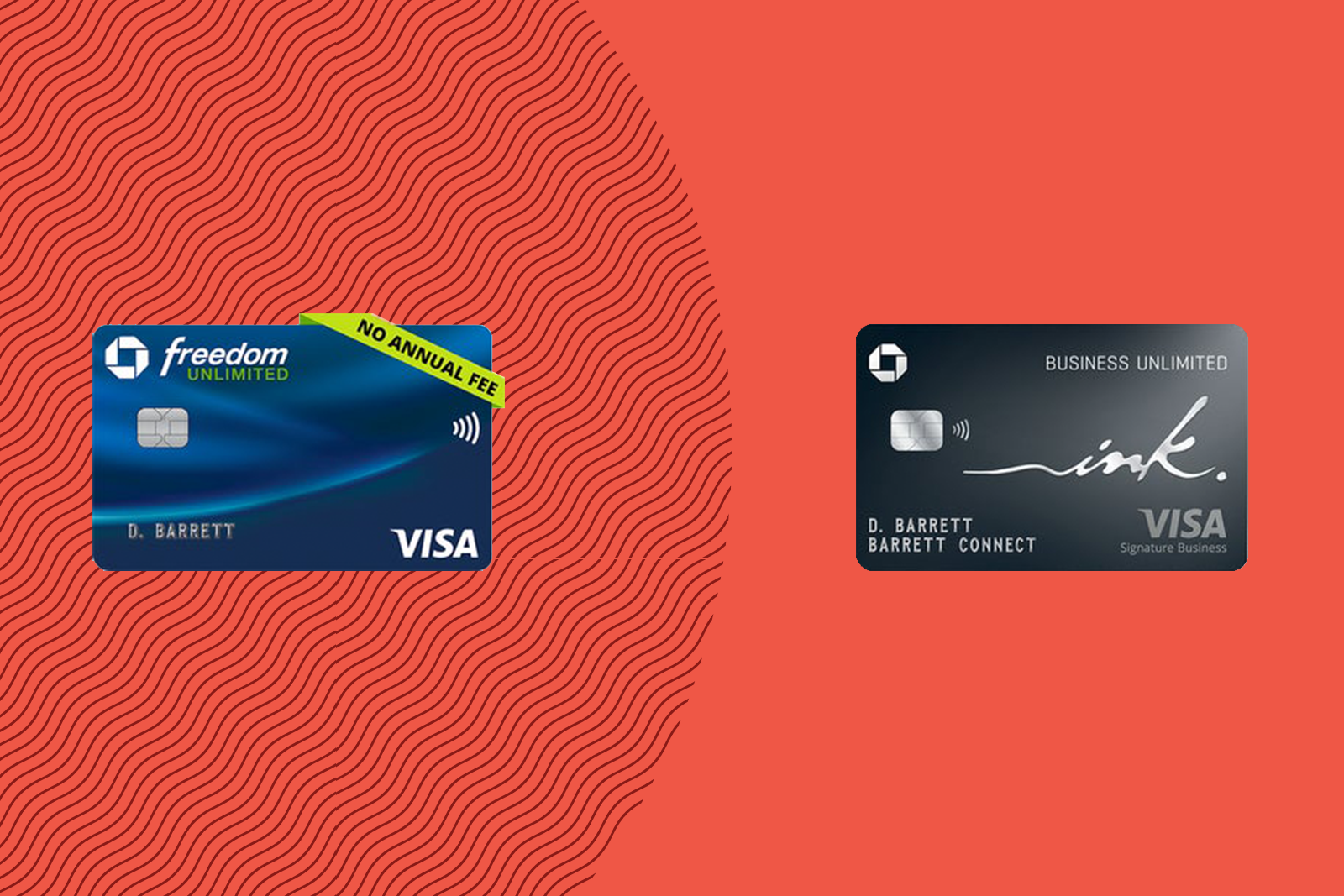
Ink Business Unlimited vs. Chase Freedom Unlimited showdown


If you’re looking into Chase’s lineup of credit cards, you may be checking out two of the issuer’s top cash-back options: the Chase Freedom Unlimited® (see rates and fees) and Ink Business Unlimited® Credit Card (see rates and fees).

These two cards share similar names and earn the same type of rewards, but there are many key differences to weigh. For one, the Freedom Unlimited is a personal credit card, while the Ink Business Unlimited is a business product.

So, if you’re considering both cards, you’ll want to be sure that you’re eligible for a business card first. You’ll also want to be under Chase’s 5/24 rule to be approved.

Now, let’s dive into these two cards and see which one is right for you.

Ink Business Unlimited vs. Freedom Unlimited comparison

Card Ink Business Unlimited Chase Freedom Unlimited 

Earn $750 bonus cash back after spending $6,000 on purchases within the first three months from account opening.

Earn a $250 bonus after spending $500 on purchases within the first three months from account opening.

$0

$0

  • 5% back on Lyft rides through Sept. 30, 2027
  • 1.5% back on everything else

  • 5% back on travel booked through Chase Travel℠
  • 3% back on dining at restaurants, including takeout and eligible delivery services
  • 3% back on drugstore purchases
  • 2% back on Lyft rides (through Sept. 30, 2027)
  • 1.5% back on everything else

3%

3%

  • Extended warranty
  • Free employee cards
  • Primary auto rental coverage
  • Purchase protection
  • Roadside assistance
  • Travel and emergency assistance services
  • Zero liability protection
  • Complimentary Instacart+ membership for three months

  • Extended warranty
  • Purchase protection
  • Secondary auto rental coverage
  • Travel and emergency assistance services
  • Trip cancellation and interruption insurance
  • Zero liability protection
  • Six months of complimentary DoorDash DashPass

Ink Business Unlimited vs. Freedom Unlimited welcome bonus

The Ink Business Unlimited provides a valuable welcome bonus to new cardholders. With this card, you can earn $750 bonus cash back after spending $6,000 on purchases within the first three months from account opening.

This is a solid offer, especially for a no-annual-fee card.
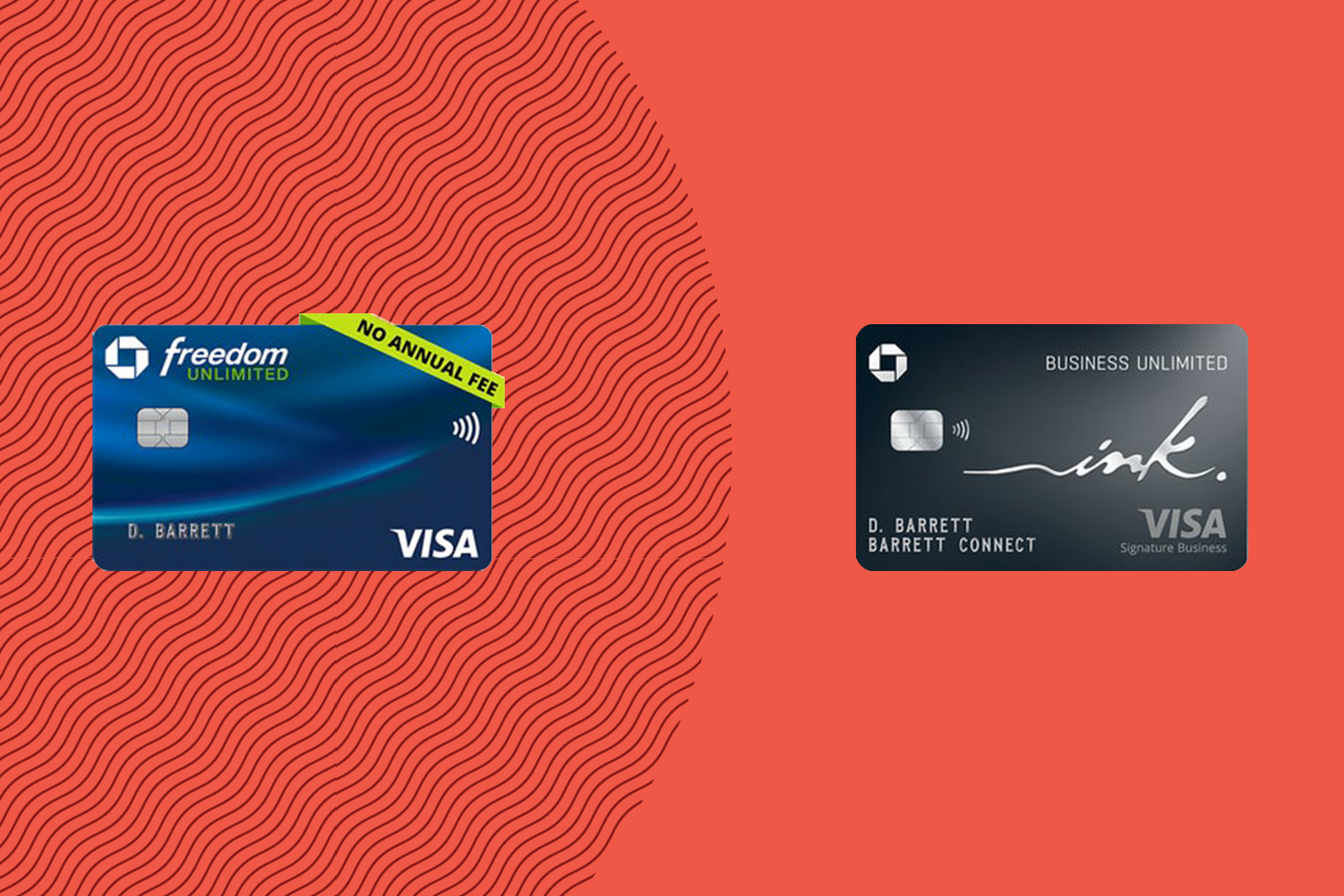
Chase Freedom Unlimited and Ink Business Unlimited side-by-side card art
THE POINTS GUY

Meanwhile, new Freedom Unlimited cardholders can earn a $250 bonus after spending $500 on purchases within the first three months from account opening. This bonus is one of the easiest to earn, since it requires a low minimum spending requirement.

Both welcome bonuses can be converted into Chase Ultimate Rewards points if you have the right card. I’ll get into more about that later in this showdown.

Winner: Ink Business Unlimited. Its welcome offer is more valuable, though it does come with a much higher minimum spending requirement than the Freedom Unlimited.

Reward your inbox with the TPG Daily newsletter

Join over 700,000 readers for breaking news, in-depth guides and exclusive deals from TPG’s experts

Related: The best time to apply for these popular Chase credit cards based on offer history

Ink Business Unlimited vs. Freedom Unlimited benefits

Since both the Ink Business Unlimited and the Freedom Unlimited charge no annual fee, neither card has a long list of additional benefits.

In fact, many of these cards’ perks are shared. This includes:

Still, there are some differences that could help you choose one card over the other.

First of all, the Freedom Unlimited does provide an extra perk that the Ink Business Unlimited does not: trip cancellation and interruption insurance. This benefit, which reimburses up to $1,500 per covered traveler and $6,000 per trip, covers travel expenses if your trip is canceled or cut short due to covered situations, such as sickness or severe weather.

I’ve had success using Chase’s trip cancellation and interruption insurance when I had to cancel a hotel stay after catching the flu.

Woman passenger with passport travel by air transportation. Woman friends taking off luggage from car trunk in Airport parking and walking to airline check in counter at airport terminal.
CANDYRETREIVER/GETTY IMAGES

However, the Ink Business Unlimited provides primary car rental insurance, which generally reimburses you for the rental car’s cash value or the cost to repair it (whichever is less) with the need to file only one claim.

The rental car coverage included with the Freedom Unlimited is secondary insurance, which means it kicks in second after other insurance and typically reimburses you for the amount not covered by your initial claim. For cardholders who frequently rent cars, you may want to opt for the Ink Business Unlimited.

The Ink Business Unlimited also provides a complimentary three-month Instacart+ membership (auto-renews at $99 a year after the complimentary period). Once this membership is activated, Instacart+ members receive a $20 Instacart credit each month (automatically loaded into your Instacart Business Account). This benefit ends Dec. 31, 2027.

Woman receiving groceries
DGLIMAGES/GETTY IMAGES

Meanwhile, the Freedom Unlimited provides six months of a complimentary DashPass membership (for both DoorDash and Caviar; auto-renews at the current monthly rate after the complimentary period). Activate by Dec. 31, 2027. DashPass members also receive up to $10 off each quarter on non-restaurant DoorDash orders through Dec. 31, 2027.

The Freedom Unlimited’s complimentary DashPass benefit lasts three months longer than the Ink Business Unlimited’s Instacart+ membership. But if you prefer Instacart+ to DashPass, that may be the better choice for you. It comes down to preference.

Winner: Freedom Unlimited. This is close, but since the Freedom Unlimited provides trip cancellation and interruption insurance, it pulls ahead of the Ink Business Unlimited.

Related: Why you might want to get a premium credit card instead of purchasing travel insurance

Earning cash back with the Ink Business Unlimited vs. Freedom Unlimited

Both the Ink Business Unlimited and the Freedom Unlimited share an elevated cash-back rate on nonbonus spending at 1.5% back.

The Ink Business Unlimited offers just one additional bonus category: 5% back on Lyft rides through Sept. 30, 2027.

Meanwhile, the Freedom Unlimited boasts three bonus categories: 5% back on travel booked through Chase Travel, 3% back on dining (including takeout and eligible delivery services), 3% back at drugstores and 2% back on Lyft rides (through Sept. 30, 2027).

AJ_WATT/GETTY IMAGES

TPG credit cards editor Olivia Mittak uses her Freedom Unlimited for any purchases that fall out of her cards’ bonus categories when she isn’t working toward a welcome bonus. She strives to earn more than 1 point per dollar spent or 1% back on as many purchases as possible, and the Freedom Unlimited goes a long way toward helping her achieve that.

The Freeeom Unlimited provides many more bonus categories than the Ink Business Unlimited, so if you’ll be spending often on Chase Travel bookings, dining or drugstores, that could push it ahead.

However, if you’re putting a lot of spend on Lyft, the Ink Business Unlimited wins over the Freedom Unlimited, since it earns 5% back instead of 2% back on rides (through Sept. 30, 2027). Since they share a 1.5% cash-back rate on all nonbonus spending, these are the biggest differentiators.

Winner: Freedom Unlimited. The card provides more elevated bonus categories than the Ink Business Unlimited.

Related: The unique bonus categories built for businesses (and the cards that offer them)

Redeeming cash back with the Ink Business Unlimited vs. Freedom Unlimited

The rewards you earn with either the Ink Business Unlimited or the Freedom Unlimited can be redeemed for cash back, goods and services offered through Chase’s rewards program, gift cards and travel.

Cash-back redemptions can be received as a statement credit, a mailed check or an electronic deposit.

Young mixed race couple using on a laptop sitting on a bed in a cabin of a vintage sailing boat
JORDI SALAS/GETTY IMAGES

If you want to keep things simple, it’s recommended to redeem for cash back rather than use the other flat-rate options.

However, you’ll get much more value if you convert your cash back to Chase Ultimate Rewards points.

Winner: Tie. These cards offer the same redemption options.

Related: The pros and cons of cash-back credit cards

Transferring cash back with the Ink Business Unlimited vs. Freedom Unlimited

You can unlock much more value out of the rewards earned with the Ink Business Unlimited and the Freedom Unlimited by transferring them from either card to a full-fledged Ultimate Rewards personal or business card.

Examples include the Chase Sapphire Preferred® Card (see rates and fees), Chase Sapphire Reserve® (see rates and fees) and Ink Business Preferred® Credit Card (see rates and fees).

Handsome man traveling by city train, scrolling on a smartphone. Man heading home after a long day at work. The single man commutes alone. Single man using dating app.
HALFPOINT IMAGES/GETTY IMAGES

If you go this route, you can boost your redemption rate on everyday spending to an effective return of at least 3%, per TPG’s April 2026 valuations.

Once you transfer your rewards to an Ultimate Rewards account, you can transfer them to one of Chase’s valuable airline and hotel partners. Olivia sends her Freedom Unlimited rewards to her Sapphire Preferred account so she can then transfer them to one of her favorite loyalty programs, World of Hyatt.

You could also choose to book directly through Chase Travel at a fixed value per point, depending on the card you hold (see your card’s guide to benefits for full details).

Winner: Tie. The options here are also identical.

Related: 10 best ways to redeem 200,000 Chase Ultimate Rewards points

Should I get the Ink Business Unlimited or Freedom Unlimited?

I see the personal Freedom Unlimited coming out on top for most cardholders since it provides more bonus categories and slightly better benefits than the Ink Business Unlimited.

Even still, I recommend the Ink Business Unlimited for business owners who want to earn 1.5% back on their everyday spending. This business card provides a highly valuable welcome bonus to those who can meet its spending requirement.

Related: How to pick a strategy for your small-business credit cards

Bottom line

Either one of these cards can be a stellar addition to your rewards card strategy. This is because both the Ink Business Unlimited and the Freedom Unlimited earn at least 1.5% back on all purchases, with no annual fee.

You’re going to get the most value out of these cards if you pair them with an Ultimate Rewards-earning card, since that unlocks the ability to convert your rewards into highly valuable Chase points.

To learn more, read our full reviews of the Ink Business Unlimited and Freedom Unlimited.


Apply here: Ink Business Unlimited

Apply here: Chase Freedom Unlimited


Source link

Leave a Reply

Subscribe to Our Newsletter

Get our latest articles delivered straight to your inbox. No spam, we promise.

Recent Reviews


About Big Data Tool?

Big data is open source software where java frames work is used to store, transfer, and calculate the data. This type of big data software tool offers huge storage management for any kind of data. Big data helps in processing enormous data power and offers a mechanism to handle limitless tasks or operations. The major purpose to use this big data used to explain a large volume of complex data. Big data can be differentiated into three types such as structured data format, semi-structured data format, and unstructured data format. One more point to remember, it’s impossible to process and access big data using traditional methods due to big data growing exponentially. As we know that traditional methods consist of the relational database system, sometimes it uses different structured data formats, which may cause failure in the data processing method.

Here are the few important features of big data;

1. Big data helps in managing the traffic on streets and also offers streaming processing.

2. Supports content management and archiving emails method.

3. This big data helps to process rat brain signals using computing clusters.

4. provides fraud detections and prevention.

5. Offers manage the contents, posts, images, and videos on many social media platforms.

6. Analyze the customer data in real-time to improve business performance.

7. Fortune 500 company called Facebook daily ingests more than 500 terabytes of data in an unstructured format.

8. The main purpose to use big data is to get full insights into their business data and also help them to improve their sales and marketing strategies.

Become a master of ETL Testing by going through this HKR ETL Testin Training !

Introduction to ETL Tools in Big Data:

ETL can be abbreviated as “Extract, transform, and Load”. ETL is a simple process to move your data from one source to multiple warehouses. The ETL process is considered to be a crucial step in the big data analysis process. ETL tools in big data applications help users to perform fundamental three processes. (they are ETL processes). With the help of this ETL tool, users can move their data from one source to a destination. The main functions of the ETL process included data migration, coordinating the data flow, and executing all the large or complex volume of data. The following are basic fundamental concepts of ETL tools;

1. Overview

2. Pricing

3. Use case

Big Data Hadoop Training

  • Master Your Craft
  • Lifetime LMS & Faculty Access
  • 24/7 online expert support
  • Real-world & Project Based Learning

Best Big Data ETL Tools used:

In this section, we are going to explain the topmost ETL tools used in big data. These tools are used to remove the issues involved while searching for the appropriate data flow.

Let us explain them one by one;

1. Hevo big data type or No code data pipeline tool:

Hevo is also known as a no-code data pipeline. This tool supports integrating pre-built data across 100+ data sources. Hevo is one of the fully managed solutions to migrate your data and also automates the data flow. Hevo has come up with a fault-tolerant architecture that makes sure that your data is secured and consistent to use. This big data tool also offers an efficient and fully automated data solution to manage your data in real-time.

The features of the Hevo big data tool are;

1. Hevo is a fully managed tool and this tool offers a high-level data transformation process.

2. Offers real-time data migration and effective schema management.

3. Supports live monitoring and 24/7 live support.

2. Talend or Talend open studio for data integration tool:

Talend is one of the popular big data tools, and also a cloud integration software tool. This tool is built on an architecture type known as Eclipse graphics. The talend big data tool also supports cloud-based and on premise database structure. This tool also provides important software popularly known as “SaaS”. It provides a smooth workflow and easy to adapt to your business.

3. Informatica big data tool:

Informatica is one of the on-premise big data ETL tools. This tool also supports the data integration method by using traditional databases. So this tool enables users to deliver data-on demand, we can also call it real-time and data capturing support. This tool is best suited for large scale business organizations.

The following are the key features of the Informatica tool:

1. Advanced level data transformation

2. Dynamic partitioning

3. Data masking.

4. IBM infosphere information server:

IBM infosphere information server works similar to the Informatica tool. This tool is widely used in an enterprise product for large business organizations. IBM infosphere also supports cloud version and hosted on IBM cloud software. This big data tool works well with mainframe computer devices. It also supports data integration with various cloud data storage are, AWS S3, and Google storage. Parallel data processing is one of the prominent features of the IBM infosphere information tool.

5. Pentaho data integration tool:

Pentaho is an open-source big data ETL tool. This tool is also known as Kettle. The Pentaho tool mainly focuses on batch-level ETL and on-premise use cases. This is designed on the basis of hybrid and multiple cloud-based architectures. The main functions of Pentaho included are data migration, loading large volumes of data, and data cleansing. It also provides a drag and drop interface and a minimum level of the learning curve. In the case of ad-hoc network analysis, the Pentaho tool is better than Talend as it offers ETL procedures in markup languages such as XML.

Acquire Big Data Hadoop Testing certification by enrolling in the HKR Big Data Hadoop Testing Training program in Hyderabad!

Cloud Technologies, big-data-etl-tools-description-0, Cloud Technologies, big-data-etl-tools-description-1

Subscribe to our YouTube channel to get new updates..!

6. Clover DX big data tool:

Clover DX big data tools is a fully java-based ETL tool to perform rapid automation and data integration processes. This tool supports data transformations across multiple data sources and data integration with emails, JSON, and XML data sources. The clover DX offers job scheduling and data monitoring methods. Clover DX also provides a distributed environment set up so that you can get high scalability and availability. If you are looking for an open-source big data ETL tool with a real-time data analysis process, then using Clover DX is the best choice. With the help of this Clover DX user can also perform deployment of data workloads on a cloud level on-premise.

7. Oracle data Integrator big data tool:

Oracle data integrator is one of the popular tools developed by Oracle Company. It also combines the features of the proprietary engine with the ETL big data tool. This is a fast tool and requires minimal maintenance tasks. With the help of this tool, users can also load plans by using one or more data sources. Oracle data integrator tool also capable of identifying the fault data and recycles them before it reaches the destination. Some of the examples for oracle data integrator tools is, IBM DB2 and Exadata, etc.

The important features included are;

1. Perform business intelligence

2. Data migration operation

3. Big data integration

4. Application integration.

If you want to have big data that should be deployed on the cloud management service, then Oracle data integrator is the right choice. It also supports data deployment using a bulk load, cloud and web services, batch and real-time services.

8. StreamSets big data ETL tool:

Stream sets are Data ops ETL tools. This tool supports monitoring and various data sources and destinations for data integration. The stream set is a cloud-optimized and real-time big data ETL tool. Many business enterprises make use of stream set tools to consolidate data sources for data analysis purposes. This tool also supports data protectors with larger data security guidelines such as GDPR and HIPAA.

9. Matillion tool:

Matillion ETL tool built especially for Amazon Redshift, Google Big Query, Azure Synapse, and Snowflake. This is the best suited tool used between raw data and Business intelligence tools. It is also used for the compute-intensive activity of loading your data on-premise environment. This is a highly scalable tool due to it being specially built to take over the data warehouse features. The matillion tool also helps to automate the data flows and provides a drag-drop web browser user interface to ease the ETL tasks.

Enroll in our ODI Training program today and elevate your skills!

Big Data Hadoop Training

Weekday / Weekend Batches

Conclusion:

In this Big data ETL tool blog, we have discussed popular big data tools, which are designed based on various terms and factors. With the help of this blog, you can choose any type of ETL tool according to your business requirements. For example, if you want to work with an open-source big data ETL tool, then you can choose Clover DX and Talend tool. If you want to work with pipelines, then you can choose the Hevo ETL tool. As per Gartner’s report, almost 65% of big companies use big data software to control an enormous amount of data. So learning this blog may help you to be a master in big data software.


Source link