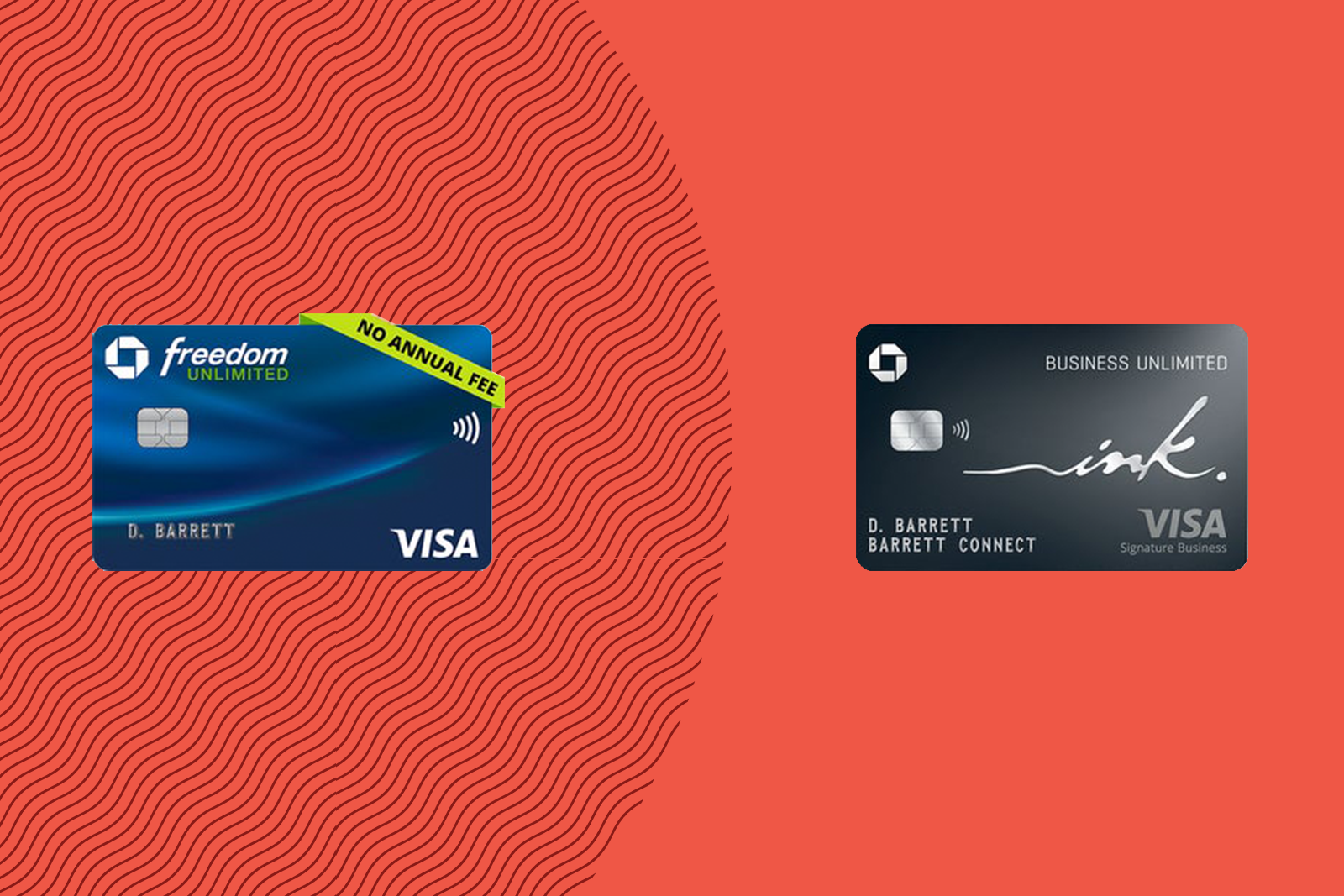
Ink Business Unlimited vs. Chase Freedom Unlimited showdown


If you’re looking into Chase’s lineup of credit cards, you may be checking out two of the issuer’s top cash-back options: the Chase Freedom Unlimited® (see rates and fees) and Ink Business Unlimited® Credit Card (see rates and fees).

These two cards share similar names and earn the same type of rewards, but there are many key differences to weigh. For one, the Freedom Unlimited is a personal credit card, while the Ink Business Unlimited is a business product.

So, if you’re considering both cards, you’ll want to be sure that you’re eligible for a business card first. You’ll also want to be under Chase’s 5/24 rule to be approved.

Now, let’s dive into these two cards and see which one is right for you.

Ink Business Unlimited vs. Freedom Unlimited comparison

Card Ink Business Unlimited Chase Freedom Unlimited 

Earn $750 bonus cash back after spending $6,000 on purchases within the first three months from account opening.

Earn a $250 bonus after spending $500 on purchases within the first three months from account opening.

$0

$0

  • 5% back on Lyft rides through Sept. 30, 2027
  • 1.5% back on everything else

  • 5% back on travel booked through Chase Travel℠
  • 3% back on dining at restaurants, including takeout and eligible delivery services
  • 3% back on drugstore purchases
  • 2% back on Lyft rides (through Sept. 30, 2027)
  • 1.5% back on everything else

3%

3%

  • Extended warranty
  • Free employee cards
  • Primary auto rental coverage
  • Purchase protection
  • Roadside assistance
  • Travel and emergency assistance services
  • Zero liability protection
  • Complimentary Instacart+ membership for three months

  • Extended warranty
  • Purchase protection
  • Secondary auto rental coverage
  • Travel and emergency assistance services
  • Trip cancellation and interruption insurance
  • Zero liability protection
  • Six months of complimentary DoorDash DashPass

Ink Business Unlimited vs. Freedom Unlimited welcome bonus

The Ink Business Unlimited provides a valuable welcome bonus to new cardholders. With this card, you can earn $750 bonus cash back after spending $6,000 on purchases within the first three months from account opening.

This is a solid offer, especially for a no-annual-fee card.
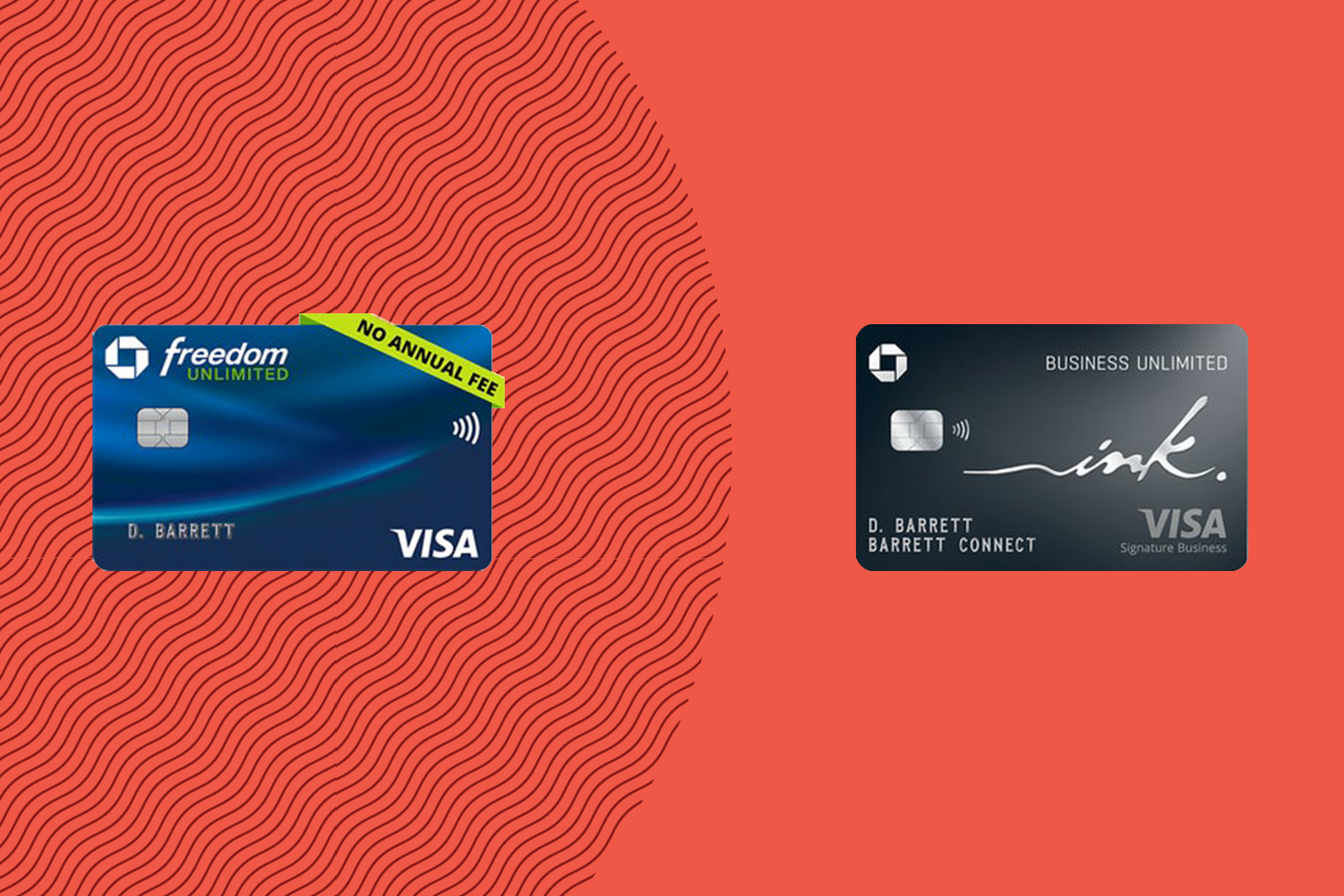
Chase Freedom Unlimited and Ink Business Unlimited side-by-side card art
THE POINTS GUY

Meanwhile, new Freedom Unlimited cardholders can earn a $250 bonus after spending $500 on purchases within the first three months from account opening. This bonus is one of the easiest to earn, since it requires a low minimum spending requirement.

Both welcome bonuses can be converted into Chase Ultimate Rewards points if you have the right card. I’ll get into more about that later in this showdown.

Winner: Ink Business Unlimited. Its welcome offer is more valuable, though it does come with a much higher minimum spending requirement than the Freedom Unlimited.

Reward your inbox with the TPG Daily newsletter

Join over 700,000 readers for breaking news, in-depth guides and exclusive deals from TPG’s experts

Related: The best time to apply for these popular Chase credit cards based on offer history

Ink Business Unlimited vs. Freedom Unlimited benefits

Since both the Ink Business Unlimited and the Freedom Unlimited charge no annual fee, neither card has a long list of additional benefits.

In fact, many of these cards’ perks are shared. This includes:

Still, there are some differences that could help you choose one card over the other.

First of all, the Freedom Unlimited does provide an extra perk that the Ink Business Unlimited does not: trip cancellation and interruption insurance. This benefit, which reimburses up to $1,500 per covered traveler and $6,000 per trip, covers travel expenses if your trip is canceled or cut short due to covered situations, such as sickness or severe weather.

I’ve had success using Chase’s trip cancellation and interruption insurance when I had to cancel a hotel stay after catching the flu.

Woman passenger with passport travel by air transportation. Woman friends taking off luggage from car trunk in Airport parking and walking to airline check in counter at airport terminal.
CANDYRETREIVER/GETTY IMAGES

However, the Ink Business Unlimited provides primary car rental insurance, which generally reimburses you for the rental car’s cash value or the cost to repair it (whichever is less) with the need to file only one claim.

The rental car coverage included with the Freedom Unlimited is secondary insurance, which means it kicks in second after other insurance and typically reimburses you for the amount not covered by your initial claim. For cardholders who frequently rent cars, you may want to opt for the Ink Business Unlimited.

The Ink Business Unlimited also provides a complimentary three-month Instacart+ membership (auto-renews at $99 a year after the complimentary period). Once this membership is activated, Instacart+ members receive a $20 Instacart credit each month (automatically loaded into your Instacart Business Account). This benefit ends Dec. 31, 2027.

Woman receiving groceries
DGLIMAGES/GETTY IMAGES

Meanwhile, the Freedom Unlimited provides six months of a complimentary DashPass membership (for both DoorDash and Caviar; auto-renews at the current monthly rate after the complimentary period). Activate by Dec. 31, 2027. DashPass members also receive up to $10 off each quarter on non-restaurant DoorDash orders through Dec. 31, 2027.

The Freedom Unlimited’s complimentary DashPass benefit lasts three months longer than the Ink Business Unlimited’s Instacart+ membership. But if you prefer Instacart+ to DashPass, that may be the better choice for you. It comes down to preference.

Winner: Freedom Unlimited. This is close, but since the Freedom Unlimited provides trip cancellation and interruption insurance, it pulls ahead of the Ink Business Unlimited.

Related: Why you might want to get a premium credit card instead of purchasing travel insurance

Earning cash back with the Ink Business Unlimited vs. Freedom Unlimited

Both the Ink Business Unlimited and the Freedom Unlimited share an elevated cash-back rate on nonbonus spending at 1.5% back.

The Ink Business Unlimited offers just one additional bonus category: 5% back on Lyft rides through Sept. 30, 2027.

Meanwhile, the Freedom Unlimited boasts three bonus categories: 5% back on travel booked through Chase Travel, 3% back on dining (including takeout and eligible delivery services), 3% back at drugstores and 2% back on Lyft rides (through Sept. 30, 2027).

AJ_WATT/GETTY IMAGES

TPG credit cards editor Olivia Mittak uses her Freedom Unlimited for any purchases that fall out of her cards’ bonus categories when she isn’t working toward a welcome bonus. She strives to earn more than 1 point per dollar spent or 1% back on as many purchases as possible, and the Freedom Unlimited goes a long way toward helping her achieve that.

The Freeeom Unlimited provides many more bonus categories than the Ink Business Unlimited, so if you’ll be spending often on Chase Travel bookings, dining or drugstores, that could push it ahead.

However, if you’re putting a lot of spend on Lyft, the Ink Business Unlimited wins over the Freedom Unlimited, since it earns 5% back instead of 2% back on rides (through Sept. 30, 2027). Since they share a 1.5% cash-back rate on all nonbonus spending, these are the biggest differentiators.

Winner: Freedom Unlimited. The card provides more elevated bonus categories than the Ink Business Unlimited.

Related: The unique bonus categories built for businesses (and the cards that offer them)

Redeeming cash back with the Ink Business Unlimited vs. Freedom Unlimited

The rewards you earn with either the Ink Business Unlimited or the Freedom Unlimited can be redeemed for cash back, goods and services offered through Chase’s rewards program, gift cards and travel.

Cash-back redemptions can be received as a statement credit, a mailed check or an electronic deposit.

Young mixed race couple using on a laptop sitting on a bed in a cabin of a vintage sailing boat
JORDI SALAS/GETTY IMAGES

If you want to keep things simple, it’s recommended to redeem for cash back rather than use the other flat-rate options.

However, you’ll get much more value if you convert your cash back to Chase Ultimate Rewards points.

Winner: Tie. These cards offer the same redemption options.

Related: The pros and cons of cash-back credit cards

Transferring cash back with the Ink Business Unlimited vs. Freedom Unlimited

You can unlock much more value out of the rewards earned with the Ink Business Unlimited and the Freedom Unlimited by transferring them from either card to a full-fledged Ultimate Rewards personal or business card.

Examples include the Chase Sapphire Preferred® Card (see rates and fees), Chase Sapphire Reserve® (see rates and fees) and Ink Business Preferred® Credit Card (see rates and fees).

Handsome man traveling by city train, scrolling on a smartphone. Man heading home after a long day at work. The single man commutes alone. Single man using dating app.
HALFPOINT IMAGES/GETTY IMAGES

If you go this route, you can boost your redemption rate on everyday spending to an effective return of at least 3%, per TPG’s April 2026 valuations.

Once you transfer your rewards to an Ultimate Rewards account, you can transfer them to one of Chase’s valuable airline and hotel partners. Olivia sends her Freedom Unlimited rewards to her Sapphire Preferred account so she can then transfer them to one of her favorite loyalty programs, World of Hyatt.

You could also choose to book directly through Chase Travel at a fixed value per point, depending on the card you hold (see your card’s guide to benefits for full details).

Winner: Tie. The options here are also identical.

Related: 10 best ways to redeem 200,000 Chase Ultimate Rewards points

Should I get the Ink Business Unlimited or Freedom Unlimited?

I see the personal Freedom Unlimited coming out on top for most cardholders since it provides more bonus categories and slightly better benefits than the Ink Business Unlimited.

Even still, I recommend the Ink Business Unlimited for business owners who want to earn 1.5% back on their everyday spending. This business card provides a highly valuable welcome bonus to those who can meet its spending requirement.

Related: How to pick a strategy for your small-business credit cards

Bottom line

Either one of these cards can be a stellar addition to your rewards card strategy. This is because both the Ink Business Unlimited and the Freedom Unlimited earn at least 1.5% back on all purchases, with no annual fee.

You’re going to get the most value out of these cards if you pair them with an Ultimate Rewards-earning card, since that unlocks the ability to convert your rewards into highly valuable Chase points.

To learn more, read our full reviews of the Ink Business Unlimited and Freedom Unlimited.


Apply here: Ink Business Unlimited

Apply here: Chase Freedom Unlimited


Source link

Leave a Reply

Subscribe to Our Newsletter

Get our latest articles delivered straight to your inbox. No spam, we promise.

Recent Reviews


Last updated on
Jun 12, 2024

SQLite vs PostgreSQL – Table of Content

What is SQLite? 

SQLite is an auto, file-based, and completely open-source relational database management system (RDBMS) that is noted because of its mobility, reliability, and excellent performance even when in low-memory applications. Even if the system fails or there is a power outage, its transactions are ACID-compliant. The SQLite project touts itself as a “serverless” database on its website. Typical relational database systems are deployed as a server process, with programs communicating with the host server via interprocess communication. SQLite, on the other hand, enables any system that utilizes the databases to read and write directly to the database disc file. This makes it easier to set up SQLite because it eliminates the requirement to set up a server process. Similarly, apps using the SQLite database don’t need to be configured; everything they need is to access.

What is PostgreSQL? 

PostgreSQL, or Postgres, describes itself as “the world’s most sophisticated open-source relational database.” It was built with the intention of being highly expandable and consistent with industry standards. PostgreSQL is indeed an object-relational database, which means that while it’s essentially a relational database, it also has features that are more commonly associated with object databases, such as table inheritance and feature overloading. Concurrency is a feature of Postgres that allows it to efficiently handle numerous processes at the same time. It does so without using read locks because it uses Multiversion Concurrency Control (MVCC), maintains the synchronization, coherence, exclusivity, and durability of its transactions, often known as ACID compliance. Although PostgreSQL isn’t as popular as MySQL, it still has a variety of third-party libraries and tools, such as pgAdmin and Postbird, that make dealing with it easier.

Take your career to next level in PostgreSQL with HKR. Join PostgreSQL online training now

Difference between SQLite and PostgreSQL

However both SQLite & PostgreSQL are available as open Relational Database Management Systems (RDBMS), there may be a few distinctions to consider when picking which one to utilize for your company. The following are the significant distinctions that influence the SQLite vs. PostgreSQL decision:

Database Model
  • SQLite is indeed an embedded database management system. This means it’s a Serverless DBMS that can be used within your apps.
  • To set up and run across a network, the PostgreSQL DBMS uses a Client-Server Model thus needs a Database Server.
Setup Size
  • SQLite is much smaller than PostgreSQL, with a data size of less than 500KB. Its installation files are over 200MB in size.
Data Types Supported
  • INTEGER, NULL, BLOB, TEXT, & REAL are the only data types supported by SQLite. In SQLite, the phrases “data type” and “storage class” are interchangeable.
  • PostgreSQL, on either hand, can store almost any type of information that you could need to put in your database. This could be an INTEGER,  CHARACTER, SERIAL, VARIABLE, or something else entirely.

PostgreSQL Training

  • Master Your Craft
  • Lifetime LMS & Faculty Access
  • 24/7 online expert support
  • Real-world & Project Based Learning
Portability
  • SQLite keeps its database as a single conventional disc file that may be found anywhere in the directory. The file is also saved in a cross-platform form, making copying and moving it a breeze. SQLite is among the most transportable Relational Database Management Systems because of this (RDBMS). PostgreSQL, on either hand, is only portable when the database is exported to something like a file and afterward uploaded to a server. It can be a time-consuming task.
Multiple Access
  • When this comes to user management, SQLite falls short. This also misses the capacity to control several users accessing the system at the same time.
  • PostgreSQL is excellent at managing users. It provides well-defined authorizations for users, which decide which database actions they are allowed to do. It can also support numerous users accessing the system at the same time.
Functionality 
  • Because SQLite is indeed a simple database management system, it includes basic capabilities that are appropriate for all sorts of users. PostgreSQL, on either hand, is a sophisticated database management system with a wide range of capabilities. As a result, users can accomplish a lot more using PostgreSQL than they can with SQLite.
Speed
  • SQLite is quick given the fact that this is a lightweight database management system having simple operations and a minimalist design.
  • PostgreSQL might not have been the best database for quick read queries. This is due to its sophisticated design as well as the reality that this is a large database management system. It is, nevertheless, a robust database management system for conducting complex processes.
Security Features 
  • Authentication is not included with SQLite. Anyone with database access has the capacity to read and modify the database file. It renders it inefficient for storing sensitive and private information. Many security features come included with PostgreSQL. It also necessitates extensive configurations from its users in order for it to be secure. As a result, PostgreSQL is a secure database management system for storing private and sensitive information.
HKR Trainings Logo

Subscribe to our YouTube channel to get new updates..!

Features of SQLite 

  • Small footprint: The SQLite module is quite light, as its name implies. Although the amount of space it takes up fluctuates based on the system on which it is installed, it can be less than 600KiB. Additionally, SQLite is completely self-contained, which means you don’t need to install any extra dependencies for it to work.
  • SQLite is known for being a “zero-configuration” database that is ready to use right out of the box. SQLite doesn’t operate as just a server process, so it doesn’t need to be halted, restarted, or resumed, and it doesn’t arrive with just about any configuration files to handle. These capabilities make the process of installing SQLite and incorporating this with an app much easier.
  • SQLite is an excellent database choice for embedded applications that require portability but do not require future expansion. Single-user local apps, mobile applications, and games are examples.
  • A whole SQLite database is kept in a single file, unlike many other database systems, that often store data as a vast batch of distinct files. This file could be transferred through external devices and file transfer protocol and can be found everywhere in a directory structure.
  • Testing: Using a DBMS that utilizes a dedicated servers process to test the functionality of multiple applications can be excessive. SQLite features an in-memory mode that allows you to run tests rapidly without having to worry about the expense of entire database transactions, making it an excellent choice for testing.
  • SQLite can be used as a disc access alternative in circumstances in which an app wants to study and modify files to disc directly. This is because SQLite has more capability and is simpler to use.

Features of PostgreSQL

  • PostgreSQL, more than SQLite, strives to follow SQL standards to the letter. PostgreSQL offers 160 of the 179 characteristics needed for proper core SQL:2011 compliance, as well as a vast range of optional capabilities, as per the authorized PostgreSQL documentation.
  • Community-driven and open-source: The source code for PostgreSQL is created by a huge and dedicated community as a fully open-source project. Likewise, the Postgres society preserves and provides a number of online resources that explain how to use the database management system, such as the official paperwork, the PostgreSQL website, and several online forums.
  • Extensible: PostgreSQL’s catalog-driven operation and dynamic loading allow users to enhance it dynamically and on the fly. An object code file, including a shared library, can be designated.
  • Data consistency is critical: PostgreSQL has indeed been completely ACID-compliant from 2001 and uses multi-version monetary control to guarantee data consistency, making it an excellent option of RDBMS where data consistency is crucial.
  • PostgreSQL is interoperable with a wide range of computing languages and systems. This means that migrating your database to a different operating system or integrating it with a specific tool will be simpler with such a PostgreSQL database compared with some other database management system.
  • Complex operations: Postgres provides query strategies that make use of several CPUs to speed up query processing. This, together with its extensive support for numerous simultaneous writers, makes it an excellent candidate for data warehousing and other complex tasks.

Click here to get latest PostgreSQL interview questions and answers

PostgreSQL Training

Weekday / Weekend Batches

Conclusion

SQLite and PostgreSQL,  are the most widely used open-source relational database management platforms today. It has its own set of characteristics and limits and shines in specific situations. When choosing an RDBMS, there are many factors to consider, and the decision is rarely as straightforward as selecting the quickest or most feature-rich option. If you require a relational database system in the future, do some study on these and other technologies to identify the one that best fits your needs.

Related Article:


Source link