
What is agile PLM?
Agile PLM is a product lifecycle management process that performs and drives a solution to the businesses that manage the value product chains. Hence, it is a business management solution that allows the cross-functional groups to work together, work-related by utilizing an integrated framework and product knowledge insights.
Agile product life cycle management allows accelerating the product development and introduction, leading to the improvement of the sales and reduction in innovation cost, etc. In this process, it will enable the quality information and issues to be visible to all the stakeholders in a product life cycle from product development through the end of life.
It helps in collaboration with suppliers and allows them to manage the sourcing relationships and data exchange among the different supplier networks. It is also responsible for managing the experimental formulations and enhancing compliance and quality which is an important aspect that is focussed by the client to the organization.
Learn new & advanced Architectures in Agile PLM with hkr’s Agile PLM Online Training !
Agile PLM modules
Agile PLM includes a new module that would help in performing the operations related to the business requirements. Let us have a quick review of the modules in product lifecycle management.
Agile Product collaboration (PC):
The agile product collaboration module is an application from the oracle that is involved in providing the visibility, collaboration, and management of ever-changing product record information of the Enterprise. This happens across the life cycle and is also providing the flexibility to extend the chain.
Agile Product cost management (PCM):
Agile product cost management is a module that provides cooperative solutions to the enterprise that mixes the supplier’s specific value and risk knowledge. It helps you in gaining a full, integrated, and product lifecycle that provides the analysis and regulation of the processes to minimize the risk and value.
Agile product quality management (PQM):
The Agile product quality management that provides you with a Cooperative atmosphere, a powerful solution that would help you in tracing the records. It also gives you the combination of the information associated with their product quality inside the record.
Agile product portfolio management
Agile product portfolio management will help in managing the deals related to the portfolio and also acts as the centralized management of the processes, technologies, methods to research and put together. It also helps in associated a long-term approach to managing the client portfolio of assets.
Agile engineering collaboration:
The Agile engineering collaboration module provides flexibility to perform visual and substantial interaction with the different tools accustomed to the model and derive the product creation. It also allows the transfer of information from the authoring tools, the agile which generate the visual representation of the components involved.
Agile PLM application Analytics (BI):
The Agile application Analytics is involved in query language for the dashboards from the multidimensional schema. The information obtained from mds schema is sourced from the Agile Product life cycle management.
Agile Enterprise visualisation (EV):
The enterprise visualization solution will help in delivering the best in class documents and CAD visualization and collaboration capabilities. It helps in making precise decisions across the product life cycle using visualization solutions.
Become a Enovia Training Certified professional by learning this HKR Enovia Training !

Agile PLM Training
- Master Your Craft
- Lifetime LMS & Faculty Access
- 24/7 online expert support
- Real-world & Project Based Learning
Principles of Agile PLM
There are some set of principles that will help in performing agile testing. The essential principles are listed below:
1.Client satisfaction
2. A massive free clean mode
3. Teamwork between the developers and the business folks.
4. Face to face conversation is recommended.
5. Customers welcome the changes and improvements.
6. Focusses on essence rather than documentation.
7. Promotion of sustainable development

Subscribe to our YouTube channel to get new updates..!
Agile PLM Metrics
Velocity: Velocity is the attribute measured by adding all the estimates of the stories that are approved. This is one of the crucial attributes that give you a clear idea about the progress, capacity, and keeps track of the different aspects.
Work strategy allocation: This attribute gives you a clear idea of the aspect or where exactly you are investing your time and also about the priority of your work.
Defect removal awareness: This attribute allows active members to produce quality products.
Cumulative flow diagram: It allows you to check the uniform workflow, which is represented in the form of a diagram. In the graphical representation, the X-axis represents time, and the Y-axis represents the number of efforts.
Sprint burndown metric: The sprint burndown metric helps in keeping track of the work done with the sprint.
Business value delivered: This is an attribute that is related to the work efficiency of the team involved in the work assigned. It helps in measuring the efficiency and work done with 100 percent as a total mark associated with every project.
If you have any doubts on Agile PLM, then get them clarified from Agile PLM Industry experts on our Agile PLM Community!
Time coverage: The time coverage is referred to as the amount of time given to the code during the testing phase. The time coverage attribute is measured based on the number of lines of code in a ratio format, by the number of relative lines of code.
Defect resolution rate: Defect resolution time is the term that is related to the process in which the team members detect the errors, bugs, and fix them.varCourseName}
Weekday / Weekend Batches
Conclusion
The Agile PLM platform is flexible in all environments providing its extensive support to many industries. It is designed and developed with the modules that are responsible for performing their functionalities, providing efficiency to the business organizations in meeting the client requirements. It has paved the way for more innovations in different industries, allowing us to make precise decisions. I hope the above information is helpful. I would recommend you to get trained and certified in agile, which is one of the booming careers these days.
Agile Tutorial
Revolution of Agile:
In recent years, there is a revolution that started for the creation of new software products. This revolution driving both software developments and software testing industries to the peaks. The new way of software revolution is called “Agile”, as per version one’s state report, Agile is now used by 97% of software companies. The term “Agile” was developed in the year 2001 at the ski resort in Utah. In the 1970s only the Agile was originated when Dr. Winston W. Royce published the book, titled “managing the developments of the large software system”. In that book, he spilled the beans is that the development of software methodologies can be changed from the traditional way to assembling them into different integrated parts. In 1997, authors called Michael and Richard published a paper “How Microsoft builds software products”. This book explains how waterfall models are gradually losing their capacity because many top companies wanted to build better software products. All these reasons cause the development of a newer software methodology that is called “Agile”.
What is Agile?
Agile is nothing but one of the software testing methodologies, that approaches the development requirements and solutions. This can be performed through the collaboration of self-organizing, cross-platform usage, and also with their customers or end-users. Agile software was developed in the year February 17th, 2001 at the Utah software developers’ conference. Firstly they called it as “Manifesto for Agile Software developments” now we call it agile methodology. They have come up with 12 main principles of agile, to support cross-functional iterations. The main purpose to use Agile in the software development lifecycle is to support adaptive business planning, evolutionary product developments, an iterative approach towards the software, encourages the team to perform flexible changes, and delivery.
Why is agile so popular?
The following reasons behind agile popularity: Let me explain them one by one;
1. This agile method has a proven record of boosting the success rate of software testing projects
2. The agile method creates a unique work culture that helps to increase team morale.
3. As compared to other testing methodologies, the agile process is quick enough to adjust any changes requested by the end –client throughout the software development life cycle.
4. Agile methodology’s focus is not only on the time it takes to hit the target return on interest or ROI but also on producing quality software end products and make the customers happy.
5. Clients’ feedback throughout the development lifecycle helps the team to understand the exact principles.
Advantages of Agile methodology:
There are lots of advantages that make Agile the most popular model now a day. I would like to mention a few primary advantages of the agile model:
1. Agile model offers better product quality:
testing is integrated into the software life cycle with regular checkups and enabling product changes if they needed it.
2. Customer satisfaction is the highest priority:
The software product is involved in the process and this makes the customer part of the project.
3. Provides more control on the project:
This offers more transparency in the development and designs, short customer meetings, visibility of every step of the project during the software development life cycle.
4. Risk Reduction:
The risk of total failure and eliminated as there is a constant contract. There is the freedom to add new changes throughout the process and adapting them to client preferences.
5. Faster Return on Interest:
With the use of agile iteration, the features will be delivered soon; developers will be having benefits from the beginning to the complete project outcome.
Agile methodology in details:
Agile methodology in general uses the short project development life cycle to produce continual integration in software development. This methodological approach is mainly focused on delivering iterative and incremental services throughout the project development life cycle. Agile methodology reduces the risk in the project plan, requirement building, execution of the product, testing the product by breaking the big cycle into smaller segments. Then these small segments or the final products will be specified, developed, and testable in a maximum of three to four weekly cycles.

There are 5 types of agile methodology process available:
1. Evaluation of the process and current structure of the organizations:
This Agile methodology supports the mapping processes to determine the starting point and the actual state.
2. Process optimization and suggestion for improvements:
This agile methodology helps to optimize the processes with the right combination of technologies.
3. Helps in the designing of applications with the client:
We choose the technologies and review options with the client. The client is a part of the project from the very beginning and feedback is vital.
4. Application construction and implementations:
Enables weekly delivery of developments for the end-users to operate and request for change. It is IDEAL that the user is a part of the process of developments and testing.
5. Evaluation and Monitoring:
These determine the KPI’s, reports, and other matrices, per user. In order to monitor that the processing is working as agreed.
Important principles of Agile Methodologies:
There are 12 primary principles in agile methodology that explain the overall working structure of the software development lifecycle.
1. As Agile always focuses on customer satisfaction, that’s the highest priority and it can be achieved through faster and continuity on the product delivery.
2. This enables users to change the project environment at any stage of the software development lifecycle process to offer the clients standard advantages.
3. With the help of Agile methodology, any type of product or service can be delivered with higher frequencies.
4. Agile methodology helps the stakeholders and business developers to collaborate closely on a daily work basis.
5. Company’s team members and all the stakeholders will be motivated continuously for the optimal project or service outcome, while the company’s team members are provided with all the necessary fundamental tools and encouragement to work towards the final project goals or outcome.
6. Face-to-face meetings are considered to be the first efficient and effective source for any project success.
7. A final working service /product will be the ultimate measure of the project’s success.
8. Sustainable development environment will be available through the agile methodology process, thereby development team members and stakeholders will be able to maintain an ongoing pace and constant outcomes.
9. Agility is possible through the continuous focus on software technical excellence and proper project planning.
10. Simplicity is an essential part of the software development life cycle.
11. This makes self-organizing business teams develop the best project architecture and design ever.
12. Regular time intervals are used by the company’s team members to improve efficiency and optimization.
Realted Article SDLC vs Agile
Agile Software development lifecycle (SDLC):
Software development life cycle (SDLC):
This is called a blueprint while you developing any software product. SDLC mainly used to design, develop, and test high-level software products. The main aim of the software development life cycle is to develop high-level software products that fulfill the customer’s requirements and keep them happy.
Agile software development life cycle (ASDLC):
This software model is a combination of both iterative and incremental test process. The main purpose of this software model is to provide adaptability and also satisfying the end customers. With the help of the agile software development life cycle, you can break down the software products into smaller iterations. The below diagram will illustrate this model:

One advantage of using Agile SDLC is that customers can able to view the end result and check the process. The disadvantage of Agile SDLC is that, not an easy task to estimate resources and development cost.
The following are the important phases that will be done in Agile SDLC:
1. Gather requirements and analysis phase.
2. Requirement designing phase.
3. Construction and iteration phase.
4. Deployment phase.
5. Testing phase.
6. Feedback stage.
Let me explain each phase in detail:
1. Gathering of requirements and analysis phase:
In this phase, you should specify the requirements which are going to use in the software development process. With the help of this phase, you can estimate the economic feasibility and technical evaluation.
2. Requirement designing phase:
When you are done with the type of project that you are going to work on, now you have to work with stakeholders and define the requirements. Here you can make use of flow diagrams and UML diagrams to show your work to the business team.
3. Construction or iteration phase:
When the software team defines the requirements, then the actual work begins. Next, the designers and developers start working on their project. This product goes through various stages include simple or minimal functionality.
4. Deployment phase:
In this phase of the software development life cycle, the team will issue product details for the users working environment.
5. Testing phase:
This phase will be carried by quality assurance team members to check the software product performance and find out any bugs.
6. Feedback:
After the release of any software product, feedback is the last step. In this step, the software team will receive feedback about the works and final product via their feedbacks.

Agile SDLC process flow:
a. Concept: here the software projects are prioritized and imagined.
b. Inception: in this stage, the organization will decide the team members, funding also done in this stage, and requirements will be discussed.
c. Iteration/ construction: here the development team works to deliver an effective product. This is done on the basis of requirements gathering and customer feedback.
d. Release version: team will perform quality assurance testing (QA), internal and external training, developing proper documentation, and the final version of the product release.
e. production: This offers ongoing support of the software.
Advantages of Agile SDLC:
1. In this lifecycle, the project will be divided into short and smaller iterations.
2. This offers a flexible change process.
3. This also reduces the risk of software developments.
4. Helps in the quick release of the product version.
5. With the help of the software development life cycle, the correctness of requirements will be implemented into the development process.
6. Customer can see the final outcome, and verification is also done here.
Disadvantages of Agile SDLC:
1. The software development team should be high-level professionals and client-based.
2. New requirements will affect the already existing architecture.
3. If there are any small changes or corrections, there may be chances that the project will cross the estimated time.
4. There may be difficult to estimate the final cost of the project.
5. A specified requirement is absent in SDLC.
Agile project management:
Agile project management is interactive to manage your software development requirements. This type of agile project management always focuses on releases and customer feedback.
Agile project management can be divided into two frameworks they are;
1. Agile Scrum
2. Agile Kanban
The Agile Scrum framework only focused on fixing the project iterations, whereas the Kanban framework focuses on continuous releases.
How agile project management works:
The Agile project management team helps teams to regularly check the cost and time. Here team members can make use of velocity, burn up and burn down charts, used to measure their works, and project milestones to track the process. The agile team members practice the continuous developments and integrations using various technologies that will automate the use of products and also quicken the product release. In this agile project management stage, project manager participation is not required. The role and responsibilities of a project manager are to distribute tasks among the team members. Many organizations use them for large and more complex project developments. The agile project management helps the team members to know their work in the agile methodologies.
Agile Scrum
Scrum is nothing but an agile framework used in the developments, delivery, and sustainable complex software products. This model also offers initial emphasis for software development lifecycle, and also the scrum model has been used in many applications such as research, sales and marketing, and also advanced business technologies. In simple terms, it can be defined as a subset of the agile model and the most widely used process framework. Scrum was first introduced by Jeff Sutherland and Ken Schwaber in the early 2000s.

The Framework:
As I said earlier, scrum and agile are not the same thing this is because, scrum model focuses only on continuous improvements, and scrum also a core foundation of agile methodology.
It’s time to learn Scrum Methodology in details:
The Scrum methodology is nothing but the overall process of the model, which explains the task or operations performed by the model.

Scrum methodology steps are as follows:
1. First, it will take the input from the customers, executives, team members, and stakeholders. The input data will then send to the respective product owner.
2. Product backlog: this contains information like features, stories, or product requirements.
3. Sprint planning meeting: this is done by team members, the team selects starting at the top as much as it can commit to delivering by the end of the sprint.
4. Product backlog refinement: This is nothing but asks breakouts.
5. These sprints backlog will be sent to Scrum master along with providing sprint end date team deliverable do not change.
6. Using burndown/up charts every 24 hours, it handles the daily scrum meeting, sprint customer reviews, working increment, and Sprint retrospective.
Sprints:
Sprints will come under the Scrum process; this is a type of product used to build a series of repetitions. The Sprint helps to break down the big complex projects into smaller size pieces. This scrum makes a project more manageable, high-quality shipments, and able users to work faster. The sprints offer more flexibility to adapt to the changes. In general, sprints are a short, time-boxed scrum period to finish the amount of work. The right amount of sprint helps the agile team to offer better software products. The below diagram illustrates the Sprints in detail:

Agile Kanban:
The term “Kanban” derived from the Japanese word. In Japanese Kanban usually stands for sign or billboard. They are used as a logo for a business purpose. Kanban is a technique from TPS and lean manufacturing used for software developments, IT, and Software. The Kanban is an agile method and takes away some lean development practices. To be more specific LKU Kanban moves away from IT and software development to focus on management methods and “evolutionary improvements”.

Kanban elements:
Kanban board is divided into five different elements. They are;
1. Visual signal
2. Columns
3. Commitment point
4. Delivery point
5. Work-in-progress limit
Let me explain them one by one;
a. Visual signals: The Kanban board is a type of visual card that is available in the form of Stickies or tickets. Kanban project team writes the project and project details into cards, usually per card/per person.
b. Columns: The columns usually represent the specific activities that will be used as a “workflow”. The workflow can be of types “to do”, “in progress”, and “complete”.
c. Work in progress limits: The work in progress limit is nothing but using the maximum number of cards in one column.
d. Commitment point: commitment team is nothing but maintaining the backlog for the board.
e. Delivery point: this is the endpoint of a Kanban workflow. The delivery point is used by a team when the product and service handed to the end customer.
Now it’s time to know the major differences between Agile and Scrum:
Agile:
1. Agile is a development methodology based on an iterative and incremental approach.
2. Agile software development has been widely seen as highly suited to environments which have small but expert project, development team.
3. In the agile process, leadership plays a vital role.
4. The biggest advantage of agile is its flexibility as it quickly reacts to changes.
Scrum:
1. Scrum is a subset of Agile methodology, in which incremental builds are delivered to the clients in every two to three weeks’ time.
2. Scrum is ideally used in a project where the requirements are rapidly changing.
3. Scrum fosters a self-organizing cross-functional team.
4. Compared to agile it is the more rapid method. So there is not much room for frequent changes.
Scaled Agile Framework (SAFe):
The scaled agile framework (SAFe) is a part of the Agile iteration method. This provides a freely proven knowledge base and also offers integrated business patterns for large scale enterprises. It is modular and higher scalable, allows each business organization to insert in a way that offers higher customer satisfaction, better business results, and engaged team members.
Scaled Agile framework adds the proper alignment, business collaborations, and proper time product delivery to the agile project teams. This framework also collaborates with software solutions and complex cyber network – physical systems, this collaboration requires a large number of employees to create, design, and maintain. The main moto of the Scaled agile framework is to solve customer’s most challenging and complex scaling issues.
Overview of Scaled Agile Framework (SAFe):
The scaled agile framework is mainly developed to solve the cust6omer complex and challenging scaling issues in large business enterprises. The below figure explains the architecture of the Scaled agile framework and its work nature.
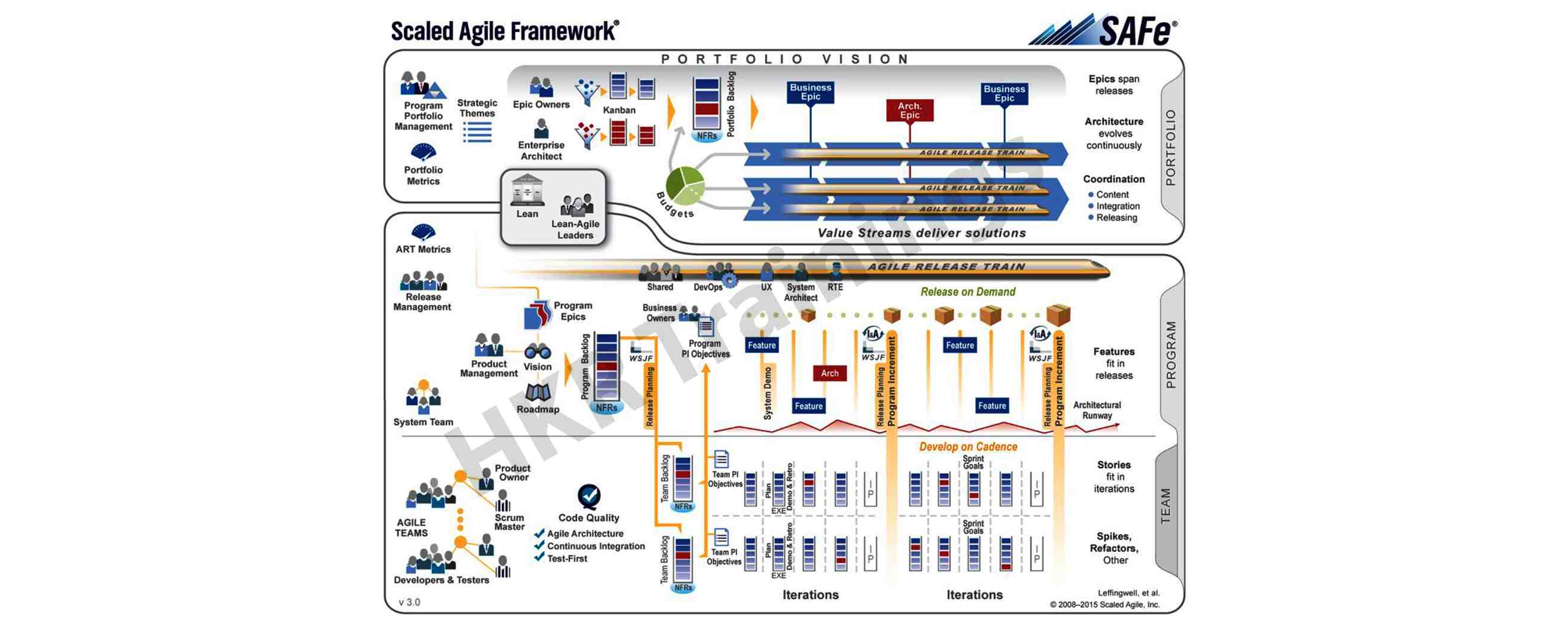
This level 4.0 big picture explains the visual overview of the scaled agile framework. Each icon in the big picture provides navigation and guidance to the customers.
.jpg)
The big picture of the scaled framework has two views:
1. The default three-level view: This provides the solution to the agile team in a modest way.
2. The four-level view: this view helps the customer to develop building large-scale solutions that involve a large number of team members to maintain, construct, and develop.
There are four organization levels or foundation levels available in the scaled agile framework (SAFe):
a. Team level: the scaled agile framework is based on agile team members; they are responsible for software-defined, product building, and software testing from their agile backlogs. This agile team can also work on scrum or Kanban iteration methods, checking of quality practices, and to deliver better product outcome.
b. Program level: the scaled agile framework teams are work based on a virtual program called “Agile Release train”. Each Agile release train is a long-lived and cross-functional self-organizing team of 10 to 20 agile teams, business stakeholders to plan, design, commit, adapt, and deliver the solution.
c. Value stream level: this value stream level provides the development of larger business and complex product solutions. This type of stream level needs multiple and synchronized agile release teams as well as a stronger focus on intent product and context of solutions.
d. Portfolio level: this agile release team involves in organizing and funding of value stream. The portfolio level provides the software development funding through Lean – agile cost, provides supportive governance, and value coordination.
e. Foundation layer: this foundation layer level holds additional elements that support designing and scaling. The elements may include are lean-agile leaders, agile communities, team core values, lean-agile principles that guide scaled agile framework, and an implementation strategy.
Agile daily stand-ups:
Agile daily stand-up we can also call it as a day-to-day meeting status on the project conducted by agile team members. These daily stand-up meetings are very important as you can discuss the project updates and problems of the team members. It focuses mainly on identifying the issue and tries to solve them quickly. The agile daily stand-up is the regular practice to know the status of your project regardless of the office location. The below diagram illustrates this;
Differences between agile and waterfall model:
We have come to the end of this tutorial. Now it’s time to know the major differences between agile and waterfall models:
Agile:
1. Agile takes an iterative approach that is derived from lean thinking and it allows changing the scope of the project.
2. Agile model works well when the project is unknown.
3. It allows changes to be made as it starts with a simple design that is derived into small modules.
4. Customer availability is so important throughout the project developments.
5. It provides flexibility to oversee the development project.
Waterfall:
1. Waterfall model approach to software development where a project is divided into different phases.
2. It works well when the scope of the project is known beforehand.
3. The contract teams won’t allow changes to be made as the process is sequential.
4. Customer availability is required only at the time of set milestones.
5. Flexibility is limited as products are based upon documented requirements.
Conclusion :
In this Agile tutorial, we have explained the overall methodologies, software development life cycle, Scaled agile frameworks, Kanban, and scrum. Learning this tutorial will help you to gain theoretical knowledge but to get some hands-on experience you must take any agile course. This tutorial is designed for both fresher as well as experienced professionals.

Stephan is the sports journalist for the Maple Grove Report.