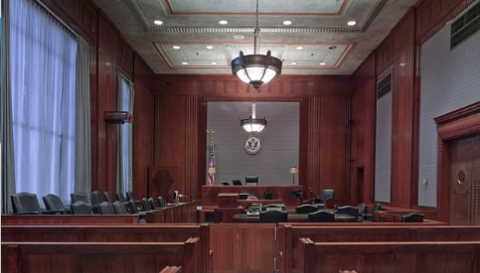


David Kluft asks: “Must a judge’s clerks, like Caesar’s Wife, be above suspicion?”
- “In a mass tort litigation involving a hotel fire in Puerto Rico and several phases of trial, both of the judge’s law clerks had brothers working as lawyers at firms representing plaintiffs (and one of the brothers had actually appeared in the case).”
- “This was not surprising because the case was so big that over 10% of the entire federal bar of Puerto Rico, and over half the large law firms in Puerto Rico, had appeared in it”
- “After two years of pretrial proceedings, and after the phase one trial, and six weeks into the phase two trial, some of the defendants moved to recuse the judge by arguing that the clerks’ relationship to their brothers created an appearance of bias.
- “The First Circuit affirmed denial of the motion, holding that it would not use the ‘Caesar’s Wife’ standard of ‘mere suspicion,’ which would make disqualification too easy to obtain for strategic reasons.”
- “Justice Breyer stated that the conflict here was ‘weak and remote,’ and even ‘assuming the family relationship raises a slight cloud, few knowledgeable people would expect that it would ordinarily cause most clerks to actually commit the serious ethical breach of seeking to influence a judge improperly.’ Additionally, Justice Breyer noted that the trial judge was fully capable of taking into account any potential bias by the clerks.”
- Decision: here.
“Firm Fights DQ Bid Against US Counsel In Chinese Arbitration” —
- “A Chinese law firm suing a Washington resident over unpaid arbitration bills has slammed an effort to disqualify its Seattle-based local counsel, saying that while one of its attorneys had worked at the law firm representing the woman, the attorney was entirely walled off from the case.”
- “Managing partner Zhizhou (Leo) Wang of Shanze Partners PLLC, the local counsel for arbitral award petitioner Beijing Dacheng Law Offices LLP, spoke with Bellevue, Washington, resident Yan Li’s lawyer last year in a call laying out all the arbitration issues, the Chinese law firm said in an opposition to the disqualification motion filed Monday.”
- “Wang informed Li’s lawyer at Harris Sliwoski LLP, Daniel Harris, in an Oct. 14 phone call that local attorney Emily Chen had never worked on the arbitration matter at Shanze Partners, had no access to the case file ‘and was walled off from the matter completely,’ according to the opposition.”
- “Whether Shanze Partners should be disqualified is not the real issue at stake, Beijing Dacheng said. Rather, it argued, Li’s motion seeks to delay resolution of the case and does not turn on ethics. After the Oct. 14 call, both Wang and Harris agreed the conflict was sufficiently addressed, and Harris chose not to seek relief from the court at that time, according to the brief.”
- “‘About six months passed, during which the court confirmed the arbitral award against [Yan Li],’ Beijing Dacheng alleged. ‘The court set a briefing schedule for entry of judgment. Respondent raised no issue. Then, on March 20, 2026, the very date respondent’s reply brief was due, respondent filed this motion seeking disqualification and a stay of all proceedings relating to entry of judgment.’”
- “The Chinese law firm added that Chen was merely a contractor attorney at Shanze Partners, where she worked on discrete tasks that had nothing to do with the Li arbitration matter. Shanze Partners and Li ‘parted ways’ three months before the motion to disqualify was even filed, the brief said.”
- “‘Disqualification is a drastic remedy, disfavored and subject to strict scrutiny, particularly when it is raised after significant delay,’ Beijing Dacheng argued. ‘Respondent sat on this issue for about half a year and raised it only when judgment was imminent. That delay alone warrants denial.’”
- “Li alleged in the March 20 disqualification motion that Shanze Partners should be taken off the case because Chen went to work for the American firm but didn’t disclose she had been involved in the arbitration case while working for Harris Sliwoski. While there, Li claimed, Chen was the lawyer who communicated ‘most directly and regularly’ with Li throughout the litigation over a petition to confirm a foreign arbitration award against her brought by Beijing Dacheng.”
- “Chen then ‘became affiliated’ with Shanze Partners, but didn’t disclose the affiliation to Li’s counsel at Harris Sliwoski, Li alleged. Also, Li said that based on Shanze Partners managing partner Wang’s account, Chen did not accurately disclose her involvement in the matter to Shanze Partners itself.”
- “In a March 20 declaration, Daniel Harris, Yi’s attorney, said Chen worked on the arbitration enforcement suit from the beginning and was ‘substantially’ involved in it during her time at the firm.”
- “‘Ms. Chen communicated directly and regularly with respondent and, because of language considerations, served as the primary point of contact between the firm and respondent throughout the representation,’ Harris said.”
- “He added that Chen was immediately fired by Harris Sliwoski on Oct. 2 after Harris learned about her affiliation with Shanze Partners by discovering her appearance on Shanze Partners’ website.”

Stephan is the sports journalist for the Maple Grove Report.