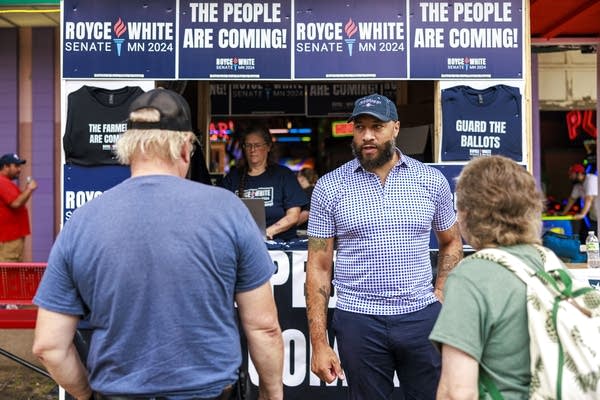

Republican U.S. Senate candidate Royce White is subject to a no-contact order after a Minnesota judge ruled there was credible evidence of threats of harm toward his ex-wife and one of two children they have together.
In court filings, White is accused of making numerous threats and being both physically and verbally abusive toward his former partner and their teenaged son. He refutes the allegations and is appealing judicial findings in the case, telling MPR News on Thursday the order is a “substantial miscarriage of justice” and “excessively punitive.”
White, a former professional basketball player who later became an online conservative activist, is running for the Senate for a second time. He was the GOP’s Senate nominee in 2024 but faces stiff party competition this time from former sports broadcaster Michele Tafoya, former Navy SEAL Adam Schwarze, past Republican Party Chair David Hann and others.
The protective order against White was granted by a judge on Feb. 17 after a preliminary order was issued in December. The order requires White to stay a quarter mile away from his ex-wife and their son, including at their home, her place of work and the boy’s school. The judge did not apply the restriction to White’s daughter because a burden of proof was not met to suggest abuse or imminent threats against her.
The order for protection is in effect for 50 years in relation to his former partner and two years for the son. It also requires White to attend domestic abuse programming, undergo a mental health evaluation and comply with treatment recommendations.
Hennepin County District Court Judge Kristen Marttila wrote that White’s ex-wife “is plainly in fear” of him and “appeared to the court to be utterly at a loss for how else to gain peace from him.”
The judge deemed the woman’s testimony “entirely credible” and added that “within the context of their history and ongoing interactions, petitioner's ongoing fear of physical harm from respondent is reasonable.”
MPR News typically does not name alleged victims without consent.
White challenges order, alleges bias
MPR News learned of the order involving White through a filing he made on April 16 with the Minnesota Court of Appeals, challenging the judge’s decisions in the case.
An appeals filing laying out White’s case contends the woman provided “no evidence of the date or specific occurrence” of physical abuse and said the judge declined to let White “rebut or argue against impressions or conclusions” that led to the no-contact order.
In an interview, White said his ex-wife “has a personal vendetta that has nothing to do with a real fear for her safety.”
He said there was no police report or evidence of physical abuse, and he said he never had an opportunity to provide witness testimony or video recordings on his behalf. White calls the accusations “overtly political.”
He said he has abided by the order nonetheless.
White is represented in the case by an attorney who was paid $15,000 between December and March through his Senate campaign. The White campaign had no prior legal expenses with the lawyer’s Minneapolis firm.
Days before the request for a protective order was lodged last year, White posted a long thread on the social media site X about his frustration with tensions involving his ex-wife. He blamed her and alleged bias in the court system for the situation.
“Increasingly the courts are being used to bully men out of fathering their children,” White wrote on Nov. 28. “When I say fathering I don’t mean material things, but being allowed to instill basic boundaries. Too often the personal battle in relationships gets weaponized through the children.”
Susan Yager, the attorney for White’s ex-wife, said when someone seeks an order for protection they don’t get money nor changes in child support determined. In an interview Thursday, Yager said this case is not politically motivated, but came after events in which White’s ex-wife was concerned about her children.
History of relationship conflict
White’s ex-wife had petitioned successfully for protective orders twice before, in 2014 and 2019.
White pleaded guilty in 2020 for violating the second order and was put on probation. He completed that probation and the case was dismissed.
With both the 2014 and 2019 protective orders, she subsequently moved to have them dissolved, saying the two were working through their issues in counseling and hoped to achieve a productive parenting relationship.
Yager, the ex-wife’s attorney, said that’s not rare in these cases.
“In general, it takes women seven times to leave a domestic violent relationship,” she said. “Usually the straw that breaks the camel's back is when the children are threatened.”
In a petition for the new order, his former partner described escalating confrontations with White. She also said she called police after he began showing up at her workplace unexpectedly and described how he was caught on a doorbell camera peering into her car windows when she was at a friend’s house.
“He appears to be tracking my movements, which causes me fear for my safety,” the woman described, including an accusation that White had accessed her social media accounts and changed her passwords.
While the couple divorced in 2015, they lived together from 2022 to August 2025, according to court documents.
In the order for protection, the judge pointed to testimony about an incident in which White was accused of grabbing and shoving his son into a metal basketball rack. The order said the alleged abuse occurred during a basketball practice at the boy’s school in Hopkins, where White had been a volunteer assistant coach.
White played his senior year of high school basketball for Hopkins High School before going on to play in college and a brief professional career in the NBA and leagues in Canada and Europe.
The boy called his mother immediately after the incident and sounded distraught, the records say.
“I didn’t beat my son. I didn’t leave any bruises or marks,” White said, explaining that he was exercising “firm discipline” as he confronted the boy about bad behavior.
Marttila wrote that the evidentiary standard for these orders was met, and she found that White committed domestic abuse against his son.
The judge said that White's ex-wife “credibly testified” that White “committed domestic abuse against petitioner on numerous, unspecified past occasions by slapping, grabbing or pulling the hair of petitioner.”
The judge also said she saw a photo which showed the woman with visible bruising on her upper left arm, and a swollen lip, which the woman said came from White slapping her.
The order also says that White showed up at his ex-wife’s home on the day former Minnesota House Speaker Melissa Hortman was fatally shot. White, who has run for office in Minnesota multiple times, conveyed his concern about the safety of her and their kids given that his involvement in politics makes him a public figure.
According to court documents, his ex-wife says White became angry when she didn't follow his instructions. She refused to go with him and said he became physical with her. The documents go on to say she ran up to a bathroom where their daughter was showering and locked herself in that room. He then left with their son.
According to the Minnetonka Police Department, there were 11 calls to service to the Minnetonka home between March 1, 2025 and Jan. 1, 2026.
White’s online response to his disagreements with his ex-wife includes his assertion that he should be able to discipline his son.
“I believe wholeheartedly that children should be disciplined when they are disrespectful or defiant. Especially if it is anything involving drugs,” White wrote on social media. “I’ve never ‘beaten’ my children, but I have had to physically grab my teenage son because of disrespect. I understand, kids and teens have these things come up, but for parents to be soft or passive in response sends a bad message.”
Campaign paying White lawyer
The court order comes as White is trying to gain ground in his race for U.S. Senate.
White said he is pressing forward in the campaign.
“There is no situation where I lay down and take things lightly, especially when they're lies about my about my character, about my parenting,” he said in a nearly 40-minute interview.
White, 35, was the GOP nominee against Democratic Sen. Amy Klobuchar in 2024. He was handily defeated but still got nearly 41 percent of the statewide vote.
So far in the 2026 race, White has received endorsements from some national Republican figures as well as Minnesota GOP gubernatorial candidate Mike Lindell. White and Lindell have held joint events as recently as this week.
The court case overlaps with his campaign in financial ways, too. According to campaign finance disclosures, White began paying attorney Lee Hutton III for “legal consulting” just days after the initial protective order request was filed. He has paid Hutton three $5,000 installments from Senate campaign funds. Hutton is representing White in the protective order case and the appeal.
White said he retained Hutton to be his campaign attorney, arguing that allegations toward him affect his bid for office.
“It's safe to assume that there are intentions aimed at your campaign,” White said. “And so we wanted him to tighten down the screws on the campaign from a legal standpoint.”
Hutton specializes in litigation involving clients in businesses, construction, employment law and sports and entertainment, according to his firm’s website. He has previously gained attention for representing professional and collegiate athletes.
White has faced prior scrutiny for his campaign spending. After an unsuccessful 2022 bid for Minnesota’s 5th Congressional District, he faced allegations of devoting thousands of dollars of campaign funds on personal items. Among them were expenses related to his visits to a strip club.
The Federal Election Commission pressed White to clarify the expenses. In 2024, he amended multiple 2022 campaign filings. White informed the FEC that he had personally reimbursed the campaign for expenses that were disallowed. He then moved to terminate the congressional campaign account, but as of this February the FEC was still seeking additional filings.