

New book tells of Minnesota's first Modern architect


A black and white photo with a woman pointing at drawings on a table, men in suits surround her looking at the table.

On a Minneapolis street, architectural historian Jane King Hession stands between a red-brick house and a boxy white one perched above Interstate 94.

Each is a Minnesota architectural landmark. The brick Malcolm Willey House was designed in the 1930s by a giant of 20th century architecture, Frank Lloyd Wright, and was a link between his early Prairie School-style of architecture and his later Usonian style.

Across the street is a white minimalist two-story house with a periwinkle blue driveway. The Faulkner House was built in 1938 and was the first home in Minneapolis designed in the International Style, a Modern architecture movement from Western Europe that prized function over form, clean lines over ornamentation and new industrial technologies and materials (glass, steel, concrete) over old ones.

The Faulkner House was designed by a lesser known but quietly influential architect, Elizabeth “Lisl” Scheu Close, who has been a muse for Hession for decades.

“What I would like people to know about Elizabeth Close is that she was a trailblazing Modern architect,” Hession said.


At the time, the Faulkner House would have been a “shock in the neighborhood,” Hession said, surrounded by century houses in Tudor and Colonial styles, ornamented with gables, shutters, window boxes and other decorative flourishes.

“Elizabeth Close was a very practical architect, and she was interested in designing a functional house,” Hession said. “She felt many houses had problems designed into them from the beginning, and she wanted to get rid of those when she designed her homes.”

Even the more Modern Wright-designed home was constructed in familiar red brick, while Close chose redwood siding and resin-bonded plywood.

“I like it simple and unpretentious and easy to take care of,” Close told MPR in a 2000 interview. “Maintenance is such a chore.”

Hession has been studying the work of Close, Minnesota’s first Modern architect, for decades, even conducting an oral history with the architect in 2000 for the Minnesota Historical Society. Close passed away at the age of 99 in 2011.

a photo of two women
Author Jane King Hession, left, with architect Elizabeth Scheu Close in 2003 at the Close-designed Hambridge House in Roseville, Minn. Close died at the age of 99 in 2011. "She didn't let anything stop her," Hession said.
Courtesy of Jane King Hession

“When I first met her, and I would say after my first session, it became really clear to me that this woman had an incredible life, an incredible career. Why didn't I know more about her?” Hession said. “I went to architecture school at the University of Minnesota. I don't recall her name ever being mentioned. So it became clear to me that her story needed to be told, and I wanted to be the one to tell it.”

This month, the University of Minnesota Press published Hession’s book “Elizabeth Scheu Close: A Life in Modern Architecture,” which features many of the more than 250 houses Close designed in Minnesota, as well as projects including hospitals, community centers, churches and Ferguson Hall, home to the music school at the University of Minnesota. In 2002, Close became the first woman in Minnesota history to win the Gold Medal from the state chapter of the American Institute of Architects, one of the highest honors in the field.

“There were no other architects like her,” Hession said. “She was not the first female architect in Minneapolis or Minnesota, but they were very, very few, and she quickly became one the most prominent female architects in the state.”

The cover of a book.
The paperback edition of "Elizabeth Scheu Close: A Life in Modern Architecture" by Minneapolis author Jane King Hession is out this month from the University of Minnesota Press.
Courtesy of University of Minnesota Press

The book came out in hardcover in March 2020, but the events surrounding the release, including an exhibit and lecture, were canceled because of COVID. With the release of the paperback, Hession is reviving a moment to celebrate and reflect on the legacy of Close, known to friends and family as “Lisl.”

Hession will give a free book talk at 6 p.m. on Wednesday, April 29, at the Elmer L. Andersen Library at the University of Minnesota. Hession also curated the exhibit on Close at the library, which is on view through May 22. (Hession also co-curated the 2025 exhibition “Making Room: Women’s Histories from the Northwest Architectural Archives” at the University of Minnesota)

“My mother would have been very pleased,” Roy Close, Close’s son, said of the book. “She was never doing it for the glory. It was that she wanted to be an architect, having seen the kind of impact that architecture could have on the people who lived in the homes.” He adds, “It meant a lot to her.”

The book is a deep dive into the life and career of Close, who was born in 1912 in Vienna, Austria, to a prominent Social Democratic family and grew up in a house designed by leading Modernist architect Adolf Loos, a residence similar to the Faulkner House with its geometric lines and stripped-down exterior. It was here that Close developed a passion for Modern architecture.

a painting of a modern house
A 1938 watercolor rendering by architect Elizabeth Scheu Close for the Cooperative Row House Project (which was never built).
Courtesy of Northwest Architectural Archives

“Lisl’s upbringing in Vienna was very interesting, because she was born into a very politically active family,” Hession said. “Among the things that her father, who was a lawyer, did was he was involved with providing housing for people in need after World War I, and there was great need for housing in Vienna and other parts of Europe at the time. So, she had this example of someone who saw architecture as a way to serve social needs and help people.”

Close began architecture studies in Vienna, but, at age 20, emigrated to the U.S. to study architecture at Massachusetts Institute of Technology, where she met her husband and fellow architect, Minnesotan Winston Close. In both Austria and the U.S., Close faced misogyny in the male-dominated field, with many firms refusing to hire her, but she persisted.

“She didn't let anything stop her. She didn't get angry, she didn't get even,” Hession said. “She just kept moving, and she just kept achieving her personal goals, and those goals were to design efficient architecture that serves the needs of the people living in it.”

“She took the attitude that she was an architect first and a woman second,” Roy Close said. “She expected to be treated professionally, and I think insisted on it.”


In 1936, Elizabeth and Winston Close moved to Minneapolis and by 1938, they had opened Close and Scheu, the first Minnesota architecture firm dedicated to Modern design. While Winston was also an advisory architect to the University of Minnesota, Close became the dominant force at the firm, designing more than 250 houses that reshaped how Minnesotans think about private residences.

Hession explains that Close’s legacy was working closely with clients to understand how to design a home that could work best for them, instead of imposing her design on them, which was a common practice for architects in the 20th century.

“When you design a house for someone, you get to know them really well, and inevitably you get to be friends,” Close said in the MPR interview.

“It wasn't really about style for her, it was about solving an architectural problem, and I think middle class Americans became more interested in living more freely in a house,” Hession said. “She wanted her architecture not to be a palace for someone to live in, but a functional space tailored to that person's needs that would support a well-lived life.”

Hession’s work on Close continues. She and Kimberly Long Loken, an associate professor at University of Wisconsin-Stout’s School of Art and Design, are working on a documentary about the architect that is set to come out in 2027.
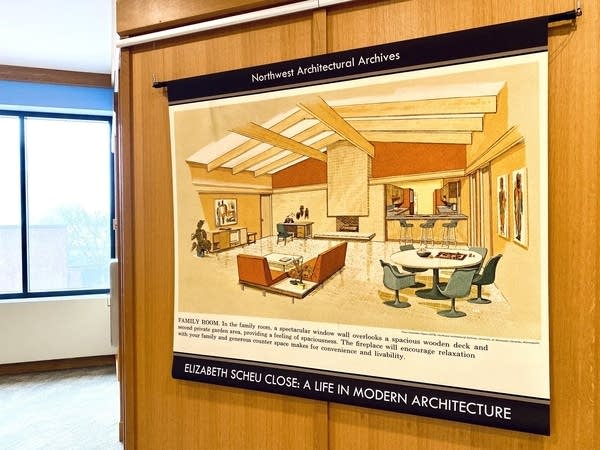
an exhibit poster hangs on a wall
Author Jane King Hession curated the Elizabeth Scheu Close exhibition at the University of Minnesota Anderson Library, which is on view through May 22.
Alex V. Cipolle | MPR News


Source link

Leave a Reply

Subscribe to Our Newsletter

Get our latest articles delivered straight to your inbox. No spam, we promise.

Recent Reviews


When taxpayers weave together various tax rules to produce a favorable outcome, the IRS will often cite various judicial doctrines to avoid the result or to unwind the transaction. This can include economic substance, the step transaction doctrine, etc. These doctrines allow the IRS to effectively reverse the tax treatment of transactions when multiple tax rules are read together to produce a favorable tax outcomes.

The IRS often engages in the very similar conduct with how it interprets and uses our tax laws. This often arises during IRS audits and in tax litigation when the IRS strategically applies multiple rules to produce a favorable outcome. This raises questions about fairness and the balance of power in tax disputes.

The IRS already has the upper hand in tax litigation–from the burden of proof being on the taxpayer to other presumptions that are IRS-favorable. Given these advantages, is it acceptable for the government to craft legal strategies that weave through various complex tax provisions during the course of the tax litigation after the IRS audit has closed or even during an IRS audit?

How far should the IRS be able to go in crafting a strategy that navigates through various tax laws to produce a higher amount of tax? How many steps should the IRS be allowed to take during the course of litigation or on audit? Should the IRS be able to make arguments that apply multiple steps or even take up alternative positions during audits or litigation? Should there be a judicial doctrine, similar to the ones that apply to taxpayers who engage in tax planning, that prevents the IRS from this type of multiple-step or multi-rule strategy?

The recent case of Scenic Trust v. Commissioner, T.C. Memo. 2024-85, provides an opportunity to consider these questions. This case involves a taxpayer who apparently reported all of their income, yet the IRS asserted fraud and developed a multi-step backup plan in the litigation to ensure that the IRS would succeed in increasing the amount of tax owed.

Facts & Procedural History

The case involves a taxpayer who owned a direct-mail subscription business. The business consisted of several related entities, including a trust (the taxpayer trust) and other legal entities.

For the tax years 2012 and 2013, tax returns were filed for the taxpayer, the trust, and related entities. The IRS subsequently initiated an audit of these returns. During the IRS audit, the taxpayer and related entities provided extensive records to the IRS, including:

  1. Organizational documents
  2. Accounting records (including QuickBooks files with general ledgers)
  3. Bank statements and records
  4. Tax returns for various related entities
  5. Balance sheets and receipts

The IRS auditor argued that some of the documents provided by the taxpayer to the IRS were altered or backdated. These included:

  1. A consulting agreement between two of the entities
  2. The trust’s trust agreement
  3. A private annuity agreement between the trust and the taxpayer
  4. Multiple versions of a unit purchase agreement between the trust and the taxpayer, with differing terms

More than three years after the filing of the tax returns for these periods (which is significant due to the general three-year statute of limitations for tax assessments under I.R.C. § 6501(a)), the IRS issued Notices of Deficiency to the taxpayer and the trust for 2012 and 2013. These notices asserted additional tax owed and imposed civil fraud penalties under I.R.C. § 6663.

The case eventually made its way to the U.S. Tax Court. The IRS attorney set a preliminary hearing with the court specifically on the question of whether the taxpayer’s 2013 return was signed by him or by someone authorized to sign on his behalf. This hearing resulted in a written court opinion (Parducci v. Commissioner, T.C. Memo. 2023-75) in which the tax court concluded that the 2013 return was not validly signed.

The tax court opinion we’re primarily discussing in this article is the subsequent decision that disposed of the remaining issues in the case. To fully understand the significance of this opinion and the IRS’s litigation strategy, we need to start with the rules governing tax assessments.

About the IRS Assessment Period

The tax assessment rules are set out in Section 6501 of the tax code. These rules provide a time period within which the IRS can determine and record additional tax liabilities for taxpayers. These rules define the temporal boundaries of the IRS’s authority to assess taxes. Put another way, these rules limit the time the IRS has to conduct an audit and to tell taxpayers that they owe more in taxes.

Section 6501(a) establishes the general rule: the IRS must assess tax within three years after a return is filed. This three-year period is designed to balance the IRS’s need for adequate time to investigate and audit returns with taxpayers’ right to finality and closure of their tax affairs.

Congress also enacted several exceptions to this general rule, allowing for extended assessment periods in specific circumstances. This includes rules for the following situations:

  1. Six-Year Period (Section 6501(e)): For substantial omissions of gross income (generally exceeding 25% of the amount stated in the return).
  2. Unlimited Period (Section 6501(c)):
    a. When no return is filed (Section 6501(c)(3)) (which does not apply to some taxes, and can apply if the taxpayer files the wrong tax form)
    b. In cases of tax fraud (Section 6501(c)(1))
    c. For willful attempts to evade tax (Section 6501(c)(2))

These exceptions are at the heart of the dispute in this case.

The IRS’s Multi-Step Arguments

In the case, the IRS issued its notice of deficiency after the standard three-year audit period had expired. To justify this late assessment, the IRS invoked the fraud exception, even going so far as to assert civil tax fraud penalties under Section 6663. So the IRS could prevail if it could show that the taxpayer committed tax fraud.

While fraud extends the statute and allows the IRS to conduct a late audit and make a late-assessment, so too would an unfiled tax return. So the IRS could also prevail by showing that there was an unfiled tax return.

But there was another factor at play in this case. The taxpayer had a loss from another business for this year. Thus, even if the IRS was to prevail on fraud or no return filed issues and the IRS was able to assess additional tax, the taxpayer could still use his unrelated tax loss to offset or minimize the amount of tax. So the IRS could also prevail by finding a way to argue that the tax loss was not allowable or useable. This brings us to the IRS’s multi-step arguments in this case.

The IRS’s Plan A: A Fraud Extension

The IRS’s first plan was to argue that the taxpayer committed tax fraud and therefore there was no limitation on the statute for assessing tax for 2012 or for 2013.

The tax court opinion addresses the rules for civil tax fraud. As noted by the tax court, to invoke the fraud exception and keep the assessment period open indefinitely, the IRS bears the burden of proving, by clear and convincing evidence, that the taxpayer filed a false or fraudulent return with intent to evade tax (Section 7454(a)). This is a higher standard than the usual preponderance of evidence required in civil tax cases (but the courts have also said that even the tax preparers fraud counts).

Courts have developed a set of “badges of fraud” as circumstantial evidence of fraudulent intent. These so-called “badges” include:

  1. Understating income
  2. Maintaining inadequate records
  3. Failing to file tax returns
  4. Giving implausible or inconsistent explanations
  5. Concealing assets
  6. Failing to cooperate with tax authorities
  7. Engaging in illegal activities
  8. Attempting to conceal illegal activities
  9. Dealing in cash
  10. Failing to make estimated tax payments

In this case, the tax court analyzed these factors. While the tax court noted that some factors were present, such as the taxpayer’s lack of credibility in testimony and an intent to mislead inferred from a pattern of conduct (particularly the presentation of altered documents), most factors were found to be neutral or weighing against a finding of fraud.

The tax court emphasized that the taxpayer had reported all of their income and cooperated with the IRS during the audit. This cooperation, combined with the absence of most badges of fraud, led the tax court to conclude that the IRS had not met its burden of proving fraud by clear and convincing evidence.

So the IRS’s Plan A failed. Likely in anticipation of this holding, the IRS had another plan in the works.

The IRS’s Plan B1: Unfiled Tax Return

Anticipating the possibility that fraud might not be established, the IRS had prepared a backup strategy involving the unfiled tax return rules.

While fraud extends the statute and allows the IRS to conduct a late audit and make a late-assessment, so too would an unfiled tax return. The IRS attorney set this very issue for a hearing with the court as to whether there was a tax return that was filed. This approach created what could be viewed as a win-win situation for the IRS:

  1. If the tax court found no valid return was filed, the IRS would have an unlimited period to assess tax for 2013 under Section 6501(c)(3).
  2. If the tax court found a return was filed but was fraudulent, the IRS would have an unlimited period to assess tax under Section 6501(c)(1).

The tax court considered this issue and determined that the taxpayer did not sign their 2013 tax return. As such, there was no tax return on file for this year. While this position avoided a finding of fraud for 2013, it also resulted in the IRS having an unlimited statute to assess additional tax for this period.

So the IRS’s Plan B1 worked.

The IRS’s Plan B2: Assignment of Income Rules

Perhaps envisioning that the tax court might not find fraud, but might find that there was an unfiled tax return, the IRS also added a tack on argument to its position. This argument involves the assignment of income doctrine.

This doctrine, rooted in the Supreme Court’s decision in Lucas v. Earl, 281 U.S. 111 (1930), holds that income is taxed to the person who earns it, regardless of who ultimately receives it. The doctrine prevents taxpayers from avoiding tax by assigning their income to other persons or entities. It has been expanded over the years to cover various scenarios, including:

  1. Anticipatory assignments of income
  2. Income from personal services
  3. Income from property

In this case, the IRS attorney argued that even if the assessment period had closed for the trust’s 2013 return as the trust filed its 2013 tax return, the income should have been reported by the individual taxpayer personally. Since the taxpayer hadn’t filed a valid 2013 return for himself (as determined in the tax court in its earlier decision in this case), the assessment period for 2013 remained open indefinitely and given the assignment of income doctrine, the income could be assessed against the taxpayer individually.

The tax court agreed with the IRS on this point. It applied the assignment of income doctrine to shift the income from the trust and entities to the individual taxpayer for the open 2013 year. The tax court based this decision on its finding that the taxpayer had full control over these entities, despite the formal ownership structures.

Thus, the IRS’s Plan B2 worked.

The IRS’s Plan B3: The Passive Activity Loss Rules

Perhaps envisioning that the tax court might not find fraud, but might find that there was an unfiled tax return and might agree with the IRS on its assignment of income argument, the IRS added another argument to its position. This one involved the passive activity loss rules.

As noted above, the taxpayer had a loss from an unrelated entity reported on his tax return. Thus, even if the IRS prevailed in the arguments above and the taxpayer’s tax increased, he would have been able to offset the tax increase with his existing and unrelated tax loss.

The passive activity loss rules generally say that one cannot offset certain passive losses with certain types of income from non-passive activities. This is set out in Section 469. Section 469 was intended to prevent taxpayers from using losses from passive activities (such as limited partnerships or rental activities) to offset non-passive income (such as wages or portfolio income). The IRS argued in this case that if income was shifted to the taxpayer’s personal return, his ability to offset this income with losses from related entities should be limited under the passive activity loss rules.

The IRS contended that the losses from the taxpayer’s related entities were subject to these passive activity loss limitations. To deduct these losses against the newly attributed income, the taxpayer would need to establish material participation in the activities.

The tax court agreed with the IRS on this point as well. The tax court found that the taxpayer failed to provide sufficient evidence of material participation in the related entities. This decision effectively increased the taxpayer’s taxable income for the open year by preventing him from offsetting the increased income (resulting from the assignment of income doctrine) with losses from other businesses that were reported on his tax return.

Thus, the IRS’s Plan B3 worked.

Takeaway

As in shown by this case, the IRS can often employ a series of interconnected arguments developed during the litigation process, each serving as a backup to the others, to find a path that results in the highest amount of tax due. This case shows how the IRS can use the tax litigation process to effectively do what taxpayers are barred from doing when they engage in tax planning. Had a taxpayer engaged in a transaction that charted a course through rules like this, the IRS would no doubt have tried to unwinde it using various judicial doctrines. There is no comparable judicial doctrine, such as a government step transaction doctrine, that applies to the IRS and how it chooses to litigate cases.

Watch Our Free On-Demand Webinar

In 40 minutes, we’ll teach you how to survive an IRS audit.

We’ll explain how the IRS conducts audits and how to manage and close the audit.  


Source link