New book tells of Minnesota's first Modern architect


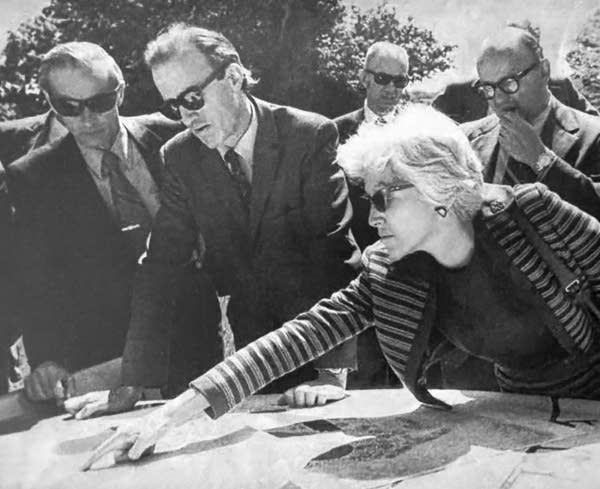
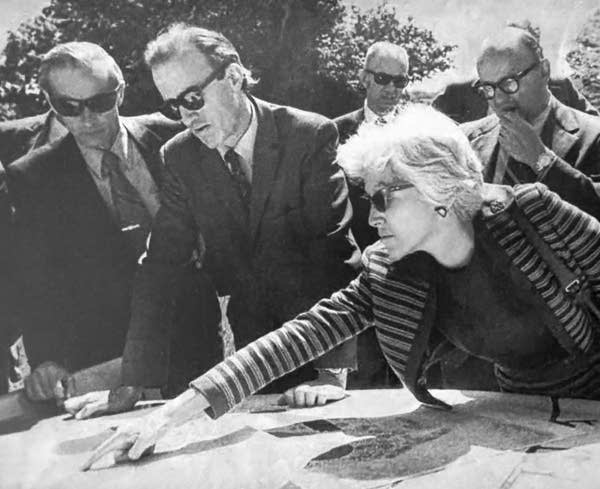
A black and white photo with a woman pointing at drawings on a table, men in suits surround her looking at the table.

On a Minneapolis street, architectural historian Jane King Hession stands between a red-brick house and a boxy white one perched above Interstate 94.

Each is a Minnesota architectural landmark. The brick Malcolm Willey House was designed in the 1930s by a giant of 20th century architecture, Frank Lloyd Wright, and was a link between his early Prairie School-style of architecture and his later Usonian style.

Across the street is a white minimalist two-story house with a periwinkle blue driveway. The Faulkner House was built in 1938 and was the first home in Minneapolis designed in the International Style, a Modern architecture movement from Western Europe that prized function over form, clean lines over ornamentation and new industrial technologies and materials (glass, steel, concrete) over old ones.

The Faulkner House was designed by a lesser known but quietly influential architect, Elizabeth “Lisl” Scheu Close, who has been a muse for Hession for decades.

“What I would like people to know about Elizabeth Close is that she was a trailblazing Modern architect,” Hession said.

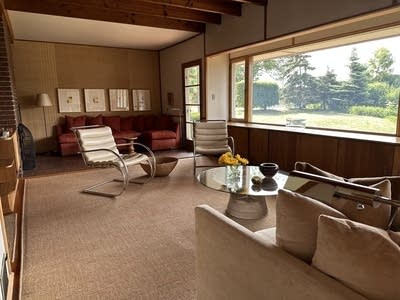
At the time, the Faulkner House would have been a “shock in the neighborhood,” Hession said, surrounded by century houses in Tudor and Colonial styles, ornamented with gables, shutters, window boxes and other decorative flourishes.

“Elizabeth Close was a very practical architect, and she was interested in designing a functional house,” Hession said. “She felt many houses had problems designed into them from the beginning, and she wanted to get rid of those when she designed her homes.”

Even the more Modern Wright-designed home was constructed in familiar red brick, while Close chose redwood siding and resin-bonded plywood.

“I like it simple and unpretentious and easy to take care of,” Close told MPR in a 2000 interview. “Maintenance is such a chore.”

Hession has been studying the work of Close, Minnesota’s first Modern architect, for decades, even conducting an oral history with the architect in 2000 for the Minnesota Historical Society. Close passed away at the age of 99 in 2011.
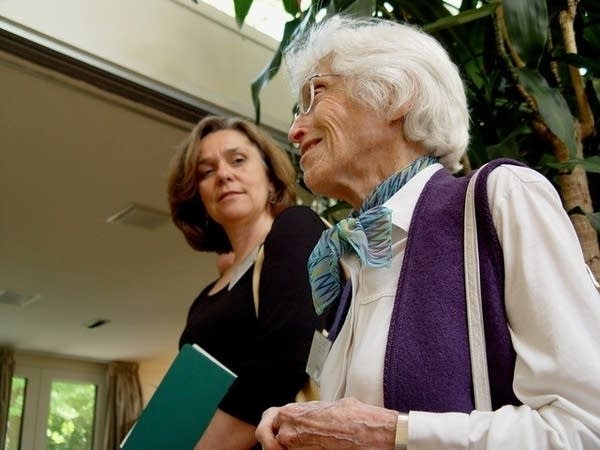
a photo of two women
Author Jane King Hession, left, with architect Elizabeth Scheu Close in 2003 at the Close-designed Hambridge House in Roseville, Minn. Close died at the age of 99 in 2011. "She didn't let anything stop her," Hession said.
Courtesy of Jane King Hession

“When I first met her, and I would say after my first session, it became really clear to me that this woman had an incredible life, an incredible career. Why didn't I know more about her?” Hession said. “I went to architecture school at the University of Minnesota. I don't recall her name ever being mentioned. So it became clear to me that her story needed to be told, and I wanted to be the one to tell it.”

This month, the University of Minnesota Press published Hession’s book “Elizabeth Scheu Close: A Life in Modern Architecture,” which features many of the more than 250 houses Close designed in Minnesota, as well as projects including hospitals, community centers, churches and Ferguson Hall, home to the music school at the University of Minnesota. In 2002, Close became the first woman in Minnesota history to win the Gold Medal from the state chapter of the American Institute of Architects, one of the highest honors in the field.

“There were no other architects like her,” Hession said. “She was not the first female architect in Minneapolis or Minnesota, but they were very, very few, and she quickly became one the most prominent female architects in the state.”
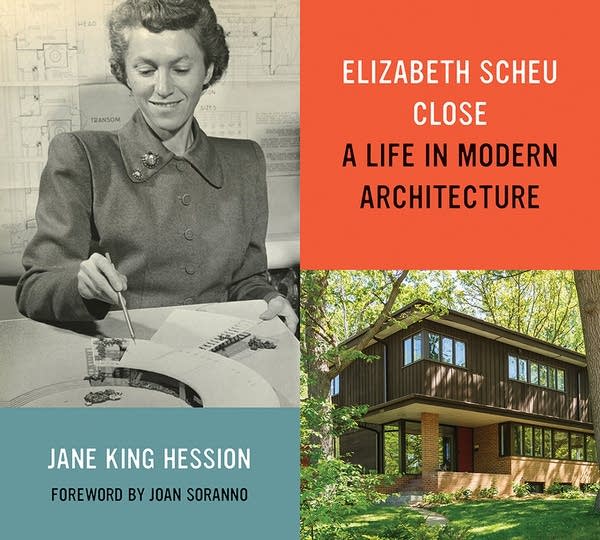
The cover of a book.
The paperback edition of "Elizabeth Scheu Close: A Life in Modern Architecture" by Minneapolis author Jane King Hession is out this month from the University of Minnesota Press.
Courtesy of University of Minnesota Press

The book came out in hardcover in March 2020, but the events surrounding the release, including an exhibit and lecture, were canceled because of COVID. With the release of the paperback, Hession is reviving a moment to celebrate and reflect on the legacy of Close, known to friends and family as “Lisl.”

Hession will give a free book talk at 6 p.m. on Wednesday, April 29, at the Elmer L. Andersen Library at the University of Minnesota. Hession also curated the exhibit on Close at the library, which is on view through May 22. (Hession also co-curated the 2025 exhibition “Making Room: Women’s Histories from the Northwest Architectural Archives” at the University of Minnesota)

“My mother would have been very pleased,” Roy Close, Close’s son, said of the book. “She was never doing it for the glory. It was that she wanted to be an architect, having seen the kind of impact that architecture could have on the people who lived in the homes.” He adds, “It meant a lot to her.”

The book is a deep dive into the life and career of Close, who was born in 1912 in Vienna, Austria, to a prominent Social Democratic family and grew up in a house designed by leading Modernist architect Adolf Loos, a residence similar to the Faulkner House with its geometric lines and stripped-down exterior. It was here that Close developed a passion for Modern architecture.
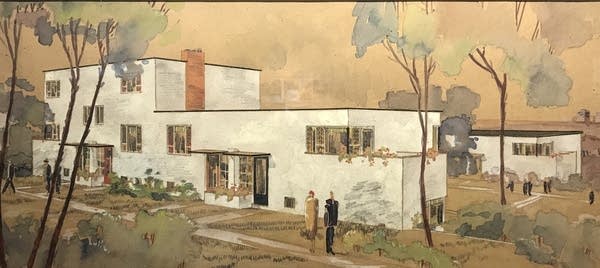
a painting of a modern house
A 1938 watercolor rendering by architect Elizabeth Scheu Close for the Cooperative Row House Project (which was never built).
Courtesy of Northwest Architectural Archives

“Lisl’s upbringing in Vienna was very interesting, because she was born into a very politically active family,” Hession said. “Among the things that her father, who was a lawyer, did was he was involved with providing housing for people in need after World War I, and there was great need for housing in Vienna and other parts of Europe at the time. So, she had this example of someone who saw architecture as a way to serve social needs and help people.”

Close began architecture studies in Vienna, but, at age 20, emigrated to the U.S. to study architecture at Massachusetts Institute of Technology, where she met her husband and fellow architect, Minnesotan Winston Close. In both Austria and the U.S., Close faced misogyny in the male-dominated field, with many firms refusing to hire her, but she persisted.

“She didn't let anything stop her. She didn't get angry, she didn't get even,” Hession said. “She just kept moving, and she just kept achieving her personal goals, and those goals were to design efficient architecture that serves the needs of the people living in it.”

“She took the attitude that she was an architect first and a woman second,” Roy Close said. “She expected to be treated professionally, and I think insisted on it.”

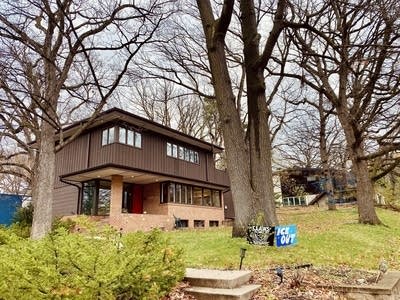
In 1936, Elizabeth and Winston Close moved to Minneapolis and by 1938, they had opened Close and Scheu, the first Minnesota architecture firm dedicated to Modern design. While Winston was also an advisory architect to the University of Minnesota, Close became the dominant force at the firm, designing more than 250 houses that reshaped how Minnesotans think about private residences.

Hession explains that Close’s legacy was working closely with clients to understand how to design a home that could work best for them, instead of imposing her design on them, which was a common practice for architects in the 20th century.

“When you design a house for someone, you get to know them really well, and inevitably you get to be friends,” Close said in the MPR interview.

“It wasn't really about style for her, it was about solving an architectural problem, and I think middle class Americans became more interested in living more freely in a house,” Hession said. “She wanted her architecture not to be a palace for someone to live in, but a functional space tailored to that person's needs that would support a well-lived life.”

Hession’s work on Close continues. She and Kimberly Long Loken, an associate professor at University of Wisconsin-Stout’s School of Art and Design, are working on a documentary about the architect that is set to come out in 2027.
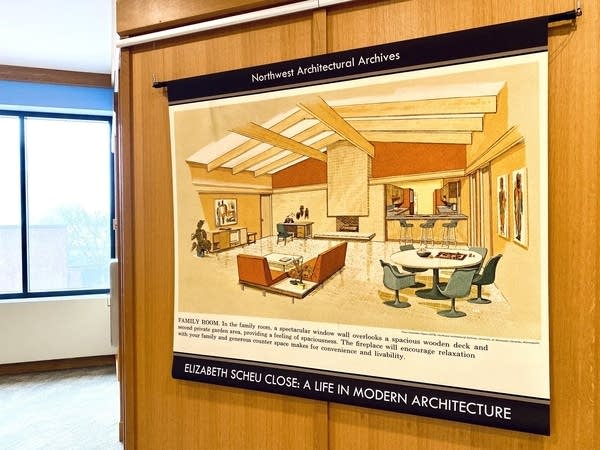
an exhibit poster hangs on a wall
Author Jane King Hession curated the Elizabeth Scheu Close exhibition at the University of Minnesota Anderson Library, which is on view through May 22.
Alex V. Cipolle | MPR News


Source link

Leave a Reply

Subscribe to Our Newsletter

Get our latest articles delivered straight to your inbox. No spam, we promise.

Recent Reviews


When someone sets up their estate plan, one would hope that the probate process would result in the terms of the estate plan being carried out. State law often allows beneficiaries and heirs to change the terms of someone’s estate plan after they die.

For example, in Texas, beneficiaries can usually agree to override the terms of a decedent’s will and distribute assets as they see fit. This is usually carried out using a family settlement agreement. The Texas Estates Code has been amended to include more liberal rules that allow trust beneficiaries to amend or reform the terms of trusts.

Even though state law allows for these post-mortem changes, the changes can have significant Federal tax consequences. The taxes can be significant and, in some cases, can result in the probate estate owing back taxes to the IRS. The recent McDougall v. Commissioner, 163 T.C. No. 5 provides an example. The case involves the termination of a trust by the trust beneficiaries after the trust settlor died. The termination triggered a massive gift tax liability.

Facts & Procedural History

The taxpayers in this case were a surviving spouse and his spouse’s adult children. The surviving spouse inherited an interest in a trust from his wife when she died. The interest he inherited was an income interest, so he was entitled to interest earned on the trust assets.

The children inherited remainder interests in the trust assets. These interests entitled the children to ownership of the trust assets when the surviving spouse died.

The surviving spouse was the executor of his wife’s estate. He made a QTIP election, which we’ll address below, which deferred the estate taxes that would have been due on the death of his spouse.

Several years later, the surviving spouse and children entered into an out-of-court agreement to terminate the trust and to distribute the assets to the surviving spouse. The taxpayers filed gift tax returns taking the position that there were two gifts, one from the surviving spouse on termination of the trust to children and then one from the children to transfer the assets to the surviving spouse. According to the taxpayers these transfers essentially offset each other and resulted in no gift tax due.

The IRS audited the gift tax returns, did not agree with the taxpayers reciprocal gift argument, and issued a statutory notice of deficiency. The dispute ended up in the U.S. Tax Court, which issued the tax court opinion that is the basis of this article.

About the QTIP Election

To understand this court case, we have to start with the QTIP election and the general concept for when the QTIP is used. QTIP elections typically involve trusts, so we’ll start with the QTIP trust.

A QTIP trust is one that holds some or all of the trust assets in trust for the surviving spouse. The surviving spouse has to be entitled to all of the income from the trust property and be paid at least annually. The trust also has to limit the power to appoint the property to anyone other than the surviving spouse during their lifetime.

This type of arrangement is often used to ensure that the income of the assets is used for the surviving spouse of the settlor, the person who set up the trust, with the remainder interest passing to the settlor’s children. This helps avoid a situation where assets are used for or transfered to the surviving spouse’s new spouse or the surviving spouse’s children from outside of the marriage. So second marriages and mixed families.

The QTIP election is an election made on the settlor’s estate tax return and is one of several estate tax planning considerations that one has to consider. It is similar to the GST election and tax planning in some ways. It is typically made on the estate tax return of the first spouse to die, which is usually due within 9 months of death (with a possible 6-month extension).

The election creates a legal fiction that the surviving spouse owns the trust assets when really they only have an income interest. This fiction allows the settlor’s estate to claim a 100% marital deduction for estate tax purposes. This marital deduction allows the trust assets to avoid estate tax on the death of the first spouse, which is usually not allowed when the surviving spouse does not actually have an ownership interest in the property in question and the settlor spouse retains control over who gets the property when the second spouse dies. This election and tax planning involving valuation discounts can often significantly reduce ones estate tax liability. Charitable trusts can be used for similar purposes too, if there is a charitable intent involved.

The QTIP trust is an easy way the first spouse to die can limit the surviving spouse’s ability to transfer or control the property while still qualifying for the marital deduction. Similar results can be obtained using a bypass or credit shelter trust. Other strategies usually leave the surviving spouse with some control over who gets the property on their death.

Gift Tax for the Surviving Spouse

The first question in this case was whether executing the settlement agreement to terminate the trust, the surviving spouse and children triggered a gift tax.

The U.S. Tax Court concluded that it did not, which it referenced its prior opinion in Estate of Anenberg v.
Commissioner
, No. 856-21, 162 T.C. (May 20, 2024) from earlier this year. The Estate of Anenberg stands for the proposition that a surviving spouse does not make a taxable gift when a QTIP trust is terminated and all its assets are distributed to the surviving spouse. This makes sense as the marital deduction is generally allowed when property passes to the surviving spouse and the estate tax is imposed when the surviving spouse dies.

The mechanics of the actual statutes are more complex than this. This is why the U.S. Tax Court had to analyze Section 2519 so closely, and then it just applied judicial reasoning instead of a close reading and application of Section 2519. In doing so, it concluded that the surviving spouse did not give away anything of value under Section 2519 and, alternatively, that there was an incomplete gift given that the surviving spouse ended up with the assets.

Thus, in applying these principles to the current case, the tax court concluded that the surviving spouse did not make a taxable gift when the residuary trust was terminated and its assets were distributed to him. This conclusion was reached despite the fact that the termination could be viewed as, and likely was, a disposition that should trigger gift tax under Section 2519.

Gift Tax for to the Children

The tax court then turned to the question of whether the termination of the residuary trust and transfer of the assets to the surviving spouse triggered a gift tax as to the children. The tax court concluded that it did.

The reasoning here is that the children had vested remainder interests in the trust property. They gave away the right to this property by allowing the property to be transferred to the surviving spouse. Thus, when viewed before and after the transfer, the children had a decrease in their net worth. They gave something up. The tax court concluded that this was sufficient to trigger a gift tax.

The tax court did not accept the taxpayer’s arguments about a reciprocal gift which negated any gift tax. The taxpayer’s argument was that the termination of the residuary trust resulted in a taxable gift for the surviving spouse. Then it also resulted in a taxable gift for the children for the transfer back to the surviving spouse. As noted above, the tax court held that the first part of this argument–the gift tax for the surviving spouse–was not a gift and therefore did not trigger a gift tax. Thus, there could be no offsetting gift. The tax court also stated that there was no such concept as a reciprocal gift in the law that can be used to offset gift taxes. It noted that there is a concept of reciprocal trusts, but that that concept does not apply here.

To provide context, we’ll briefly take a detour to discuss reciprocal trusts. The reciprocal trust doctrine is a legal principle that addresses situations where two individuals create similar trusts for each other’s benefit. This doctrine allows the IRS and courts to “uncross” or “unwind” trusts that are interrelated and leave the grantors in approximately the same economic position as they would have been if they had created trusts naming themselves as life beneficiaries. This is similar to the economic substance doctrine that allows the IRS and/or the courts to void certain business transactions. When the IRS and/or courts apply this reciprocal trust doctrine, the result is that the trust assets are included in the settlor’s taxable estate under Sections 2036 or 2038. Again, this is not what we had in this case, so it was not applicable here according to the tax court.

    The Takeaway

    It is getting more common for beneficiaries of trusts to modify and even terminate their trusts. This can trigger significant tax liabilities, as in this case. This case helps to explain when the gift tax applies when one termites a trust. A QTIP trust can be terminated and this will not necessarily trigger gift taxes for the surviving spouse. If the termination results in the children getting their fair share of the trust assets, that may also avoid gift taxes. But as in this case, if the termination results in the surviving spouse getting more than what they otherwise would, the termination will likely trigger a gift tax for the children for the transfer to the surviving spouse.

    Watch Our Free On-Demand Webinar

    In 40 minutes, we’ll teach you how to survive an IRS audit.

    We’ll explain how the IRS conducts audits and how to manage and close the audit.  


Source link