Even if you seldom (or never) fly with budget airlines like Spirit Airlines or Frontier Airlines, they’re important to you.
For years, ultra-low-cost carriers have been key players in keeping airfare lower across the industry. Without the competition they provide, it’s likely the big network airlines would charge more for tickets.
But does that make them worthy of billions of dollars in taxpayer-funded support?
The nation’s budget carriers last week asked the Trump administration to float them $2.5 billion to help pay for skyrocketing jet fuel costs.
Calling it a “necessary and targeted measure,” the Association of Value Airlines argued the pool of cash would help them “stabilize operations and keep airfares low.” The group represents Spirit, Frontier, Allegiant Air, Avelo and Sun Country Airlines.
Keeping the big airlines honest
Part of the reason these airlines say they deserve the cash infusion is because of their upstart role in the airline industry.
ALLEGIANT AIR
Roughly 3 in every 4 flights that took off in America last year were operated by American Airlines, Delta Air Lines, United Airlines and Southwest Airlines according to data from aviation analytics firm Cirium.
And historically speaking, the presence of carriers like Spirit and Frontier have brought down average fares in markets they serve.
Reward your inbox with the TPG Daily newsletter
Join over 700,000 readers for breaking news, in-depth guides and exclusive deals from TPG’s experts
Yes, that’s even despite the add-on fees they’ve long tacked onto their bare-bone fares — a double-edged sword that’s frustrated flyers for years (along with Spirit and Frontier’s longstanding ..0struggles with operational reliability).
Budget airlines’ financial woes
Low-cost carriers have struggled financially this decade, as travelers have flocked en masse to the larger airlines and the premium seats, lounges, long-haul flights and powerful loyalty programs they offer.
President Donald Trump was already weighing potential taxpayer-funded assistance for Spirit, to potentially help it stave off a worst-case scenario for travelers and employees alike.
But now, it appears all the discounters want in on some federal help.
Is helping low-cost airlines a good use of tax dollars?
It’s not clear they’ll get it.
Transportation Secretary Sean Duffy on Monday said only Congress could authorize such significant financial assistance, Reuters reported.
Meanwhile, bipartisan lawmakers had already raised eyebrows at using government money to lift Spirit which has been unable to find its financial footing in years.
In a social media post last week Sen. Ted Cruz (R-TX), for one, called a potential Spirit bailout an “absolutely terrible idea.”
And there would surely be questions over the type of future precedent massive government assistance would set. After all, the budget airlines — in asking for this cash advance — reminded the feds about the lifeline Congress extended to the industry in 2020 at the height of the COVID-19 pandemic.
Concerns over future airfare
At the same time, consumers could face real pricing concerns if the current global oil crisis causes Spirit to permanently ground planes and significantly weakens other low-cost airlines.
Frontier Airlines Airbus A320. SEAN CUDAHY/THE POINTS GUY
A top United Airlines executive already predicted carriers may collectively use this recent run-up in fuel prices (and airfares) to keep flight prices high, long-term — even after fuel costs normalize.
Count United, by the way, among those against major government assistance for the low-cost airline sector.
“I don’t think this crisis is anywhere near big enough to cause the need for an airline bailout,” CEO Scott Kirby said on last week’s earnings call. “Well-run airlines are still solidly profitable, even in this environment.”
If you adjust for inflation and seasonal fluctuations, average airfare in March was 27% cheaper than a decade prior, according to Federal Reserve data.
To be clear, the budget airlines certainly can’t take all the credit for that.
However, they have helped keep fares at the “bigs” in check, which means you’ve probably felt the impact of that sector even if you’ve never stepped on a big yellow Spirit jet or a wildlife-adorned Airbus from Frontier.
Does that mean they deserve public money? That’s now up to DC.
Like my man Cole Porter said, in olden days a glimpse of stocking, was looked on as something shocking, now Heaven knows . . . anything goes.
Especially when a company sues a former employee who took documents containing the company’s alleged “trade secrets.”
In a case like that, can the company get a temporary restraining order (TRO) requiring the employee not to use the documents?
Can the judge also make the employee immediately “return” the documents to the company?
After handling cases like this for over a decade, I can tell you the practical answer is simple: in a TRO the judge can—and will—do whatever the judge wants. Anything goes.
It doesn’t really matter what “the law” of trade secrets TROs says. There are a couple reasons for this.
First, as a general rule there is no appeal from a TRO. So you don’t have a bunch of appellate court opinions you can cite.
Second, the TRO case law you can find—mainly federal district court opinions—is a hopeless muddle of conflicting principles and results. I mean, you could try to reconcile all the divergent results based on differences in the facts of the cases, but good luck with that.
You can also cite appellate cases on injunctions, which raise similar issues to TROs, but that case law is also a muddle. Part of the problem is the standard of review: abuse of discretion. Appellate courts don’t decide whether they think the trial court judge made the right decision on an injunction; they just decide if the decision was within the bounds of the judge’s discretion (in theory).
Bottom line: As a practical matter there is no “law of TROs” in trade secret litigation. I will leave it to smarter people to debate whether any law of TROs exists as a philosophical matter.
But if you’re a lawyer handling a trade secrets lawsuit, you still have to make a legal argument for or against a proposed TRO. And it probably won’t sound very persuasive if you just say “Your Honor, you can do whatever you want, I mean, it’s not like there’s going to be an appeal.”
No, you need to know the legal principles that apply to TROs so you can couch your argument in those terms.
Having done a lot of these, I can help you with that.
If you’re trying to get a TRO in a trade secrets case, the first thing you need to do is show that the documents the employee took contain trade secrets.
You’ll find two kinds of court opinion on this issue.
The first kind says that whether the information in the documents is a trade secret is an ultimate issue to be decided at trial, not at the TRO stage, and that it’s enough for the company just to make a “prima facie” case for misappropriation. See, e.g., NRT Texas LLC v. Wilbur, No. 4:22-cv-02847, at *10 (S.D. Tex. Sept. 7, 2022) (“At this stage, the Court is not in a position to weigh the credibility of the evidence,” and plaintiff made sufficient “prima facie case” for threatened or actual misappropriation of trade secrets).
The second kind says the plaintiff must present evidence to prove a “likelihood of success on the merits,” or a “probable right to relief.” In other words, you’ve got to actually persuade the judge there’s a trade secret. See, e.g., Thompson Safety LLC v. Jones, No. 4:24-CV-2483, 2024 WL 4108788, at *2-3 (S.D. Tex. Sept. 6, 2024) (denying preliminary injunction where plaintiff did not carry its burden to show that names on the customer list were not “ascertainable through public sources”).
Coincidentally, the first type of case usually grants a TRO, and the second type usually denies it. Isn’t that interesting?
Anyway, if you’re trying to get the TRO, you should cite some cases from the first category, and if you’re trying to avoid the TRO, you should cite some cases from the second category.
If you’re really fancy, you can try to “distinguish” the cases cited by the opposing counsel, i.e. point out pertinent factual distinctions between the cases they cite and your case. But I wouldn’t spend a lot of billable hours on that. Remember, the judge is going to do whatever she wants anyway.
The next issue is whether the defendant “misappropriated” the documents containing the trade secrets, creating an imminent threat of harm to the company.
Usually there will be evidence the employee copied, transferred, or saved the documents to a non-company device or account, often shortly before leaving the company. In many cases the company will have already done a forensic exam that reveals this.
But at the TRO stage, the plaintiff company usually won’t have any evidence that the employee did anything with the documents, such as giving them to a new employer or using them to take business from the first employer.
So the plaintiff company will cite cases holding that there is an imminent threat of harm when a former employee has the company’s trade secrets and is in a position to use them at a competitor. See, e.g., Gilscot-Guidroz Int’l Co. v. Milek, No. 24-1409, 2024 WL 3011013, at *9 (E.D. La. June 3, 2024) (“to satisfy the irreparable injury element, [plaintiff] need only show that the ‘defendant possesses the trade secrets and is in a position to use them’”). This is sometimes called the “inevitable disclosure” doctrine.
The employee’s lawyer will cite cases rejecting or curtailing the inevitable disclosure doctrine. See, e.g., Nat. Oilwell Varco, L.P. v. Garza, No. H-22-2006, 2022 WL 3098238, at *2 (S.D. Tex. Aug. 4, 2022) (“In Texas, the remedy to mitigate harm when a former employee misappropriates trade secrets is to enjoin the use or disclosure of those secrets. [Plaintiff] has not shown how it could suffer irreparable harm if [defendant] returns to work without disclosing trade secrets.”)
Again, the conflict in the case law is interesting, but don’t try to puzzle it out. You’ll only drive yourself crazy.
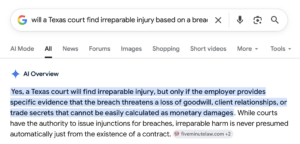
The next issue is whether the imminent harm of the defendant using the trade secrets is “irreparable” for purposes of a TRO, i.e. whether it is an injury that could be adequately compensated by damages.
Some cases say it is. See, e.g., Chevron U.S.A., Inc. v. Guajardo, No. H-17-1549, 2017 WL 2265694, at *2 (S.D. Tex. May 24, 2017) (citing Am. Express Fin. Advisors, Inc. v. Scott, 955 F. Supp. 688, 693 (N.D. Tex. 1996)).
Some say it isn’t. See, e.g.,Advanced EDR Sys., LLC v. Design Solutions, Inc., No. A-07-CA-698-LY, 2007 WL 9710218, at *2 (W.D. Tex. Aug. 27, 2007) (“the lost goodwill of a company like [plaintiff], operated over a short period of tie, is generally compensable in money damages”).
I explore this issue in Irreparable Injury, I Presume? Again, I wouldn’t spend a lot of your time trying to reconcile these cases. Just cite some of the ones that support your position.
Now we get to the nitty-gritty, will the judge grant the TRO, and if so, what will it say?
Judges are usually willing to grant the part of the TRO that says “Defendant will not use or disclose Plaintiff’s confidential, proprietary, or trade secret information.” They figure, what’s the harm in ordering that? The Defendant shouldn’t be doing that anyway.
That, of course, is part of the problem. As a general rule, injunctions that effectively just say “follow the law” are disfavored. Unless there is evidence the defendant has already used the alleged trade secrets or is about to use them, I say the plaintiff doesn’t need a TRO that says don’t use them.
But most judges are not going to want to get down in the weeds of figuring out what is actually a trade secret or not. So they’ll go with the general language.
The harder question is whether the TRO will order the defendant to “return” the documents to the company. How exactly does one “return” documents in electronic form? See How Should Employees “Return” Electronic Files?
To keep it simple, suppose the defendant transferred a hundred company documents to a USB drive on her last day of work. How do you order her to “return” those?
I suppose the former employee could just hand over the USB drive, but the drive itself is her property. And suppose it also has her own personal documents on it.
The employee could plug the drive into her computer and email the documents on it to her lawyer, to be forwarded to the plaintiff’s lawyer. But there’s a big problem with that: metadata. Anything she does with the documents can alter the metadata, which is potential evidence in the lawsuit.
And then what does she do, delete the documents? That would potentially violate her duty to preserve evidence, which arose as soon as she learned about the lawsuit, if not earlier.
The bottom line is that “returning” company documents is just not that simple, and that’s one reason this kind of relief usually shouldn’t be in a TRO. If anything, this issue should be addressed later, either by agreement of the parties or at an evidentiary hearing. It usually shouldn’t be ordered “on the fly” at a short TRO hearing.
A related question is whether the TRO should require the defendant to turn over her computer, phone, and other electronic devices for forensic examination. This is called a “direct access” order.
Direct access orders are highly invasive. “Providing access to information by ordering examination of a party’s electronic storage device is particularly intrusive and should be generally discouraged, just as permitting open access to a party’s file cabinets for general perusal would be.” In re Weekley Homes, 295 S.W.3d 309, 317 (Tex. 2009).
In most cases, it’s inappropriate to include a direct access order in a TRO. The limited purpose of a TRO is to maintain the status quo for the short time between the TRO and an injunction hearing. Injunctive relief should be “narrowly tailored to enjoin the actual or threatened misappropriation of trade secrets to apply only to the use of confidential or trade secret information.” Nat. Oilwell Varco, L.P. v. Garza, No. H-22-2006, 2022 WL 3098238, at *2 (S.D. Tex. Aug. 4, 2022).
A direct access order is inappropriate for a TRO because it “would alter, rather than preserve, the status quo.” Advanced EDR Sys., LLC v. Design Solutions, Inc., No. A-07-CA-698-LY, 2007 WL 9710218, at *2 (W.D. Tex. Aug. 27, 2007).
But judges often include a direct access order in a TRO anyway.
If you can’t handle that, maybe TRO practice is not for you.
Like my man Coolio said, if you can’t take the heat, get yo a$$ out the kitchen.
____________________
Zach Wolfe (zach@zachwolfelaw.com) is a Texas trial lawyer who handles non-compete and trade secret litigation at Zach Wolfe Law Firm (zachwolfelaw.com). Thomson Reuters has named him a Texas “Super Lawyer”® for Business Litigation every year since 2020.
These are his opinions, not the opinions of his firm or clients. Reasonable people can disagree. Every case is different, so don’t rely on this post as legal advice for your case.
To provide the best experiences, we use technologies like cookies to store and/or access device information. Consenting to these technologies will allow us to process data such as browsing behavior or unique IDs on this site. Not consenting or withdrawing consent, may adversely affect certain features and functions.
Functional
Always active
The technical storage or access is strictly necessary for the legitimate purpose of enabling the use of a specific service explicitly requested by the subscriber or user, or for the sole purpose of carrying out the transmission of a communication over an electronic communications network.
Preferences
The technical storage or access is necessary for the legitimate purpose of storing preferences that are not requested by the subscriber or user.
Statistics
The technical storage or access that is used exclusively for statistical purposes.The technical storage or access that is used exclusively for anonymous statistical purposes. Without a subpoena, voluntary compliance on the part of your Internet Service Provider, or additional records from a third party, information stored or retrieved for this purpose alone cannot usually be used to identify you.
Marketing
The technical storage or access is required to create user profiles to send advertising, or to track the user on a website or across several websites for similar marketing purposes.