Anything Goes? TROs in Trade Secret Lawsuits


Like my man Cole Porter said, in olden days a glimpse of stocking, was looked on as something shocking, now Heaven knows . . . anything goes.

Especially when a company sues a former employee who took documents containing the company’s alleged “trade secrets.”

In a case like that, can the company get a temporary restraining order (TRO) requiring the employee not to use the documents?

Can the judge also make the employee immediately “return” the documents to the company?

After handling cases like this for over a decade, I can tell you the practical answer is simple: in a TRO the judge can—and will—do whatever the judge wants. Anything goes.

It doesn’t really matter what “the law” of trade secrets TROs says. There are a couple reasons for this.

First, as a general rule there is no appeal from a TRO. So you don’t have a bunch of appellate court opinions you can cite.

Second, the TRO case law you can find—mainly federal district court opinions—is a hopeless muddle of conflicting principles and results. I mean, you could try to reconcile all the divergent results based on differences in the facts of the cases, but good luck with that.

You can also cite appellate cases on injunctions, which raise similar issues to TROs, but that case law is also a muddle. Part of the problem is the standard of review: abuse of discretion. Appellate courts don’t decide whether they think the trial court judge made the right decision on an injunction; they just decide if the decision was within the bounds of the judge’s discretion (in theory).

Bottom line: As a practical matter there is no “law of TROs” in trade secret litigation. I will leave it to smarter people to debate whether any law of TROs exists as a philosophical matter.

But if you’re a lawyer handling a trade secrets lawsuit, you still have to make a legal argument for or against a proposed TRO. And it probably won’t sound very persuasive if you just say “Your Honor, you can do whatever you want, I mean, it’s not like there’s going to be an appeal.”

No, you need to know the legal principles that apply to TROs so you can couch your argument in those terms.

Having done a lot of these, I can help you with that.

If you’re trying to get a TRO in a trade secrets case, the first thing you need to do is show that the documents the employee took contain trade secrets.

You’ll find two kinds of court opinion on this issue.

The first kind says that whether the information in the documents is a trade secret is an ultimate issue to be decided at trial, not at the TRO stage, and that it’s enough for the company just to make a “prima facie” case for misappropriation. See, e.g., NRT Texas LLC v. Wilbur, No. 4:22-cv-02847, at *10 (S.D. Tex. Sept. 7, 2022) (“At this stage, the Court is not in a position to weigh the credibility of the evidence,” and plaintiff made sufficient “prima facie case” for threatened or actual misappropriation of trade secrets).

The second kind says the plaintiff must present evidence to prove a “likelihood of success on the merits,” or a “probable right to relief.” In other words, you’ve got to actually persuade the judge there’s a trade secret. See, e.g., Thompson Safety LLC v. Jones, No. 4:24-CV-2483, 2024 WL 4108788, at *2-3 (S.D. Tex. Sept. 6, 2024) (denying preliminary injunction where plaintiff did not carry its burden to show that names on the customer list were not “ascertainable through public sources”).

Coincidentally, the first type of case usually grants a TRO, and the second type usually denies it. Isn’t that interesting?

Anyway, if you’re trying to get the TRO, you should cite some cases from the first category, and if you’re trying to avoid the TRO, you should cite some cases from the second category.

If you’re really fancy, you can try to “distinguish” the cases cited by the opposing counsel, i.e. point out pertinent factual distinctions between the cases they cite and your case. But I wouldn’t spend a lot of billable hours on that. Remember, the judge is going to do whatever she wants anyway.

The next issue is whether the defendant “misappropriated” the documents containing the trade secrets, creating an imminent threat of harm to the company.

Usually there will be evidence the employee copied, transferred, or saved the documents to a non-company device or account, often shortly before leaving the company. In many cases the company will have already done a forensic exam that reveals this.

But at the TRO stage, the plaintiff company usually won’t have any evidence that the employee did anything with the documents, such as giving them to a new employer or using them to take business from the first employer.

So the plaintiff company will cite cases holding that there is an imminent threat of harm when a former employee has the company’s trade secrets and is in a position to use them at a competitor. See, e.g., Gilscot-Guidroz Int’l Co. v. Milek, No. 24-1409, 2024 WL 3011013, at *9 (E.D. La. June 3, 2024) (“to satisfy the irreparable injury element, [plaintiff] need only show that the ‘defendant possesses the trade secrets and is in a position to use them’”). This is sometimes called the “inevitable disclosure” doctrine.

The employee’s lawyer will cite cases rejecting or curtailing the inevitable disclosure doctrine. See, e.g., Nat. Oilwell Varco, L.P. v. Garza, No. H-22-2006, 2022 WL 3098238, at *2 (S.D. Tex. Aug. 4, 2022) (“In Texas, the remedy to mitigate harm when a former employee misappropriates trade secrets is to enjoin the use or disclosure of those secrets. [Plaintiff] has not shown how it could suffer irreparable harm if [defendant] returns to work without disclosing trade secrets.”)

I cover this divergence in The “Inevitable Disclosure” Doctrine in Texas Trade Secrets Litigation.

Again, the conflict in the case law is interesting, but don’t try to puzzle it out. You’ll only drive yourself crazy.

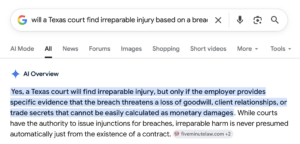
The next issue is whether the imminent harm of the defendant using the trade secrets is “irreparable” for purposes of a TRO, i.e. whether it is an injury that could be adequately compensated by damages.

Some cases say it is. See, e.g., Chevron U.S.A., Inc. v. Guajardo, No. H-17-1549, 2017 WL 2265694, at *2 (S.D. Tex. May 24, 2017) (citing Am. Express Fin. Advisors, Inc. v. Scott, 955 F. Supp. 688, 693 (N.D. Tex. 1996)).

Some say it isn’t. See, e.g., Advanced EDR Sys., LLC v. Design Solutions, Inc., No. A-07-CA-698-LY, 2007 WL 9710218, at *2 (W.D. Tex. Aug. 27, 2007) (“the lost goodwill of a company like [plaintiff], operated over a short period of tie, is generally compensable in money damages”).

I explore this issue in Irreparable Injury, I Presume? Again, I wouldn’t spend a lot of your time trying to reconcile these cases. Just cite some of the ones that support your position.

Now we get to the nitty-gritty, will the judge grant the TRO, and if so, what will it say?

Judges are usually willing to grant the part of the TRO that says “Defendant will not use or disclose Plaintiff’s confidential, proprietary, or trade secret information.” They figure, what’s the harm in ordering that? The Defendant shouldn’t be doing that anyway.

That, of course, is part of the problem. As a general rule, injunctions that effectively just say “follow the law” are disfavored. Unless there is evidence the defendant has already used the alleged trade secrets or is about to use them, I say the plaintiff doesn’t need a TRO that says don’t use them.

But a lot of judges won’t agree with me.

The other big problem with this kind of TRO is that it doesn’t define the alleged “confidential information” or “trade secrets” specifically enough for the defendant to know exactly what he can or cannot do. I cover this in Fuzzy Language: The Specificity Requirement in Departing Employee Litigation.

But most judges are not going to want to get down in the weeds of figuring out what is actually a trade secret or not. So they’ll go with the general language.

The harder question is whether the TRO will order the defendant to “return” the documents to the company. How exactly does one “return” documents in electronic form? See How Should Employees “Return” Electronic Files?

To keep it simple, suppose the defendant transferred a hundred company documents to a USB drive on her last day of work. How do you order her to “return” those?

I suppose the former employee could just hand over the USB drive, but the drive itself is her property. And suppose it also has her own personal documents on it.

The employee could plug the drive into her computer and email the documents on it to her lawyer, to be forwarded to the plaintiff’s lawyer. But there’s a big problem with that: metadata. Anything she does with the documents can alter the metadata, which is potential evidence in the lawsuit.

And then what does she do, delete the documents? That would potentially violate her duty to preserve evidence, which arose as soon as she learned about the lawsuit, if not earlier.

The bottom line is that “returning” company documents is just not that simple, and that’s one reason this kind of relief usually shouldn’t be in a TRO. If anything, this issue should be addressed later, either by agreement of the parties or at an evidentiary hearing. It usually shouldn’t be ordered “on the fly” at a short TRO hearing.

A related question is whether the TRO should require the defendant to turn over her computer, phone, and other electronic devices for forensic examination. This is called a “direct access” order.

Direct access orders are highly invasive. “Providing access to information by ordering examination of a party’s electronic storage device is particularly intrusive and should be generally discouraged, just as permitting open access to a party’s file cabinets for general perusal would be.” In re Weekley Homes, 295 S.W.3d 309, 317 (Tex. 2009).

In most cases, it’s inappropriate to include a direct access order in a TRO. The limited purpose of a TRO is to maintain the status quo for the short time between the TRO and an injunction hearing. Injunctive relief should be “narrowly tailored to enjoin the actual or threatened misappropriation of trade secrets to apply only to the use of confidential or trade secret information.” Nat. Oilwell Varco, L.P. v. Garza, No. H-22-2006, 2022 WL 3098238, at *2 (S.D. Tex. Aug. 4, 2022).

A direct access order is inappropriate for a TRO because it “would alter, rather than preserve, the status quo.” Advanced EDR Sys., LLC v. Design Solutions, Inc., No. A-07-CA-698-LY, 2007 WL 9710218, at *2 (W.D. Tex. Aug. 27, 2007).

But judges often include a direct access order in a TRO anyway.

If you can’t handle that, maybe TRO practice is not for you.

Like my man Coolio said, if you can’t take the heat, get yo a$$ out the kitchen.

____________________

Zach Wolfe (zach@zachwolfelaw.com) is a Texas trial lawyer who handles non-compete and trade secret litigation at Zach Wolfe Law Firm (zachwolfelaw.com). Thomson Reuters has named him a Texas “Super Lawyer”® for Business Litigation every year since 2020.

These are his opinions, not the opinions of his firm or clients. Reasonable people can disagree. Every case is different, so don’t rely on this post as legal advice for your case.


Source link

Leave a Reply

Subscribe to Our Newsletter

Get our latest articles delivered straight to your inbox. No spam, we promise.

Recent Reviews


Quick, can you name the number one song of 2014?

I’ll help you out. It was “Happy” by Pharrell Williams.

But to be honest, I was not so happy in early 2014. I had just lost my job working for a Houston law firm. Fortunately, I had a good paying client who was being sued for violation of a non-compete. And the rest is history.

At the time I’m writing this (the end of 2024), my Texas law practice has focused on the defense of lawsuits involving claims for violation of non-competes and/or alleged misappropriation of “trade secrets” for about ten years.

I put scare quotes around “trade secrets,” because very rarely have my cases involved any actual trade secrets. But that’s an issue for another post.

A little more background on me: From 1997 through 2014, I worked on a wide variety of business litigation matters in Texas. Some of those matters involved non-competes, and I was generally familiar with Texas non-compete law, but non-compete litigation was not my specialty.

Starting in 2014, my practice began to focus on litigation involving non-compete and trade secret claims. Today, my firm focuses almost entirely on defense of non-compete and trade secret litigation, plus providing “pre-litigation” advice to clients seeking to avoid such litigation. That means we’re representing either the departing employee, the company hiring the departing employee, or sometimes both.

After about ten years of doing that, I’ve learned some practical lessons. I could charge my hourly rate to teach these lessons, but I’ve decided to share them with the world for free. Hey, business has been good, so why not.

1. Clients usually ask the wrong questions

Clients typically come to me with questions they want answered. Sometimes the client will even have very specific questions, like “what is your success rate in defeating injunctions in the custom-built air conditioning hose industry?”

Usually these are the wrong questions. But that’s ok, because part of the value I provide is knowing the right questions.

Clients will often ask me “is my non-compete enforceable?”

It’s understandable they would ask that. I asked the same question when I put out my first YouTube video as That Non-Compete Lawyer. The question was, “Is My Texas Non-Compete Enforceable?

In that video I outlined how to analyze enforceability of a non-compete under Texas law, but at the end of the video I emphasized that it can cost a lot of money in legal fees to get the answer from a court. More about that later.

I was already hinting at the point that whether the client’s non-compete is enforceable as written, in the abstract, is not really that important.

Don’t get me wrong, it is a relevant issue. But after ten years, I’ve learned it’s not as important as clients usually think it is.

There are a lot of reasons for this, but let’s just say the more important thing is the practical question of what is likely to happen if your former employer tries to enforce the non-compete?

That brings me to the next lesson.

2. The most immediate risk to the employee is that your new employer will get scared and fold.

Clients also tend to ask “what am I allowed to do under this non-compete?”

Again, it’s totally understandable they would ask this, but as a practical matter, it’s the wrong question. The more pertinent question is “what is likely to happen if I go to work for a competitor and my former employer makes a stink about my non-compete?”

In most cases, that question will be prompted by the former employer or its lawyer sending the employee a demand letter. Sometimes they will copy the employee’s new employer on the letter. Sometimes they will call it a “cease and desist” letter, because they think that sounds more serious. I prefer the technical term “nastygram.”

The effects of a nastygram vary widely. The stiffness of the subsequent employer’s spine is usually the determining factor.

Some subsequent employers have spines like noodles. The minute they hear the words “non-compete” and “lawsuit,” they’ll drop the employee like a hot potato. (I know, mixed metaphors.)

Others with stiffer spines will take the opposite approach. Their response to a nastygram will be more like “tell that former employer they can go f*** themselves, we’ll hire whoever we want to hire, and we can pay lawyers too.”

But most of the time, the new employer will be somewhere in the middle. They will back up the new employee they just hired, to a point.

The important thing for the employee to understand is that you have little, if any, control over this decision. And if the subsequent employer decides to drop you, there’s virtually nothing I can do about that as your lawyer. I can argue Texas case law on non-competes backwards and forwards, but if the company that hired you decides to back out, I can’t stop them.

Usually, the best you can do as an employee is to discuss the issue with the new employer ahead of time. They are not going to give you any formal written commitment, but you can at least try to get a general sense of whether they will back you up if there’s a lawsuit, or a threat of a lawsuit. That informal commitment won’t be binding, but it’s better than nothing.

Ok, let’s say you have that discussion and the subsequent employer doesn’t immediately fold under pressure. What then?

3. The next most immediate risk to the employee is drawing a judge who likes non-competes.

My firm will often get hired by the employee at the nastygram stage. Usually, in those situations our goal is to try to work something out and avoid a lawsuit. That could mean providing assurances the employee didn’t take any confidential documents, agreeing the employee won’t do business with certain customers, or anything else needed to resolve the dispute.

If that doesn’t work out, and there’s a lawsuit, clients will usually want to know if the law is on their side.

Again, that’s an understandable and not entirely irrelevant question.

But if ten years of litigation practice has taught me anything, it’s that my opinion on what “the law” is doesn’t mean much. That’s because I’m not the one who gets to decide.

No, a judge will decide, of course. (Or in some cases it could be an arbitrator, but let’s go with “judge” for simplicity.)

More specifically, a judge will decide whether to grant an injunction. An injunction is essentially a court order telling you not to do something; there is also a short-term form of injunction called a “temporary restraining order.” Your lawyer can explain the procedural nuances.

The injunction could say, for example, that the employee is not allowed to work for the subsequent employer until the employee’s non-compete expires. Or it could just say the employee is not allowed to use the employer’s confidential information, or that the employee can’t do business with the customers she serviced when working for the first employer. Or anything else the judge thinks is reasonable.

In one case, the judge granted an injunction putting the ten best customers off limits. Why ten? Is there something in the Law of Non-Competes that says ten is a reasonable number of customers to restrict?

No, of course not. It’s just a number the judge picked because it seemed fair.

The practical lesson: The injunction can say whatever the judge wants it to say. And usually that will be whatever the judge thinks is fair under the circumstances.

Here’s what else ten years of focusing on departing employee litigation has taught me about the judge:

  • You should not assume the judge understands the law that applies to your case.
  • If the judge does understand the law that applies, you should not assume the judge will feel bound to follow it.
  • The judge will come to the case with a certain worldview that largely determines how the judge feels about non-competes in general.
  • The specific facts of your case do matter to some extent (more about this later), but the most important factor is how the judge feels about non-competes in general.

Furthermore, how the judge feels about non-competes is often hard to predict, even after you know which judge was assigned to your case.

The best prediction model I can give you is a bell curve. On the left end are the cases where the judge denies an injunction entirely. On the right side of the curve, you have the cases where the judge completely bars the employee for working for the new employer.

But most cases are in the middle, where the judge will grant a more limited injunction that allows the employee to continue working for the second employer, but with some limitations.

The thing to understand is that while the extreme results are less likely, your result could be anywhere on the curve. I’ve had results on both ends.

For example, I had a case in Tarrant County where the judge entered an order that literally put my clients out of their jobs and effectively required them to change careers.

I won’t say who the judge was (editor’s note: it was Judge Josh Burgess), but when I cited a whole line of Texas cases holding that the non-compete at issue was too broad, his response was that those were not Fort Worth cases. What he was really saying was that he didn’t care what the case law said, if you signed a non-compete you’re stuck with it.

So my clients were hit with an onerous injunction. (To add insult to injury, Tarrant County was not even the proper venue for the lawsuit in the first place, but I digress.)

Can you appeal that decision? In theory, yes. But in most cases an appeal will do you no good, because (1) you will probably lose the appeal (for reasons), and (2) in most cases the appeal will take so long that it won’t do you any good as a practical matter.

The bottom line: the biggest factor is who the judge is, and what that judge thinks about non-competes generally.

Notice I said biggest factor, not the only factor. The employee’s conduct is also an important factor, for better or worse. In other words, your conduct can shift the bell curve in either direction.

4. A “clean exit” is the best way for an employee to reduce the risk of an injunction.

If you’re the departing employee, you can’t control how your new employer will react to the threat of a lawsuit, and if there’s a lawsuit you can’t control who the judge will be, but you can control your own actions. And your actions can have a significant impact on the judge’s decision.

The best thing you can do to reduce the risk of a decision against you is to have a “clean exit.”

For an example of a messy exit, read the opinion in Winsupply E. Houston v. Blackmon, No. 4:21-cv-01387, 2021 WL 5504756 (S.D. Tex. Nov. 22, 2021). That was a difficult case for the defense, because the key employee who left the plaintiff was not careful to have a clean exit.

The lawyer for the company that hired the employee described her departure as a “messy transition.” U.S. District Judge Eskridge, an astute judge and all-around decent guy, rejected that characterization as too charitable to the employee. See id. at *7. I know this well because I was the lawyer who argued it was just a “messy transition.”

Anyway, a messy exit is not what you want if you’re the employee, or the company hiring the employee. You want a clean exit.

But how?

First, you need to understand that everything you do on a computer or phone or other electronic device leaves a trail, so if your exit is not clean, the company will find out.

Imagination is the only limit to the bad things an employee can do on the way out, but let me give you some examples of common things you should not do if you are an employee who wants a clean exit:

  • Once you’ve decided you’re leaving, don’t start doing anything unusual like accessing or downloading confidential company documents without a genuine work-related reason.
  • Don’t transfer, email, copy, download, or print company documents and take them with you when you leave.
  • Don’t copy company documents from your computer to an external device like a USB drive or portable hard drive unless absolutely necessary to doing your job (and in most cases, it won’t be absolutely necessary, will it?)
  • For the love of God, please don’t email company documents from a company email address to a personal email address even if it’s for a legitimate work reason. Just don’t do this.
  • Don’t hold on to company documents, in electronic or paper form, after leaving. Figure out how you are going to return these documents to the company. (This can be tricky, so get a lawyer to help you with this.)
  • Don’t “wipe” your computer or devices or delete documents to try to cover your tracks. Understand that attempts to cover your tracks will leave their own tracks.
  • Don’t sign an agreement with a customer or client on behalf of your new company or a new employer while you’re still employed by the first company.
  • Don’t tell clients or customers, or potential clients or customers, that you’re leaving or planning to leave. If you must tell them, wait until after your employment with the company ends.
  • While still employed by the first employer, don’t send a client or customer’s business to someone else.
  • After you leave the first employer, don’t communicate with the employer’s clients, customers, or employees without first consulting with a lawyer and making a specific plan on what you should and shouldn’t do.

This is not an exhaustive list, but you get the idea. The way people usually go wrong is taking or keeping company documents after leaving, soliciting company customers or employees while still employed, or both.

The problem with a messy exit is that it significantly increases the likelihood that a judge will think it’s fair to enter an onerous injunction against you. It’s just human nature. I can argue the case law to the judge all day, but if you did stuff that looks sneaky and underhanded to the judge, it will impact how the judge sees the case.

Luckily, there was a happy ending to the “messy transition” case, because we successfully persuaded the judge the plaintiff had failed to show the harm at issue was “irreparable.” See id. at *8-9. But you can’t count on that.

5. Money changes everything.

Speaking of counting, if you get sued for breaking a non-compete, get ready to start counting the dollars you will spend on legal fees.

How much will have to spend?

I’m tempted to say “if you have to ask, then you can’t afford it,” but that’s a little too snarky.

The answer is that it depends in large part on the law firm you hire. If you hire a BigLaw firm, look out. Don’t be surprised if the fees get into six figures within a few months.

Don’t get me wrong, I’m not bashing the big firms. Many of the best lawyers are in BigLaw. (I cover this in depth in Should Clients Pay a Premium for Big-Name Law Firms?) But they’re in BigLaw because that’s where the big money is. And they wouldn’t make big money if the bills were not big.

A solo or small firm lawyer will usually cost less. As a rule of thumb, you should be prepared to spend at least $10,000 for the initial temporary injunction stage of a non-compete lawsuit. I explain at my video How Much Does a Texas Non-Compete Lawsuit Cost?

Now let me be blunt for a moment. If writing a check for $10,000 is a financial hardship for you, then you should probably not be playing at this table. That may sound harsh, but it’s the reality.

Truth is, if you can’t afford that, then your former employer will be in a position to try to bully you into submission, because they can afford to pay lawyers and you can’t.

And believe me, they know this. So if you expect to be in a non-compete dispute, start building up your rainy day fund now.

That brings me to the number one song of 2024. “Lose Control” by Teddy Swims. That’s what you don’t want.

The bottom line is that if you want to have any control over your destiny, you’re gonna need gas in the tank and money in the bank.

_______________________

Zach Wolfe (zach@zachwolfelaw.com) is a Texas trial lawyer who handles non-compete and trade secret litigation at Zach Wolfe Law Firm (zachwolfelaw.com). Thomson Reuters has named him a Texas “Super Lawyer”® for Business Litigation every year since 2020.

These are his opinions, not the opinions of his firm or clients, so don’t cite part of this post against him in an actual case. Every case is different, so don’t rely on this post as legal advice for your case.


Source link