High-fiber foods can be a great addition to a weight loss diet because they promote satiety, help regulate digestion, and promote overall health. Credit: blissfullife / Getty Images
Lentils are high in fiber and protein, which helps slow digestion and curb hunger.
Eating raspberries and blackberries supplies antioxidants, which may help prevent certain diseases.
Edamame offers magnesium and potassium, which help control blood pressure.
High-fiber foods improve digestion and help you feel fuller, which supports weight loss. These foods also contribute to better overall health.
1. Lentils
Credit: Cris Cantón / Getty Images
Fiber: 15.6 grams per cup, 55.7% of the 28-gram Daily Value (DV).
Why It Helps: Lentils are high in protein, with 17.9 grams per cup, in addition to fiber. Protein and fiber slow digestion and encourage the release of hormones that make you feel full. A 2023 study found that adults in the United States who ate legumes gained much less weight over 10 years compared to those who did not.
How To Use It: Lentils can be used in salads, soups, and grain dishes, and roasted and enjoyed as a high-fiber snack.
2. Avocado
Credit: Aurelian Buse / Getty Images
Fiber: 13.5 grams per (201-gram) avocado,48% of your daily fiber needs.
Why It Helps: Eating fiber-rich foods like avocados may help you avoid weight gain over time and also prevent risk factors for heart disease, such as high low-density lipoprotein (LDL) cholesterol. Avocados are low in carbohydrates and high in healthy fats, making them suitable for low-carb diets.
How To Use It: Slice avocado and add it to salads, or use mashed avocado as a high-fiber mayo or butter replacement on sandwiches and toast.
3. Flaxseeds
Credit: Uma Shankar sharma / Getty Images
Fiber: 5.62 grams per tablespoon of whole flaxseeds, 20% of the DV.
Why It Helps: Flaxseeds are also high in several vitamins and minerals, including copper, magnesium, and selenium. Plus, people who supplement with 30 grams of ground flaxseed have been found to see more decreases in waist circumference and waist-to-hip ratio compared to a control group.
How To Use It: Add whole or ground flaxseeds to oatmeal, chia pudding, and smoothie bowls for a high-fiber boost.
4. Raspberries
Credit: Elena Esich / Getty Images
Fiber: 8 grams of fiber per cup,29% of the DV.
Why It Helps: Besides fiber and vitamins, raspberries are packed with powerful antioxidants that protect your cells from damage, which decreases the risk of diseases. Studies show antioxidant-rich foods may lower risks associated with oxidative stress, including heart disease and certain cancers.
How To Use It: Try frozen raspberries in smoothies and protein shakes, and use fresh raspberries as a high-fiber topping for oatmeal and cereal.
5. Brussels Sprouts
Credit: Lara Hata / Getty Images
Fiber: 4 grams per cup, 14.3% of the DV.
Why It Helps: A 2018 review found that people who ate more vegetables had a lower risk of gaining weight and developing obesity compared to those with low vegetable intake. Brussels sprouts are also high in vitamins and minerals, like vitamin C, vitamin K, and folate, as well as protective plant compounds like carotenoids.
How To Use It: Brussels sprouts are usually enjoyed cooked, but they can also be eaten raw, such as thinly shaved in a salad.
6. Chia Seeds
Credit: HUIZENG HU / Getty Images
Fiber: 9.75 grams per ounce, 34.8% of your DV.
Why It Helps: Eating chia seeds could help decrease body fat, especially belly fat. A 2024 review found that chia seed supplementation was associated with a significant decrease in waist circumference. Chia seeds are also high in minerals like calcium, selenium, iron, manganese, and magnesium.
How To Use It: Chia seeds can be added to several recipes, like yogurt parfaits, chia pudding, and even baked goods.
7. Blackberries
Credit: Stickney Design / Getty Images
Fiber: 7.63 grams per cup, 27.3% of the DV.
Why It Helps:Blackberries are a good source of essential vitamins and minerals, like folate, vitamin C, vitamin K, and manganese. They are also high in protective phenolic compounds with powerful antioxidant properties.
How To Use It: Blackberries are delicious in fruit salads and can be used as a high-fiber topping for oatmeal.
8. Black Beans
Credit: Krit of Studio OMG / Getty Images
Fiber: 15 grams per cup, over half of your DV.
Why It Helps: The same serving contains 15.2 grams of protein, making black beans a filling choice. The fiber found in black beans encourages healthy bowel movements and can protect against digestive conditions like colon cancer and diverticulitis.
How To Use It: Add black beans to soups, salads, and tacos, or use mashed black beans to increase the fiber and protein content of baked goods, like brownies.
9. Oat Groats
Credit: Arx0nt / Getty Images
Fiber: 5 grams per one-quarter cup, 18% of your DV.
Why It Helps: Oat groats, also known as whole oats, are the least processed form of oats. Oat groats contain 5 grams of fiber per quarter-cup serving, which is more than double the amount found in the same serving of rolled oats. They are also higher in protein than rolled oats, which makes oat groats a better choice for weight loss.
How To Use It: Oat groats have a chewier texture than rolled oats and can be used in a number of dishes, like porridge, grain bowls, and salads.
10. Edamame
Credit: PamelaJoeMcFarlane / Getty Images
Fiber: 8 grams per cup, 28.6% of the DV
Why It Helps: The same serving of edamame also provides 18.5 grams of protein.Choosing foods high in filling nutrients, like protein and fiber, could help you reach and maintain a healthy body weight. Edamame is also a rich source of vitamins and minerals, like magnesium and potassium, which are needed for blood pressure regulation, and could help lower your risk of heart disease.
How To Use It: Edamame can be enjoyed as a simple snack or added to dishes like salads, grain bowls, and soups.
DevOps combines development and operations. It entails a set of processes, philosophies, technologies,and resources that enable businesses to rapidly enhance their ability to provide services and applications with better products. Previously, conventional infrastructure management and software development approach made achieving this velocity difficult. DevOps brings the two divisions together to provide consumers with a more open, reliable, and timely software delivery experience.
DevOps Engineers are System Administrators with programming expertise that work in organizations. They are responsible for organizing the following tasks:
Planning for applications and infrastructure
Creating and managing CI/CD pipelines
Monitoring development security.
Development process automation.
Become a Devops Certified professional by learning this HKR AWS Devops Training !
What is AWS?
Cloud Computing has increased in popularity over time,and there is now a slew of cloud providers to choose from, including Microsoft Azure, Google Cloud, Amazon AWS, IBM Cloud Services, and others. AWS,or Amazon Web Services, is a cloud infrastructure created by Amazon, one of the world’s most well-known companies. It provides a variety of services and products that aid in data storage, access, and editing, as well as other related functions.AWS and other cloud services make it simple to securely archive vast amounts of business data remotely rather than in physical locations, saving money and space.
Take your career to next level in AWS with HKR. Enroll now to get Aws Online Training
What is AWS DevOps?
AWS DevOps is a technology designed to help businesses execute DevOps principles using the different services, applications, and software provided by this cloud platform. AWS provides a variety of offerings that are scalable and built to help companies build and deliver products more efficiently and quickly using AWS and DevOps.AWS DevOps simplifies a variety of enterprise activities, including testing programs, managing resources, automating product delivery, and distributing program code, among others. This technology enables enterprises to execute operations such as continuous integration and continuous delivery (CI/CD), allowing them to store source code for software and track their versions when creating, installing, and evaluating them automatically on AWS or on-premises.
As previously said, AWS DevOps is a branch of Cloud Computing, and Cloud Computing is divided into three parts:
Platform as a Service (PaaS)
Software as a Service (SaaS)
Infrastructure as a Service (IaaS)
AWS DevOps Architecture
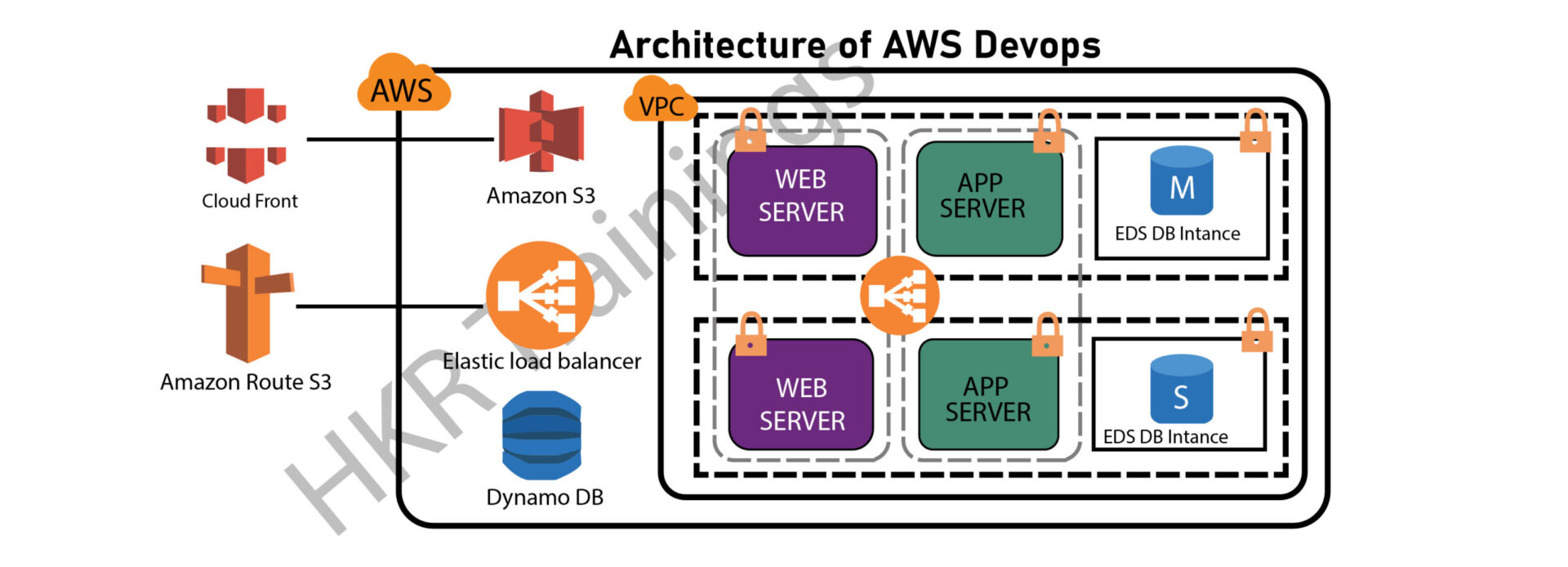
Understanding the design of AWS DevOps is critical to gaining a thorough understanding of the service. We will try to break down all of the elements of AWS DevOps now so you can get a better understanding of how each technology is used.
Load Balancing
It’s a virtual network appliance that lets businesses spread Amazon Elastic Compute Cloud (EC2) traffic across many web server services that can be scaled up or down depending on demand. Elastic Load Balancing from Amazon Web Services will help automate this operation.
Amazon Security Group
Safety has become a top concern due to the exponential rise in the theft of corporate data and other classified and personal information. Amazon protection groups serve as a network firewall to secure an organization’s information. To obtain access to EC2, users must define the appropriate authorized ports, protocols, source IP ranges, and so on. All users can assign multiple protection groups to a single EC2 instance, and each of them can then send approved traffic to the appropriate instances.
Amazon CloudFront
It serves up dynamic, static, and streaming websites as well as other content. It can be used with other cloud systems with ease, and it can be designed to work with other AWS components as well.
ElastiCache
It aids in the use of the cloud’s memory cache. This web service caches commonly used data, helping businesses to reduce service stress and improve scalability and efficiency.
Amazon’s Simple Storage Service (S3)
AWS S3 is an Amazon service that helps professionals to view, back up, and store web application properties such as records. Amazon S3 provides an immersive and user-friendly user interface for managing vast amounts of data over the Internet as required. You can store the data as objects in buckets, which you can then open, change, read, and update as required.
Amazon Relational Database Services (RDS)
This Amazon program streamlines many aspects of a cloud-based relational database, including configuration, scalability, and operations. This service aids in the management of database operations and procedures on a regular basis. It also provides approaches for dealing with RDS that are both cost-effective and flexible. RDS currently supports a variety of databases, including Microsoft SQL Server, Oracle, MariaDB, Amazon Aurora, and others.
Amazon Elastic Block Store (EBS)
Users can handle device logging and storage partitions for it. It also provides long-term sustainability and fast access. For file systems, files, and other applications that need access to raw and unformatted updates, EBS volumes are the safest choice when dealing with primary storage.
Amazon Auto-scaling
AWS Auto-scaling creates server classes that consumers can shrink or extend depending on demand and requirements.
You will have a variety of tasks and responsibilities as an AWS Certified DevOps Engineer in an organization, some of which are stated below:
Deploy, automate, administer, and operate an Amazon Web Services (AWS) cloud-based infrastructure.
Ensure AWS production systems’ efficiency, scalability, availability, and security.
Handle the systems’ development, deployment, and configuration.
Analyze the new technology and vendor products as alternatives.
Perform device troubleshooting and problem-solving through a variety of platforms and applications.
These are only a few of the many job roles played by an AWS DevOps Engineer in a business.
Tools in AWS DevOps
AWS DevOps offers a collection of tools to aid in the development of applications in the cloud. Let’s look at some of the most common and widely deployed AWS DevOps services.
AWS CodeStar
AWS CodeStar is a great method for integrating DevOps on the Amazon Web Services platform. It has a user-friendly and collaborative interface that makes it simple for users to build and deploy applications on AWS. Furthermore, it enables users to set up the entire continuous delivery toolchain in a matter of minutes. If you want to keep your attention on running applications on AWS, this is the best tool since it manages the entire life cycle of a software product in one place
AWS CodePipeline
This tool makes it possible to simplify the continuous-delivery software code in order to receive timely and reliable updates. This helps to improve processes like application creation, testing, and deployment.
AWS CodeBuild
CodeBuild is a fully managed service that enables experts to compile application source code, validate the application, and prepare a deployable software kit. It helps users to continuously scale the code as they build and test it.
AWS CodeDeploy
AWS CodeDeploy automates the process of distributing applications to local environments or cloud providers like AWS Fargate, AWS Lambda, and Amazon EC2, among others. This tool eliminates downtime during the deployment phase.
AWS Cloud Development Kit
The AWS Cloud Development Kit is an application development tool that is open-source. To design and configure tools for cloud applications, it employs well-known programming languages.
Popular Use Cases and Best Practises of AWS DevOps
The most common use cases and best practices for AWS DevOps in organizations will now be discussed.
Infrastructure Automation This helps to provide high-quality code by checking it at regular intervals automatically.
CI/CD DevOps is built on the basis of CI/CD pipelines. Continuous integration, or CI, aids in the creation and continuous validation of business projects by making frequent changes to the code and upgrading it.Continuous delivery (CD), on the other hand, propels CI forward by assisting in the automated deployment of code in the production area.
Infrastructure as a Code This enables organizations to handle AWS cloud resources using human-readable and machine-readable template files. The AWS CloudFormation tool is the most useful tool for AWS cloud developers.
Collaboration and Communication All of an organization’s divisions should be on board with innovative ideas for the project at hand and they must be well-informed. Furthermore, there should be a forum where people will exchange useful suggestions that will aid in the project’s progress.
Logging and Monitoring All machine operations must be recorded and tracked to ensure that incidents occur at the appropriate times and that any errors are corrected promptly.
Subscribe to our YouTube channel to get new updates..!
Comparison of Azure DevOps and AWS DevOps
The product creation life cycle is automated in both Azure and AWS. Let’s look at how AWS DevOps and Azure DevOps vary from each other.
AWS DevOps
Infrastructure
AWS approaches have already been ahead of the curve in terms of resources in the creativity graph, and they provide robust storage and compute services. Service Integration
It helps users to combine and use a range of AWS utilities, including S3, EC2, and Beanstalk. Best Feature
AWS DevOps uses AWS Services to automate the whole code deployment process.
Azure DevOps
Infrastructure
Azure began as a PaaS, allowing professionals to build applications without having to think about the servers they were running on. Service Integration
It provides SQL databases, Azure App Servers, Azure VM, and other services, as well as facilitating the SDLC process through Jenkins and other software. Best Feature
Kanban workflows, boards, and a massive extension ecosystem are all part of Azure DevOps.
Advantages of AWS DevOps
Now, you will come across some of the advantages of using AWS for DevOps.
Easy to Work with Companies must have an AWS account in order to access AWS facilities.Furthermore,they must update the app in order to access the appropriate facilities. The modular design of AWS enables the organization’s DevOps department to operate on many instances with ease. This unique DevOps feature helps companies to quickly disperse resources for software and cloud programs. AWS also assists them with correctly allocating money and has an immersive user interface.
Facilitates Collaboration DevOps is a collection of services that helps to make coordination and teamwork between a company’s different departments easier. DevOps is a collection of services that helps to make coordination and teamwork between a company’s different departments easier. AWS resources such as access and identity management allow DevOps team members to define the extent of access, permissions, and policies for various project stakeholders. AWS also allows developers to view and share DevOps progress in real-time over a protected network.
Process Automation One of the most important functions of a DevOps specialist is to automate complex activities, which AWS CodeDeploy can assist with. This Amazon Web Services (AWS) solution enables businesses to simplify a variety of manual processes, such as rollout and testing. AWS Management Console and AWS Command Line Interface (CLI) both assist in handling and automating a variety of operations, as well as providing reports on achieving the desired outcomes. Furthermore, AWS eliminates the need for businesses to set up and install hardware because it is handled automatically.
What is the best way to get started with AWS DevOps?
If you’d like to learn AWS DevOps and work in this area, you must first complete the following steps:
Learn AWS and DevOps services.
Understand the main AWS and DevOps concepts.
Learn how to use the different AWS DevOps software and technology.
Get hands-on experience in this field through projects.
Enroll in the most effective course and clear the test. Professional-level AWS Certified DevOps Engineer.
HKR Trainings has one of the most comprehensive online AWS DevOps Certifications available. With the aid of this training program, you will become a professional expert in this lucrative area. You’ll also get hands-on exposure by working on industry-related programs. You’ll also master all of the fundamental and specialized skills that can help you find a lucrative career in the field. You can also earn an industry-recognized course completion certificate upon completion of the course, which will add a lot of credibility to your resume when applying for work.
AWS DevOps Professional Certification
You learned everything there is to know about AWS, DevOps, AWS DevOps, how to become an expert in it, the design of this technology, the software and resources, best practices, advantages, the discrepancies between AWS DevOps and Azure DevOps, and more in this AWS DevOps tutorial blog. If you are interested in this technology and want to try a promising career in it, you can enroll in the right course as soon as possible.
Conclusion Technology organizations should adopt AWS DevOps standards and activities to make the transition to the cloud as seamless, reliable, and profitable as possible. The AWS DevOps Foundation is built on these ideas. They are, in fact, at the center of a number of AWS services, especially those related to deployment and monitoring. Your AWS DevOps values will add versatility to your company and IT organisation, as well as speed up your path to the cloud, with AWS as your partner.
To provide the best experiences, we use technologies like cookies to store and/or access device information. Consenting to these technologies will allow us to process data such as browsing behavior or unique IDs on this site. Not consenting or withdrawing consent, may adversely affect certain features and functions.
Functional
Always active
The technical storage or access is strictly necessary for the legitimate purpose of enabling the use of a specific service explicitly requested by the subscriber or user, or for the sole purpose of carrying out the transmission of a communication over an electronic communications network.
Preferences
The technical storage or access is necessary for the legitimate purpose of storing preferences that are not requested by the subscriber or user.
Statistics
The technical storage or access that is used exclusively for statistical purposes.The technical storage or access that is used exclusively for anonymous statistical purposes. Without a subpoena, voluntary compliance on the part of your Internet Service Provider, or additional records from a third party, information stored or retrieved for this purpose alone cannot usually be used to identify you.
Marketing
The technical storage or access is required to create user profiles to send advertising, or to track the user on a website or across several websites for similar marketing purposes.


:max_bytes(150000):strip_icc():format(jpeg)/Health-GettyImages-1267597687-2eb653c4d62147c9a89d7a1457b7d5a8.jpg "Two slices of bread topped with cream cheese, sliced avocado, blackberries, raspberries and sprinkled with chia seeds.")