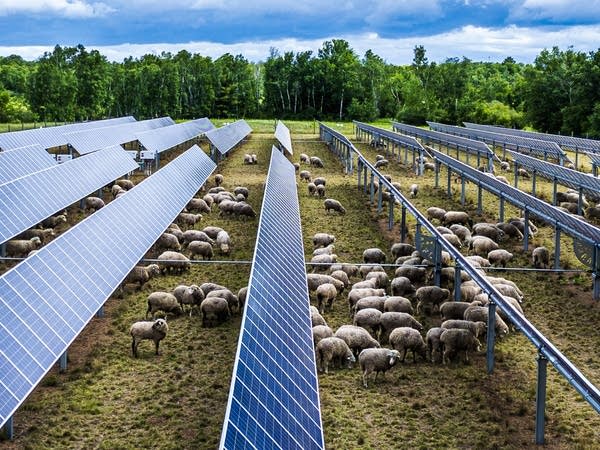

The majority of electricity used in Minnesota continues to come from carbon-free sources, but the growth of green energy generation has slowed, while the use of coal grew over the past year, according to a report released this week from Clean Energy Economy Minnesota and the Business Council for Sustainable Energy.
Zero-carbon sources including wind and solar power and nuclear energy supplied 55 percent of Minnesota’s electricity in 2025. That’s well over the national average of 43 percent, and it’s the sixth straight year clean energy has supplied more than half of the state’s power.
“Minnesota continues to be a leader at the forefront of the energy transition,” said Gregg Mast, executive director of Clean Energy Economy Minnesota at an event Thursday announcing the release of the 2026 Energy Factsheet.
But the total of the state’s electricity coming from renewable sources has remained flat since 2022. And significant growth is needed for the state is to meet its mandate to produce 100 percent of electricity from carbon-free sources by 2040.
Renewable sources have generated one-third of the state’s electricity for the past three years. Over the past year, the share of the state’s electricity generated by coal grew from 20 to 24 percent— although looking back over the past decade, the use of coal has dropped by 15 percent.
Nuclear energy’s use ticked up two points to 22 percent over the past year, and has held fairly steady over the past decade. Natural gas, which burns cleaner than coal but still produces greenhouse gas emissions, declined from 27 to 21 percent of the state’s energy mix last year. But over the past decade, the state’s use of gas has grown by eight percent.
The state’s greenhouse gas emissions held steady over the past year, after three consecutive years of declines. Minnesota has cut emissions nearly in half over the past 20 years, outpacing the national reduction of 38 percent.
Despite that progress, the state is not on pace to meet its goal of cutting greenhouse gas emissions in half by 2030, compared to 2005 levels, and to reach net-zero emissions by 2050.
Renewable energy development in Minnesota and nationwide has faced significant hurdles in President Donald Trump’s second term. The federal government has terminated billions of dollars in grants for renewable energy and electric grid modernization projects.
“Minnesota is not arguing, we are transitioning. It is only Washington, D.C. that is arguing against the clean energy transition,” said Pete Wyckoff, deputy commissioner of energy resources at the Minnesota Department of Commerce.
Still, headwinds remain. Residential solar installations, for example, have slowed since the federal government eliminated tax credits for them, said Marty Morud, president of TruNorth Solar in the Twin Cities.
“The phone has not been ringing nearly as often this year as it was last year,” said Morud, who added that some some homeowners have to wait years for utilities to interconnect their solar systems to the electric grid.
But Minnesota is part of a global trend showing a rapid transition to renewable energy, said Wyckoff. Around the world, wind and solar met 99 percent of new energy demand last year, Wyckoff said.
In Minnesota, wind and solar accounted for 98 percent of all new electric generation capacity added in the past five years. The state added 264 megawatts of new solar capacity in 2025, nearly ten times the amount of natural gas added to the state’s energy mix.
“In Minnesota, we don't tilt at windmills,” Wyckoff said. “We erect wind turbines, and more recently, solar panels, and we dig geothermal wells.”