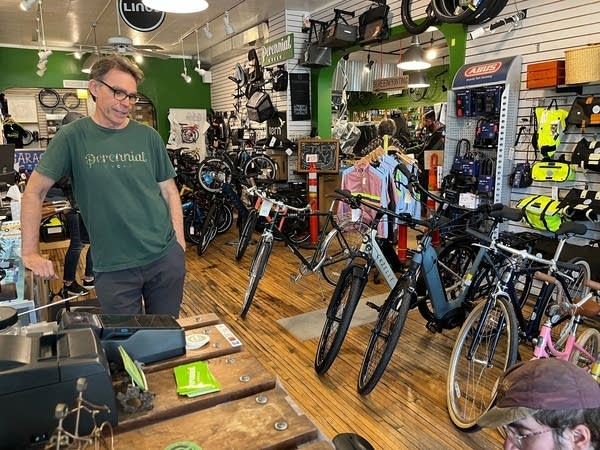
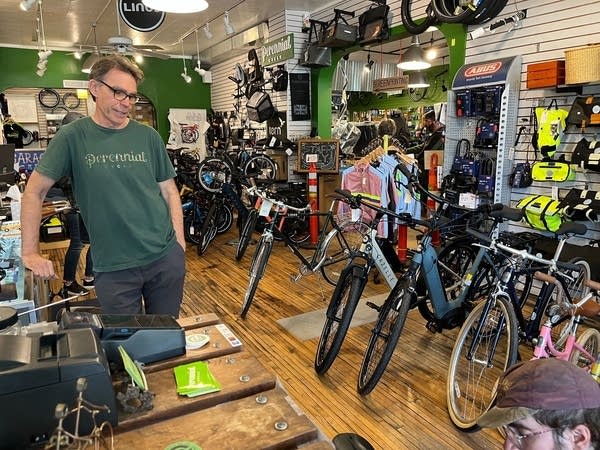
It was a busy Saturday for the staff in the workshop at Perennial Cycle Shop in Minneapolis. Mechanics swapped in new tires, checked brake lines and lubricated bike chains.
Luke Breen has owned Perennial on Hennepin Avenue for 37 years, and while spring brings its fair share of tune-ups, he’s noticed a difference this year.
“We’re seeing a lot of repair bikes coming in. People are pulling their bikes out of their garages. Many people come in to get air in their tires and lube on their chains because they are seeing the gas prices going up.”
While gas prices are causing more customers to consider new ways to get around town, Breen hasn’t seen an increase in new bike purchases — at least not yet.
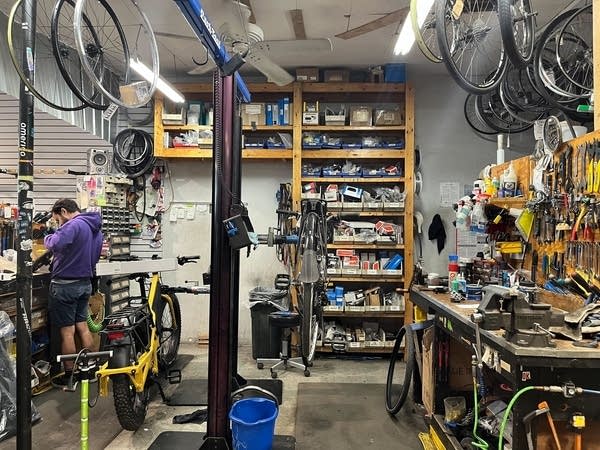
“At what point does the gas price actually push people to buying bikes? I don't know. I can guess, and it's around five bucks a gallon.” Breen said. “We're not there yet. We're at the point where people are just trying. They're worried that it might happen, and they like to prepare themselves by just getting their bike ready to go.”
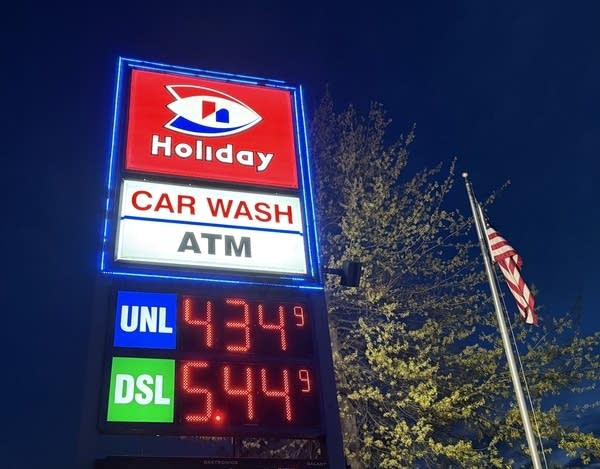
AAA listed the average price per gallon of regular gasoline in Minnesota on Monday at $4.17, more than a dollar more than the same time last year.
It all comes down to tanker traffic through the Strait of Hormuz.
Tankers moved about 20 million barrels of oil daily through the strait in 2025, according to estimates from the Energy Information Administration, a federal research agency.
Even with a tenuous cease fire between the U.S. and Iran, ships carrying 20 percent of the global supply have stopped moving through the strait.
Paul Sankey is the lead analyst for Sankey Research, an independent energy research firm. He says the U.S. has avoided the worst of it by tapping emergency reserves.
“Our view is that it gets worse before it gets better — a lot worse — because of the emergency inventory running down. But so far, they've centered the situation well,” he said.
Sankey says there aren’t viable alternatives to shipping through the strait. Much of the infrastructure for exporting oil was built to travel through ports to arrive at refineries around the world.
President Donald Trump has said he foresaw the spike, and that it is a sacrifice for toppling the Iranian regime.
But even if everything went back to the way they were before the U.S. strikes on Iran, Sankey says a change in prices won't happen overnight.
“It's all a question of physics. You can't conjure a tanker into a different place. These things move at 15 miles an hour,” Sankey said. “So once they decide to go somewhere else. It takes, you know, a lot of time to get them back to where they should be.”
Metro Transit sees bump in riders
The war more than 6,000 miles from the Twin Cities has commuters searching for alternatives to avoid paying at the pump.
For example, Metro Transit General Manager Lesley Kandaras says April saw 4.5 million rides, a 3 percent bump compared to 2025.
"A lot of factors can be at play. Certainly, we know gas prices are higher this year than that time last year, so that could be a factor."
Kandaras says improved security and expanded services could be increasing ridership.
“We also know transit is a really affordable way to get around our region,” she said. “So it would not be surprising if people are turning to transit as one way to save money — not just on gas — but parking, wear and tear on your vehicle and so forth.”
Breen thinks alternative travel options will become more attractive.
“I think people definitely want to use any type of alternative transportation,” Breen said. “But sometimes, everybody needs a little bit of a push, and so when gas prices go up, that is the kind of little push that that will get them over the edge.”
Breen and Kandaras both say commuters should prepare if they plan to switch up. Knowing the bus lines will help if you’re dealing with bad weather on a bike, and a good bike lock is a solid investment.
And anyone wanting to save that extra bit of money may want to consider it, because, as Sankey said, “The situation looks like it’s going to continue for a while.”