Postal Service releases special edition bald eagle stamps for America's 250th


Eagle Stamps

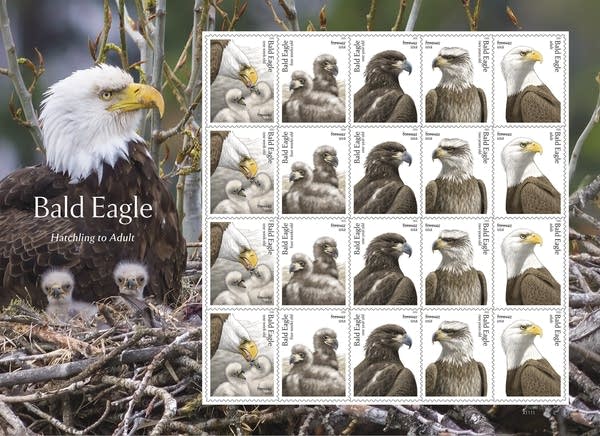
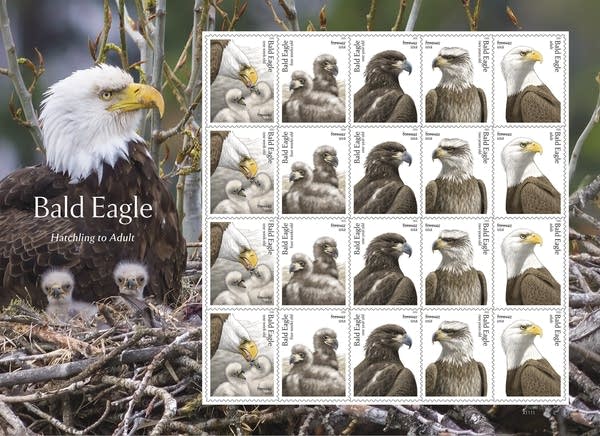
For America's 250th birthday, the U.S. Postal Service is releasing special edition stamps featuring one of the nation's icons: the bald eagle.

The stamps unveiled Thursday at the National Eagle Center in Wabasha, Minnesota, showcase the bird across five major life stages, from a fuzzy hatchling to the iconic white-headed adult depicted on the country's seal. They were available for immediate purchase across the United States.

“The fact that we’re seeing the eagles in all different stages of its life, it’s sort of making us look back at the stages of the life of our country,” said Steve Kochersperger, a historian at the Postal Service. “At one time, we were just fuzzy little hatchlings, too.”

The bald eagle has been a national emblem since Congress adopted the Great Seal in 1782, though it wasn't designated the national bird until 2024.

The bird has long symbolized American values like strength, freedom and independence, said Kochersperger. At the top of the food chain, the bald eagle dominates in the sky alone with its impressive wingspan and sharp talons.

Some believe Benjamin Franklin wanted the wild turkey to be the national bird because the eagle steals food from other birds, but Kochersperger said that's a myth.

There's another reason why it makes a strong American symbol: the bald eagle is a major conservation success story. In the 1960s, eagles became a rare sight in the U.S. because of poisoning by the pesticide DDT.

But that decline was reversed, thanks to a 1972 DDT ban and the bald eagles' listing as an endangered species in 1978.

“The public relations campaign brought greater awareness that, ‘Hey, this is our national symbol, but they may all be gone if we don’t change our ways,’” Kochersperger said. “And that turned out to be very effective.”

In 2007, the bald eagle was removed from the endangered list, and there are now more than 300,000 eagles in the continental United States, according to the U.S. Fish and Wildlife Service.

David Sibley, the Massachusetts-based artist and bird watcher behind the stamp collection, said the conservation story is part of what makes him think of the bald eagle as a symbol.

“Maybe seeing a bald eagle on the stamp as a bird, living its life from nestling to adult, will hopefully make people think about the natural world and how important things like eagles are, not as a symbol but as part of the ecosystem around us,” he said.

Sibley spent nearly a year working on the digital illustrations for the collection. As someone who usually draws life-sized birds, the tiny stamp size was perhaps the biggest challenge, so he chose to focus on the bald eagle’s head to show as much detail as possible.

Postage stamps have long served as a way to celebrate holidays and highlight American culture, but they can also be educational, if you look closely.

“A stamp does not demand your attention, but it rewards it,” Kochersperger said. “A tremendous amount of planning and effort went into producing that tiny little piece of paper.”




Source link

Leave a Reply

Subscribe to Our Newsletter

Get our latest articles delivered straight to your inbox. No spam, we promise.

Recent Reviews


Learn the difference between accountability and responsibility — and why building a more accountable team starts with what you do as a leader.

Do you want your team to be more accountable?

If you’re like most of the CEOs I work with, you do.

You want clear ownership. You want clear communication. You want consequences for missing targets.

But here’s what most CEOs miss: holding accountability is your responsibility, not theirs.

In this essay, I’ll explain the difference between accountability and responsibility, and share the questions you need to ask to make sure you’re doing your part.

What is accountability?

I define accountability as the ability to account for one’s actions and decisions.

There are two sides to accountability: 

  • Being accountable: that’s the person giving an account.
  • Holding someone accountable: that’s the person they are giving it to.

The most common form of accountability is a report that shows:

  1. The numbers
  2. The story behind them. 

In fact, the word account can refer to numbers (think accounting) or stories (an account of what happened).

Reporting is powerful because it forces people to check in on their goals, what they’ve done, and what to do next. And great reports can create a self-managing system where the report does a lot of the heavy-lifting.

Accountability has benefits: it helps people remember and focus on their goals, and it can maximise their learning. Plus, it keeps stakeholders informed.

However, accountability is only half of the equation.

The other part is responsibility, and without it, accountability isn’t nearly as helpful.

What is responsibility?

I define responsibility as the ability to respond with effective actions and decisions.

So is the manager or the teammate responsible for getting results? 

This needs to be crystal clear:

  • Your team is responsible for getting results.
  • You are responsible for the team itself.

Your team is responsible for planning their work, making commitments, and solving problems in order to get results.

However, you are responsible for selecting the right people, communicating expectations, and supporting them as best you can.

Accountability is a service. It’s goal is to increase a person’s level of responsibility.

Haven’t you craved some accountability so you followed through on something important?

It actually starts with you, not them.

The first step in driving accountability is to check in with your responsibilities first: 

  • Have you selected the right people? 
  • Have you communicated expectations? 
  • Have you supported them and provided them with accountability?

Because the consequences you want aren’t actually on them, they are on you.

Answering these questions? That’s accountability.

Actually doing something about them? That’s taking responsibility.

Related Reading: 

Originally published on February 25th, 2026


How do top founders actually scale?

I’ve coached CEOs for 10,000+ hours—here’s what works.
Join 17,000+ founders learning how to scale with clarity.

Unsubscribe any time.


Source link